


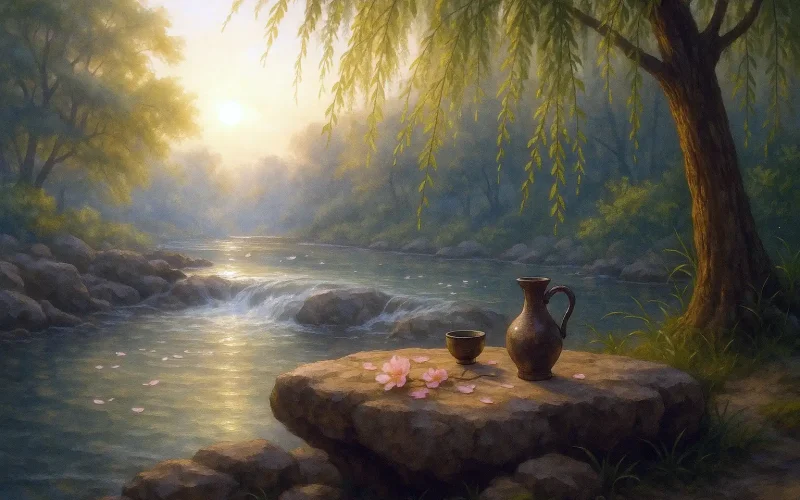
How I love this flat rock by the fountain clear!
Willow branches sway and brush my cup here.
If the spring breeze knows not what’s in my heart,
Why bring fallen petals where I sit apart?
Original Poem
「戏题盘石」
王维
可怜盘石临泉水,复有垂杨拂酒杯。
若道春风不解意,何因吹送落花来。
Interpretation
This poem is a representative work from Wang Wei's period of seclusion at his Wang River estate, composed in his later years when his thought and artistry reached full maturity. Having experienced the fluctuations of official life, the poet chose to withdraw from the court, seeking spiritual liberation and peace of mind within nature. During his time at Wangchuan, Wang Wei often contemplated the world through a Chan (Zen) Buddhist lens, transforming landscapes into reflections of his own serene state of mind. The scene of drinking alone by a spring depicted here is a vivid portrayal of this lifestyle and spiritual realm. The seemingly casual selection of imagery and the conversational tone of the poem conceal Wang Wei's profound insight into the relationships between nature, life, and the cosmos. It serves as a concise embodiment of his aesthetic ideal, where poetry and painting merge, infused with Chan Buddhist wisdom.
First Couplet: 可怜盘石临泉水,复有垂杨拂酒杯。
Kělián pánshí lín quánshuǐ, fù yǒu chuíyáng fú jiǔbēi.
How lovely, this great rock reclining by the spring! / And tender willow branches brushing my wine cup as I sing.
Explication: The couplet, with its strong sense of immediacy, constructs a reclusive space of intimate harmony between man and nature. The word "lovely" (kělián) does not signify pity in the modern sense, but carries its Tang Dynasty meaning of "delightful" or "pleasing," revealing the poet's genuine fondness and admiration for the scene. "This great rock reclining by the spring" sketches a serene foundation—the rock's solidity and the spring's clarity, one still and one moving, one firm and one yielding, forming a complementary contrast of textures. "And tender willow branches brushing my wine cup" adds a touch of lively vitality to this tranquil base. The verb "brushing" conveys a gentle, occasional, yet continuous and intimate motion, blurring the boundary between plant and human, as if the willow willingly joins the poet's feast. The poet does not describe arranging the setting himself; instead, he shows how natural elements (rock, spring, willow) spontaneously "arrange" it for him. This reflects an aesthetic mindset of "responding effortlessly to what arrives" and a fusion of subject and object.
Second Couplet: 若道春风不解意,何因吹送落花来。
Ruò dào chūnfēng bù jiě yì, hé yīn chuī sòng luòhuā lái.
If you say the spring breeze is without feeling or art, / Why then does it blow these fallen blossoms right into my heart?
Explication: This couplet employs a pointed rhetorical question, rich in Chan paradox, to elevate the poem from mere scenic appreciation to philosophical reflection. "If you say…" introduces a hypothesis, alluding to a conventional, mundane view of nature as insentient. The phrase "is without feeling" personifies the spring breeze, setting the stage for the counterargument. The interrogative "Why then…" forcefully refutes this view. The poet uses the immediate "fact"—the fallen blossoms being carried into his cup—as evidence that the breeze not only "understands feeling" but actively "offers it." The detail of the "fallen blossoms" arriving is particularly exquisite: while typically associated with decay in late spring, their deliberate "blowing" and directional movement "into" the cup lend them a joyful sense of "enhancing the moment" or "embellishment." Through this implied dialogue, Wang Wei subtly reveals his view of nature: not as a cold object, but as a sentient, spiritual existence capable of resonating with the human heart. This is both a projection of the poet's present joyful mood and an echo of the Chan Buddhist idea that "all things are endowed with spirit."
Holistic Appreciation
Though comprising only twenty-eight characters, the poem completes a full aesthetic and philosophical journey. The first two lines focus on "scene-setting": with a painter's eye, the poet selects iconic images (rock, spring, willow, cup) and uses the verbs "reclining by" and "brushing" to define their spatial and dynamic relationships, crafting a solitary drinking scene that is serene yet vibrant. This highly personal, momentary scene achieves universal resonance through its typicality. The latter two lines shift to "philosophical inquiry". Moving from quiet observation to contemplation, the poet uses a rhetorical question about the breeze's intent to internalize the external scene into a mental dialogue. The instant the blossom enters the cup becomes a symbolic moment of nature communicating with the poet, an opportunity for awakening to the unity of self and world. The poem's structure reveals a subtle progression "from stillness to movement, from scene to Chan": the rock's stillness, the spring's flow; the willow's brush, the breeze's blow; the leisure of the outer scene, the depth of the inner query. Wang Wei perfectly integrates a painter's spatial composition, a poet's crafting of mood, and Chan's intuitive insight, embedding layers of meaning within an extremely concise form.
Artistic Merits
- Conveying Chan Wisdom Through Scenery: Wang Wei does not preach doctrine but fully immerses philosophical insight into description and momentary experience. The rock's steadfastness hints at mental stability; the spring's flow suggests life's continuity; the willow's brushing symbolizes nature's affinity; the breeze-borne blossoms imply the harmony of causes and the universe's benevolence. Chan spirit permeates the lines without a trace.
- Skillful Shift in Perspective: The viewpoint flows naturally from what the poet "sees" (rock, spring, willow) in the first couplet to what he "senses" (the breeze's understanding) in the second. This movement from objective observation, to subjective questioning, to recognition of communion between self and object deepens the poetic meaning.
- Precision and Vitality of Verbs: "Reclining by" captures the spatial intimacy between rock and spring, containing tension within stillness. "Brushing" gives the willow branch gentle motion and a personal touch. "Blow… into" concretizes and gives purpose to the breeze's invisible force, making it the key catalyst for the poem's elevation.
- Speculative Power of Rhetorical Question: The final couplet's rhetorical question avoids bland statement, engaging the reader's intellect. It denies the separation between humanity and nature, affirms their spiritual exchange, and lends the short poem dialectical depth.
Insights
This work transcends traditional landscape poetry's mere depiction of scenery. It reveals a spiritual communion between humanity and nature found in daily subtle moments. Wang Wei suggests that true peace and joy may not require grand narratives or distant quests, but can dwell in the present encounter with a single rock, a clear spring, or a brushing willow branch. When the mind is clear and open, even the most ordinary natural images can become partners for dialogue and sources of inspiration. The question of whether the breeze "understands feeling" is, ultimately, an inquiry into whether the world is meaningful and interconnected. Wang Wei's affirmative, poetic answer has comforted countless readers longing to settle their souls in a turbulent world. In a modern society obsessed with efficiency and marked by alienation, this poem acts as a soothing balm. It invites us to occasionally pause, sit on the rock "reclining by the spring," feel the leisure of "willow branches brushing my wine cup," and perhaps we too may await our own breeze that "blows fallen blossoms" our way, rediscovering a world where all things are sentient—a world too often overlooked.
About the poet
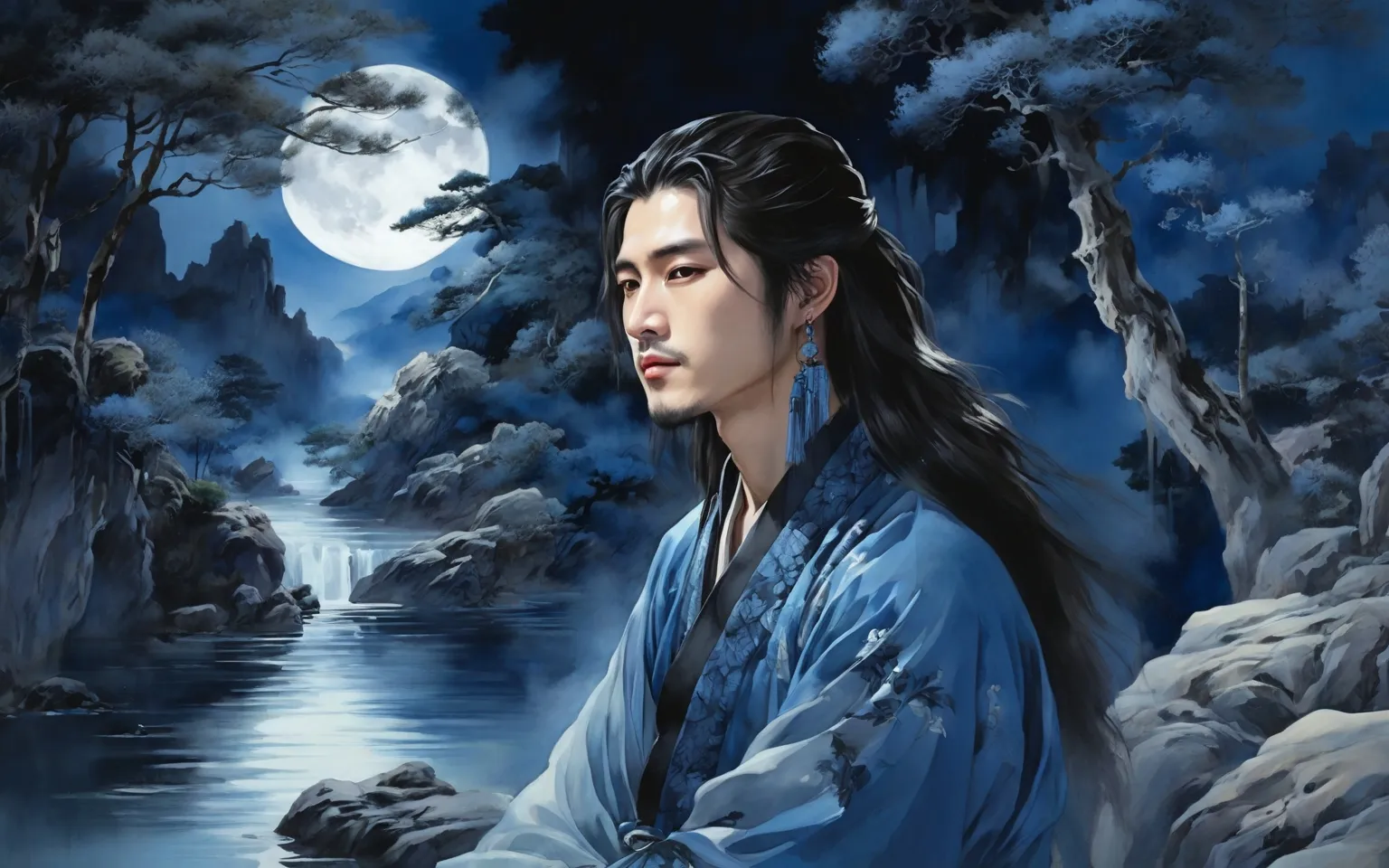
Wang Wei (王维), 701 - 761 A.D., was a native of Yuncheng, Shanxi Province. Wang Wei was a poet of landscape and idylls. His poems of landscape and idylls, with far-reaching images and mysterious meanings, were widely loved by readers in later generations, but Wang Wei never really became a man of landscape and idylls.