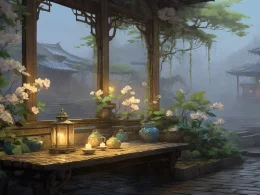



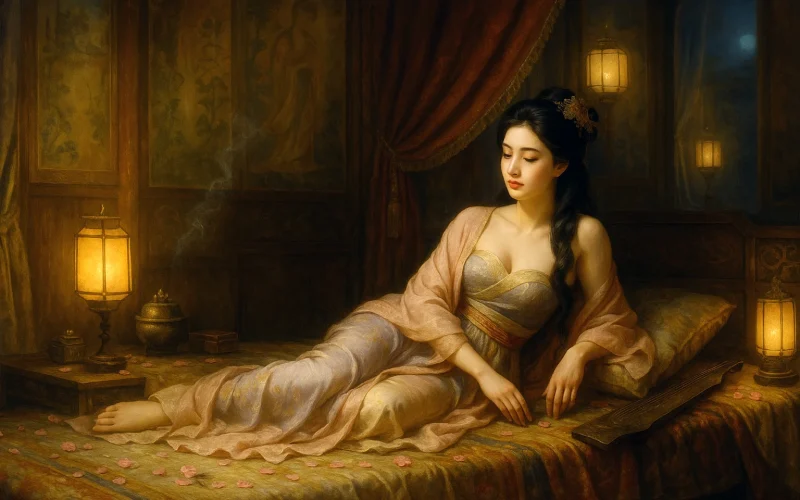
Deep curtains hang in lonely Mochou’s bower;
The night is long and chill after she lies still.
A goddess’s love is but a dream’s brief flower;
A maiden’s room has none to love at will.

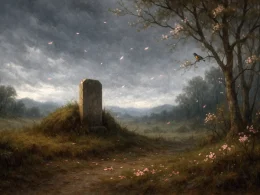
The storm believes not that weak reeds can endure;
Who makes sweet cassia scent the moon’s cold dew?
I know that lovesickness brings no cure;
Why not be mad, yet clear and true?
Original Poem
「无题 · 重帷深下莫愁堂」
李商隐
重帷深下莫愁堂,卧后清宵细细长。
神女生涯原是梦,小姑居处本无郎。
风波不信菱枝弱,月露谁叫桂叶香。
直道相思了无益,未妨惆怅是清狂。
Interpretation
This poem stands as one of the most philosophically profound within Li Shangyin’s series of "Untitled" poems. Written in his middle years, around 852 AD, it belongs to a period marked by the complete collapse of his political ideals, the normalization of a rootless life, and the deepening internalization of his personal emotions. The enclosed space of the "Hall of Mochou" and the temporal experience of the "long, long quiet night" in the poem serve as a portrayal of the poet's increasingly introspective inner world.
Li Shangyin’s "Untitled" poems often invite multiple interpretations. Superficially, this one describes feminine longing, yet its deeper layers are saturated with the poet’s fundamental questioning of his own fate and the meaning of existence. The line "The Goddess’s encounter was but a dream" can be read as a summary of romantic experience, as well as a metaphor for his political career (once favored, then neglected). The loneliness in "A small maid’s chamber has no lord" symbolizes not only a woman’s predicament but also a scholar’s suspended state between ideal and reality. By this time, Li Shangyin’s early indignation had matured into a profound, quiet observation; poetry had become his unique way of dialoguing with the world and reconciling with himself.
First Couplet: 重帷深下莫愁堂,卧后清宵细细长。
Chóng wéi shēn xià Mòchóu táng, wò hòu qīng xiāo xì xì cháng.
Layer on layer of drapes hang deep in the Hall of Mochou;
After lying down, the still night grows so long, so slow.
Explication: The opening, with "layer on layer of drapes," constructs a visually enclosed space, while "the still night grows so long, so slow" captures the viscous, stretched quality of time in solitude. The word "slow" is exquisitely subtle, describing both the depth of the night and hinting at thoughts becoming minutely distinct. This couplet establishes the poem’s introspective, abyssal tone, creating a tension between external stillness and internal movement.
Second Couplet: 神女生涯原是梦,小姑居处本无郎。
Shénnǚ shēngyá yuán shì mèng, xiǎo gū jū chǔ běn wú láng.
The Goddess’s encounter was but a dream;
A small maid’s chamber has no lord, as it would seem.
Explication: Using dual allusions, this couplet achieves a dual negation of fate. The "Goddess" allusion, from Song Yu’s "Rhapsody on Gaotang," refers to a once-possessed beauty or opportunity, but "was but a dream" renders it utterly illusory. The "small maid" allusion, from the Music Bureau poem "Song of the Small Maid of Black Stream," with its inherent premise of having "no lord," negates the very possibility of expectation from its origin. Employing both allusions creates a logical progression from "once had, but unreal" to "never had, and fated," elevating the sense of solitude to a level of destiny.
Third Couplet: 风波不信菱枝弱,月露谁教桂叶香。
Fēngbō bù xìn líng zhī ruò, yuè lù shuí jiào guì yè xiāng.
The storm believes not the water-chestnut branch is frail;
Who told the dews to scent the leaves of cinnamon frail?
Explication: Shifting to natural imagery for metaphorical meaning, this couplet implies a world indifferent to human plight. "The water-chestnut branch is frail" metaphorically represents the individual’s fragility before fate; "believes not" reveals the cold, indiscriminate nature of external forces. "The leaves of cinnamon" symbolize inner talent or virtue; the rhetorical question "who told" expresses how such intrinsic value is not necessarily recognized or cherished by the outside world. Juxtaposed, they present a world order where circumstances are not apportioned by morality or worth.
Final Couplet: 直道相思了无益,未妨惆怅是清狂。
Zhí dào xiāngsī liǎo wú yì, wèi fáng chóuchàng shì qīng kuáng.
I know well that longing is of no avail,
Yet need not mind this melancholy, this pure folly.
Explication: The final coupleet achieves a paradoxical sublimation through clear-eyed realization. "I know well" is rational cognition; "is of no avail" is a practical judgment. Yet "Yet need not mind" turns the stance, reaffirming on a value level this "futile" emotional investment. The term "pure folly" is profoundly creative—fusing "folly" with "purity," it grants hopeless longing a legitimacy on aesthetic and spiritual planes, completing a shift from "emotional outpouring" to an "existential stance."
Holistic Appreciation
This is a philosophical poem that constructs meaning within despair, that achieves affirmation through negation. The poem traces an emotional arc of "enclosure—reminiscence—interrogation—transcendence." Each couplet attempts to deconstruct a certain illusion (romantic, destined, or pertaining to value), yet in the process of deconstruction, it unexpectedly constructs a new subjective posture.
Li Shangyin’s profundity lies not only in articulating the clarity of "longing is of no avail," but more so in articulating the transcendence of "need not mind this melancholy, this pure folly." The lyrical subject in the poem is like an ascetic in the dark night, progressively stripping away all illusions. When everything is revealed to be "but a dream," to have "no lord," to be "believed not" and "who told," she (or he) instead, in utter clarity, gains the freedom to choose the "pure folly" of facing the void. This poetic tenacity born of despair elevates the poem beyond common boudoir plaint or personal lament, making it a profound parable about confronting the absurdity of existence.
Artistic Merits
- Psychologizing Space and Time: "Layer on layer of drapes" is not merely scene-setting but the visualization of a psychological state; "the still night grows so long, so slow" transforms the intangible sense of time into a tangible texture, showcasing Li Shangyin’s exquisite grasp of sensory experience.
- Layering and Inversion of Allusion: The Goddess and the small maid allusions—one dreamlike, the other mundane; one transient, the other constant—form, in their juxtaposition, a two-way deconstruction of "love" or "encounter," allowing the poetry to resonate with multiple historical echoes within limited lines.
- Affirmative Power Within Negative Expression: The poem is full of negations: "was but," "has no," "believes not," "who told," "of no avail." Yet the word "Yet" in the final line acts as a keystone, establishing an island of affirmation amidst the successive waves of negation, demonstrating the poet’s masterful emotional dialectic.
Insights
The poem reveals a profound paradox of existence: it is precisely in recognizing that all efforts may be "of no avail" that one attains genuine spiritual freedom. The protagonist in Li Shangyin’s poem, after experiencing all disillusionment (of dreams, companionship, favor, the return on value), does not fall into nihilism, but chooses to transform "melancholy" itself into a stance of "pure folly."
This offers us a form of classical wisdom for confronting modern dilemmas: when instrumental reason tells us that unrewarded investment is foolish; when utilitarianism declares that futile emotions should be discarded—this poem reminds us that some of life’s most precious experiences (like longing, melancholy, steadfastness) hold meaning precisely because they transcend utilitarian calculation, because we knowingly choose to invest in them despite their "futility," in an act of "pure folly."
The statement, "Yet need not mind this melancholy, this pure folly," suggests a possible path toward reconstructing a sense of self in an age of fragmented values: when external standards become chaotic and void, turning inward, sincerely confronting one's own "melancholy," and consciously forging it into a lucid, deliberate "folly" may serve as the final bastion against the dissipation of meaning and the erosion of personal integrity. What Li Shangyin wrote a millennium ago is not merely a love poem; it is a spiritual testament on preserving inner dignity after all external supports have fallen away.
About the poet
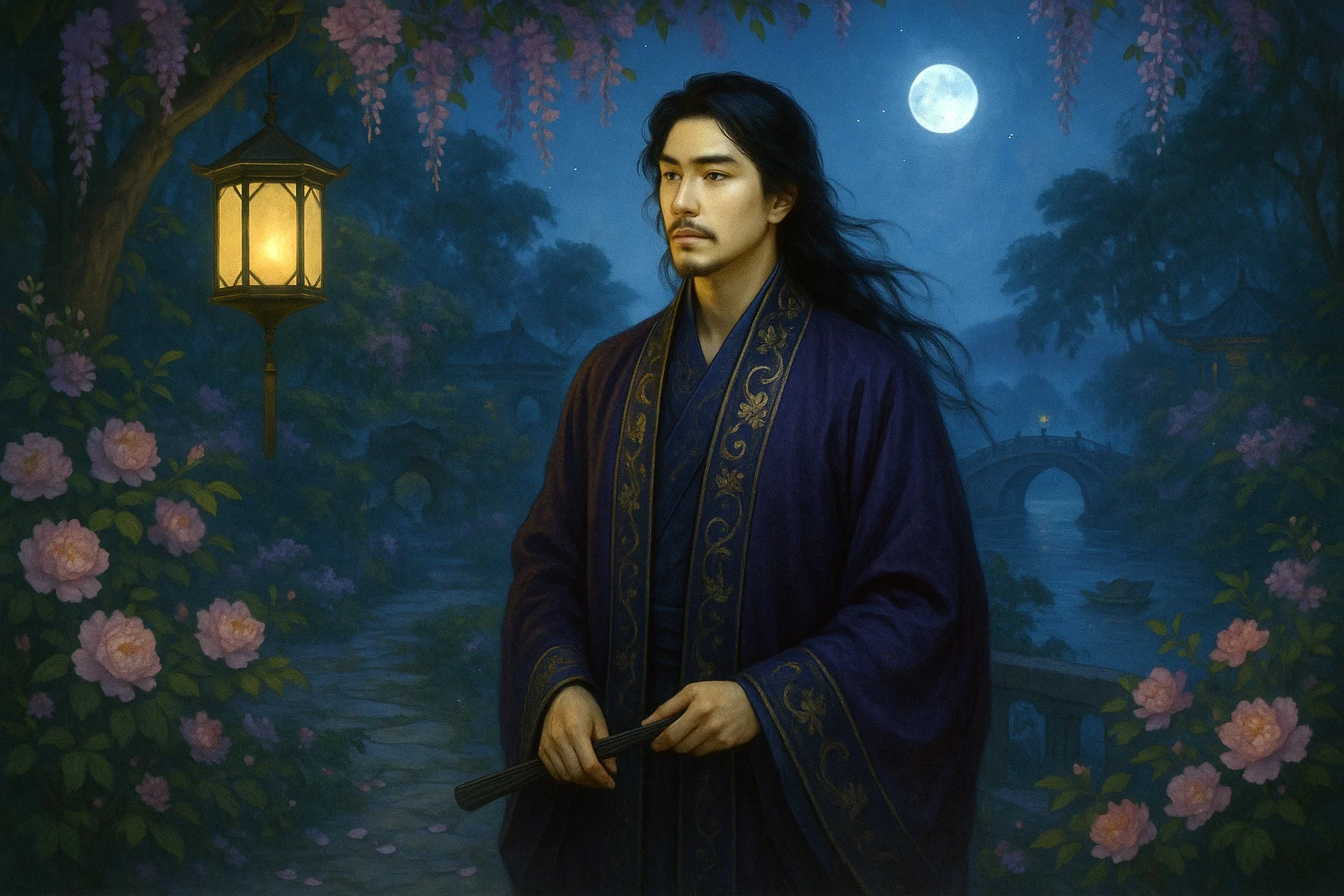
Li Shangyin (李商隐), 813 - 858 AD, was a great poet of the late Tang Dynasty. His poems were on a par with those of Du Mu, and he was known as "Little Li Du". Li Shangyin was a native of Qinyang, Jiaozuo City, Henan Province. When he was a teenager, he lost his father at the age of nine, and was called "Zheshui East and West, half a century of wandering".