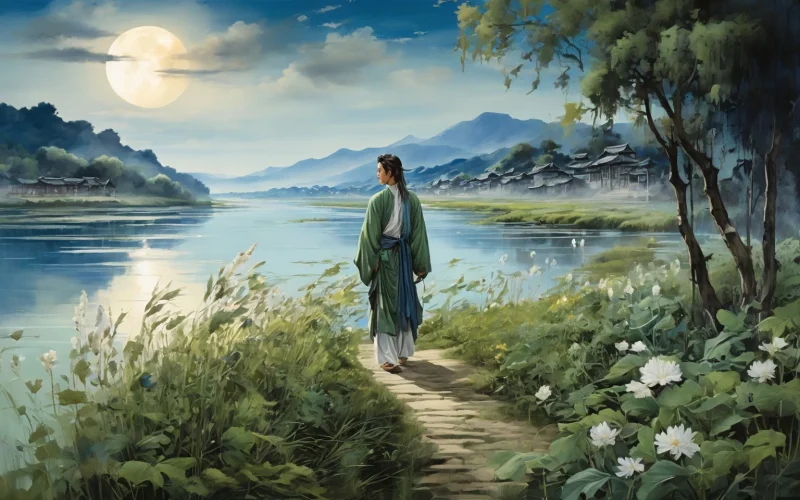



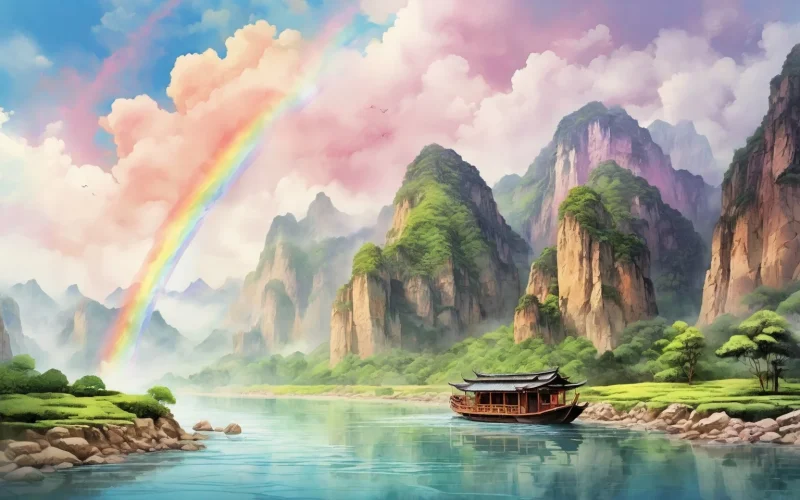
Going upstream, I see mountain on mountain high;
The twelve green peaks with Sunny Terrace scrape the sky.
The king in hunting caught by sudden evening shower
Slept there and dreamed of the Goddess in Sunny Bower.

To her charm added the mist-veiled rainbow dress bright;
Away she flew with faded stars and clouds in flight.
However far I stretch my eyes, she can't be found;
Hearing the monkey's wail, in longing tears I'm drowned.
Original Poem
「巫山曲」
孟郊
巴江上峡重复重,阳台碧峭十二峰。
荆王猎时逢暮雨,夜卧高丘梦神女。
轻红流烟湿艳姿,行云飞去明星稀。
目极魂断望不见,猿啼三声泪滴衣。
Interpretation
This poem was composed by the late Tang poet Luo Yin while passing through the Wu Gorge. Luo Yin famously "failed the imperial examinations time and again," stranded in the examination halls for decades. In his later years, he drifted from place to place, serving in various military governors' courts, always dependent on others. He possessed a profoundly intimate understanding of the world's fickleness and the cruel whims of fate. His poetry often uses objects to convey his feelings or borrows from the past to satirize the present, revealing a sharp edge beneath a cool surface and deep feeling beneath a somber tone.
The Wu Gorge has long been a site celebrated by poets and scholars, shrouded in an added layer of mysterious romance by the legend from Song Yu's Rhapsody on Gaotang, where King Xiang of Chu dreamed of encountering a goddess. The "Divine Maiden of Witch Mountain" has become an eternal symbol in Chinese literature—she is both a spirit of the mountains and rivers, a symbol of love, and a phantom upon whom countless frustrated literati project their emotions. Traveling by boat to this place, facing the perilous, layered peaks where "the River Ba climbs gorges, fold on fold," and gazing up at the "twelve green-peaked crags of Sunny Terrace," what rose in Luo Yin's heart was not only awe for the natural wonder but also a distant longing for that millennia-old legend. The goddess from the Chu king's dream, that ethereal form that "at dawn was morning cloud, at dusk was driving rain," subtly overlapped with the poet's own fate of rootless drifting and shattered ideals. It was as if he were reliving the king's dream-journey to Sunny Terrace within the gorge, projecting his own loneliness and melancholy onto the goddess. Thus, the goddess's dream became the poet's dream; myth and reality, history and personal feeling converged and fused here, finally crystallizing into this hauntingly beautiful, mysteriously elusive, and poignantly moving Song of Witch Mountain.
First Couplet: "巴江上峡重复重,阳台碧峭十二峰。"
Bā jiāng shàng xiá chóng fù chóng, Yángtái bì qiào shí èr fēng.
The River Ba climbs the gorge, ridge folded upon ridge;
Sunny Terrace's twelve emerald peaks stand steep at the gorge's edge.
The poem opens with bold, powerful strokes, outlining the Wu Gorge's perilous and profound majesty. "The River Ba climbs the gorge" establishes the location of the boat's journey. The phrase "ridge folded upon ridge" masterfully emphasizes the layered mountains and the chasm's extreme depth, serving as both stark visual realism and a subtle metaphor for the uncertain path ahead and the complex, winding nature of the traveler's own thoughts. The following line, "Sunny Terrace's twelve emerald peaks stand steep", shifts the gaze from the river surface to the mountain peaks, introducing the "Sunny Terrace" and "twelve peaks" intimately connected to the goddess legend. The two words "emerald peaks" (碧峭) capture both the verdant green hue of the mountains and their precipitous, sheer form, setting a suitably mysterious and lofty stage for the divine maiden soon to appear. This couplet is purely scenic, yet it successfully creates an atmosphere of deep mystery and enchantment for the entire poem, making the reader feel as if they are entering this myth-suffused landscape alongside the poet.
Second Couplet: "荆王猎时逢暮雨,夜卧高丘梦神女。"
Jīng wáng liè shí féng mù yǔ, yè wò gāo qiū mèng shénnǚ.
The king of Chu, on the hunt, met the evening's rain;
At night upon the high hill, he dreamed the goddess came.
This couplet skillfully employs the literary allusion from Song Yu's Rhapsody on Gaotang, in which King Xiang of Chu dreamed of encountering a goddess. "The king of Chu" is identified. "Met the evening's rain" both references the goddess's defining characteristic—that she was "driving rain at dusk"—and establishes the hazy,朦胧 atmosphere necessary for the dream's emergence. "He dreamed the goddess came" condenses the entire allusion into seven succinct and vivid characters. The poet implicitly compares himself to the Chu king. Is the goddess in that dream not also the embodiment of his own ideals and emotions? This word "dream" is thus layered: it is the Chu king's dream, the poet's own dream, and the shared spiritual refuge for all frustrated scholars of the age. The rootless drifting and hardships of reality find a moment of transcendence within the dream; the unattainable desires of reality find an illusory fulfillment.
Third Couplet: "轻红流烟湿艳姿,行云飞去明星稀。"
Qīng hóng liú yān shī yàn zī, xíng yún fēi qù míng xīng xī.
A haze of lightest crimson mist bedewed her beauty's glow;
She flew as driving cloud, stars sparse where she did go.
This couplet describes the goddess's appearance and disappearance, employing the poem's most romantically colored brushstrokes. "A haze of lightest crimson mist"—four words of极致朦胧美. That pale red mist and cloud seem to be the fluttering ribbons of the goddess's gown, and yet also the very substance of the dream itself. "Bedewed her beauty's glow" uses the word "bedewed" to depict the goddess's form, half-visible within the misty rain, fitting the "evening's rain" setting and adding a touch of alluring mystery. The next line, "She flew as driving cloud, stars sparse where she did go", describes the goddess's departure—transforming into driving cloud, she floats ethereally away, and the stars in the sky grow sparse and dim. The two words "flew as" capture the dream vision's heartbreaking brevity and irrecoverable nature; the three words "stars sparse" are simultaneously the literal scene of the approaching dawn and the emptiness and desolation that fills the heart after the dream's dissipation. The goddess's appearance and departure are both like mist, like cloud, fleeting and transient, leaving the poet only the gradually thinning starlight and an ever-thickening melancholy.
Final Couplet: "目极魂断望不见,猿啼三声泪滴衣。"
Mù jí hún duàn wàng bú jiàn, yuán tí sān shēng lèi dī yī.
Gaze strained till soul-severed, she's vanished from the sight;
Three cries of gibbons—tears now soak my robe outright.
The final couplet wrenches us from the illusory dream back to reality, concluding the scene to convey an emotion of piercing desolation. "Gaze strained till soul-severed" depicts the poet gazing with desperate, soul-rending intensity into the distance, but never again seeing the figure from his dream. The three words "vanished from the sight" express the utter despair and loss of seeking but not finding. The following line, "Three cries of gibbons—tears now soak my robe", adapts the ancient proverb, "The Three Gorges of Ba are long; at the gibbons' three cries, tears soak one's clothes," merging the poet's personal sorrow with timeless, collective grief. Those gibbon cries are both a real sound within the gorge and the lament echoing from the poet's own heart; those tears are both the tears of this moment and the shared tears of countless drifters over a thousand years. The dream has dispersed, the vision turned to empty air; only the mournful cries of gibbons linger, echoing long within the chasm, accompanying his solitary form and the clear tears that soak his robe.
Holistic Appreciation
This is a masterful work where Luo Yin uses myth to voice personal lament. In eight lines, he fuses the immediate landscape of Wu Gorge, the ancient legend of the goddess, and his own inner world, creating a haunting, elusive, and deeply moving poetic vision of a traveler's heart.
Structurally, the poem moves deftly from concrete reality, through layered illusion, to final, stark sorrow. It begins with the solid, imposing geography ("fold on fold," "green-ridged peaks"), establishes the dream through literary allusion ("king of Chu... dreamed"), dissolves into the ethereal beauty of the vision ("light rose mist... flew off"), and finally crashes back to a desolate, lonely reality ("seen no more," "tears soak"). This progression—from real to illusory, from ancient dream to present vision, and finally to shattered awakening—unfolds with a seamless, inevitable logic.
Thematically, the poem's power lies in the interplay between dream and rupture. The king's dream was a romantic encounter a millennium past; the poet's vision is a dream rising from his own present longing. Yet both dreams end in rupture—the dream ends, the gaze breaks, the soul is severed. Within this rupture lies a complex grief: regret for beauty's inevitable passing, despair over unreachable ideals, and a profound lament for life's dreamlike illusion and fate's cruel caprice. By channeling the goddess's dream, the poet voices his own tragedy of rootless wandering and shattered hopes.
Artistically, the poem's brilliance is its dreamlike interweaving of temporal layers and states of being. The poet superimposes the present landscape and the ancient myth, making the king's dream his own and the goddess's phantom a vessel for his own emotion. The "light rose mist" that "bedewed her radiant form" is both the goddess and a symbol of all unattainable beauty in the poet's heart; her flight "as driving cloud" is both the end of the dream and the poet's stark recognition of life's impermanence. This technique of merging myth and reality, past and self, embodies a pinnacle of classical Chinese poetry: using the ancient to express the immediate.
Artistic Merits
- Allusion Made Organic, Erasing Time: The ancient Chu king's dream feels like a personal memory, a seamless extension of the poet's own experience in the gorge.
- Reality and Illusion Intertwined, Creating a Dreamscape: The brushwork shifts effortlessly from tangible cliffs to intangible mist, from historical record to private vision, achieving an ethereal, haunting beauty.
- Luminous, Evocative Diction: Phrases like "light rose mist, a drifting haze" and "flew off as driving cloud" are both vividly pictorial and poignantly elusive.
- Emotion Concluded Through Scene, Resonance Lingering: The final image of gibbon cries and tear-soaked robes grounds the personal sorrow in the timeless, echoing landscape, leaving a sadness that stretches far beyond the last word.
Insights
Through a dream of a goddess, this poem touches an eternal theme: Life is a dream, a dream is life; the grief of seeking but not finding, of gazing but not seeing, is a constant through all ages.
First, it reveals both the "consolation and the illusion of dreams." The king's dream granted what reality withheld; the poet's vision offered a sanctuary from his drifting life. Yet a dream, however beautiful, must end. The poem reminds us that dreams offer momentary solace but cannot mend the fractures in our waking world.
Deeper still, it compels us to contemplate the "eternal paradox of the gaze and its breaking." "Eye strains till the soul breaks, but she is seen no more"—the more intensely we look, the more the object of our longing recedes. The goddess vanishes, the gibbons cry, leaving only solitude and tears. This anguish of the unattainable gaze is a universal human experience: the gaze turned toward fame, reunion, an ideal, any form of beauty that remains just out of reach.
Most profoundly moving is the poem's portrayal of a "persistence that pursues even while knowing it is a dream." The poet knows the goddess is legend, yet he still searches the gorge for her trace; he knows the dream will end, yet he clings to it. This persistence borders on obsession, yet it is also a form of rare sincerity. True depth of feeling is often precisely this: knowing the unattainable, yet being unable to relinquish it; knowing the illusion, yet choosing, in a moment, to believe.
This poem writes of a goddess from Witch Mountain, yet it speaks to all who harbor a dream in their heart, a phantom in their mind. Those mountains "fold on fold" are the winding path before every seeker; the form "bedewed" in "light rose mist" is the most beautiful vision in every dreamer's heart; the mournful "gibbons' three cries" are the echo in every dreamer's ears upon waking. This is the enduring life of poetry: it records a legend from a thousand years ago, but it gives voice to the yearning, solitary souls of every era.
Poem translator
Xu Yuanchong (许渊冲)
About the Poet
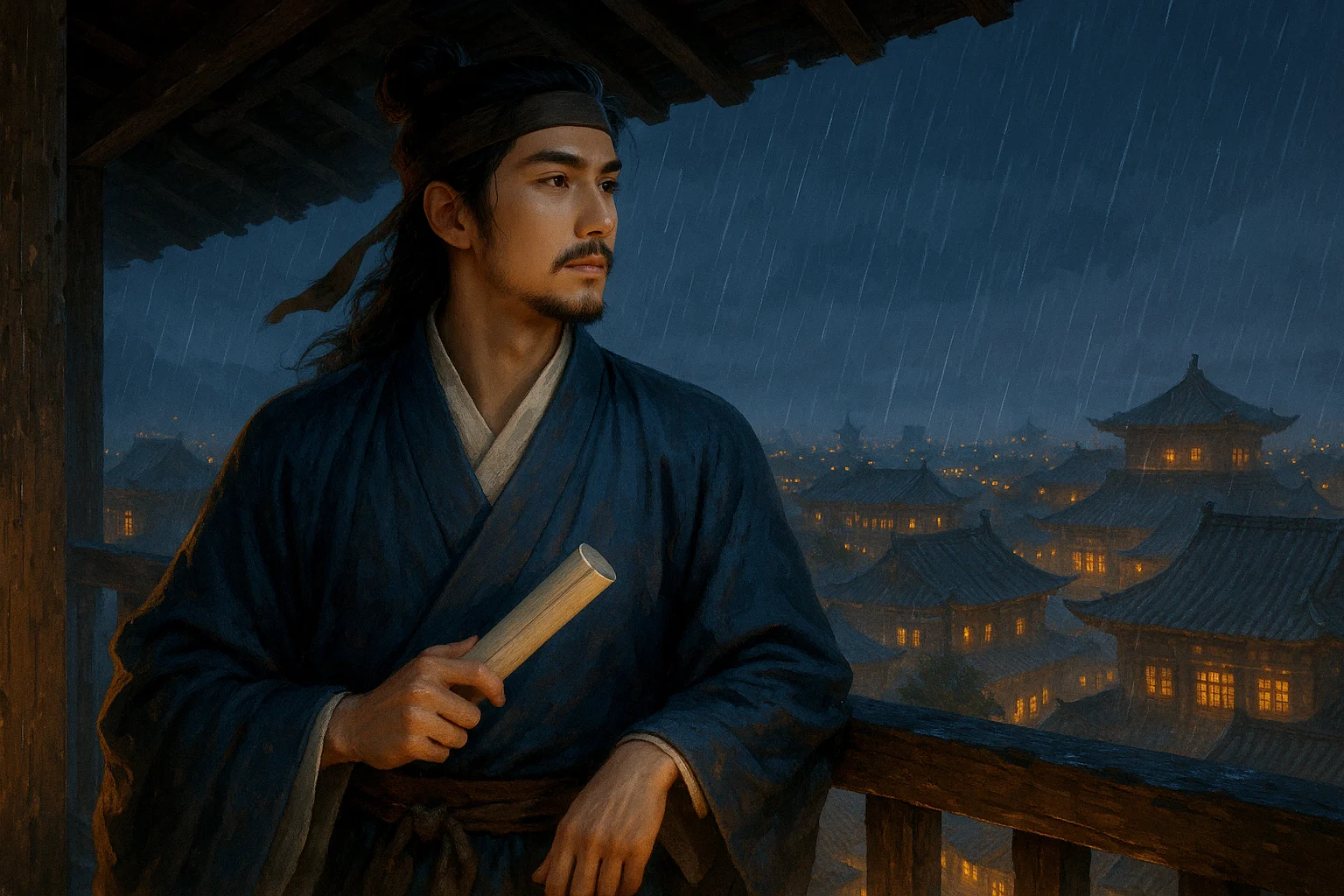
Meng Jiao (孟郊 751 - 814), a native of Deqing, Zhejiang Province, was a renowned poet of the Mid-Tang Dynasty. In his early years, he repeatedly failed the imperial examinations and only obtained the jinshi degree at the age of forty-six. He held minor posts such as Sheriff of Liyang, living a life of poverty and hardship. In his later years, he suffered the loss of his son and died while en route to a new official post. His poetry is renowned for its "bitter chanting" style, and he was often mentioned alongside Jia Dao, with Su Shi coining the famous phrase: "Jiao is lean, Jia is thin." His yuefu (Music Bureau) poems inherited the tradition of Du Fu and paved the way for Yuan Zhen and Bai Juyi, establishing a unique and distinctive place in the history of Tang poetry.