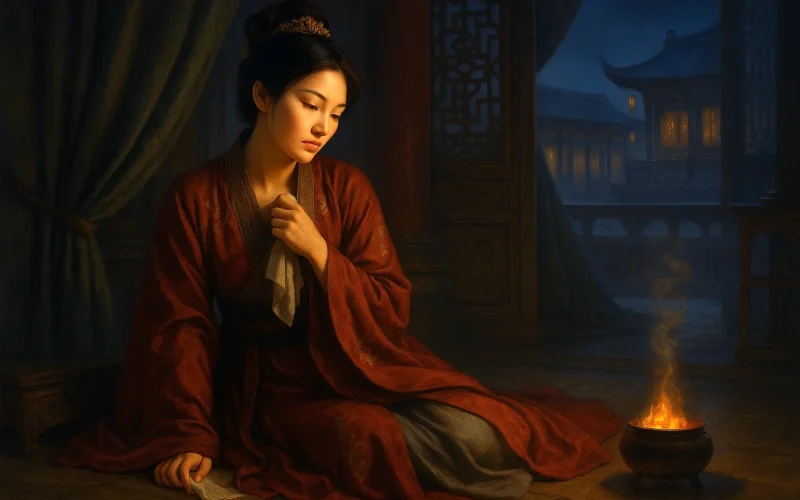



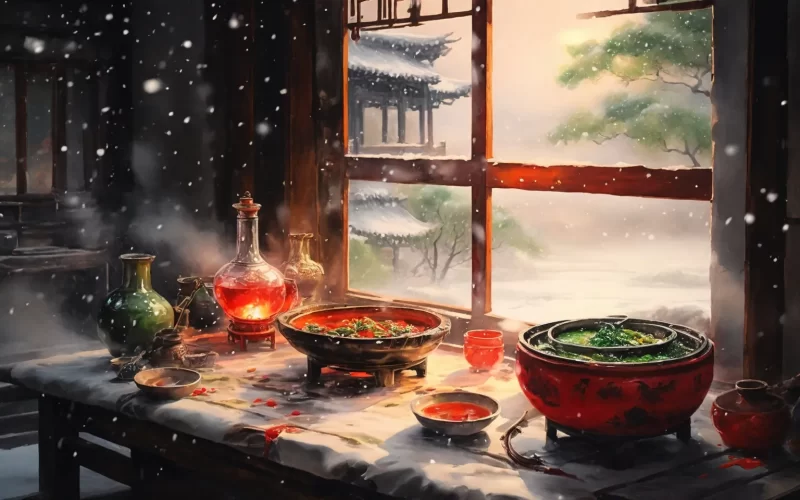
There's a gleam of green in an old bottle,
There's a stir of red in the quiet stove,
There's a feeling of snow in the dusk outside --
What about a cup of wine inside?
Original Poem
「问刘十九」
白居易
绿蚁新醅酒,红泥小火炉。
晚来天欲雪,能饮一杯无?
Interpretation
This poem was composed around 817 CE, during the Yuanhe reign, while Bai Juyi served as Assistant Prefect of Jiangzhou. Having weathered the storms of official life, the poet's state of mind grew increasingly serene and detached. He turned his attention more towards the subtle warmth and charm of daily life. This short verse resembles a simple yet evocative sketch, capturing and conveying a warm, sincere invitation against the backdrop of a cold, snow-threatened dusk. It is not merely a summons to a friend but reflects the poet’s wisdom and warmth in proactively creating poetic moments and seeking solace for the soul amidst challenging circumstances.
First Couplet: 绿蚁新醅酒,红泥小火炉。
Lǜ yǐ xīn pēi jiǔ, hóng ní xiǎo huǒlú.
New wine, with its greenish foam of yeast; / A small red-clay stove, aglow with gentle heat.
Explication: The opening lines depict a meticulously arranged indoor scene, focusing on two quintessential objects of a winter's day. "New wine, with its greenish foam of yeast" – the "greenish foam" (绿蚁) vividly describes the fresh fermentation, with "new" emphasizing the wine's immediacy and the genuine hospitality. "A small red-clay stove, aglow with gentle heat" constructs a focal point of warmth through its color, humble material, modest size, and gentle state. The contrast between the "greenish" foam and the "red-clay," and the interplay between the cool, fresh wine and the warm stove, creates a cozy, tangible, and inviting atmosphere in just ten characters.
Second Couplet: 晚来天欲雪,能饮一杯无?
Wǎn lái tiān yù xuě, néng yǐn yī bēi wú?
Evening comes, the sky threatening snow; / Could you, perhaps, come drink a cup or so?
Explication: This couplet shifts the perspective outward, from objects to person, completing the emotional gesture. "Evening comes, the sky threatening snow" masterfully sets the scene: dusk deepens the sense of lateness, while "threatening snow" intensifies the feeling of bitter cold and seclusion, making the indoor "wine" and "stove" seem all the more precious and inviting. Against this backdrop, the concluding question, "Could you, perhaps, come drink a cup or so?" flows with the natural ease of casual speech, yet holds profound affection. This query is an intimate summons, an anticipation of shared company, and a subtle gesture against solitude. Without dramatic declaration, its depth resides in its simplicity, and its certainty is implied within the asking, perfectly exemplifying the Tang poetic art of conveying deep feeling through plain words.
Holistic Appreciation
The charm of this quatrain lies in its perfect fusion of atmosphere, domestic charm, and human warmth. Its structure is exquisite: the first two lines present a static "tableau of objects," establishing a warm tone through precise depiction. The final two lines introduce a dynamic "context" and "human element," using the impending weather to create a poignant tension between indoor warmth and outdoor chill, which ultimately crystallizes in a single, warmly expectant question. The four lines form a complete vignette, moving from preparation to invitation, filled with a sense of narrative flow and emotional appeal. With the most economical language, the poet melds a winter evening's chill, a room's warmth, the richness of wine, and the depth of friendship into one of the most classically resonant scenes of domestic comfort and human connection in Chinese poetry.
Artistic Merits
- Iconic and Affective Imagery: The "new wine" and "small stove" are not merely winter objects but cultural symbols of warmth, leisure, fellowship, and poetic sentiment. Their juxtaposition naturally evokes the classic, cherished scene of gathering around the hearth to converse and ward off the cold night.
- Contrast and Fusion of Color and Sensation: The fresh, vivid "greenish foam" contrasts subtly with the warm, earthy "red-clay" in hue and texture, jointly serving the theme of "warm hospitality." The grey, cold "sky threatening snow" creates a broader environmental contrast with the interior's red-and-green warmth, heightening the appeal of the invitation.
- Colloquial Language and the Art of Suggestion: The concluding line, "Could you… come drink a cup or so?" uses purely colloquial language, intimate as a face-to-face remark, greatly bridging the distance with the reader. This question is also a powerful act of suggestion: Will the friend come? What will they discuss? The poem remains silent, granting the reader infinite space for imagination and reflection, creating a lasting resonance.
- Highly Condensed Scene and Narrative: Within twenty characters, the poem contains time (evening), weather (impending snow), place (indoors), characters (host and implied guest), event (preparing wine and extending an invitation), and emotion (anticipation). The narrative density is remarkably high, yet it feels effortless, demonstrating the poet's extraordinary command of language.
Insights
This work transcends a typical poem of friendship. It reveals an art of living: the proactive creation of beauty and the nurturing of emotional bonds within the ordinary, even amidst hardship. The poet does not passively endure the loneliness and chill of his place of exile. Instead, with "new wine" and a "small stove," he constructs a circle of warmth and extends a sincere invitation. This reflects his philosophical ease—the idea that "where the heart is at peace, there is home"—and his wisdom in discovering vitality within life's minutiae.
In a modern society often marked by interpersonal distance and a frenetic pace, this poem serves as a gentle, clarifying reminder. It suggests that true warmth and solace often stem from the simplest, most unadorned shared moments. Perhaps no grand feast is needed—just a cup of wine, a stove's fire, an evening as snow threatens, and a genuine, "Could you come drink a cup?" It encourages us, amidst busyness and pressure, to actively create small, warm rituals for ourselves and others, to settle our hearts and minds, and to find shelter from the world's chill through connection and presence. This ability to discover poetry and convey warmth within plain living is a precious legacy Bai Juyi bequeaths to us.
Poem translator
Kiang Kanghu
About the Poet

Bai Juyi (白居易), 772 - 846 AD, was originally from Taiyuan, then moved to Weinan in Shaanxi. Bai Juyi was the most prolific poet of the Tang Dynasty, with poems in the categories of satirical oracles, idleness, sentimentality, and miscellaneous rhythms, and the most influential poet after Li Bai Du Fu.