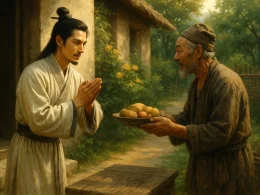



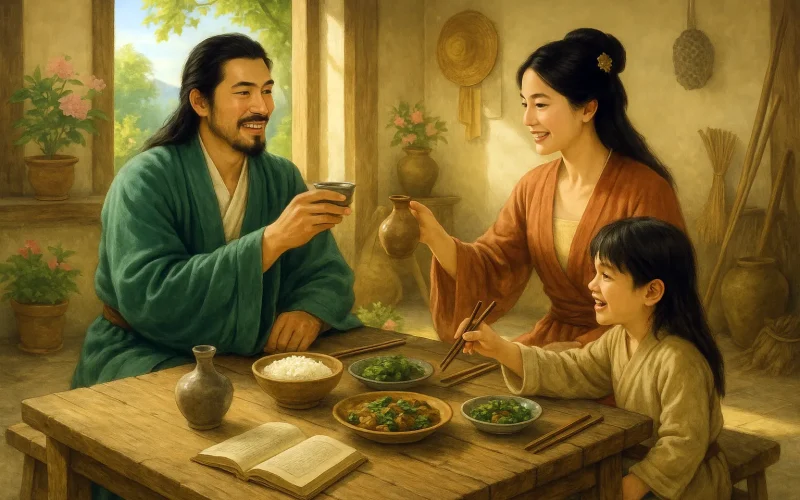
News at this far western station! The north has been recaptured!
At first I cannot check the tears from pouring on my coat --
Where is my wife? Where are my sons?
Yet crazily sure of finding them, I pack my books and poems- -
And loud my song and deep my drink
On the green spring-day that starts me home,
Back from this mountain, past another mountain,
Up from the south, north again-to my own town!
Original Poem
「闻官军收河南河北」
杜甫
剑外忽传收蓟北, 初闻涕泪满衣裳。
却看妻子愁何在? 漫卷诗书喜欲狂。
白日放歌须纵酒, 青春作伴好还乡。
即从巴峡穿巫峡, 便下襄阳向洛阳。
Interpretation
This poem was composed in the spring of 763 CE, the first year of the Guangde era under Emperor Daizong of the Tang dynasty. The eight-year-long An Lushan Rebellion had just concluded with the defeat and suicide of the rebel leader Shi Chaoyi and the subsequent recovery of the Hebei and Henan regions. At that time, Du Fu was living in exile in Zizhou, having endured the profound sufferings of war, displacement, and a shattered nation. When the news of victory broke like sudden thunder through the Jianmen Pass, the poet's years of accumulated anguish and yearning instantly overflowed, transforming into this timeless masterpiece, celebrated as Du Fu's "most exultant poem." It records not only a pivotal moment for a nation but also the ecstatic release of a sensitive soul suddenly unburdened by the weight of history.
First Couplet: “剑外忽传收蓟北,初闻涕泪满衣裳。”
Jiàn wài hū chuán shōu Jì běi, chū wén tì lèi mǎn yī shang.
News of regained northern frontiers strikes my ears; / My gown is wet with tears on hearing the cheers.
The opening line strikes with the force of a sudden storm. "North of the Sword Pass" and "the northern frontiers", two geographical names, instantly connect the poet's place of exile with the long-lost territory that haunted his thoughts, the spatial distance laden with immeasurable sorrow. "Strikes my ears" captures with startling immediacy the complex wartime psychology of scarcely daring to hope while yearning day and night for good tidings. "My gown is wet with tears" is the most primal, powerful eruption of emotion—tears holding the pain of eight years of chaos, the hope born of despair, and the collective catharsis of a nation's interwoven grief and joy.
Second Couplet: “却看妻子愁何在?漫卷诗书喜欲狂。”
Què kàn qī zǐ chóu hé zài? Màn juǎn shī shū xǐ yù kuáng.
Where is my wife's distress, once written on her face? / I roll up verse books wild with joy, leaving no trace.
The focus shifts from individual outburst to a domestic scene. "Where is my wife's distress" represents a tender glance backward; the vanished sorrow from his family's faces confirms and amplifies the poet's inner frenzy. "I roll up verse books wild with joy" is inspired. The word "wild" perfectly conveys the delirious, disorderly state of elation, where the scholar's habitual careful reading is utterly overthrown by flustered excitement. This small household tableau becomes the most vivid epitome of the era's prevailing mood.
Third Couplet: “白日放歌须纵酒,青春作伴好还乡。”
Bái rì fàng gē xū zòng jiǔ, qīng chūn zuò bàn hǎo huán xiāng.
Let me sing loud and drain my cup in sunlight bright! / With verdant spring for companion, I'll homeward take flight.
Emotion turns from contained frenzy to outward exuberance and future vision. "Sing loud and drain my cup" are classic celebratory acts of the High Tang, particularly rare in Du Fu's typically somber verse, underscoring the intensity of his delight. "With verdant spring for companion" refers both to the natural season and, more significantly, to the revitalized life-force and hope rekindled by victory. The vision of homecoming perfectly merges personal joy with the universal longing for rebuilding and a return to normalcy.
Fourth Couplet: “即从巴峡穿巫峡,便下襄阳向洛阳。”
Jí cóng Bā xiá chuān Wū xiá, biàn xià Xiāng yáng xiàng Luò yáng.
We shall sail through Three Gorges in a day, / Going down to Xiangyang, towards Luoyang our way.
A cascade of place names flows forth like a swift current, materializing the dream of return into a flickering mental itinerary. Verbs and prepositions like "sail through," "Going down," and "towards" create a sense of lightning speed and rhythm. The leap across these locations not only charts a geographical course but also generates a light, rushing cadence, mirroring the poet's heart pounding with urgency. His hometown, Luoyang, as the journey's endpoint, embodies the ultimate longing for peace and reunion shared by all displaced by war.
Holistic Appreciation
This poem is hailed as Du Fu's "most exultant poem" precisely because it breaks from his dominant "somber and restrained" style, revealing a rare, eruptive "exultation." This quality manifests in multiple dimensions: the swiftness of emotional outburst (sudden news - tears); the rapidity of action (glancing back - wildly rolling books); the brisk rhythm and meter (the final couplet flows like a boat downstream); the rapid traversal of time and space (from beyond Sword Pass to Luoyang).
The poem's emotional logic is tightly constructed and clearly layered: from the individual shock at hearing the news, to the shared joy with family, to the present catharsis of singing and drinking, finally culminating in the future vision of planning the journey home. Throughout, personal destiny intertwines with national fate; familial sorrow and joy merge with epochal upheaval. With astounding artistic control, Du Fu renders a near-delirious ecstasy that is both utterly uninhibited and never loses poetic dignity or formal gravity.
Artistic Merits
- Torrential Emotion, Unbroken Momentum
The poem's emotion surges forward like an unimpeded torrent. From the initial shock of "news… strikes my ears" to the final vision of "homeward take flight," the eight lines form a complete and compelling emotional arc. Each line connects seamlessly to the next, driven by an internal, urgent logic rather than overt transitional phrases, masterfully expressing the state of being "wild with joy" with full-throated, unbridled intensity. - Evocative Details, Action Reveals Feeling
Actions like "gown is wet with tears," "roll up verse books wild with joy," and "sing loud and drain my cup" are highly evocative and expressive. Through a series of uncharacteristic behaviors, the poet transforms abstract, formless ecstasy into visible, tangible, and deeply affecting scenes from life. - Swift Spatio-Temporal Leaps, Lively Rhythm
Especially in the final couplet, place names tumble forth, aided by swift verbs and prepositions. Within the compact verse form, a thousand-mile journey is conjured, creating a uniquely light and flowing rhythm. - Unadorned Language, Direct Expression
The poem's diction is almost colloquial, clear and simple, yet its power to move the heart stems from the sincerity and intensity of its emotion. This represents the highest realm where profound feeling needs no ornament, and all technical artifice yields to the natural overflow of genuine sentiment.
Insights
This work captures for us the pure, immense joy of a people rediscovering hope after profound suffering. It teaches us that the most intense joy is often born after the longest night; the true power of an "exultant poem" springs precisely from the "slow" suffering and waiting it carries within.
Du Fu's ecstasy is not merely personal liberation; it is the momentary healing of an era's trauma, the concentrated expression of countless ordinary people's most fundamental longing for peace, stability, and reunion. This poem reminds us to cherish hard-won peace and tranquility, for it is saturated with historical tears. Simultaneously, no matter the darkness endured, we must hold fast to faith and yearning for a bright future, just like the hope of returning home "With verdant spring for companion." In this poem, we read not only Du Fu's "exultation," but also the resilient spirit of a people who, even in adversity, forever strive forward toward hope.
Poem translator
Kiang Kanghu
About the poet
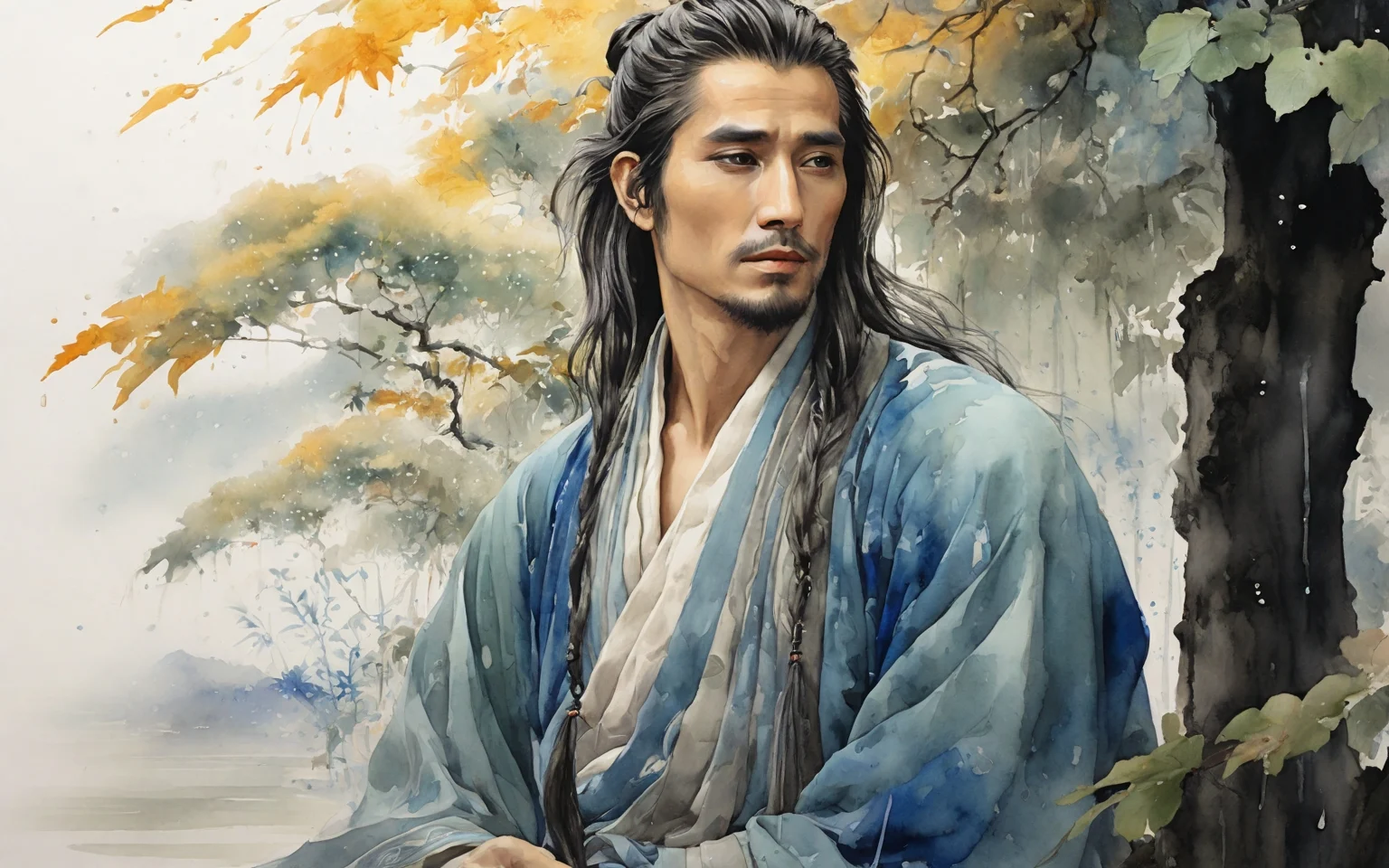
Du Fu (杜甫), 712 - 770 AD, was a great poet of the Tang Dynasty, known as the "Sage of Poetry". Born into a declining bureaucratic family, Du Fu had a rough life, and his turbulent and dislocated life made him keenly aware of the plight of the masses. Therefore, his poems were always closely related to the current affairs, reflecting the social life of that era in a more comprehensive way, with profound thoughts and a broad realm. In his poetic art, he was able to combine many styles, forming a unique style of "profound and thick", and becoming a great realist poet in the history of China.