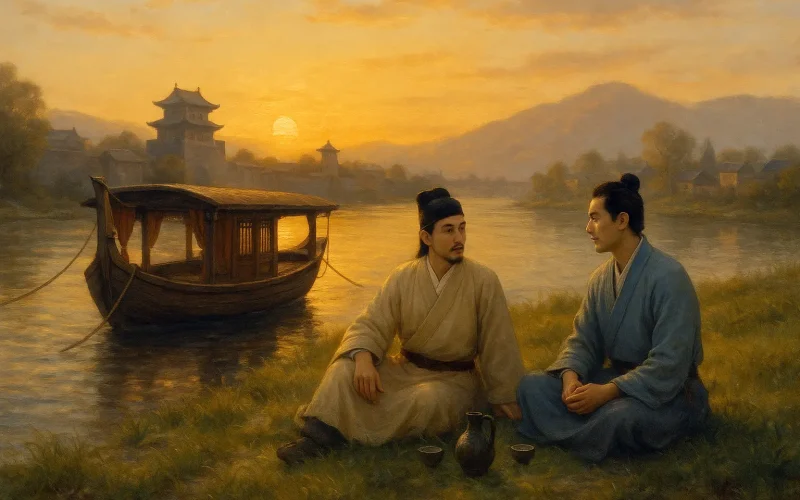



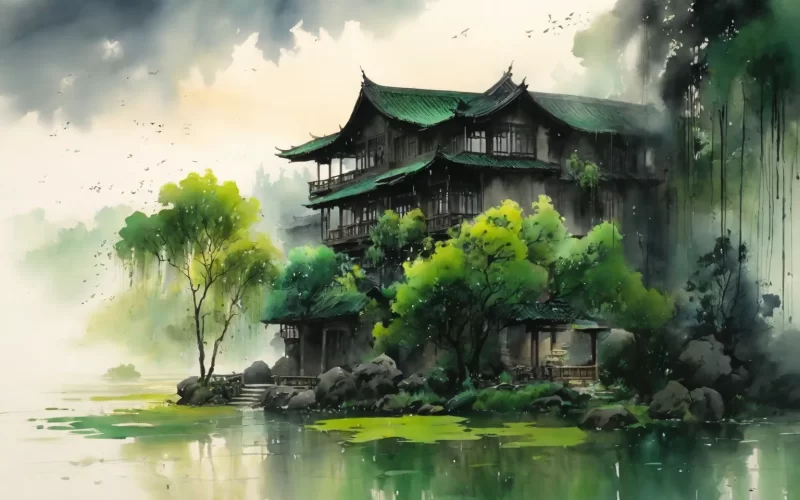
The morning rain in Weicheng has settled the light dust;
Fresh and green are the willows shading the inn, anew.

I urge you to empty this cup of wine, my friend once more —
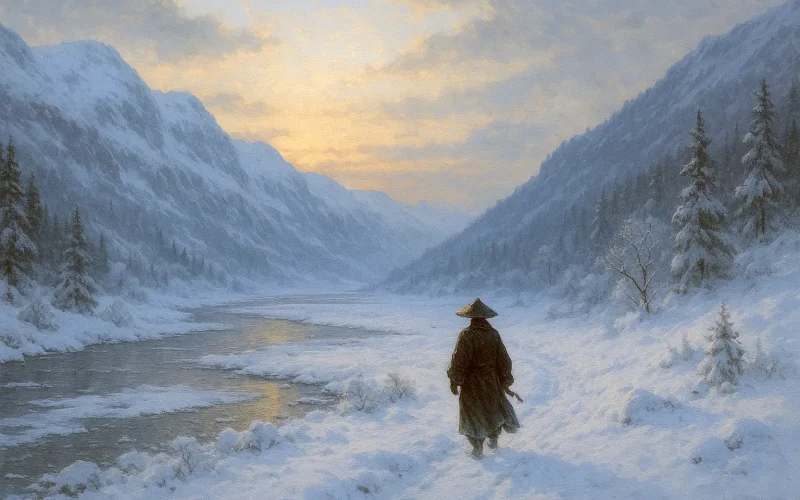
West of the Sunlit Pass, you’ll find no old friend like before.
Original Poem
「渭城曲」
王维
渭城朝雨邑轻尘,客舍青青柳色新。
劝君更尽一杯酒,西出阳关无故人。
Interpretation
"Farewell Song at Weicheng" (also known as "Farewell to Yuan the Second on His Mission to Anxi") is the pinnacle of Wang Wei's farewell poetry, and indeed of the entire genre in Chinese poetic history. Composed around the Tianbao era, during the High Tang when national power was strong and East-West exchanges were frequent, the Western Regions remained a distant frontier. Wang Wei bid farewell to his friend Yuan the Second, who was on a diplomatic mission to Anxi, at Weicheng (present-day Xianyang, Shaanxi). He distilled a specific, era-colored parting into a crystal of emotion common to all humanity, transcending time and space. In merely twenty-eight characters, the poem perfectly fuses poetic concision, painterly atmosphere, musical rhythm, and emotional depth, becoming the "universal grammar" and spiritual symbol for expressing the feelings of parting within Chinese civilization.
First Couplet: 渭城朝雨浥轻尘,客舍青青柳色新。
Wèichéng zhāo yǔ yì qīng chén, kèshè qīngqīng liǔ sè xīn.
A morning rain in Weicheng settles the light dust; / The traveler's lodge is green, the willows fresh and new.
With a master painter's brush, this couplet applies a layer of clear, moist, and bright—yet faintly sorrowful—background wash to the parting. The "morning rain" subtly aligns season and mood: it washes away the dust, clarifying the world as if paving a clean path for the journey; its dampness also echoes the moisture in the traveler's eyes and heart. The character "settles" (浥) is exquisitely precise—it dampens, not drenches; it caresses, not scourges. "The traveler's lodge is green, the willows fresh and new" further defines the setting: the "traveler's lodge" symbolizes impermanent meetings and partings; the "willow" (柳 liǔ) is a cultural code, its name a homophone for "to stay" (留 liú) and associated with the willow-breaking farewell ritual. "Green" and "new," revitalized by the rain, exude vibrant life—a vitality that, in turn, highlights the relentlessness of parting and the haste of life. These two lines use joyful scenery to express sorrow, freshness to contrast depth. The picture is pure and bright, yet the emotion within is complex and resonant, establishing the poem's supreme aesthetic tone of being "mournful but not distressing."
Final Couplet: 劝君更尽一杯酒,西出阳关无故人。
Quàn jūn gèng jìn yī bēi jiǔ, xī chū Yángguān wú gùrén.
I urge you to drain one more cup of wine; / West of Yang Pass, you'll meet no old friends.
This couplet is the emotional climax and the ultimate spiritual bequest, recited through the ages, with not a word to be changed. "I urge you to drain one more cup of wine" is action, sound, and ritual. This "one cup of wine" condenses all the unspoken, and ultimately unspeakable, friendship, concern, well-wishing, and helplessness. The words "drain one more" (更尽) are especially earnest; they imply that many cups have been drunk, all words have been said, and only this final cup remains as the ultimate vessel for all emotion and a button to delay the moment of parting. "West of Yang Pass, you'll meet no old friends" is the entire, necessary reason for drinking that cup. Yang Pass was the geographical and cultural boundary between the Central Plains and the Western Regions, the threshold between the known world and the unknown wilderness. The three words "meet no old friends" calmly articulate one of humanity's deepest fears: absolute cultural loneliness and emotional desolation. It is not merely geographical, but psychological. This urging and this statement, this feeling and this reason, elevate a personal farewell into a universal lament on the human condition.
Holistic Appreciation
This is a structurally perfect, emotionally dense poem of the "eternal moment." The poem follows the classic structure of "scene (setup) — emotion (climax)." The first two lines are the carefully arranged stage and atmosphere; the last two are the single, complete climactic action on that stage. Yet within this simple structure lies infinite richness: the rain-washed Weicheng is both the specific site of parting and the archetypal scene for all farewells; that cup of wine is both literal and becomes the symbol for all deep affection and wordless blessing; the "no old friends" west of Yang Pass lays bare the longing for the familiar and warmth that lies deep in the heart of every distant traveler.
Wang Wei's supreme artistic achievement is manifest in his writing of what was likely a tearful farewell with such clarity, brightness, and warm tension. The poem contains no tears, only rain; no lament, only urging to drink; no anxiety about the future, only the calm statement of the "no old friends" condition. This restraint and sublimation of emotion purifies sorrow into a deep feeling of parting, infused with understanding and acceptance. It is precisely this beauty of "mournful but not distressing, joyful but not excessive" moderation that allows the poem to achieve emotional resonance across eras and cultures.
Artistic Merits
- Exquisite Selection of Imagery and Cultural Coding: "Morning rain," "light dust," "traveler's lodge," "willow color," "wine," "Yang Pass"—each image fulfills a specific descriptive function and carries deep cultural symbolism. Like a code, they efficiently activate the entire collective memory and emotional patterns of the Chinese people regarding parting, friendship, and distant travel.
- Harmony of Color and Sound: "Green" and "new" give the visual scene a fresh, bright tone; the poem's own rhythm is fluent, with balanced tonal patterns. The colloquial rhythm of the final two lines, in particular, made it极易 suited for singing, which is the inherent reason it was set to music as the guqin song "Three Refrains of Yang Pass" and passed down through the centuries.
- Capturing the Moment and Freezing the Eternal: The poet captures the decisive moment of raising the cup and urging the drink. This moment condenses everything before the farewell and foreshadows everything after. By poeticizing and ritualizing this moment, Wang Wei lifts it from the flow of time, making it an eternal statue of emotion.
- Extreme Purity of Language and Extreme Fullness of Tension: The poem uses no obscure characters, no rhetorical flourish, yet achieves perfection where "adding a character would be excessive, subtracting one would be insufficient." Words like "drain one more" and "meet no old friends" contain immense power within their simplicity, carrying the heaviest emotion in the simplest form—the ultimate realm of linguistic art.
Insights
This masterpiece is like an eternal mirror of emotion, reflecting the faces of all who have ever parted, past and present. It reveals to us: the deepest emotional expression often lies in a profound gaze upon and solemn treatment of a single moment. That "one cup of wine" can be a handshake, an embrace, a word of advice, or simply a moment of silent companionship. In parting (and indeed at any important emotional juncture), what matters may not be lengthy discourse, but finding that ritualistic "moment" and imbuing it with one's whole heart.
In our globalized, highly mobile contemporary society, "going west of Yang Pass" has become a common life experience. We constantly bid farewell to familiar people, things, and environments, setting off for new realms with "no old friends." Wang Wei's poem reminds us to cherish that "cup of wine," that feeling, before we depart; and also to embrace courage, for every journey "west" implies both loneliness and the potential for new possibilities. More importantly, it teaches us that true "old friends" are not necessarily geographical, but are kindred spirits who recognize each other's souls; and that melody of "Weicheng" is the eternal bond that, across time and space, makes all lonely travelers "old friends" to one another in spirit.
This poem is Wang Wei's gift to Yuan the Second, and also an eternal farewell song for all who are about to embark on a journey, or are already on one. It tells us that even when we "go west of Yang Pass," as long as the echo of that urging—"drain one more cup of wine"—still resonates in our hearts, we are never truly cut off from warmth and deep affection.
Poem translator
Kiang Kanghu
About the poet
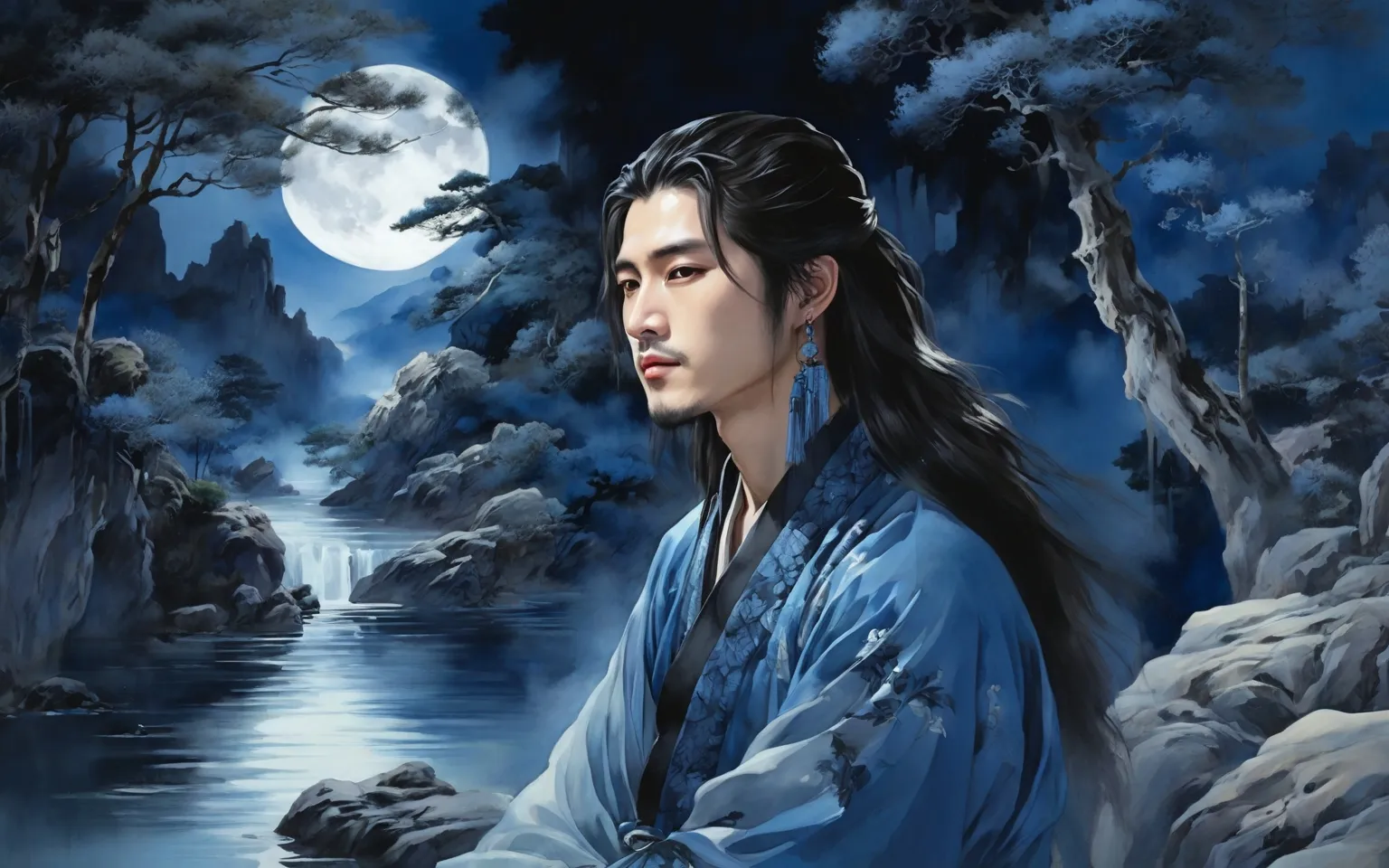
Wang Wei (王维), 701 - 761 A.D., was a native of Yuncheng, Shanxi Province. Wang Wei was a poet of landscape and idylls. His poems of landscape and idylls, with far-reaching images and mysterious meanings, were widely loved by readers in later generations, but Wang Wei never really became a man of landscape and idylls.