


Willow, Willow,
On the pale sand at nightfall.

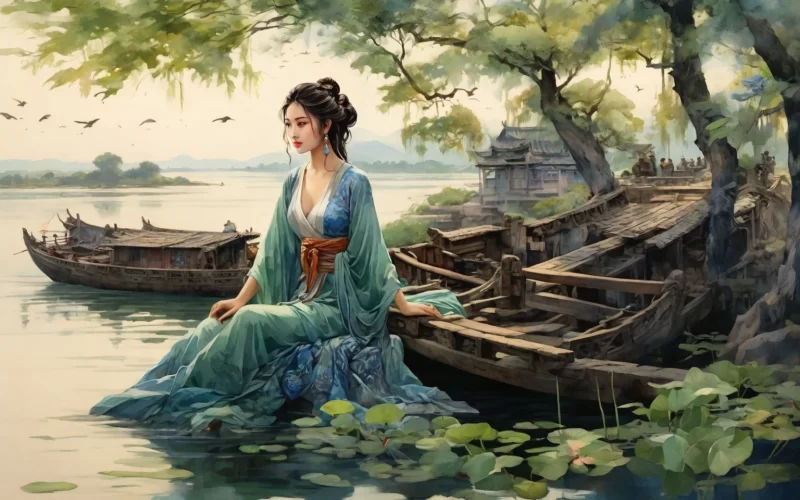
From the boat’s head, the River
Spreads wide. The Merchant’s young Wife
Quivers.

Quivers, quivers —
A partridge flies by night, and shivers.
Original Poem
「调笑令 · 杨柳」
王建
杨柳,杨柳,日暮白沙渡口。
船头江水茫茫,商人少妇断肠。
肠断,肠断,鹧鸪夜飞失伴。
Interpretation
This lyric is the fourth in Wang Jian’s series to the tune of Song of Flirtatious Tune and a model work among Mid-Tang literati poems on the theme of merchants’ wives. Set against the twilight scene of the White Sand Ferry and seen through the eyes of a young merchant’s wife, this short lyric weaves a desolate and lonely tapestry of longing—a call to the distant traveler, a sigh for time gone by, a lament for her own fate. During the Mid-Tang period, with the prosperity of commerce, merchants were often adrift for years, while their wives remained behind at river ferries, enduring the pain of separation alone in their daily vigil. Their spirits suffered the torment of solitude—guarding empty houses, gazing at the river, not knowing when the homebound boat would appear. This unique state of existence became a new theme of concern for Mid-Tang poets.
Wang Jian was a master at depicting this group. Throughout his life, he remained in lowly official posts, granting him deep insight into the lives of the common people and their hardships. He excelled at unearthing heart-stirring power from the mundane. When he turned his gaze to the merchants’ wives at the river ferries, he saw not only personal joys and sorrows but a profile of an era—behind commercial prosperity lay the separation of countless families.
The choice of the tune Song of Flirtatious Tune is also profoundly meaningful. Originally a folk tune, its irregular line lengths and repeated, circling refrains gave it the freshness and naturalness of folk songs, while also suiting the expression of lingering, entangled emotions. Wang Jian’s choice of this tune was perfect—the plaintive, repeated chant of “杨柳,杨柳” is the name the young wife mutters over and over in her heart; the urgent cry of “肠断,肠断” is the uncontrollable wail of a heart breaking. The fusion of folk form and literati emotion allows this short lyric to crystallize the sigh of an era within literary memory.
First Stanza: "杨柳,杨柳,日暮白沙渡口。船头江水茫茫,商人少妇断肠。"
Yáng liǔ, yáng liǔ, rì mù bái shā dù kǒu. Chuán tóu jiāng shuǐ máng máng, shāng rén shào fù duàn cháng.
Willow, oh willow, at twilight on the White Sand shore. River waters stretch boundless from the prow; The young merchant’s wife, her heart is broken now.
The lyric begins with the plaintive repetition, “杨柳,杨柳”. This opening serves the tune’s formal requirement for a repeated phrase while also embedding deep symbolism. Since the Book of Songs (“Long ago, when I set out, Willows shed tear.”), the willow has been an enduring emblem of parting. The doubled invocation mimics the young wife’s own murmuring—whether it is the name of her distant husband, or a memory of the day they parted by snapping a willow twig. Immediately, “日暮白沙渡口” anchors the scene in a specific, poignant time and place: dusk, the hour of homecoming, and the very ferry where she once bid farewell, now the site of her lonely vigil. These two six-character lines, seemingly pure description, have quietly implanted the seed of “sorrow.” The following line, “船头江水茫茫”, dramatically expands the view. The word “茫茫” describes the vast, boundless scene of the river, but more powerfully, it symbolizes the depth of the young wife’s sorrowful thoughts, the remoteness of the return date, the unknowable road ahead. The river stretches boundlessly, its end unseen, just as her waiting seems to have no end. At this point, emotion has accumulated fully within the scene, so the next line, “商人少妇断肠”, bursts forth like a breached dam—revealing that all the preceding scenery is the scene in her eyes, the pain in her heart; that willow, dusk, ferry, and river are all connected to that distant traveler, all pricking that waiting heart.
Second Stanza: "肠断,肠断,鹧鸪夜飞失伴。"
Cháng duàn, cháng duàn, zhègū yè fēi shī bàn.
Heart is broken, broken, like a partridge in the night Flying alone, its companion lost to sight.
The first stanza ends with “断肠”; the second begins with “肠断,肠断”. This repeated phrase is both the transition point of the tune and a progression and deepening of emotion. The phrase “断肠” expresses all the young wife’s pain; the repeated chant of “肠断,肠断” allows this pain to accumulate and intensify in its circling, until it becomes unbearable. Just as the reader expects the lyricist to express this directly, he turns the brush instead, concluding with “鹧鸪夜飞失伴”, entrusting the emotion to an image. The call of the partridge, ancients believed, sounds like “you cannot go, brother,” already carrying a note of sorrow; flying alone at night, having lost its mate, adds to the feeling of lonely desolation. This metaphor is both apt and subtle: is the young wife not that partridge flying at night? In the long, long night, with no companion, no one to tell, she can only swallow the bitterness of longing alone. The lyric stops abruptly here, yet the partridge’s mournful cry seems to still echo in the night sky.
Holistic Appreciation
Though only a little over twenty characters, this lyric is a complete “Picture of the Longing Woman at the Riverbank” and a mournful “Song of Heartbroken Longing.” The entire lyric moves from the first stanza’s description and narration to the second stanza’s lyrical metaphor, with a clear structure and distinct layers. The first stanza begins with “Willow” and ends with “heartbroken,” moving from outside to inside, from scene to emotion; the second stanza continues with “heartbroken” and concludes with “mate lost,” moving from emotion to metaphor, from concrete to abstract. The four lines are like ripples of mood, building from small waves to a climax, then fading into lingering echoes.
Structurally, the work exhibits a progressive layering from descriptive narration in the first stanza to lyrical metaphor in the second. The first stanza opens with the repeated chant “杨柳,杨柳”, which fits the tune’s meter and, borrowing the willow’s imagery of “staying” (liu, a homophone for “to stay”), instantly immerses the reader in the atmosphere of parting. Then, “日暮白沙渡口” clarifies time and space, using a vast, desolate scene to set off feelings of loneliness. “船头江水茫茫” broadens the view to the immense river, also deepening the sorrow. It is with “商人少妇断肠” that the person’s innermost feelings are revealed, like dotting the eyes of a dragon—all the preceding scenery suddenly finds its emotional anchor. The second stanza begins with “肠断,肠断”, connecting and transitioning; this urgent repetition is both an emotional progression and the tune’s transition point. The concluding line, “鹧鸪夜飞失伴”, suddenly turns to metaphor, using the image of the partridge losing its mate to conclude the whole piece, elevating personal sorrow to the universal human experience of loneliness. The first stanza moves from outside in, from scene to emotion; the second moves from emotion to metaphor, from concrete to abstract. Between the four lines, the layers deepen, forming a seamless whole.
Thematically, the core of this lyric lies in the word “孤” (gū, solitary/lonely). In the first stanza, the “杨柳” is a solitary silhouette—the willow branches swaying in the wind resemble the young wife’s solitary figure; “日暮” is a solitary moment—twilight is the time for returning home, yet she keeps watch alone at the ferry; “江水茫茫” is a solitary sorrow—the river boundless, sorrow boundless, with no one to tell, no one to understand. In the second stanza, “肠断” is a solitary pain—the heart-wrenching pain can only be swallowed alone; “鹧鸪夜飞失伴” is a solitary cry—the partridge flying alone in the night, its mournful cry, is precisely the young wife’s own portrayal. This character “孤” (lonely) runs through the entire lyric: solitary at the ferry, solitary heart facing the river, solitary pillow through the long night, solitary soul following the partridge. With extremely concise strokes, Wang Jian exhaustively writes this “solitude,” making the reader feel as if they see that slender figure gradually merging into the night in the twilight, finally becoming a mournful cry in the night sky.
Artistically, the lyric’s most moving aspect is the dual resonance of “repetition conveying emotion” and “concluding feeling with scene.” The lyricist masterfully uses repetition, which both conforms to the tune’s meter and intensifies the lyrical effect. The plaintive “杨柳,杨柳” is the lingering attachment of parting, the inescapable longing; the repetition of “肠断,肠断” is the pain after parting, the irrepressible lament. The two repetitions, one at the beginning and one at the end, echo each other from afar, like sobbing and telling. The technique of “concluding feeling with scene” further shows the lyricist’s craftsmanship: the final line does not express emotion directly but concludes with “鹧鸪夜飞失伴”, entrusting emotion to an image. The partridge’s call is inherently mournful; flying at night, having lost its mate, adds to the loneliness. This metaphor is both apt and subtle—is the young wife not that partridge flying at night? In the long, long night, with no companion, no one to tell, she can only swallow the bitterness of longing alone. This technique of “concluding feeling with scene” allows the lyric to stop abruptly as emotion reaches its climax, while the partridge’s mournful cry seems to still echo in the night sky—the words end, but the meaning lingers.
This short lyric speaks of the sorrows of a merchant’s wife a thousand years ago, yet it can still move us today. The repeated chant of “杨柳,杨柳” is the unspoken longing; the “江水茫茫” is the eager anticipation, watching until the eyes grow weary; the “鹧鸪夜飞失伴” is the desolation of a lonely, sleepless night. In just over twenty characters, Wang Jian exhaustively writes the pain of human parting. The depth of his brushstrokes and the truth of his emotion command admiration.
Artistic Merits
- Perfect Harmony of Lyric Pattern and Content: The Song of Flirtatious Tune pattern is characterized by repeated phrases and shifting rhymes. Wang Jian cleverly uses the two repeated chants, “杨柳,杨柳” and “肠断,肠断”, which not only meet the metrical requirements but also express the lingering attachment and pain of the emotion to the fullest. The points of repetition are precisely the focal points of emotion; form and content achieve perfect unity.
- High Concentration and Organic Unity of Imagery: The entire lyric is only a little over twenty characters, yet it gathers multiple images—“杨柳”, “日暮”, “渡口”, “江水”, “鹧鸪”—and not one is superfluous. These images are like pearls, strung together by the thread of emotion, “断肠”, forming a complete chain of imagery, all pointing to the theme of longing.
- Skillful Arrangement of Time and Space, and Layered Progression of Emotion: Time in the lyric progresses from “日暮” (dusk) to “夜飞” (night flight); space expands from the “渡口” (ferry) to the “江上” (river), then shifts from actual scene to imagination. The shifts in time and space coincide with the progression of emotion. At dusk, it is gazing and anticipation; after nightfall, it is loneliness and lament. The layers deepen, each step stirring the heart.
- Perfect Fusion of Folk Song Flavor and Literati Elegance: The language is simple and natural, the rhythm bright and fluent, incorporating both imagery commonly used in folk songs like “杨柳” and “鹧鸪”, and expressions rich in literati subtlety like “江水茫茫” and “夜飞失伴”. This style, appealing to both refined and popular tastes, is an important achievement of Mid-Tang literati learning from folk tradition and refining folk song lyrics.
Insights
This short lyric speaks of the sorrows of a merchant’s wife a thousand years ago, yet it can still move us today. The insights it offers are manifold:
First, truly good poetry need not be long-winded; it need only capture a single moment. Wang Jian does not write of the young wife’s long wait from spring to winter, nor the myriad details of her sleepless nights. He captures only the scene of her at the river ford at dusk, yet conveys all the longing and loneliness. This technique of “using a point to represent the whole,” “using a moment to write eternity,” is the highest realm of poetic creation.
Second, parting and longing are eternal themes of human emotion. No matter how the times change, how technology develops, the pain of parting and the ache of longing are experiences common to all humanity. The vastness of the “江水茫茫”, the loneliness of the “鹧鸪…失伴”—are these not the state of mind of every waiting person? Through the voice of the young wife, Wang Jian sings of humanity’s eternal loneliness and hope.
Third, the charm of literature lies in elevating individual experience to universal resonance. This lyric is about a woman of a specific era and identity, yet readers can see themselves reflected in her emotions. The figure standing alone at the riverbank, the heart-wrenching pain, the lonely flight of the parted mate—these have long transcended specific time and space to become universal symbols of human emotion. This is the power of literature: it makes one person’s heartache the heartache of all; it makes a sigh from a thousand years ago still echo in our hearts today.
After reading this short lyric, it is as if one sees the young wife’s figure gradually merging into the night, hears the partridge’s mournful cry fading into the distance. Yet the line “商人少妇断肠” is like a mark engraved on the heart, lingering for a long time. In just over twenty characters, Wang Jian exhaustively writes the pain of human parting. The depth of his brushstrokes and the truth of his emotion command admiration.
About the poet
Wang Jian (王建 c. 767 – c. 830), a native of Xuchang, Henan Province, was a renowned poet of the Mid-Tang Dynasty. Born into a humble family, he served on the frontier in his early years. During the Yuanhe era, he held positions such as Assistant Magistrate of Zhaoying County and Assistant Director of the Court of Imperial Treasury. In his later years, he rose to the post of Sima (Minister of War) in Shanzhou, earning him the sobriquet "Sima Wang." His greatest poetic achievements were in the yuefu (Music Bureau) style, and he was often mentioned alongside Zhang Ji as the "Zhang-Wang Yuefu," becoming an important representative of the New Yuefu Movement. His poetic style is characterized by accessible language and profound meaning, securing him a significant place in the tradition of Tang Dynasty realist poetry.