


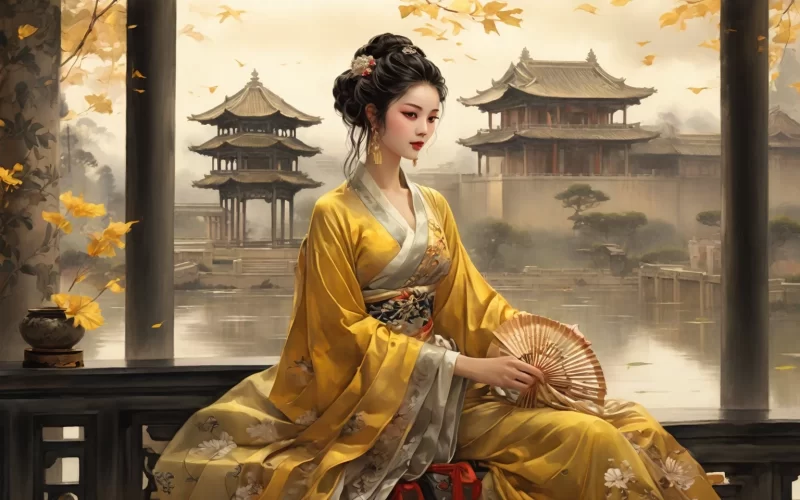
Silk Fan, Silk Fan,
The Beauty hides from the sun.
Three Springs have watched it fade —
Who’ll call the flute, the string, to aid?

The flute, the string —
The path to the Sunshine Hall is overgrown in spring.
Original Poem
「调笑令 · 团扇」
王建
团扇,团扇,美人病来遮面。
玉颜憔悴三年,谁复商量管弦。
弦管,弦管,春草昭阳路断。
Interpretation
This lyric is the first in Wang Jian’s series to the tune of Song of Flirtatious Tune and a model work among Mid-Tang literati poems on the theme of palace ladies’ sorrow. Using a round fan as its central thread and speaking in the voice of a fading beauty who has lost imperial favor, this short lyric weaves a desolate tapestry of neglect within the deep palace—a recollection of bygone glory, a lament for a withered countenance, a despair over the end of the sovereign’s grace. During the Mid-Tang period, the palace music and entertainment system was highly developed. Thousands of women, chosen for their talent and beauty, entered the palace to serve the emperor’s pleasure. Yet favor was fickle. After a brief period of glory, most were forgotten in the deep, cold courtyards, whiling away their youth in solitude and waiting out their lives until old age. Their existence was precisely like that of the round fan—clutched in hand during summer, then discarded into a chest when autumn came. This theme of life’s impermanence became a subject Mid-Tang poets returned to repeatedly. With a cool, detached brush, Wang Jian penned this silent elegy for these forgotten women.
Wang Jian spent his life in lowly official posts, granting him a profound understanding of the fates of those at society’s margins. His yuefu ballads are celebrated for their "narrative quality," excelling at unearthing heart-stirring power from ordinary life. When he turned his gaze to the destinies of palace women, he saw not only individual joys and sorrows but a profile of an era—within the realm of power, countless women were treated as objects, their glory and neglect hinging on a single thought of the sovereign. The tune Song of Flirtatious Tune was originally a folk melody. Its irregular line lengths and repeated, circling refrains gave it the freshness and naturalness of folk songs, while also suiting the expression of lingering, entangled emotions. Wang Jian’s choice of this tune was perfectly apt—the plaintive, repeated chant of “团扇,团扇” is the fading beauty’s murmured soliloquy; the urgent call of “弦管,弦管” is the heart-rending echo of memory.
First Stanza: "团扇,团扇,美人病来遮面。玉颜憔悴三年,谁复商量管弦。"
Tuán shàn, tuán shàn, měi rén bìng lái zhē miàn. Yù yán qiáo cuì sān nián, shuí fù shāng liáng guǎn xián.
Round fan, oh round fan, the fair one uses it to hide her face, now she is ill. Her jade-like countenance has languished three long years; Who now consults with her on tunes of pipes and strings?
The lyric begins with the plaintive repetition, “团扇,团扇”. This opening serves the tune’s formal requirement for a repeated phrase while also embedding deep meaning. The round fan was an object palace women carried with them—used to stir a breeze in summer, or as a prop in song and dance, a symbol of favor and joy. Here, however, it becomes a tool to “遮面” (zhē miàn, hide her face)—the object once used to enhance her charm now serves as a barrier to conceal her pallor. The single word “遮” (hide) encapsulates all the shame and desolation of the beauty in her illness: she dares not show her true face, for that countenance is no longer what it was; she does not wish to be seen, for to be seen marks the beginning of being forgotten. This dual significance of the "round fan"—both a witness to past glory and a veil for present落魄—establishes the lyric’s profound tragic tone.
Immediately following, “玉颜憔悴三年” (Yù yán qiáo cuì sān nián, Her jade-like countenance has languished three long years) specifies the span of time. “三年” (sān nián, three long years)—not three months, not three days, but a length of time sufficient for the emperor to forget her completely. The once nation-toppling "jade-like countenance" now remains only in the two words “憔悴” (qiáo cuì, languished/withered). The next line, “谁复商量管弦” (shuí fù shāng liáng guǎn xián, Who now consults with her on tunes of pipes and strings), posed as a rhetorical question, makes the desolation all the more piercing. "Consulting on pipes and strings" was the most glorious moment for a palace lady—discussing repertoire with musicians, rehearsing songs and dances, awaiting the sovereign's summons. Yet the phrase “谁复” (who now) lays bare the fickleness of the world: those who once surrounded her have long since scattered; the music of pipes and strings that once filled the palace halls, no one now "consults" with her about it. This line is both realistic depiction and portrayal of the heart: losing the sovereign's favor meant losing everything.
Second Stanza: "弦管,弦管,春草昭阳路断。"
Xián guǎn, xián guǎn, chūn cǎo Zhāo yáng lù duàn.
Pipes and strings, pipes and strings, to the Zhaoyang Hall the vernal grass has blocked the way.
The second stanza opens with the repeated chant, “弦管,弦管”. This echoes the "consulting on pipes and strings" from the previous stanza while pulling the thoughts from memory back to reality. The once lively music of pipes and strings now remains only as a hollow echo. Just as the reader expects the poet to continue lamenting, he abruptly turns the brush, concluding with “春草昭阳路断” (chūn cǎo Zhāo yáng lù duàn, to the Zhaoyang Hall the vernal grass has blocked the way), entrusting the boundless sorrow and resentment to imagery. "Zhaoyang" was the palace hall where Emperor Cheng of Han’s favorite consort, Zhao Feiyan, resided; later it came to symbolize the sovereign’s abode, the place of favor. The four words “春草路断” (vernal grass has blocked the way) paint a bleak picture: lush, overgrown spring grass has choked and buried the path to Zhaoyang Hall—not that there is no path, but that the path is no longer trodden, no longer maintained, just as the sovereign’s grace was severed long ago, never to return. This concluding line uses scene to conclude emotion,含蓄而沉痛 (implicit yet deeply poignant): the spring grass greens each year, but the sovereign’s favor does not return.
Holistic Appreciation
Though only a little over thirty characters, this lyric is a complete "Picture of a Sorrowing Palace Lady" and a mournful "Elegy of the Round Fan." The entire lyric moves from the first stanza’s narrative self-pity to the second stanza’s lyrical symbolism, with a clear structure and distinct layers.
Structurally, the work exhibits a progressive layering from narrative self-pity in the first stanza to lyrical symbolism in the second. The first stanza opens with the repeated chant “团扇,团扇”, using the image of the fan "hiding the face" to introduce the beauty’s ashamed demeanor in illness. Then, “玉颜憔悴三年” clarifies the passage of time, and “谁复商量管弦” uses a rhetorical question to intensify the sense of loss—by this point, the desolate situation of the slighted lady is fully laid bare. The second stanza begins with “弦管,弦管”, connecting and transitioning; this urgent repetition is both an emotional progression and the tune’s transition point. The concluding line, “春草昭阳路断”, suddenly shifts to symbolism, using the image of the overgrown path to conclude the whole piece, elevating personal resentment to the universal tragic fate shared by palace ladies. The first stanza moves from object to person, from surface to depth; the second moves from sound to scene, from concrete to abstract. Between the four lines, the layers deepen, forming a seamless whole.
Thematically, the core of this lyric lies in the concept of "severance" (断, duàn). In the first stanza, “团扇遮面” (the round fan hiding the face) is the severance of favor—the fan once used to enhance her charm now serves as a tool to conceal her憔悴, heralding the end of joyful days. “玉颜憔悴” (the jade-like countenance languishes) is the severance of youth—three years of illness have worn away a face that could topple cities. “谁复商量管弦” (who now consults...) is the severance of human connection—the people who once surrounded her have long since vanished without a trace. In the second stanza, the repetition of “弦管” is the severance of an echo—the once lively music now only reverberates in memory. And “春草昭阳路断” is the severance of the sovereign’s grace—the path to Zhaoyang Hall is buried in wild grass, never to be trodden again. This concept of "severance" runs through the entire lyric: severance of favor, of youth, of human connection, of imperial grace—layers of severance advancing step by step, exhaustively depicting a woman’s process from losing favor to being forgotten. With extremely concise brushstrokes, Wang Jian exhaustively writes this "severance," making the reader feel as if they see, within the deep palace, the spring grass greening year after year, while that person never returns.
Artistically, the lyric’s most moving aspect is the dual resonance of "repetition conveying emotion" and "concluding feeling with scene." The poet masterfully uses repetition, which both conforms to the tune’s meter and intensifies the lyrical effect. The plaintive “团扇,团扇” is the murmured soliloquy in shame, the inescapable self-pity; the repetition of “弦管,弦管” is the heart-rending echo in memory, the irrepressible lament. The two repetitions, one at the beginning and one at the end, echo each other from afar, like sobbing and telling. The technique of "concluding feeling with scene" further shows the poet’s craftsmanship: the final line does not express emotion directly but concludes with “春草昭阳路断”, entrusting emotion to imagery. Vernal grass is inherently a symbol of vigorous life, yet here it becomes a barrier blocking imperial grace—this contrast makes the desolation all the more piercing. This technique of "concluding feeling with scene" allows the lyric to stop abruptly as emotion reaches its climax, while the image of the deep palace with its lush spring grass is forever fixed in the reader’s mind—the words end, but the meaning lingers.
This short lyric speaks of the sorrows of a palace lady a thousand years ago, yet it can still move us today. The repeated chant of “团扇,团扇” is the shame of wanting to hide yet still being exposed; the rhetorical question “谁复” is the desolation of being ignored; the imagery of “春草路断” is the despair of endless darkness. In just over thirty characters, Wang Jian exhaustively writes the bitterness of palace resentment. The depth of his brushstrokes and the truth of his emotion command admiration.
Artistic Merits
- Perfect Harmony of Lyric Pattern and Content: The Song of Flirtatious Tune pattern is characterized by repeated phrases and shifting rhymes. Wang Jian cleverly uses the two repeated chants, “团扇,团扇” and “弦管,弦管”, which not only meet the metrical requirements but also express the lingering attachment and desolation of the emotion to the fullest. The points of repetition are precisely the focal points of emotion. The plaintive "团扇,团扇" is the murmured soliloquy in shame; the repeated "弦管,弦管" is the heart-rending echo in memory.
- Dual Symbolism of Imagery and Ring Composition: The "round fan" is both an everyday object in the palace and a symbol of fate—it was the support of Consort Ban Jiéyú "in and out of my lord’s sleeves," and also the sigh of "discarded into a bamboo chest." Wang Jian borrows this traditional image, imbuing it with the new meaning of "hiding the face," making the contrast between glory and decay even stronger. The concluding line, “春草昭阳路断”, uses scene to conclude emotion, forming a ring composition with the opening fan image: the fan hiding the face is internal isolation, the grass blocking the road is external isolation—trapped from both within and without, with no escape.
- Skillful Treatment of Time and Layered Progression of Emotion: The treatment of time in the lyric, from “病来” (falling ill) to “三年” (three years) to “路断” (road blocked), shows a clear progression. Falling ill is the turning point, three years is the period of torment, and the blocked road is the final outcome. In just over twenty characters, the entire process of a woman falling from favor to being forgotten is depicted. Especially the phrase “三年”, seemingly plain, carries the weight of a thousand jun—how many days and nights of watchful waiting and despair does it represent?
- Rhetorical Question and Depth in Simplicity: The line “谁复商量管弦” is posed as a rhetorical question. It does not directly state neglect, yet neglect is evident; it does not directly lament sorrow and resentment, yet the depth of sorrow and resentment is felt. This technique of “expressing depth through simplicity” is the essence of Wang Jian’s yuefu poetry—he never weeps openly, yet allows the reader to feel the pain of open weeping.
Insights
This short lyric speaks of the sorrows of a palace lady a thousand years ago, yet it can still move us today. The insights it offers are manifold:
First, true tragedy often lies hidden within the calmest narration. Wang Jian does not describe the slighted lady wailing and sobbing, nor her tossing and turning on sleepless nights. He writes only of her action of “hiding her face” when ill, the single rhetorical question “who now consults...”, and the image of “the vernal grass has blocked the way”, yet conveys all the humiliation and despair. This technique of "expressing motion through stillness" and "expressing intensity through simplicity" is the highest realm of literature.
Second, the impermanence of glory and decay is an eternal theme of human life. The lament of “Her jade-like countenance has languished three long years”—is it not the sigh of everyone forgotten by their time? The desolation of “to the Zhaoyang Hall the vernal grass has blocked the way”—is it not the portrayal of everyone who has lost their place? Through the fate of the palace lady, Wang Jian speaks to the universal human predicament—throughout our lives, we struggle against being forgotten.
Third, the charm of literature lies in making the forgotten remembered. Those women in the deep palace, their names long lost to the dust of history, yet because of Wang Jian’s lyric, their resentment, their desolation, their fate, is forever fixed in the memory of literature. This is the power of literature: it gives voice to the voiceless, makes the forgotten remembered, and allows a sigh from a thousand years ago to still echo in our hearts today.
After reading this short lyric, it is as if one sees the lady hiding her face with the round fan, sitting alone in the deep palace; as if one sees the path to Zhaoyang Hall, already swallowed up by spring grass. And the line "春草昭阳路断" is like a mark engraved on the heart, lingering for a long time. In just over thirty characters, Wang Jian exhaustively writes the bitterness of palace resentment. The depth of his brushstrokes and the truth of his emotion command admiration.
About the poet
Wang Jian (王建 c. 767 – c. 830), a native of Xuchang, Henan Province, was a renowned poet of the Mid-Tang Dynasty. Born into a humble family, he served on the frontier in his early years. During the Yuanhe era, he held positions such as Assistant Magistrate of Zhaoying County and Assistant Director of the Court of Imperial Treasury. In his later years, he rose to the post of Sima (Minister of War) in Shanzhou, earning him the sobriquet "Sima Wang." His greatest poetic achievements were in the yuefu (Music Bureau) style, and he was often mentioned alongside Zhang Ji as the "Zhang-Wang Yuefu," becoming an important representative of the New Yuefu Movement. His poetic style is characterized by accessible language and profound meaning, securing him a significant place in the tradition of Tang Dynasty realist poetry.