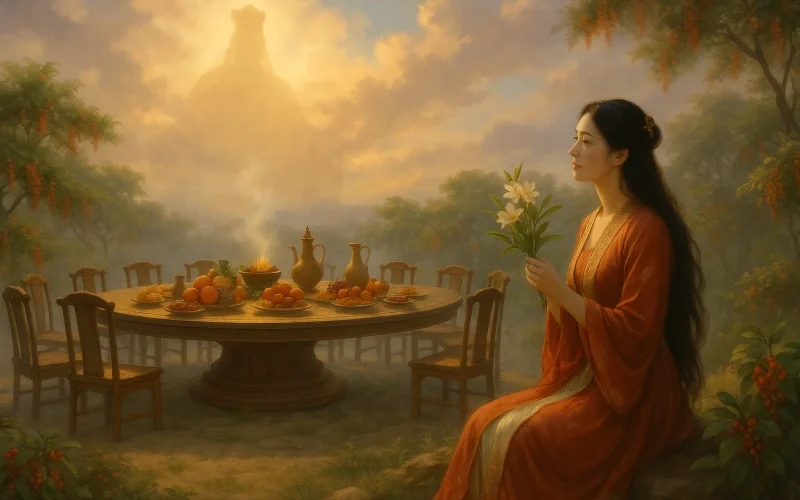



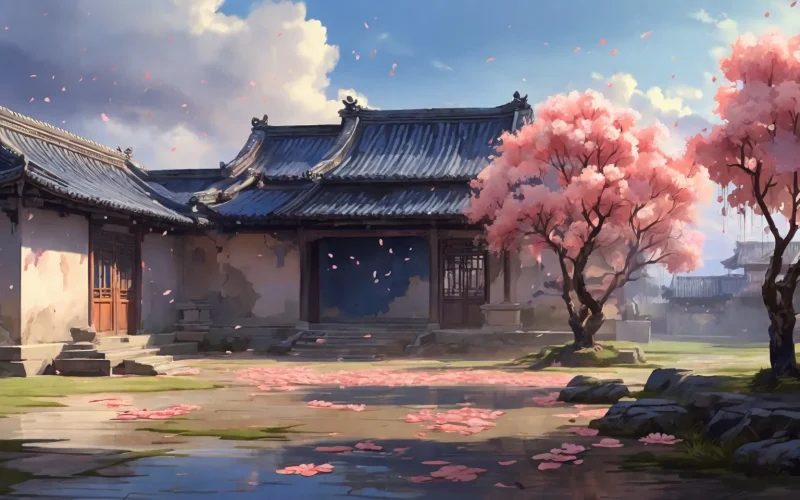
Peach pink with overnight rain;
Willow green in morning haze.
Fallen blooms unswept by the lane,
Birds sing, the hill guest still stays.
Original Poem
「田园乐 · 其六」
王维
桃红复含宿雨,柳绿更带朝烟。
花落家童未扫,莺啼山客犹眠。
Interpretation
This work was composed during Wang Wei’s later years, a period of retreat at his Wang River Estate in Lantian. Having weathered the vicissitudes of an official career, the poet had profoundly internalized the truth that "the affairs of this floating world are not worth pursuing," and he immersed himself completely in a semi-reclusive life imbued with Chan (Zen) contemplation. This quatrain, written in six-character lines, is not merely a depiction of pastoral scenery. It represents a pinnacle of Wang Wei’s poetic art, where he fused the Chan Buddhist concept of tranquil emptiness with the painterly "arrangement of elements." It presents not a bustling scene of rural labor, but a world of contemplative stillness, filtered of worldly clamor, where time seems suspended. It is a microcosm of his aesthetic ideal where "there is painting in his poetry, and poetry in his painting."
First Couplet: 桃红复含宿雨,柳绿更带朝烟。
Táo hóng fù hán sùyǔ, liǔ lǜ gèng dài zhāo yān.
The peach blossoms, flushed pink, again hold the overnight rain; / The willow fronds, fresh green, still trail the mist of dawn.
The opening captures two quintessential images of a spring morning through a painter’s eye. "Flushed pink" and "fresh green" offer a vivid contrast of colors. Yet, the intervention of "the overnight rain" and "the mist of dawn" washes away any garishness, imparting a moist, hazy, and tranquil greyish tone. The verbs "hold" and "trail" are exquisite: "hold" describes the peach blossoms, heavy with absorbed rainwater, bowing in languid grace—a contained fullness. "Trail" gives the willow tendrils a sense of light, drifting motion—a visible ethereality. This couplet is purely scenic, devoid of human emotion, yet it lays a foundation of lucid, empty tranquility through its palette and atmosphere.
Second Couplet: 花落家童未扫,莺啼山客犹眠。
Huā luò jiā tóng wèi sǎo, yīng tí shān kè yóu mián.
Fallen petals blanket the ground, the houseboy has not yet swept; / Orioles warbled in the branches, the mountain-dweller still sleeps.
This couplet shifts from pure observation of scenery to the barest hint of human activity, yet the negating states of "has not yet" and "still" transform this "activity" into part of the "still scene." "Fallen petals" is the result of action; "has not yet swept" freezes that action, turning it into a "still life of fallen blossoms" available for prolonged contemplation. "Orioles warbled" is a clear, sharp sound, but "still sleeps" absorbs and dissolves this sound into boundless silence, highlighting instead the transcendent detachment and profound inner peace of the "mountain-dweller." This figure refers to the poet himself and symbolizes an ideal state of being—though situated amidst the sounds and changes of nature, his spirit remains undisturbed, maintaining deep inner serenity and ease.
Holistic Appreciation
This short poem is a Chan-inspired ink-wash miniature painted with words. Its structure presents a dichotomy and unity between "pure scene" and "still person": the first two lines depict the suffusion of color and the diffusion of atmosphere, constructing a physical space, fresh-washed and far from the mundane world; the final two lines present the suspension of motion and the absorption of sound, revealing a mental world of lucid clarity, unmoved by external things. Together, the four lines create a mood akin to an "eternal morning": time flows with extreme slowness here—the overnight rain is not yet dry, the dawn mist not yet dispersed, the flowers "not yet" swept, the man "still" asleep. Everything exists in a liminal state between waking and sleeping, action and stillness, embodying the Chan appreciation for the beauty of contemplative stillness where "the present moment is eternity." Unlike the lively vitality of Meng Haoran's "Spring Dawn," Wang Wei's poem focuses more on the infinite vitality and philosophical depth contained within "tranquil emptiness" itself.
Artistic Merits
- The Unique Rhythm and Pictorial Quality of the Six-Character Line: The six-character meter has a balanced, measured cadence, between the conciseness of four-character and the fluidity of seven-character lines. It is particularly suited for portraying serene, balanced, and elegant imagery. The 2-2-2 rhythm of this poem is like the even application of a painter's brush, building a stable, harmonious visual composition where each word adds to the scene.
- Painterly Treatment of Color and Light: "Flushed pink" and "fresh green" are saturated hues. Yet, through the moderating and veiling effects of "the overnight rain" (transparent water-wash) and "the mist of dawn" (grey-white haze), the poem achieves the effect found in Chinese painting of "applying color according to category" while remaining "alive with spirit and resonance." The colors are bright yet not vulgar, fresh yet profoundly still.
- "Negating Words" that Create a Chan Space: "Has not yet swept" and "still sleeps" are the linchpins of the entire poem. They do not indicate negligence or idleness, but intentionally suspend everyday logic (fallen petals should be swept, birdsong should wake one). In doing so, they open up an aesthetic and contemplative space that transcends ordinary concerns, where subject and object are both forgotten. Here, "not yet" and "still" become the keys to the realm of stillness.
- Fluidity and Vitality within Parallel Structure: Both couplets employ strict parallelism, yet within this precision lies variation. "Again hold" and "still trail" suggest progression, while "has not yet swept" and "still sleeps" imply a causal link. The disciplined formal rhythm and the fluid movement of meaning enhance each other perfectly.
Insights
This work demonstrates how Wang Wei refined a slice of life into a spiritual sanctuary. It reveals that true tranquility is not an escape from sound and change, but maintaining a focus and detachment akin to "still sleeping" amidst the tumult of sensory experience. True leisure is not idleness, but allowing things to exist in their natural state, like the "not yet swept" fallen petals, refraining from hasty intervention or judgment.
In an era of information overload and efficiency worship, this poem acts as a soothing balm for the spirit. It invites us to adopt the perspective of the "mountain-dweller." Perhaps we cannot retreat to forested hills, but we can preserve a "Wang River" in our hearts. On some morning, we can consciously suspend the tasks we "should" do, to feel the moisture of "peach blossoms holding the overnight rain," the haze of "willow fronds trailing the dawn mist," or simply to listen to the warble of an oriole crossing the lake of the mind without stirring ripples. This discipline of "finding stillness within movement, perceiving emptiness within form" is a profound art of settling the mind, a legacy Wang Wei bequeaths to later generations.
About the poet
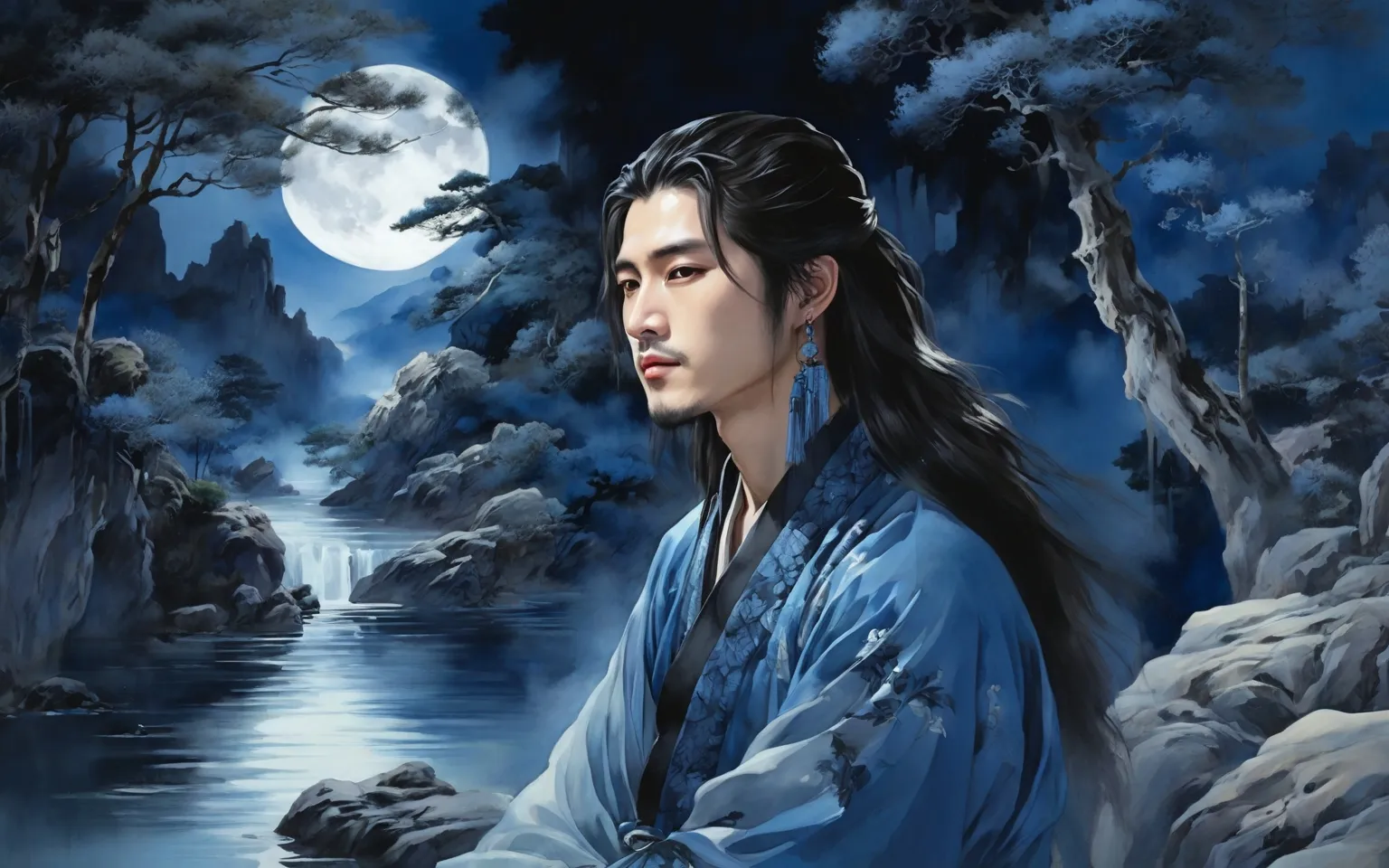
Wang Wei (王维), 701 - 761 A.D., was a native of Yuncheng, Shanxi Province. Wang Wei was a poet of landscape and idylls. His poems of landscape and idylls, with far-reaching images and mysterious meanings, were widely loved by readers in later generations, but Wang Wei never really became a man of landscape and idylls.