


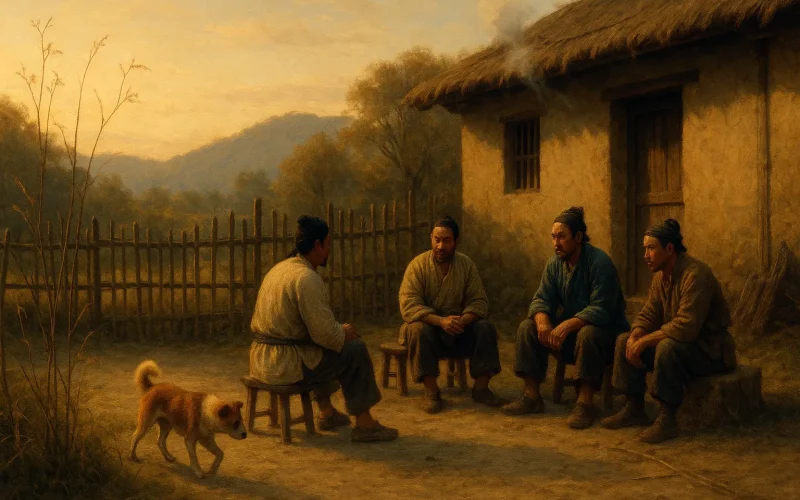
Fences part the cooking glow,
Neighbors whisper—soft and low.
Crickets chant through hemp's thin shade,
Looms stand naked, silk betrayed.
Taxmen come with midnight feast,
Bragging how their lords increased:
"East carts drowned in autumn mire,
Yet the rods still sing with fire!"
"Save your skin, bend your spine,
New year's tax will taste like mine."
Original Poem
「田家三首 · 其二」
柳宗元
篱落隔烟火,农谈四邻夕。
庭际秋虫鸣,疏麻方寂历。
蚕丝尽输税,机杼空倚壁。
里胥夜经过,鸡黍事筵席。
各言官长峻,文字多督责。
东乡后租期,车毂陷泥泽。
公门少推恕,鞭朴恣狼藉。
努力慎经营,肌肤真可惜。
迎新在此岁,唯恐踵前迹。
Interpretation
After the failure of the Yongzhen Reforms, Liu Zongyuan fell from a court official to a disgraced minister "awaiting punishment" in remote prefectures. This shift in political status brought a change in perspective—he no longer looked upon the people's livelihood from a lofty position but stood on the same ground as the common folk, witnessing their toil and suffering firsthand. In the mid-to-late Tang Dynasty, with regional militarist separatism and frequent warfare, the court increasingly levied heavy taxes to fund the military. Peasants not only had to hand over most of their harvest but also bore a multitude of corvée labor duties. Petty local officials further exploited tax collection to extort and embezzle. What Liu Zongyuan saw and heard in Yongzhou and Liuzhou was precisely the people's suffering under this systemic oppression. Three Poems on Farming Households is his faithful record of this reality.
The first poem depicts the hardship of peasant labor. The second, however, focuses on the oppression and brutality within the tax collection process, using stark, realistic description to expose the cruel nature of feudal tyranny.
First Couplet: "篱落隔烟火,农谈四邻夕。"
Líluò gé yānhuǒ, nóng tán sìlín xī.
Faint cooking-smoke drifts from behind wattled hedges;
In the dusk, peasants from four homes share neighborly talk.
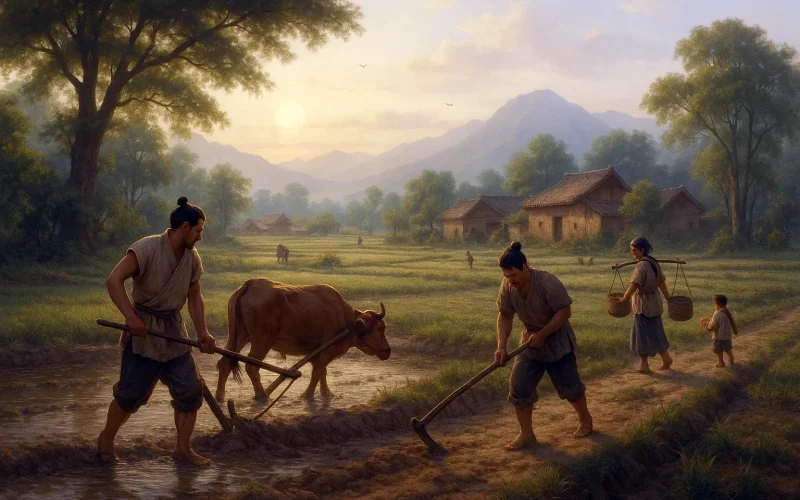
The opening sketches a seemingly tranquil rural evening scene. "Wattled hedges" are the bamboo or wooden fences common to farmhouses; "cooking-smoke" is the smoke from household fires, a peaceful, warm image. "In the dusk… neighborly talk" describes the common, warmest moment of rural life—neighbors gathering to chat after the day's work. Yet this peace is only a surface—the more serenely the poet paints this prelude, the heavier the suffering revealed later becomes. This is Liu Zongyuan's habitual technique of using serene scenes to accentuate sorrow.
Second Couplet: "庭际秋虫鸣,疏麻方寂历。"
Tíng jì qiū chóng míng, shū má fāng jìlì.
Autumn insects chirp softly beside the courtyard wall;
Sparse flax-plants stand, forlorn, a thin and meagre stock.
These lines seem to continue describing the scene, but unease is already hidden within. "Autumn insects" signals the season—autumn, the harvest time, is also when official tax demands are most urgent. The five words "Sparse flax-plants stand, forlorn" reveal the household's dire straits: flax is raw material for weaving cloth; "sparse" indicates scarcity, "forlorn" indicates desolation. The flax field, which should be lush, is so sparse, hinting at a poor harvest and foreshadowing the "silk all rendered for tax" to come. In the scenery, we already see the people's destitution.
Third Couplet: "蚕丝尽输税,机杼空倚壁。"
Cánsī jǐn shū shuì, jīzhù kōng yǐ bì.
The household's silk, all rendered for the tax-collector's hand,
The loom leans idle, silent, vacant, 'gainst the wall.
This couplet delivers the poem's first heavy blow. The word "all" (尽) in "silk, all rendered" echoes the "all rendered up" (尽输) of the first poem—not a portion paid, but everything taken. The woman's hard work raising silkworms and reeling silk, hoping to weave cloth to supplement the family's needs, now leaves her empty-handed. "The loom leans idle"—the loom sits unused against the wall, silent. The word "idle/vacant" (空) fully conveys the desolation of a stripped-bare home and the collapse of hope.
Fourth Couplet: "里胥夜经过,鸡黍事筵席。"
Lǐ xū yè jīngguò, jī shǔ shì yánxí.
The bailiff comes by night, on his official round;
A fowl is killed, coarse fare on simple boards is spread.
"Bailiff" refers to the petty local official in charge of tax collection. Their coming "by night"—not openly on official business by day, but under cover of darkness—itself reeks of furtiveness and intimidation. Facing these uninvited guests, the peasant household dares not neglect them, and must "kill a fowl" and "spread coarse fare." A simple meal of chicken and millet, meant for family or friends, is now offered to these bloodsuckers. This detail is deeply ironic: the exploited must use their meager remaining food to curry favor with their exploiters.
Fifth Couplet: "各言官长峻,文字多督责。"
Gè yán guānzhǎng jùn, wénzì duō dūzé.
'Our magistrate,' they say, 'is strict, a man of might;
His written orders press us, day and night.'
This is the bailiffs' excuse to absolve themselves—'It's not us pressuring you, it's the higher-ups, the "strict magistrate," the "pressing orders."' They portray themselves as mere "implementers" caught in the middle, shifting the blame upward. Yet Liu Zongyuan's brush turns, letting us see clearly: despite the layered pressure, it is precisely these "complaining" bailiffs who do the beating, who demand the feasts. This couplet records their words; the next reveals their actions—the contrast between word and deed exposes their hypocrisy.
Sixth Couplet: "东乡后租期,车毂陷泥泽。"
Dōngxiāng hòu zū qī, chēgǔ xiàn ní zé.
'The Eastern Hamlet failed the tax-collection date—
Their cart's wheel sank deep in the mire, such was their fate.'
This couplet gives a concrete example: a household in the Eastern Hamlet failed to pay taxes on time. The reason was not deliberate delay but "the cart's wheel sank deep in the mire"—muddy roads, wheels stuck, an objective difficulty. Yet the authorities show no understanding; in their eyes, only the three words "failed the tax-collection date" matter, the reason is irrelevant, only punishment follows. These two short lines fully convey the system's cold cruelty.
Seventh Couplet: "公门少推恕,鞭朴恣狼藉。"
Gōngmén shǎo tuī shù, biān pū zì lángjí.
'The court shows little mercy, as is widely said;
The lash and club lay on till flesh is raw and red!'
This is the poem's most shocking couplet. "The court shows little mercy"—five words that utterly convey the bureaucratic machine's coldness—no sympathy, no discretion, only rule by the book. "The lash and club… flesh is raw and red": "lash and club" are instruments of punishment; "lay on… raw and red" describes the casual, cruel brutality. One can imagine those peasants who delayed payment because "the cart's wheel sank" kneeling in the yamen, beaten bloody. This is not "taxation"; it is plunder.
Eighth Couplet: "努力慎经营,肌肤真可惜。"
Nǔlì shèn jīngyíng, jīfū zhēn kěxí.
Strive with care, manage well, do all that you are bid,
Or see your own flesh bruised and torn—alas, you did!
This is the poet's direct commentary. "Strive with care, manage well" describes the peasants' diligence and caution—they are not idlers, not troublemakers, but good, common folk who labor diligently and cautiously avoid trouble. Yet the reward is "your own flesh bruised and torn—alas." The bruised flesh is shocking. The phrase "alas" (可惜), seemingly plain, is saturated with the poet's grief and indignation.
Ninth Couplet: "迎新在此岁,唯恐踵前迹。"
Yíngxīn zài cǐ suì, wéi kǒng zhǒng qián jì.
The coming year, a fresh start, waits at the gate,
Yet all they fear is treading the same path, the same harsh fate.
The final couplet pushes time into the future, revealing the deepest despair. The New Year should be a time of renewal, of hope. But for these drained peasants, "a fresh start" only means a new round of fear—they "fear is treading the same path," dreading that the new year is merely a repetition of the old year's suffering. The words "all they fear" (唯恐) fully capture the peasants' psychological state: not anticipation, not hope, only fear. Using "a fresh start" to write "hopelessness"—the stark contrast is suffocating.
Holistic Appreciation
Using plain description, this poem layer by layer reveals the tragic fate of peasants under the oppression of taxation. The first two couplets describe the village scene, tranquility hinting at destitution. The next two couplets describe the silk all paid in tax, the loom idle, pointing to economic ruin. Couplets five to seven describe the bailiffs collecting taxes and the officials' violence, bringing the systemic oppression to a climax. The final couplets conclude with commentary, directly stating the grief, indignation, and despair.
The poem's structure is tight, its narrative clear. The poet does not denounce loudly but lets the details speak for themselves—the loom leaning idle against the wall, the forced offering of chicken and millet, the cart wheel stuck in the mire, the freely applied lash and club—each image is a tearful, bloody indictment of tyranny. Liu Zongyuan uses a sober brush to depict cruel reality, a restrained attitude to express deep compassion, making this poem one of the most profound chapters in Chinese literary history exposing feudal exploitation.
Artistic Merits
- Plain, Unadorned Description, True and Unsparing: The poem uses little ornament, presenting the cruel truth of rural life in an almost documentary way, with a truth that shocks.
- Layered Progression, Rigorous Structure: From village scene to economy, from economy to tax collection, from collection to violence, from violence to despair—each step deepens, each part connects.
- Vivid Details, Evocative Imagery: "The loom leans idle" depicts ruin; "A fowl is killed… fare… spread" depicts humiliation; "cart's wheel sank" depicts helplessness; "lash and club… flesh is raw" depicts brutality—each detail carries profound meaning.
- Simple Language, Deep Emotion: The lines are plain, conversational, yet filled with compassion and indignation, embodying Liu Zongyuan's art of "using common words to express un-common pain."
Insights
This poem first makes us see the system's cruelty and the distortion of humanity. Those bailiffs beating peasants may have been farmers' sons themselves; those courts "show[ing] little mercy" should serve the people. But when the system itself aims at exploitation, those within it become tools of oppression. Liu Zongyuan reminds us with this poem: An unjust system distorts all humanity—it not only crushes the oppressed, but also corrupts the oppressor.
The couplet, "The coming year, a fresh start… / Yet all they fear is treading the same path," also prompts reflection on the dialectic of hope and despair. For these peasants, the New Year is not the beginning of hope but the continuation of fear. This psychology of "welcoming the new yet fearing" expresses the powerless feeling of the dispossessed before time. In today's society, do we also have such moments—facing a new year, not anticipating change, but fearing the repetition of past suffering? Liu Zongyuan's poem teaches us: True hope must be built on the foundation of systemic improvement; otherwise, "a fresh start" is just another name for a new round of suffering.
This poem also teaches us about the intellectual's conscience and responsibility. Liu Zongyuan could have written of landscapes, of leisure. He chose to speak for the underclass. In his disgraced status, he stood on the side of the oppressed, using his pen to record truth, expose darkness. This stance of "chronicling the common people, preserving a record of suffering" established his unique position as a "poet of society." Today, as literature grows increasingly oriented toward entertainment and the personal, we still need such voices—writing that records its era, reveals truths, transmits compassion—that is truly powerful literature.
Finally, the poem's quality of "not spelling it out" is especially worth learning. Facing such cruel reality, Liu Zongyuan does not cry to heaven, does not launch into impassioned rhetoric. He simply lets the reader see the emptiness of "the loom leans idle," the humiliation of "a fowl is killed… fare… spread," the brutality of "the lash and club… flesh is raw," the fear of "all they fear is treading the same path." This calm presentation is more piercing than any indictment. It teaches us: facing suffering, quietness can sometimes be more powerful than agitation; presentation can sometimes touch hearts more than commentary.
About the Poet

Liu Zongyuan (柳宗元, 773 - 819), a native of Yuncheng in Shanxi province, was a pioneering advocate of the Classical Prose Movement during China's Tang Dynasty. Awarded the prestigious jinshi degree in 793 during the Zhenyuan era, this distinguished scholar-official revolutionized Chinese literature with his groundbreaking essays. His prose works, remarkable for their incisive vigor and crystalline purity, established the canonical model for landscape travel writing that would influence generations. As a poet, Liu mastered a distinctive style of luminous clarity and solitary grandeur, securing his place among the legendary "Eight Great Masters of Tang-Song Prose" - an honor reflecting his enduring impact on Chinese literary history.