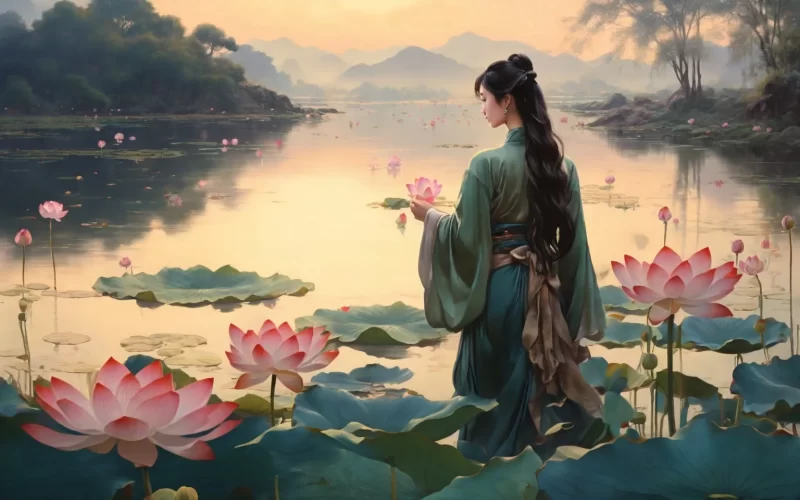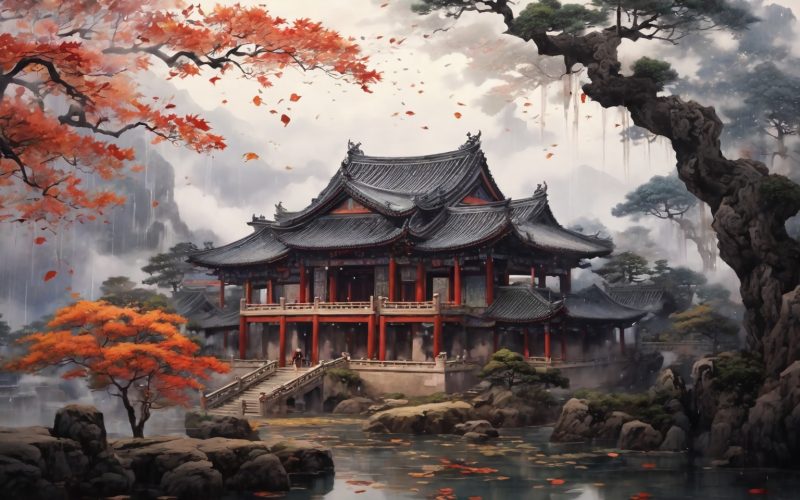



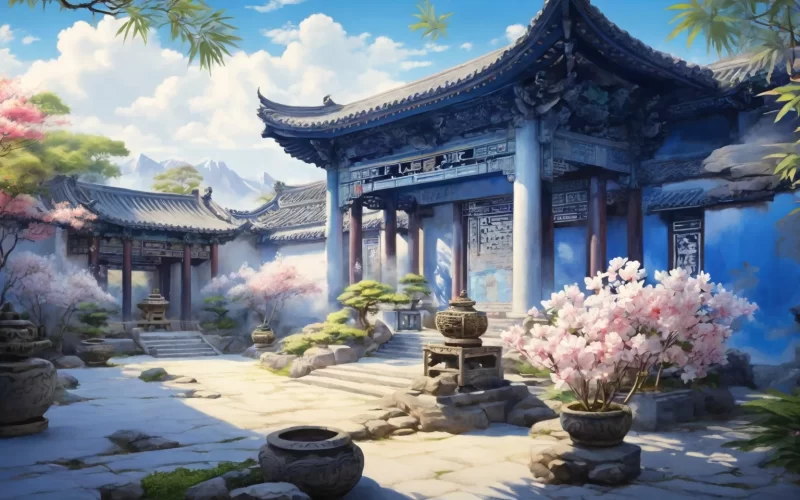
Palm‑flowers fill the court. Moss enters the still room.
Between us, speech is done. The named is overcome.
Then, in the air, a scent not known before —
Not flower, not moss — is waiting at the door.
Original Poem
「题僧房」
王昌龄
棕榈花满院,苔藓入闲房。
彼此名言绝,空中闻异香。
Interpretation
Wang Changling had a significant connection to Buddhism throughout his life. In his poems, he once referred to himself as having "早得空门义" (comprehended the principles of emptiness early), indicating his understanding of Buddhist teachings. During his later years in exile at Longbiao, located in the deep, secluded mountains and waters of western Hunan where many Zen temples existed, he often interacted with monks, seeking solace for his soul within the monastery walls. This poem is an impromptu work composed during a visit to a tranquil Zen temple. The title "Inscribed in a Monk's Chamber" indicates it was written on the wall of a monk's cell. The poet, present within the temple, sees palm flowers filling the courtyard, moss silently creeping into the room; monks sit opposite each other in silence, deep in meditation; the air seems permeated with a strange fragrance—not a worldly scent, but the incense that 'arises from the mind' during Zen stillness.
At this time, Wang Changling's official career was fraught with setbacks; he was far from the capital, and his inner melancholy is understandable. Yet, within this Zen temple, amidst the monks' silence, within that "空中异香" (strange fragrance in the air), he perhaps found a moment of peace and transcendence. This poem is his comprehension of the Zen state, and also a form of solace for his own soul.
First Couplet: "棕榈花满院,苔藓入闲房。"
Zōnglǘ huā mǎn yuàn, táixiǎn rù xián fáng.
Palm flowers fill the courtyard,
Moss creeps into the quiet room.
The opening sketches the temple's tranquility and vitality with an extremely minimalist brush. "棕榈花满院"—palm flowers bloom abundantly; the word "fill" (满) describes the flowers' profusion and also the vigor of life. These flowers are nature's gift, and also adorn the temple grounds. They give color and vitality to this quiet, secluded courtyard.
"苔藓入闲房"—Moss is a plant that grows in silence; it "creeps into" (入) the meditation room, not brought in by anyone, but spreading in quietly on its own. The word "creeps into" captures the moss's noiseless, imperceptible movement, and also conveys the room's emptiness and lack of human disturbance—precisely because it is undisturbed, the moss can grow in so freely.
This couplet juxtaposes "fill" and "creeps into," depicting two different forms of life: The "filling" of the palm flowers is expressive, fervent; the "creeping" of the moss is introverted, silent. The two coexist within the temple grounds, just as movement and stillness, the manifest and the hidden in the human world find accommodation and harmony here.
Second Couplet: "彼此名言绝,空中闻异香。"
Bǐcǐ míngyán jué, kōngzhōng wén yìxiāng.
Facing each other, words and names are cut off;
In the empty air, a strange fragrance is sensed.
This couplet shifts from describing scenery to describing the mind, the state of Zen meditation. "彼此名言绝"—The monks sit facing each other, yet no words are spoken. "Words and names" (名言) refer to language, concepts. In Zen practice, language is an obstacle, an attachment; true communication requires not words, but spiritual resonance. This "cut off" (绝) is a realm beyond language, embodying the Zen principle of "不立文字" (not establishing words).
"空中闻异香"—In ultimate silence, it is as if a strange fragrance drifting in the air is sensed. This "strange fragrance" is not a worldly scent, not the fragrance of blooming flowers, but the "incense of the mind" that arises during Zen concentration. Buddhist texts often speak of the "incense of precepts," the "incense of meditation," the "incense of wisdom"; when cultivation reaches a certain level, a pure joy arises within the mind, permeating like a fragrance. The poet uses the phrase "闻异香" (sense a strange fragrance) to concretize this ineffable Zen state into a perceptible experience.
This couplet uses the "cut off" of the first line to describe soundlessness, and the "sense" of the second line to describe perception; between soundlessness and perception, it poetically expresses the Zen state.
Holistic Appreciation
This short poem, in its extremely concise twenty-character length, accomplishes both a depiction of the Zen temple and a comprehension of the Zen state. The first two lines describe the scenery, using the palm flowers' "filling" and the moss's "creeping" to outline the temple's tranquil yet vibrant atmosphere. The last two lines describe the mind, using "名言绝" to depict the monks' silence, and "闻异香" to describe the state of meditation, transforming the ineffable Zen meaning into a perceptible experience.
The entire poem is concise in language and ethereal in mood. Not a single line speaks directly of Zen, yet every line is Zen; it contains no Buddhist terminology, yet Buddhist principles permeate throughout. The contrast between "满" and "入", the resonance between "绝" and "闻", are all the poet's profound comprehension and exquisite expression of the Zen state. Compared to Wang Changling's stirring, solemn frontier poems, this poem is of a completely different style. It shows us that the poet who sang triumphantly "黄沙百战穿金甲" could also write lines so ethereal and serene; the poet who sighed "孤舟微月对枫林" could also find inner peace within a Zen temple. This very diversity of style is where the charm of Wang Changling's poetry lies.
Artistic Merits
- Mastering Complexity with Simplicity, Concise yet Rich: Twenty characters contain the temple's scenery, the monks' state, and the poet's insight—each word carries weight, none is superfluous.
- Interaction of Movement and Stillness, Exquisite Imagery: "棕榈花满院" describes movement (flowers blooming); "苔藓入闲房" describes stillness (growth). One moving, one still, they play off each other delightfully.
- Combination of Tangible and Intangible, Ethereal Mood: "彼此名言绝" describes the tangible (monks sitting opposite); "空中闻异香" describes the intangible (experience of meditation). The tangible and intangible give rise to each other, creating endless resonance.
- Poetry within Zen, Zen within Poetry: The entire poem contains no Buddhist terminology, yet Zen feeling permeates throughout, achieving the state of "诗禅合一" (poetry and Zen as one).
Insights
This poem first reveals to us a mode of communication within silence. "彼此名言绝"—The monks face each other wordless, yet their hearts connect. In the clamor of modern life, we are accustomed to filling every silence with words, forgetting that true understanding often requires none. It tells us: Sometimes, not speaking allows us to hear more. In silence, we can feel others, ourselves, and the world more deeply.
The imagery of "空中闻异香" also prompts us to contemplate experiences beyond the senses. That "strange fragrance" is not smelled by the nose, but perceived by the heart. It reveals: Many things in life cannot be perceived by ordinary senses; they require the heart to comprehend. Those seemingly intangible experiences—love, beauty, truth, Zen meaning—are often more real and more enduring than material existence.
The contrast between "棕榈花满院" and "苔藓入闲房" further leads us to reflect on the relationship between expression and restraint. The "filling" of the palm flowers is life expressed; the "creeping" of the moss is life in stillness. The two coexist in the temple, complementing each other. It reveals: Life requires both moments of expression and moments of restraint. In expression, we release life; in restraint, we gather strength. This is the complete state of being.
The figure of the poet "闻异香" within the Zen temple is especially evocative. He is not a monk, not a Zen master, merely a disheartened official, a wandering traveler. Yet in this moment, in the courtyard filled with blooming palm flowers, in the meditation room where moss creeps, amidst the silent companionship of the monks, he senses that ineffable "异香". This feeling is a gift he gives himself, and also life's offering to him. It teaches us: Even in difficulty, even with a troubled heart, we can, at certain moments, in certain places, find inner peace and transcendence. That "异香" is always there, waiting only for us to "闻" it.
About the poet
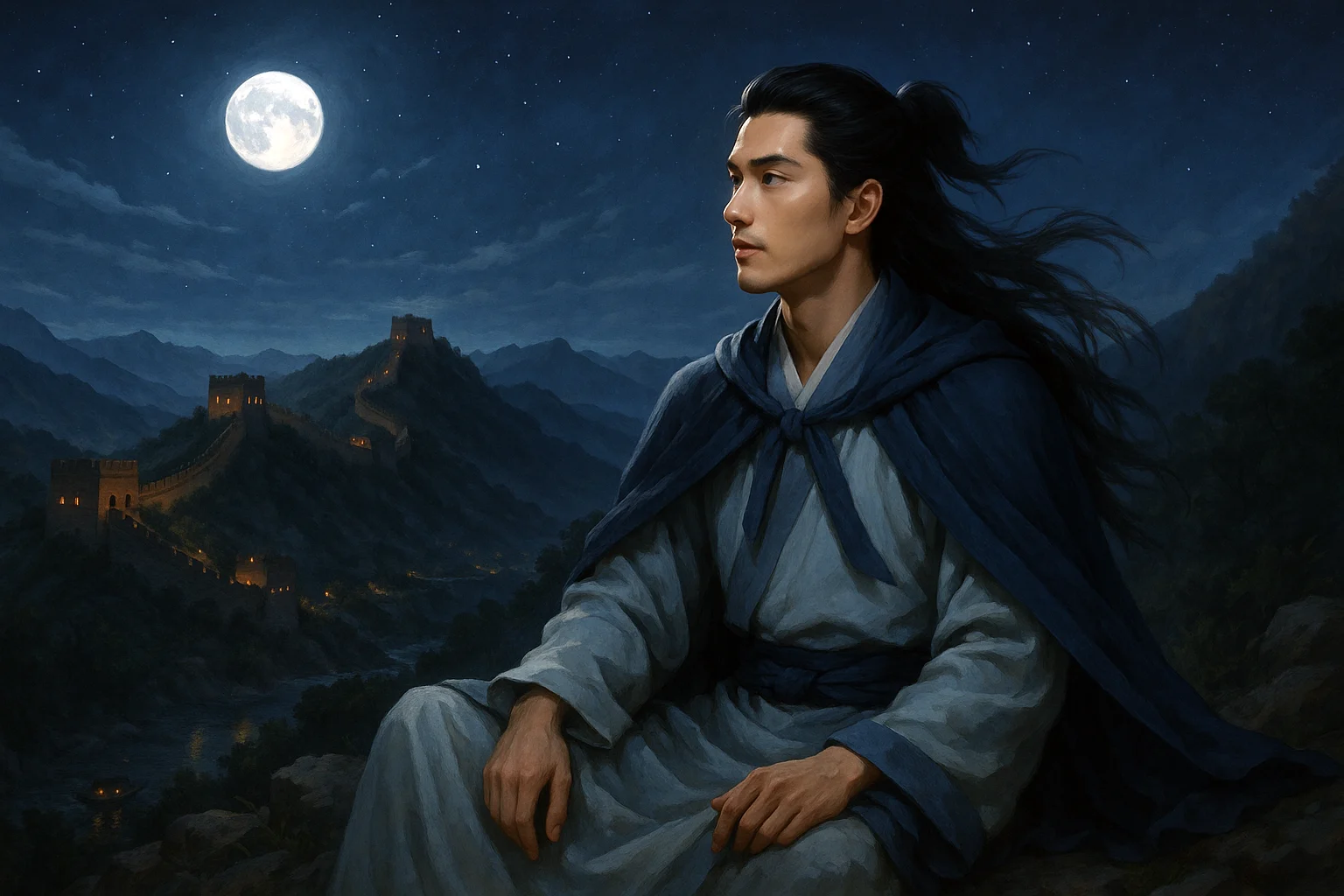
Wang Changling (王昌龄), circa A.D. 690 - 756, was a native of Xi'an, Shaanxi Province. Wang Changling's poems were mostly about the Border Places, love affairs and farewells, and he was well known during his lifetime. His seven poems are equal to those of Li Bai, and he is known as the “Master of seven lines”.