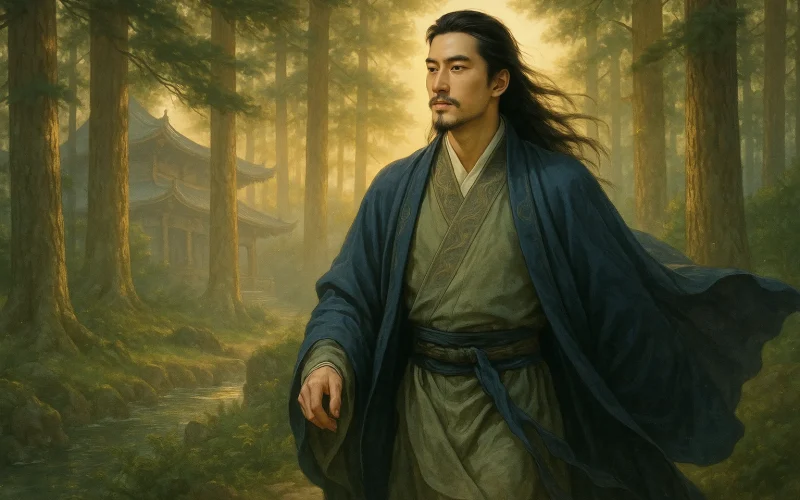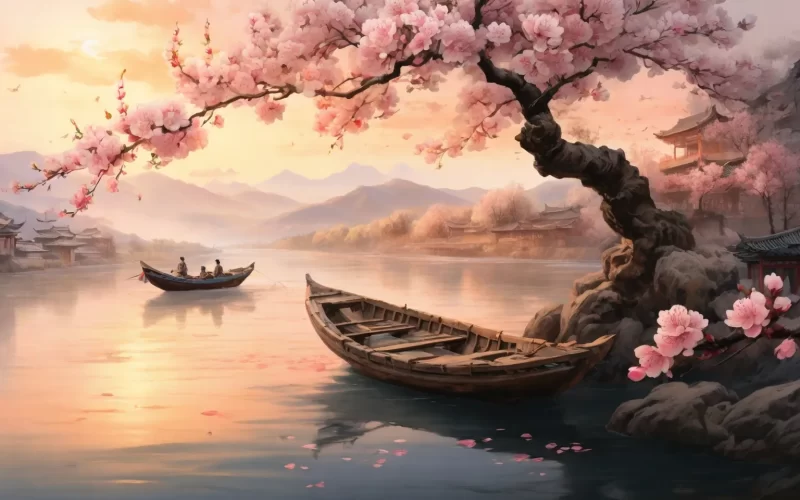
A fisherman drifts, charmed by spring mountains fair,
And peach blooms on both banks guide him to a source old and rare.
Watching the flushed trees, he forgets how far he has come,
Till the blue stream ends — and he sees men unknown, struck dumb.

A cave! Its mouth so narrow he must crawl to proceed,
Then it broadens to a path, level and wide indeed.
Beyond, clouds crown woods stretching far as eyes can see,
And houses, thousands, hide in flowers and bamboo shadows free.

Woodcutters tell their names in the ancient Han tongue;
In clothes of Qin style, old and young are clad among
The uplands above Wuling River, where they stay,
On farms and in gardens like a world far away.

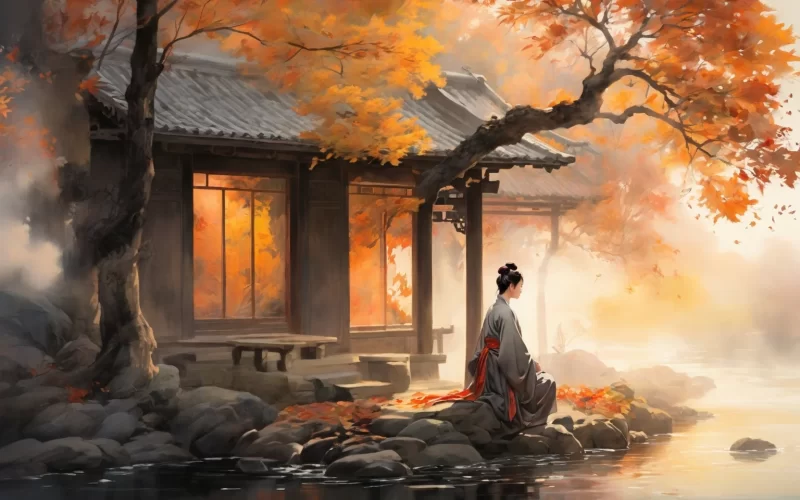
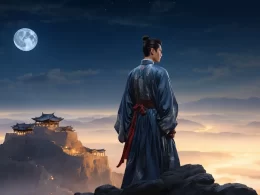
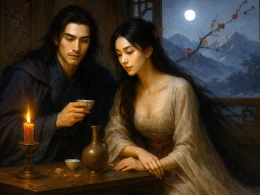
Their homes rest in peace under pines in the moon clear,
Till sunrise fills the low sky with cocks’ crow and dogs’ cheer.
At news of a stranger, all gather in delight,
Each invites him home, asks of his world day and night.

Paths are cleared of petals at dawn for his tread;
Fishermen and farmers bring gifts as dusk is spread.
They left the mundane world long ago, seeking refuge here,
Living like angels since, blessedly free from fear.

None in the cave knows of the world outside;
Outsiders see but empty mountains where clouds hide.
Unaware of this fortune, the fisherman starts to yearn
For his native land, for ties he must return.

He finds his way out, past hills and streams once more,
Planning to come back with kin from his home shore.
He memorizes each step, fixes the route in mind,
Forgetting cliffs and peaks may change with time, unkind.

To enter deep into such hills, one thing is sure:
A green stream leads you where mists in woods endure.
But now with spring floods everywhere and peach petals afloat,
Where is the way to find that hidden source? Lost is the boat.
Original Poem
「桃源行」
王维
渔舟逐水爱山春,两岸桃花夹古津。
坐看红树不知远,行尽青溪不见人。
山口潜行始隈隩,山开旷望旋平陆。
遥看一处攒云树,近入千家散花竹。
樵客初传汉姓名,居人未改秦衣服。
居人共住武陵源,还从物外起田园。
月明松下房栊静,日出云中鸡犬喧。
惊闻俗客争来集,竞引还家问都邑。
平明闾巷扫花开,薄暮渔樵乘水入。
初因避地去人间,及至成仙遂不还。
峡里谁知有人事,世中遥望空云山。
不疑灵境难闻见,尘心未尽思乡县。
出洞无论隔山水,辞家终拟长游衍。
自谓经过旧不迷,安知峰壑今来变。
当时只记入山深,青溪几曲到云林。
春来遍是桃花水,不辨仙源何处寻。
Interpretation
This poem was composed in the seventh year of the Kaiyuan era of Emperor Xuanzong of Tang (719 AD), when Wang Wei was nineteen years old and actively pursuing scholarly honors in Chang'an. Although inspired by Tao Yuanming's "Record of the Peach Blossom Spring," it is not a simple imitation but a creative transformation by Wang Wei using the early Tang seven-character song form (ge xing ti). While society appeared stable in the early Kaiyuan period, court intrigues and political undercurrents were already emerging. The young Wang Wei, through the imagery of the Peach Blossom Spring, expresses a longing for a tranquil and harmonious ideal society while subtly conveying a sense of detachment from the real world. The narrative of "leaving the human world to escape calamity" resonates deeply with the Tang literati's cultural psychology of "retiring in seclusion while awaiting official service," showcasing the unique spiritual temperament in Wang Wei's early poetry: "thoughts of withdrawal within engagement with the world."
Section One:
渔舟逐水爱山春,两岸桃花夹古津。坐看红树不知远,行尽青溪不见人。
Yú zhōu zhú shuǐ ài shān chūn, liǎng àn táo huā jiā gǔ jīn. Zuò kàn hóng shù bù zhī yuǎn, xíng jìn qīng xī bù jiàn rén.
The fisherman’s boat follows the stream, he delights in the spring mountains; / Peach blossoms flank both banks, embracing the ancient ford. / Sitting, he gazes at red-blooming trees, unaware of the distance; / Journey’s end on the clear stream, still no person in sight.
The opening unfolds the scene with a flowing perspective. "Follows the stream, delights in the spring mountains" describes both action and mood, establishing the poem’s serene and carefree tone. The visual combination of peach blossoms and the ancient ford exudes both vibrant beauty and antique seclusion. "Unaware of the distance" skillfully conveys the psychological state of being so immersed in beauty that time and space are forgotten, paving the way for the entry into the hidden realm. The three characters "no person in sight" suddenly create suspense, naturally leading to the journey of discovery.
Section Two:
山口潜行始隈隩,山开旷望旋平陆。遥看一处攒云树,近入千家散花竹。
Shān kǒu qián xíng shǐ wēi ào, shān kāi kuàng wàng xuán píng lù. Yáo kàn yī chù cuán yún shù, jìn rù qiān jiā sàn huā zhú.
Stealthily passing the mountain’s mouth, he starts through winding defiles; / The mountains part, opening to a vast view, then level land appears. / Afar, he sees a place where clouds and trees cluster; / Drawing near, he enters a thousand homes scattered among flowers and bamboo.
This section depicts the dramatic spatial transition. "Stealthily passing" and "winding defiles" create a sense of secret exploration, while "The mountains part, opening to a vast view" recreates the classic moment of "suddenly seeing the light." The contrast between the distant view ("clouds and trees cluster") and the close-up ("a thousand homes scattered among flowers and bamboo") provides clear compositional layers while evoking the transcendent scenery of the Peach Blossom Spring—cloud-wrapped like a fairy realm, yet lush with flora like the human world.
Section Three:
樵客初传汉姓名,居人未改秦衣服。居人共住武陵源,还从物外起田园。
Qiáo kè chū chuán Hàn xìngmíng, jū rén wèi gǎi Qín yīfú. Jū rén gòng zhù Wǔlíng yuán, hái cóng wù wài qǐ tiányuán.
Woodcutters first passed down Han-era surnames; / The inhabitants have not yet changed their Qin-style clothes. / Together they dwell at Wuling’s source, / And beyond the worldly realm, they’ve made fields and gardens.
The focus shifts from scenery to people, highlighting the core feature of the spring’s temporal dislocation. The details "Han-era surnames" and "Qin-style clothes" freeze history in concrete objects, creating a fantastical sense of time travel. "Beyond the worldly realm, they’ve made fields and gardens" carries forward Tao Yuanming’s concept of a "world beyond" while imbuing it with a spirit of self-sufficiency and agency, suggesting this is a consciously chosen way of life.
Section Four:
月明松下房栊静,日出云中鸡犬喧。惊闻俗客争来集,竞引还家问都邑。
Yuè míng sōng xià fáng lóng jìng, rì chū yún zhōng jī quǎn xuān. Jīng wén sú kè zhēng lái jí, jìng yǐn huán jiā wèn dūyì.
When the moon is bright, beneath pines, rooms are still; / At sunrise, from the clouds, fowl and dogs clamor. / Startled to hear a worldly guest, they vie to gather, / Competing to lead him home, asking of the capital town.
The contrast between night and day reveals the complete rhythm of life in the spring. The stillness of "moonlight and pines" and the liveliness of "fowl and dogs at sunrise amid clouds" complement each other, forming a poetic balance of ideal existence. "Startled to hear" and "vie to gather" vividly portray the simple, warm nature of the people, while the detail "asking of the capital town" subtly reveals their psychological state: though they have withdrawn from the world, they have not forgotten it, foreshadowing what is to come.
Section Five:
平明闾巷扫花开,薄暮渔樵乘水入。初因避地去人间,及至成仙遂不还。
Píngmíng lǘ xiàng sǎo huā kāi, bómù yú qiáo chéng shuǐ rù. Chū yīn bì dì qù rénjiān, jí zhì chéng xiān suì bù huán.
At dawn, in lanes and alleys, they sweep the fallen blooms; / At dusk, fishermen and woodcutters ride the water in. / At first, to escape calamity, they left the human world; / Having almost become immortals, they thus do not return.
"Sweep the fallen blooms" and "ride the water in" are two daily scenes that poeticize life in the spring as an eternal pastoral idyll. "To escape calamity, they left the human world" speaks of historical trauma, while "Having almost become immortals, they thus do not return" elevates the meaning of their choice—this is not merely a geographical escape but a spiritual transcendence. Here, Wang Wei transforms Tao Yuanming’s "escaping the Qin" into the more Tang-era colored imagery of "becoming immortals."
Section Six:
峡里谁知有人事,世中遥望空云山。不疑灵境难闻见,尘心未尽思乡县。
Xiá lǐ shéi zhī yǒu rénshì, shì zhōng yáo wàng kōng yún shān. Bù yí líng jìng nán wén jiàn, chén xīn wèi jìn sī xiāng xiàn.
Within the gorge, who knows of human affairs? / From the world, gazing afar, one sees only empty cloud-wrapped peaks. / Never doubting this numinous realm was hard to hear of or see, / Yet worldly thoughts not severed, he longed for his native town.
The perspective shifts to a contrast between inside and outside. "Who knows of human affairs" and "gazing afar, one sees only empty cloud-wrapped peaks" create a two-way isolation, emphasizing the spring’s secrecy. The four characters "worldly thoughts not severed" are the crucial turn—the fisherman ultimately cannot completely transcend worldly attachments. This human weakness re-emphasizes the boundary between the fairy realm and the mundane world and lays the psychological groundwork for the subsequent "impossible to find again."
Section Seven:
出洞无论隔山水,辞家终拟长游衍。自谓经过旧不迷,安知峰壑今来变。当时只记入山深,青溪几曲到云林。春来遍是桃花水,不辨仙源何处寻。
Chū dòng wúlùn gé shānshuǐ, cí jiā zhōng nǐ cháng yóu yǎn. Zì wèi jīngguò jiù bù mí, ān zhī fēng hè jīn lái biàn. Dāngshí zhǐ jì rù shān shēn, qīng xī jǐ qū dào yún lín. Chūn lái biàn shì táohuā shuǐ, bù biàn xiān yuán héchù xún.
Leaving the cave, regardless of mountains and streams barring the way, / Leaving home, he still planned long wanderings there. / He thought the old path he’d passed would not mislead; / How could he know the peaks and ravines had now changed? / He only remembered going deep into the mountains then, / Several bends of the clear stream led to cloud-woods. / Spring comes, everywhere is peach blossom water; / He cannot tell where the immortal source is to be found.
The final section elevates the theme amid loss and melancholy. The gap between "thought the old path… would not mislead" and "had now changed" reveals the unrepeatable nature of the ideal world—it exists only in a specific state of mind and a unique opportunity. The last four lines are especially profound: the beautiful scene before his eyes, "Spring comes, everywhere is peach blossom water," remains, but the inquiry, "He cannot tell where the immortal source is to be found," transforms the Peach Blossom Spring from a geographical location into a spiritual symbol. What cannot be found again is not merely the place but also the pure state of mind and the perfect moment of the first encounter.
Overall Appreciation
The value of this poem lies not only in its successful transformation of a prose classic into poetic form but also in Wang Wei’s infusion of the Peach Blossom Spring with the youthful vitality and spiritual color unique to the High Tang. Compared to the simple, solid world in Tao Yuanming’s account, Wang Wei’s version is more ethereal and lyrical, rich in musicality and pictorial quality. Using the fisherman’s experience as a thread, the poem downplays narrative in favor of crafting atmosphere and emotional flow, elevating the spring from a historical parable to an eternal spiritual ideal. The introduction of the "becoming immortals" imagery reflects the influence of Buddhist and Taoist thought on the Tang literati’s inner world. The bewilderment in the closing lines, "He cannot tell where the immortal source is to be found," foreshadows the Zen-like realm in Wang Wei’s later poetry, as in "On the empty mountain, no man is seen, / Yet the sound of men’s voices is heard."
Artistic Merits
- Musical Treatment of Visual Narrative: Wang Wei masterfully blends a painter’s eye for composition with a poet’s feel for rhythm. The verses unfold like a flowing cinematic sequence—moving from the close-up of “peach blossoms lining both banks” to the panoramic “clouds cloaking distant groves” and then to the middle-ground view of “a thousand homes nestled among flowers and bamboo”—weaving these visual layers into a rich, cadenced symphony of imagery.
- Poetic Softening of Historical Specificity: The poet mutes the original tale’s explicit historical marker of “fleeing the chaos of the Qin dynasty,” replacing it with the more universal phrase “to escape calamity, they left the human world.” This lifts the Peach Blossom Spring beyond a fixed time and place, transforming it into a timeless symbol of spiritual refuge.
- Subtle Deepening of Psychological Portrayal: By emphasizing the fisherman’s inner conflict—that “his worldly heart was not entirely severed”—Wang Wei moves beyond a simple tale of exotic discovery. This touches on the enduring tension between the ideal and the real, between withdrawal from and engagement with the world.
- Reimagining the Imagery System: While drawing on conventional motifs like peach blossoms, winding streams, and mist-veiled mountains, Wang Wei also introduces subtle plays of light and shadow, such as “moonlight bathing the pines, rooms steeped in stillness” and “at sunrise, fowl and dogs clamor from within the clouds.” This creates a dreamlike, multi-layered poetic atmosphere that feels at once tangible and elusive.
Insight
The work reveals a profound paradox of the human spirit: Humans forever seek the Peach Blossom Spring on the other shore, yet the true spring exists only in the process of seeking. The fisherman’s initial "unaware of the distance" is a state of self-forgetful immersion; his subsequent "cannot tell where… is to be found" is a state of deliberate search. The Peach Blossom Spring vanishes precisely in the shift of mindset from "self-forgetful immersion" to "deliberate search." This reminds us that the ideal world is not a specific geographic coordinate but a state of mind—it manifests within the heart when one is completely immersed in the present, united with nature, and encounters goodwill. By dissolving the Peach Blossom Spring into the ordinary spring scene of "everywhere is peach blossom water", Wang Wei offers this revelation: the immortal source need not be sought afar; perhaps it appears in the very moment we learn to view the world before us with a clear and luminous heart.
Poem translator
Kiang Kanghu
About the poet
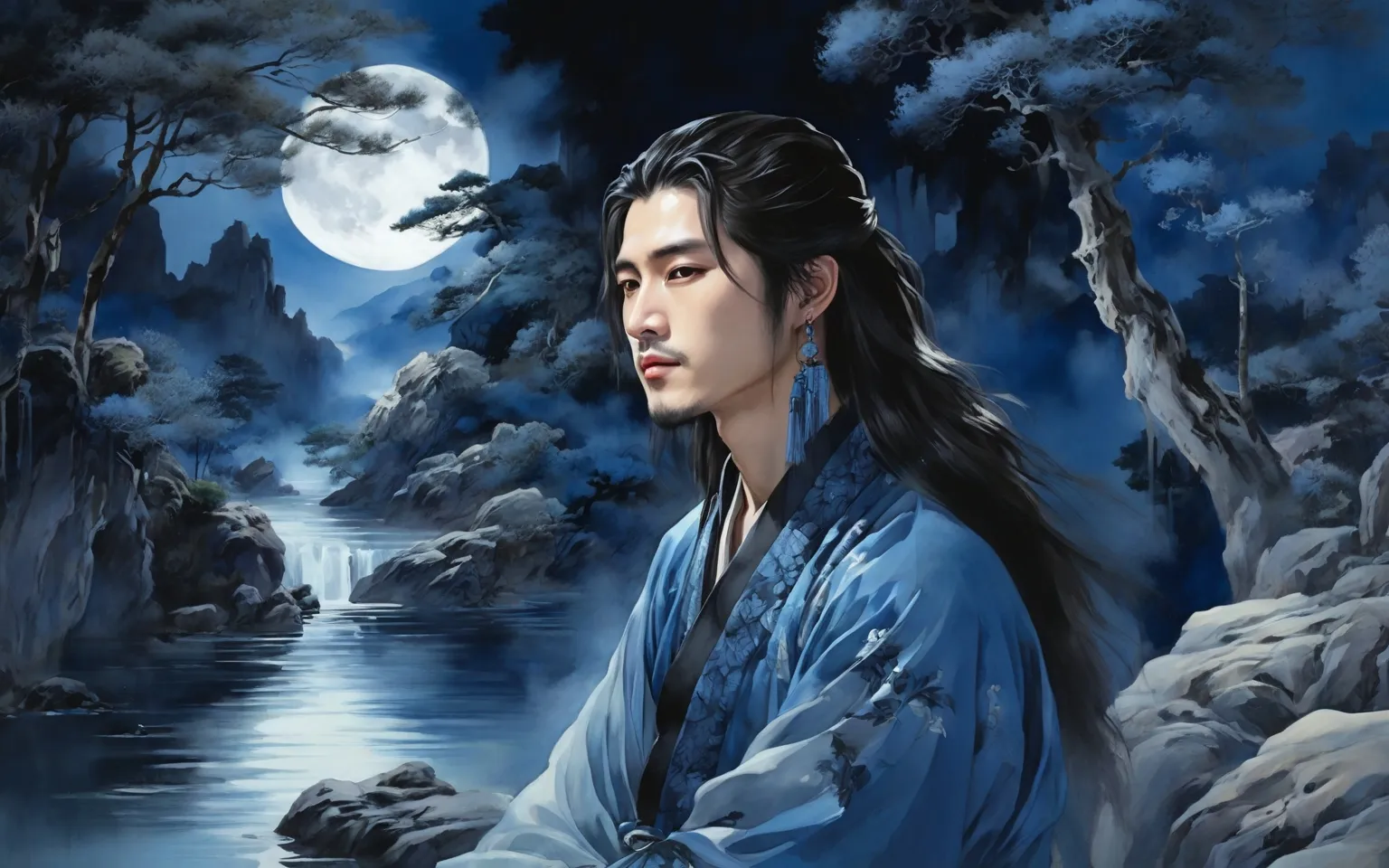
Wang Wei (王维), 701 - 761 A.D., was a native of Yuncheng, Shanxi Province. Wang Wei was a poet of landscape and idylls. His poems of landscape and idylls, with far-reaching images and mysterious meanings, were widely loved by readers in later generations, but Wang Wei never really became a man of landscape and idylls.