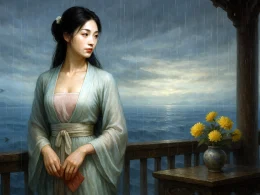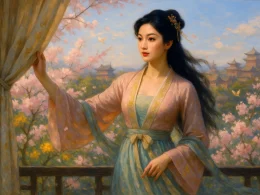



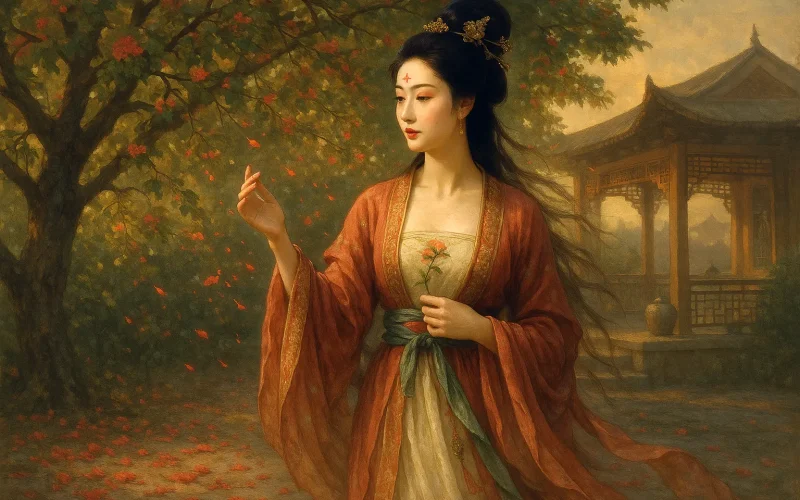
I regret to be late to seek for blooming spring;
The flowers not in full bloom in years past I've seen.
The strong wind blows down flowers which sway and swing,
The tree will be laden with red fruit and leaves green.
Original Poem
「叹花」
杜牧
自是寻春去校迟,不须惆怅怨芳时。
狂风落尽深红色,绿叶成阴子满枝。
Interpretation
The creation of this poem is intimately connected to a lifelong regret in Du Mu's life. According to records in unofficial histories like Missing Histories of the Tang, Du Mu, in his youth while traveling in Huzhou, encountered a young girl with hair still worn in childish buns and was struck by her beauty. He made an agreement with her mother to return and marry her in ten years. However, his official career took him elsewhere, and it was only fourteen years later, when appointed Prefect of Huzhou, that he was able to revisit the place. By then, the girl had been married for three years and had two children. Deeply disappointed, Du Mu wrote this poem. The story was widely circulated by the late Tang. This misalignment spanning fourteen years was not merely a personal emotional wound but became a literary occasion for the poet to contemplate chance, promises, and time's inexorability. The image of the "violent wind" in the poem is both a depiction of natural violence and a metaphor for the unforeseeable variables in life that rewrite destiny's trajectory.
First Couplet: 自是寻春去校迟,不须惆怅怨芳时。
Zì shì xún chūn qù xiào chí, bù xū chóuchàng yuàn fāng shí.
Indeed, I went to seek spring, to verify, too late; No need for sorrow, no blaming the season's lovely state.
Explication: The opening phrase "Indeed, I" establishes the poem's tone: this is a clear-eyed attribution of cause to the self, with no shifting of blame to external factors, only a complete acceptance of his own belatedness. The phrasing "went to seek spring, to verify, too late" is masterful: the character for "verify" originally means to check or compare, here implying the poet always carried the agreed-upon timeframe in his heart as a measuring standard, and "late" is the harsh conclusion drawn from that measurement. The second line, "No need for sorrow," appears to be self-consolation, but through its negative construction ("No need"), it paradoxically intensifies the very presence of "sorrow." This technique—expressing affirmation through negation, revealing deep feeling through attempted dissuasion—demonstrates the unique depth of Du Mu's emotional expression.
Final Couplet: 狂风落尽深红色,绿叶成阴子满枝。
Kuángfēng luò jǐn shēn hóng sè, lǜyè chéng yīn zǐ mǎn zhī.
The violent wind has stripped all that deep crimson hue; Now leaves form shade, and branches bend with fruit, anew.
Explication: This couplet forms one of the most famous metaphors in Chinese poetic history. "The violent wind has stripped all that deep crimson hue" is both an accurate record of a natural phenomenon—flowers fallen after a late spring storm—and a poetic freeze-frame of beauty's sudden vanishing. Deep crimson, the most intense and saturated color, carries the full weight of youth, passion, and loveliness. Its being "stripped all" delivers a dual shock, visual and psychological. "Now leaves form shade, and branches bend with fruit" completes the narrative of life-stage transition: the season of blossoms is past, giving way to the mature phase of bearing fruit. Most profound is the image of "branches bend with fruit"—it is proof of life's continuation and simultaneously implies the person he sought has established new familial bonds. The progression of imagery—blossom, leaf, fruit—condenses a woman's life journey from maidenhood to motherhood.
Holistic Appreciation
This is a temporal allegory that uses the life cycle of a plant as a metaphor for human emotional history. Du Mu's brilliance lies in transforming a personal story that could have lapsed into mere sentimentality into a philosophical contemplation of a universal human condition. The poem follows a strict causal logic: because "I went… too late" (cause), therefore "The violent wind has stripped all that deep crimson hue" (effect); because the blossoms fell (cause), therefore "leaves form shade, and branches bend with fruit" (effect). This interlinked natural logic lends an air of inevitability that transcends individual regret.
The poem's emotional structure follows a complete process: acknowledgment—dissuasion—presentation—acceptance. The poet first acknowledges his own lateness, then attempts rational dissuasion, next calmly presents the current state, and finally achieves emotional acceptance through objective description. This turn from subjective emotion to objective spectacle reflects Du Mu's restraint and maturity as a poet—he does not wallow in sorrow but transforms it into an observation and presentation of the world's operating principles.
Particularly noteworthy is the poem's multi-layered folding of time: the agreed decade (past), the belated fourteen years later (present), the youthful "blossoming season" represented by "deep crimson hue" (bygone days), and the mature "now" symbolized by "branches bend with fruit" (the current moment). These temporal layers are unified within a single space (the branches) through the plant's natural growth, creating a poetic effect of "a moment containing many years." When the reader contemplates the image of "branches bend with fruit," they see not only the present fruit but also the passage of over a decade and the transformation of a life.
Artistic Merits
- Integrity of the Metaphorical System: The complete plant growth cycle (blooming → wind scattering blossoms → leaves forming shade → branches laden with fruit) corresponds to the complete human life stages (maidenhood/youth → external intervention → maturity/marriage → bearing children). This high degree of isomorphism between metaphor and subject allows the poem to be read both concretely and universally.
- Symbolic Power of Color Narrative: "Deep crimson hue," the poem's only intense color, carries the full weight of youth, passion, and beauty. Its being "stripped all" is not merely the disappearance of color but the end of an emotional world. In contrast, "green" is a peaceful but ordinary color, suggesting life has entered another, more commonplace state.
- Causal Chain of Verbs: "Seek" (active pursuit), "went" (spatial movement), "stripped all" (action of external force), "form" (natural growth), "bend with" (state of completion). These verbs construct a narrative progression from human pursuit to the triumph of natural law, with the final phrase "bend with," through its plump visual imagery, drawing a closing period to all change.
Insights
This work reveals an eternal paradox in human emotion: we invariably measure our long and varied lives against things that are transient and fleeting—like blossoms, youth, promises—and time always delivers answers beyond our plans. Du Mu's "went… too late" was not an accidental tardiness but the price life exacts amidst the vicissitudes of an official career and the changes of the world. The lesson for the modern reader may be this: what matters is perhaps not clinging to a specific "season of blossoms," but learning to read the different landscapes life presents in its various seasons.
The introduction of the "violent wind" image is especially profound. It reminds us: life's path is shaped not only by personal will but by countless uncontrollable factors—fate, chance, social change. The violent wind that strips the "deep crimson hue" could be war, illness, family misfortune, or a chance encounter or missed connection. Recognizing the existence of these forces beyond human control does not lead to passivity but fosters greater reverence for and acceptance of life.
Ultimately, this poem offers not an immersion in regret but a perspective of clarity achieved by moving through regret. When Du Mu wrote "Now leaves form shade, and branches bend with fruit," he saw not only his own loss but also what the other had gained; not only the end signified by fallen blossoms but also the beginning signified by fruit. This ability to simultaneously perceive absence and wholeness, ending and renewal, is perhaps the most precious wisdom for facing life's impermanence. In this sense, Lament for the Blossoms is not merely a love poem but a poem about life—about how to reconcile oneself with missed chances and how to find meaning within change.
Poem translator
Xu Yuanchong (许渊冲)
About the poet
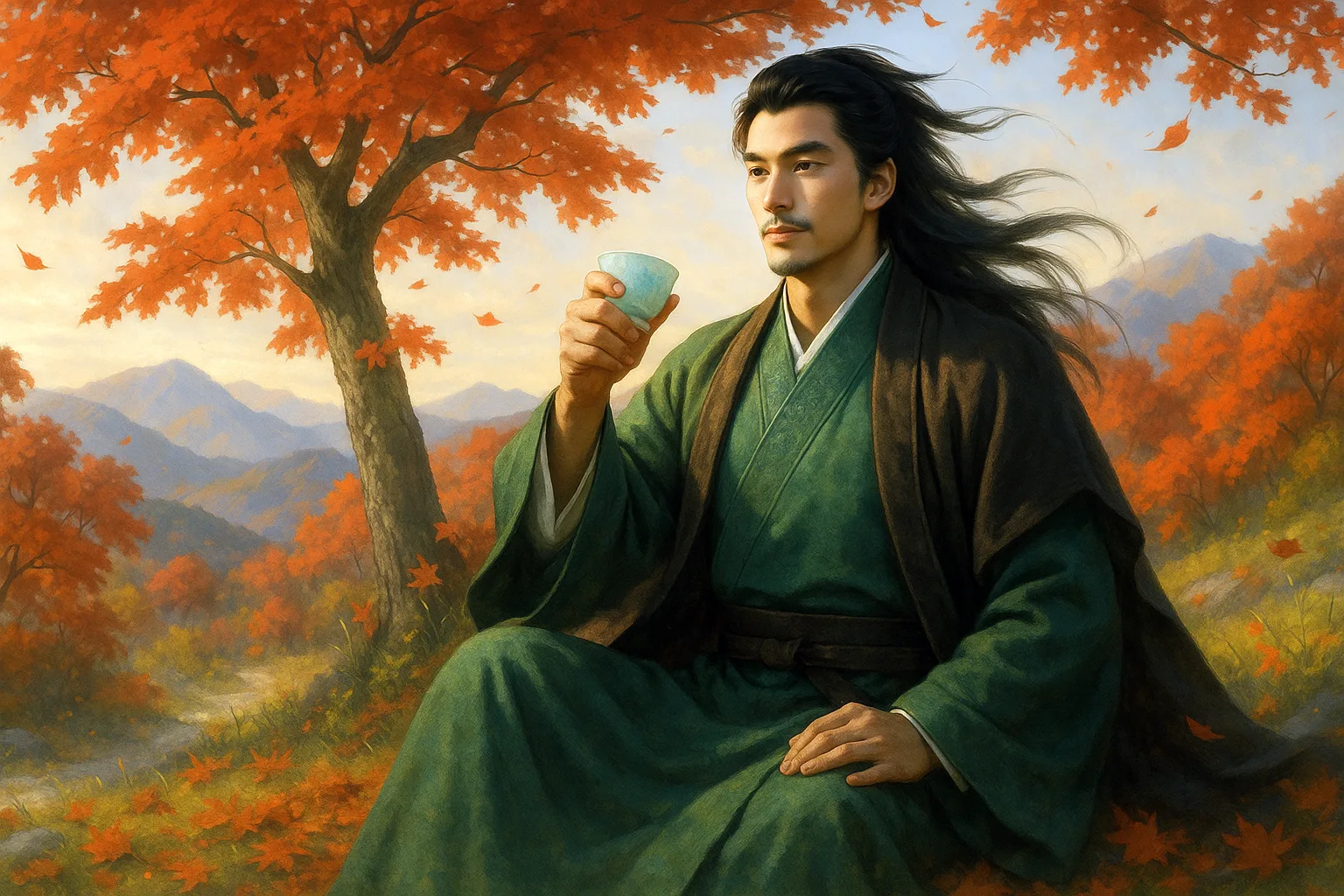
Du Mu (杜牧), 803-853 AD, was a native of Xi'an, Shaanxi Province. Among the poets of the Late Tang Dynasty, he was one of those who had his own characteristics, and later people called Li Shangyin and Du Mu as "Little Li and Du". His poems are bright and colorful.