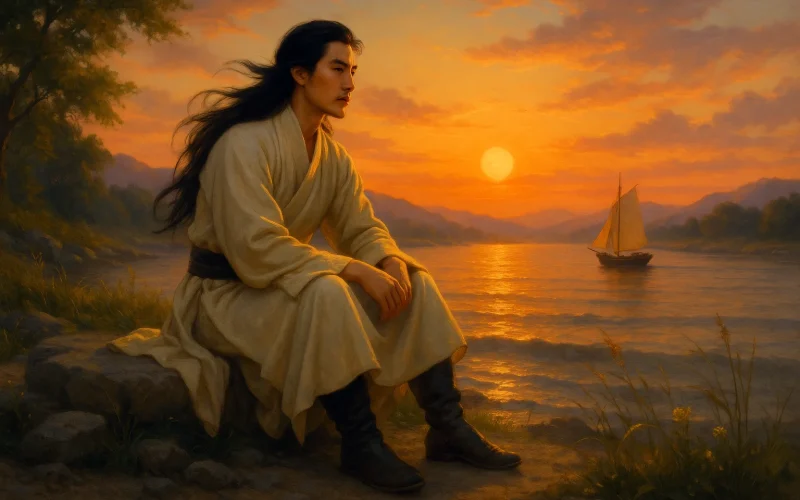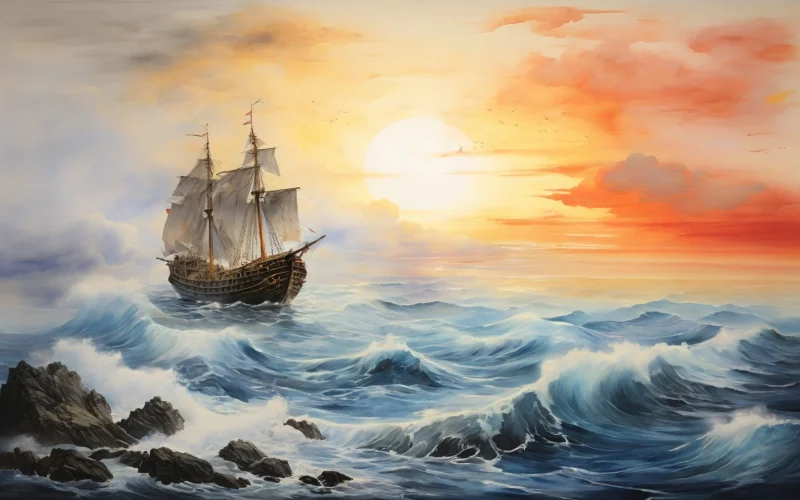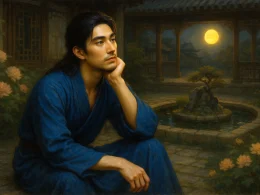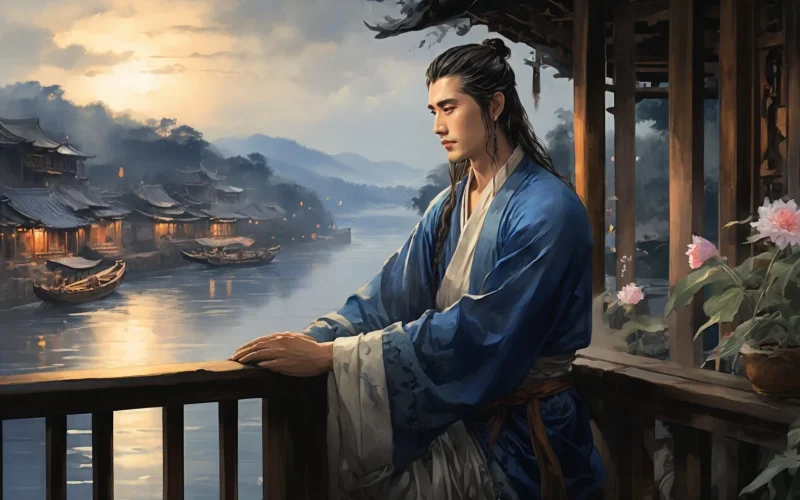
Drunk, we leave the wine shop sweetened with orange blooms;
The breeze brings in your boat the rain casting cold glooms.
When steeped in moonlight far away in Southern streams,
You would be grieved to hear monkeys' wail in your dreams.
Original Poem
「送魏二」
王昌龄
醉别江楼橘柚香,江风引雨入舟凉。
忆君遥在潇湘月,愁听清猿梦里长。
Interpretation
This poem was composed during Wang Changling's exile in Longbiao. During the Tianbao era, due to "not guarding petty conduct, repeatedly demoted," he was demoted from Magistrate of Jiangning to a minor post in Longbiao. Longbiao, in present-day Qianyang, Hunan, is located in western Hunan, part of the ancient Chu region, which corresponds to the "Xiao and Xiang" mentioned in the poem. "Wei the Second" in the title was a friend of Wang Changling, with an unknown life history. On an autumn day, the poet held a farewell feast for Wei the Second in a riverside pavilion. It was the season when mandarins and pomelos were fragrant, with a river breeze and drizzling rain, the boat about to depart. In a tipsy haze, the poet wrote this farewell poem.
Different from other farewell poems, this one stretches the time of parting and extends the space of separation. The first two lines describe the actual scene before the eyes, while the last two lines jump to "I think of you"—it is not the present farewell, but an imagination of himself missing his friend in a dream after parting. This dislocation of time and leap of space allow the short twenty-eight characters to contain deeper, richer emotion.
First Couplet: "醉别江楼橘柚香,江风引雨入舟凉。"
Zuì bié jiāng lóu jú yòu xiāng, jiāng fēng yǐn yǔ rù zhōu liáng.
We part, drunk, in the riverside tower, the air rich with the scent of mandarins and pomelos;
The river wind brings in the rain, and the rain chills the boat as it comes aboard.
The opening writes the farewell scene with a richness of the senses. "The scent of mandarins and pomelos"—the sense of smell, the breath of autumn, a fragrance particular to the south. This scent gives the parting a slightly intoxicating warmth. "We part, drunk"—taste and state, slightly inebriated, feelings lingering. The poet and his friend part amid fragrance and the warmth of wine, the atmosphere originally warm and pleasant.
However, "The river wind brings in the rain, and the rain chills the boat as it comes aboard"—sight and touch suddenly turn cool. The word "brings" is exquisite, as if the river wind intentionally ushers the rain into the boat, reminding the traveler it is time to depart. The word "chills" is both a physical sensation and an inner feeling. The scent of the mandarins and pomelos, the warmth of the tipsy feeling, ultimately cannot withstand the chill of the wind and rain. This couplet, with the contrast of scent and chill, inebriation and clarity, writes the subtle change of emotion at the moment of parting—no matter how warm the gathering, it will eventually be covered by the chill of parting.
Second Couplet: "忆君遥在潇湘月,愁听清猿梦里长。"
Yì jūn yáo zài xiāo xiāng yuè, chóu tīng qīng yuán mèng lǐ cháng.
I think of you, so far away now, under the moon of Xiao and Xiang;
In sorrow, I will hear, in my dream, the long cry of the monkeys' clear wail.
This couplet shifts from the real to the imagined, using imagination to write longing, using dreams to write sorrow. "I think of you" is not recollection, but imagination—the poet imagines his friend already far away, now in the land of Xiao and Xiang, under that solitary moon. Xiao-Xiang is the ancient land of Chu, also a place symbolizing exile and sorrow. The friend goes there, just as the poet himself has been, is experiencing.
"In sorrow, I will hear, in my dream, the long cry of the monkeys' clear wail"—The poet goes a step further, imagining that he will hear the monkeys' cries in his dream. The cry of monkeys is mournful in itself; "clear wail" makes it even more desolate; the three characters "in my dream, the long cry" extend this sorrow infinitely—in dreams, there is no time, no boundaries; that monkey's cry can go on forever, resounding through the whole night, through the whole of longing. This line brings the sorrow of parting from reality into dreams, extends it from a moment to eternity, giving the finite farewell infinite depth.
Holistic Appreciation
This farewell poem, with only twenty-eight characters, uses the technique of blending the real and the imagined to contain rich layers of emotion. The first two lines describe the real: riverside tower, mandarins and pomelos, drunken parting, wind and rain, chill in the boat—each image is concrete and tangible, together forming a three-dimensional scene of parting. The last two lines describe the imagined: Xiao-Xiang, bright moon, monkeys' clear wail, dreams—each image is ethereal and distant, together constructing a deep space of longing.
From real to imagined, from near to far, from present to future, from reality to dreams—just four lines accomplish multiple leaps in time and space. These leaps do not create fragmentation; instead, they make the emotion more lingering, the artistic conception more profound. That "long cry… in my dream" is both the poet's concern for his friend's distant journey, and a recognition of his own lonely situation, and also a condensed expression of the sorrow of parting itself.
Compared to farewell poems that express feelings directly, this one is more implicit and restrained, and also more thought-provoking. The poet does not say "how much I miss you," he only imagines you under the moon of Xiao-Xiang, imagines me listening to monkeys in a dream—that is all. But it is precisely this "not stating directly" that makes the longing deeper, the sorrow of parting more enduring.
Artistic Merits
- Blending Reality and Imagination, Leaping Time and Space: The first two lines describe reality, the last two describe imagination; leaping from the scene before the eyes to the distant moon, from the present parting to a future dream, the shifts in time and space are natural, the emotion progresses layer by layer.
- Rich Sensory Detail, Exquisite Imagery: "The scent of mandarins and pomelos" describes smell, "We part, drunk" describes taste and state, "The river wind brings in the rain" describes touch, "the moon of Xiao and Xiang" describes sight, "the monkeys' clear wail" describes hearing—multiple senses interweave, the imagery vivid and layered.
- Using Scene to Convey Feeling, Implicit and Suggestive: The entire poem contains no direct expression of emotion, yet lets the reader feel warmth from the scent of mandarins and pomelos, feel chill from the river wind and rain, feel loneliness from the moon of Xiao-Xiang, feel sorrow from the monkeys' cry in the dream.
- Extended Ending, Lingering Resonance: The three characters "in my dream, the long cry" infinitely extend the monkeys' cry, and also infinitely extend the sorrow of parting; the words end but the meaning is endless.
Insights
This poem first illuminates for us how to create eternity within parting. Wang Changling and Wei the Second are about to part; the physical distance cannot be crossed. But through imagination, the poet lets his friend be with him "under the moon of Xiao and Xiang"; through dreams, he lets the monkeys' cry echo forever "in my dream, the long cry." This ability to transcend reality through imagination and dreams is the most precious gift of human emotion. It tells us: Even if we cannot meet, we can still gaze at each other in imagination; even if parting is decided, we can still gather in dreams.
The word "chill" in "江风引雨入舟凉" also leads us to consider the psychological change brought by parting. The mandarins and pomelos are fragrant, the wine is warm, but when wind and rain come, everything turns chill. This "chill" is external chill, and even more, internal chill—the chill of parting will ultimately cover the warmth of gathering. It reveals: Parting is part of life; accepting this "chill" allows us to feel that "fragrance" more deeply. Precisely because there is parting, gathering is precious; precisely because there is chill, warmth is unforgettable.
The imagery of "愁听清猿梦里长" also leads us to consider the endurance and pain of longing. That monkeys' cry, infinitely prolonged in dreams, is just like longing, endless in the heart. This "long cry" is both torment of pain and proof of deep feeling—precisely because we care, we cannot forget; precisely because it is unforgettable, we continue longing in dreams. It reveals: True longing does not stop because of parting, does not cease because of sleep. It continues to grow in dreams, extends infinitely in time.
Finally, the figure of the poet parting drunk in the riverside tower, listening to monkeys in his dream, is especially moving. He does not force a smile, does not pretend to be carefree; he simply honestly writes his feelings: the fragrance of the drunken parting, the chill in the wind and rain, the imagined moon, the monkeys in the dream. This attitude of honestly facing parting is itself a kind of strength. It teaches us: When parting, one can be drunk, can be sorrowful, can listen to monkeys' cries until dawn in dreams. There is no need to conceal, no need to put on a brave face. Because all sadness is proof of deep feeling.
Poem translator
Xu Yuanchong (许渊冲)
About the poet
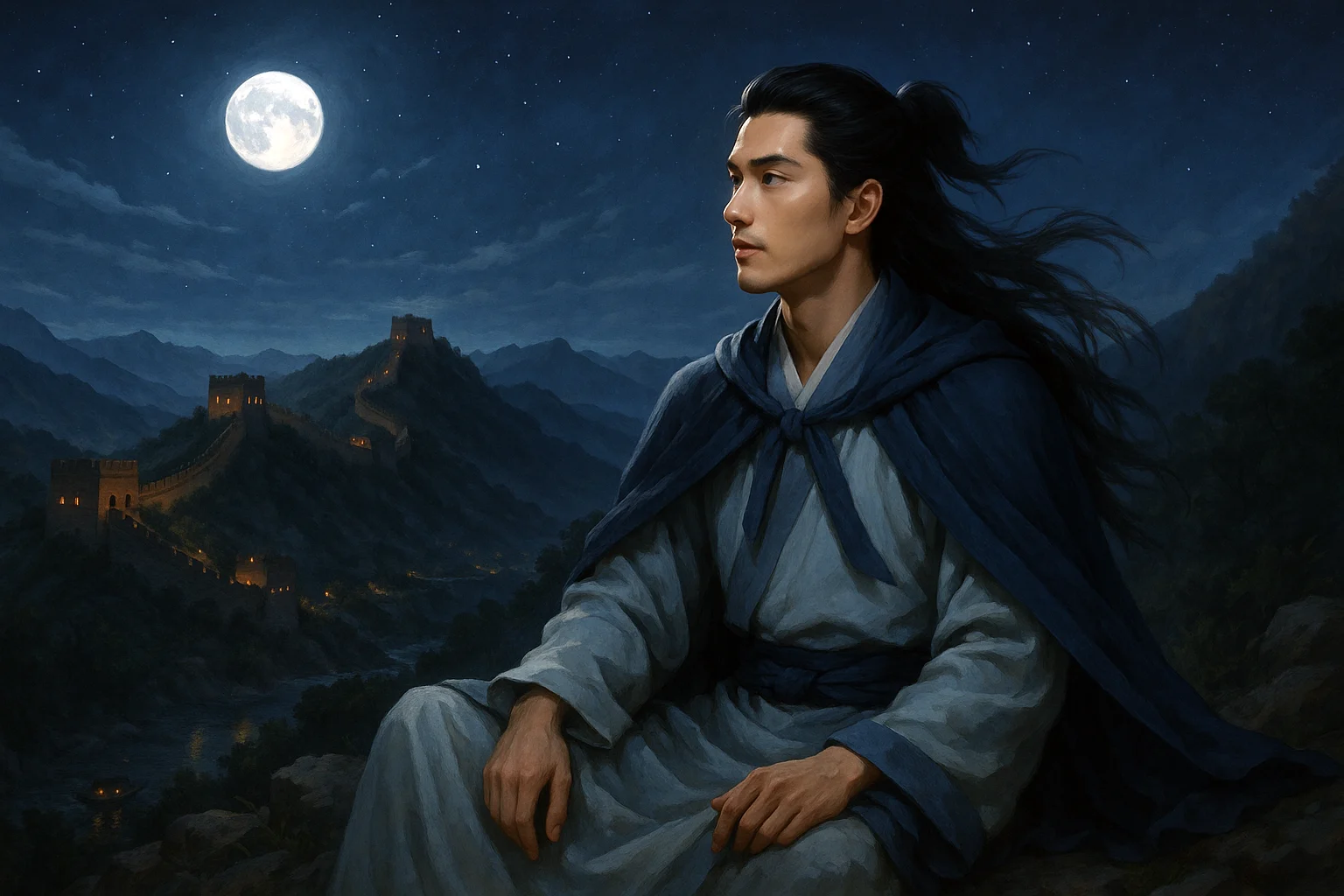
Wang Changling (王昌龄), circa A.D. 690 - 756, was a native of Xi'an, Shaanxi Province. Wang Changling's poems were mostly about the Border Places, love affairs and farewells, and he was well known during his lifetime. His seven poems are equal to those of Li Bai, and he is known as the “Master of seven lines”.