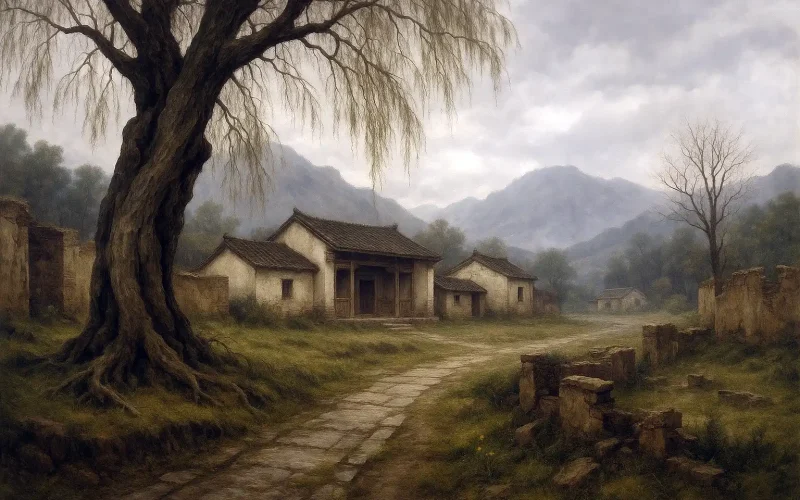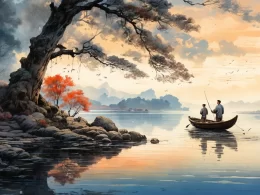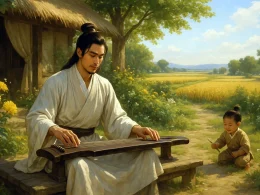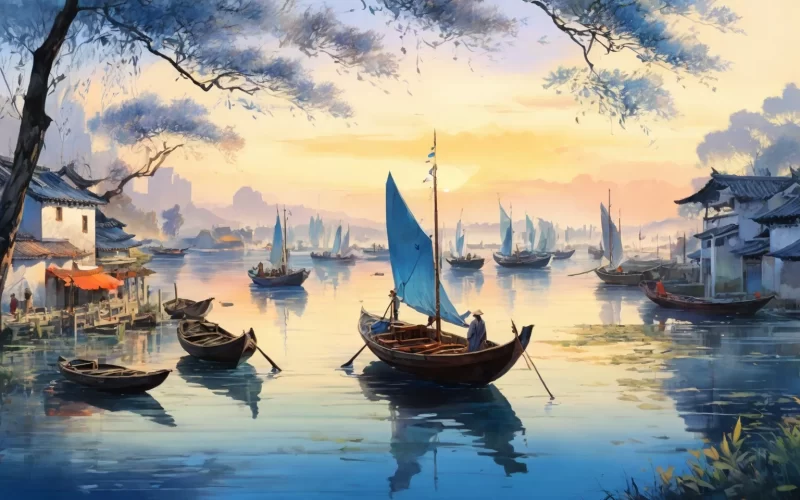
Few travelers pass by the willow-fringed ferry;
To Linqi the boatman rows, fast and merry.
My longing alone, like spring’s green overflow,
Sees you off where south and north of the river go.
Original Poem
「送沈子福之江东」
王维
杨柳渡头行客稀,罟师荡桨向临圻。
惟有相思似春色,江南江北送君归。
Interpretation
While the exact time and place of this farewell poem's composition are difficult to determine, the freshness and enduring charm of its vision, along with its magnificent and far-reaching imagination, mark it as a work from Wang Wei's peak maturity during the High Tang period. Although a farewell poem, it sweeps away the customary melancholy of parting. Using the spring scenery of the Jiangnan region as its warp and weft, it weaves a richly affective and expansive picture of departure. The poet masterfully blends personal friendship with the boundless beauty of spring, elevating a finite parting into a spiritual companionship that transcends geographical space. This showcases his highest poetic achievement: the ability to "grasp the moment's essence within the scene" and achieve a state where "feeling and setting harmonize as one."
First Couplet: 杨柳渡头行客稀,罟师荡桨向临圻。
Yángliǔ dù tóu xíngkè xī, gǔ shī dàng jiǎng xiàng lín qí.
At the willow-shaded ferry, wayfarers are few and slight; / The boatman plies his oars, towards distant Linqi fading from sight.
Explication: The opening outlines the farewell scene with simple, sketch-like brushstrokes, clear and pictorial. "The willow-shaded ferry" is a classic farewell image, indicating the season (spring) and subtly carrying the connotation of "staying" (柳, liu, 'willow', homophonous with 留, liu, 'to stay'). The phrase "wayfarers are few" not only paints the ferry's loneliness but, by contrast, focuses attention on the moment of parting, as if the surrounding world has receded, leaving only the one who stays and the one who departs. The second line focuses on the departing boat. The action of the "boatman" (literally 'fisherman', here meaning boatman) "pl[ying] his oars" and the destination "distant Linqi" calmly announce the fact of separation and the impending geographical divide. The two lines move from stillness (the ferry) to motion (the oars), from near to far, narrating clearly while embedding emotion within the scene.
Second Couplet: 惟有相思似春色,江南江北送君归。
Wéi yǒu xiāngsī sì chūnsè, jiāngnán jiāngběi sòng jūn guī.
Only this longing in my heart, like springtime's boundless hue, / From south of the River to the north, will travel home with you.
Explication: This couplet is the soul of the poem. With an extraordinary metaphor and magnificent imagination, it elevates the poetic sentiment to its peak. The poet compares the abstract, formless feeling of "longing" to the concrete, visible, and limitless "springtime's boundless hue," giving the emotion both form and spatial dimension. Even more ingenious is the second line, "will travel home with you." It imbues this "longing-spring" with a dynamic, companionable function: it is not a static backdrop but an active, pervasive, boundary-crossing force that accompanies. No matter where the friend's boat travels—south of the River or north—the poet's thoughts will envelop him like the spring landscape, omnipresent. This is both the ultimate expression of deep affection and a kind of spiritual triumph—geographical separation is dissolved by the pervasion of feeling.
Holistic Appreciation
This heptasyllabic quatrain is a "creative farewell poem that transforms parting sorrow into spring's colors." Its structure is exquisite, the flow of emotion natural: the first line sets the scene, using the tranquil, willow-lined ferry to establish the mood of parting; the second line narrates the action, the boat heading for Linqi confirming the departure; the third line introduces the wonderful metaphor, externalizing inner longing as the vast springscape; the final line extends this, letting the longing, like spring, traverse all distances to accomplish spiritual companionship. The four lines form a complete emotional chain: "tranquil scene—departure in motion—emotion transformed—spirit following." Wang Wei's brilliance lies in not dwelling on the sadness evoked by the loneliness of "wayfarers… few" or the remoteness of "distant Linqi." Instead, pivoting on the words "Only this," he uses the imagery of "springtime's… hue"—vibrant, warm, and radiant—to bear and elevate the feeling of parting. He transforms the commonly sorrowful tone of farewell poetry into a feeling that is expansive, bright, and filled with the warmth of life. This reflects the healthy, luminous emotional world and powerful creative spirit of High Tang poets.
Artistic Merits
- The Originality and Power of the Metaphor: "Longing… like springtime's boundless hue" is a stroke of genius. Spring's colors are visual, vast, warm, and full of life. Using this to symbolize longing makes the emotion visible, palpable, boundless, and hopeful. It thoroughly revitalizes the expression of parting sorrow and is profoundly artistically effective.
- Skillful Handling and Transcendence of Space: The poem's space expands from the ferry (a point), to the regions south and north of the River (a plane), finally suffusing the entire spring-filled world (a volume). This continual expansion of space symbolizes the continual diffusion and升华 of emotion, ultimately breaking the inherent spatial limits of farewell poetry (from here to there) and achieving the spiritual connection of "feeling close though mountains apart."
- Dynamic Fusion of Scene and Emotion: The first two lines are a relatively static picture (the tranquil ferry scene, the boat's movement). The last two shift to powerful emotional dynamism (longing flowing like spring, accompanying the friend across the land). Stillness and motion combine; the scene gains life from the emotion, the emotion gains form from the scene.
- Natural, Lucid Language and Vast, Profound Ambience: The poem's diction is simple and clear—"wayfarers are few," "plies his oars," "travel… with you"—almost conversational. Yet, combined, they create the vast ambience of "spring fills heaven and earth, longing shares your every step." This represents Wang Wei's highest standard: poetry that is "like a lotus rising clear from the water, naturally adorned" yet achieves a realm of far-reaching depth.
Insights
This work demonstrates how Wang Wei transformed a common emotion of parting into an artistic expression possessing universal beauty and spiritual power. It teaches us that: The deepest feelings need not be presented through tears and laments; they can be elevated, through the most beautiful natural imagery (like spring's colors), into a warm, expansive, spiritually companionable presence.
In our world of convenient travel and instant communication, physical parting no longer poses the same emotional obstacle. Yet, a sense of spiritual distance may be everywhere. This poem suggests that what sustains emotional connection is perhaps precisely this kind of imaginative, projective capacity—like "longing… like springtime's boundless hue"—letting fine affection, like spring light, be everywhere, warming each other's journey through life. With his poetic brush, Wang Wei transformed a specific farewell into an eternal song of friendship, longing, and spiritual companionship, reminding us to cherish our bonds and to learn to express and nurture them in more poetic and creative ways.
About the poet
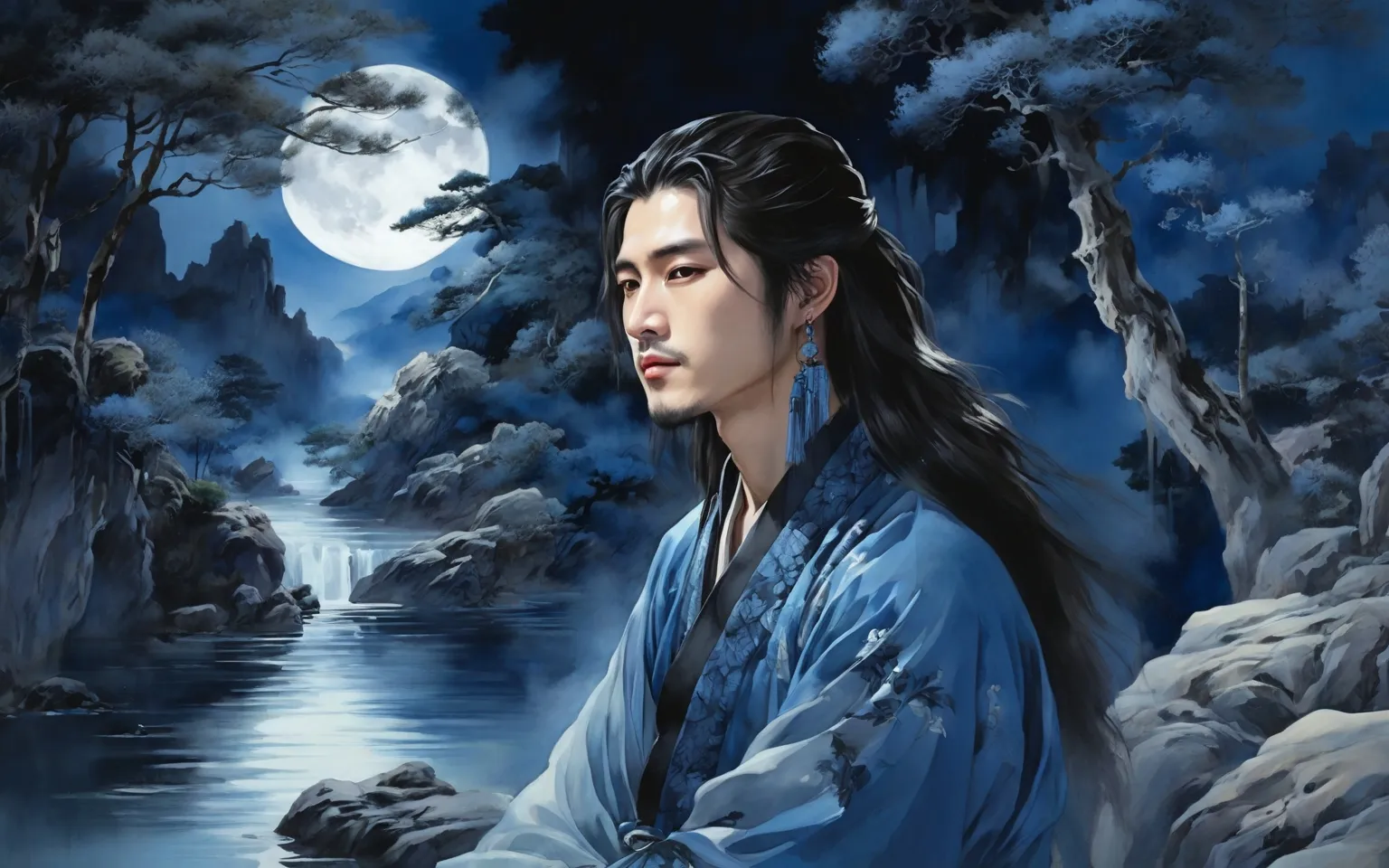
Wang Wei (王维), 701 - 761 A.D., was a native of Yuncheng, Shanxi Province. Wang Wei was a poet of landscape and idylls. His poems of landscape and idylls, with far-reaching images and mysterious meanings, were widely loved by readers in later generations, but Wang Wei never really became a man of landscape and idylls.