
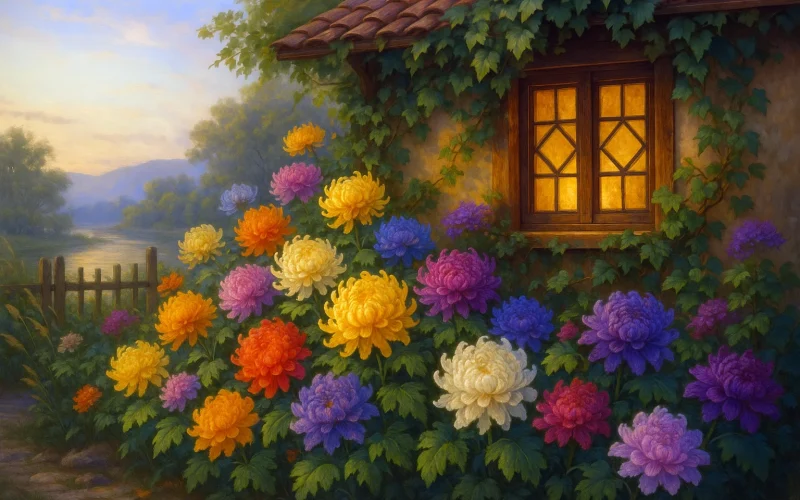
Around the cottage like Tao's autumn flowers grow;
Along the hedge I stroll until the sun slants low.
Not that I favor partially the chrysanthemum,
But it is the last flower after which none will bloom.
Original Poem
「菊花」
元稹
秋丛绕舍似陶家,遍绕篱边日渐斜。
不是花中偏爱菊,此花开尽更无花。
Interpretation
This poem is a celebrated work praising an object by the Mid-Tang poet Yuan Zhen, composed in the deep autumn of the eighteenth year of the Zhenyuan period of Emperor Dezong of Tang (802 AD). Yuan Zhen and Bai Juyi passed the imperial examination in the same year, advocated the New Yuefu Movement, and together are known as "Yuan-Bai." His poetic language is plain, his emotions deep and sincere, and he is especially skilled at embedding life's insights within ordinary scenes.
This poem was composed during the initial stage of Yuan Zhen's political career, before he was deeply mired in the bitterness of officialdom's vicissitudes. While admiring chrysanthemums in Chang'an, the poet saw autumn chrysanthemums surrounding his cottage, blooming all along the fence; feelings of admiration for Tao Yuanming welled up in his heart. The reclusive realm of "Picking chrysanthemums by the eastern fence, I see the southern hills in leisure" and the noble character of "not bending the waist for five pecks of rice" were the faint aspirations in the young Yuan Zhen's heart. However, the poet did not linger merely on admiration for Tao Yuanming. Instead, in the final couplet, with a light turn in the lines "Not that I favor partially the chrysanthemum; But it is the last flower after which none will come," he highlights the chrysanthemum's most precious quality—it is not the peony contending for beauty in spring, nor the lotus competing in splendor in summer, but the one that blooms proudly alone after all other flowers have faded. This character of "not contending with the hundred flowers for spring, but standing alone in the frost" is both Yuan Zhen's praise for the chrysanthemum and his aspiration for his own character. The entire poem begins with admiring chrysanthemums and concludes with expressing ideals. Within its elegant, natural language lies deep philosophical reflection, making it a unique masterpiece among Tang dynasty poems praising chrysanthemums.
First Couplet: "秋丛绕舍似陶家,遍绕篱边日渐斜。"
Qiū cóng rào shè sì Táo jiā, Biàn rào lí biān rì jiàn xiá.
Around the cottage like Tao’s autumn flowers grow; Along the fence I stroll until the sun is low.
The poem opens with a leisurely scene of admiring chrysanthemums on an autumn day. "秋丛绕舍" (Around the cottage like Tao’s autumn flowers grow)—four characters describe the abundance of chrysanthemums: cluster after cluster surrounding the cottage, as if the entire courtyard is enveloped by chrysanthemums. "似陶家" (like Tao’s)—three characters juxtapose the scene before his eyes with Tao Yuanming's eastern fence; the reclusive sentiment of "picking chrysanthemums by the eastern fence" naturally flows from this light touch. The next line, "遍绕篱边日渐斜" (Along the fence I stroll until the sun is low), uses "遍绕" (I stroll) to convey the poet's infatuation with admiring the chrysanthemums—not a cursory glance, but walking around the fence, looking carefully, savoring slowly, to the point where, before he realizes it, the sun is already setting in the west. The three characters "日渐斜" (the sun is low) signify both the passage of time and a reflection of his state of mind—so immersed in the world of chrysanthemums that he is oblivious even to the passage of time. Within this couplet, the abundance of chrysanthemums, the infatuation with flower-viewing, and the leisure of the heart are all present.
Second Couplet: "不是花中偏爱菊,此花开尽更无花。"
Bù shì huā zhōng piān ài jú, Cǐ huā kāi jìn gèng wú huā.
Not that I favor partially the chrysanthemum; But it is the last flower after which none will come.
This couplet is the soul of the entire poem, using plain language to express profound philosophy. "不是花中偏爱菊" (Not that I favor partially the chrysanthemum) begins with a negative structure, as if denying a particular fondness for chrysanthemums. However, the next line, "此花开尽更无花" (But it is the last flower after which none will come), gently reveals the true reason for this "favor." The three characters "更无花" (after which none will come) are the chrysanthemum's most precious quality: it does not contend with the hundred flowers for spring, but stands alone in the frost; when all other flowers have withered, it blooms proudly, becoming the final scenery of autumn. The poet uses "不是" (Not that) to introduce "是" (But it is), using negation to strengthen affirmation, allowing the reader to appreciate the chrysanthemum's unique beauty within this turn. This "更无花" (after which none will come) is both realistic description and symbol—what the chrysanthemum symbolizes is precisely that character of not following the crowd, not contending with the secular world, yet still standing tall after all other fragrances have faded. The poet does not directly state "the chrysanthemum is noble and pure"; he only lightly highlights it with this line, "But it is the last flower after which none will come," and yet the chrysanthemum's character and the poet's state of mind are fully contained within.
Holistic Appreciation
This is a divine work among Yuan Zhen's object-praising poems. The entire poem consists of four lines and twenty-eight characters. Using the admiration of autumn chrysanthemums as a starting point, it merges the leisure of flower-viewing, the fondness for chrysanthemums, and the character of chrysanthemums, showcasing the poet's yearning and pursuit of noble character.
Structurally, the poem presents a progression from scene to emotion, from appreciation to realization. The first couplet writes of the scene of admiring chrysanthemums—autumn clusters surrounding the cottage, blooming all along the fence, is what the eyes see; strolling around the fence, the sun setting unnoticed, is what the heart feels. The second couplet writes of the reason for loving chrysanthemums—not partial fondness, but that after this flower blooms, no other will come, is the realization of emotion. Between the two lines, the poem moves from external to internal, from scene to emotion, from appreciation to realization, each layer deepening, forming a seamless whole.
Thematically, the core of this poem lies in the three characters "更无花" (after which none will come). The poet does not describe how the chrysanthemum defies the frost, nor its aloofness; he only states the simplest truth—it blooms after all other flowers, at the end of autumn, at the time when all other flowers have faded. This character of "not contending with the hundred flowers for spring, but standing alone in the frost" is more powerful than any direct praise. The poet, through the turn of "不是" (Not that) and "是" (But it is), lightly highlights this character, allowing the reader to feel the chrysanthemum's unique beauty and the loftiness of character within the simple words.
Artistically, the poem's most moving aspect lies in the simple technique of "using plain language to express deep meaning." The poet does not pile up ornate phrases, nor does he pretend to be profound; he only uses the plainest language to write of the most ordinary act of admiring chrysanthemums. Yet it is precisely this plain language that makes the poetic meaning deeper; it is precisely this simplicity that makes the philosophy more moving. The seven characters, "此花开尽更无花" (But it is the last flower after which none will come), have become a famous line for praising chrysanthemums throughout the ages precisely because they use the simplest language to express the chrysanthemum's most essential character.
Artistic Merits
- Natural Allusion, Without Trace: Using "似陶家" (like Tao’s) to allude subtly to the典故 of Tao Yuanming admiring chrysanthemums by the eastern fence, integrating reclusive sentiments into the scene before his eyes, naturally and aptly.
- Vivid Details, Subtle Emotion: The line "遍绕篱边日渐斜" (Along the fence I stroll until the sun is low), uses "遍绕" (I stroll) to write the infatuation with flower-viewing, uses "日渐斜" (the sun is low) to write the passage of time, depicting the poet's state of immersion in the chrysanthemum scene as if before our eyes.
- Powerful Turn, Revealing Intent in the Finale: Using "不是" (Not that) to introduce "是" (But it is), using negation to strengthen affirmation, the turning point in the final couplet reveals the main theme of the entire poem, concise in words yet deep in meaning.
- Embedding Philosophy in Scenery, Rich in Implication: Using "此花开尽更无花" (But it is the last flower after which none will come) to write of the chrysanthemum's character, embedding profound philosophy within ordinary scenery, deep meaning within simple language, the extraordinary within the ordinary.
Insights
This poem, through an autumn day of admiring chrysanthemums, speaks to an eternal theme—True value often lies not in contending for novelty and beauty, but in independence and perseverance after all other fragrances have faded.
First, it lets us see "philosophy within the ordinary." The poet does not write of the chrysanthemum defying the frost, nor of its aloofness; he only writes of the simplest truth—after this flower blooms, no other will come. It is precisely this simple truth that expresses the chrysanthemum's most precious quality: it does not contend with the hundred flowers for spring, but stands alone in the frost. It reminds us: True value often lies not in the clamor, but in the silence; not in the contention, but in the perseverance.
On a deeper level, this poem makes us contemplate "the meaning of choice." The poet says, "Not that I favor partially the chrysanthemum"—it is not that he is partial, but because the chrysanthemum has its irreplaceable value. This choice is not born of partiality, but of an understanding of value. It makes us understand: True choice is not based on momentary likes and dislikes, but stems from an understanding of the essence of things; true appreciation is not blind favoritism, but clear recognition.
And what is most evocative is that "non-contention" wisdom in the poem. The chrysanthemum does not contend with the hundred flowers for spring, yet it blooms alone after all other flowers have faded; the poet does not directly state his love for chrysanthemums, but uses "更无花" (after which none will come) to highlight the chrysanthemum's uniqueness. This "non-contention" is not incompetence, but confidence; this "not speaking" is not speechlessness, but the greatest sound seems voiceless. It tells us: Things that are truly powerful do not need to contend; things that are truly valuable do not need to proclaim.
This poem writes of an autumn day in the Mid-Tang, yet allows everyone who seeks value amidst clamor, who perseveres in their true heart amidst worldly splendor, to find resonance within it. The splendid scene of "autumn clusters surrounding the cottage" is the scenery in the eyes of every chrysanthemum lover. The infatuation of "strolling around the fence" is the shared posture of every admirer. The realization of "after this flower blooms, no other will come" is the deepest recognition in the heart of everyone who understands value. This is the vitality of poetry: it writes of chrysanthemums, but one reads the human heart.
Poem Translator
Xu Yuanchong (许渊冲)
About the Poet
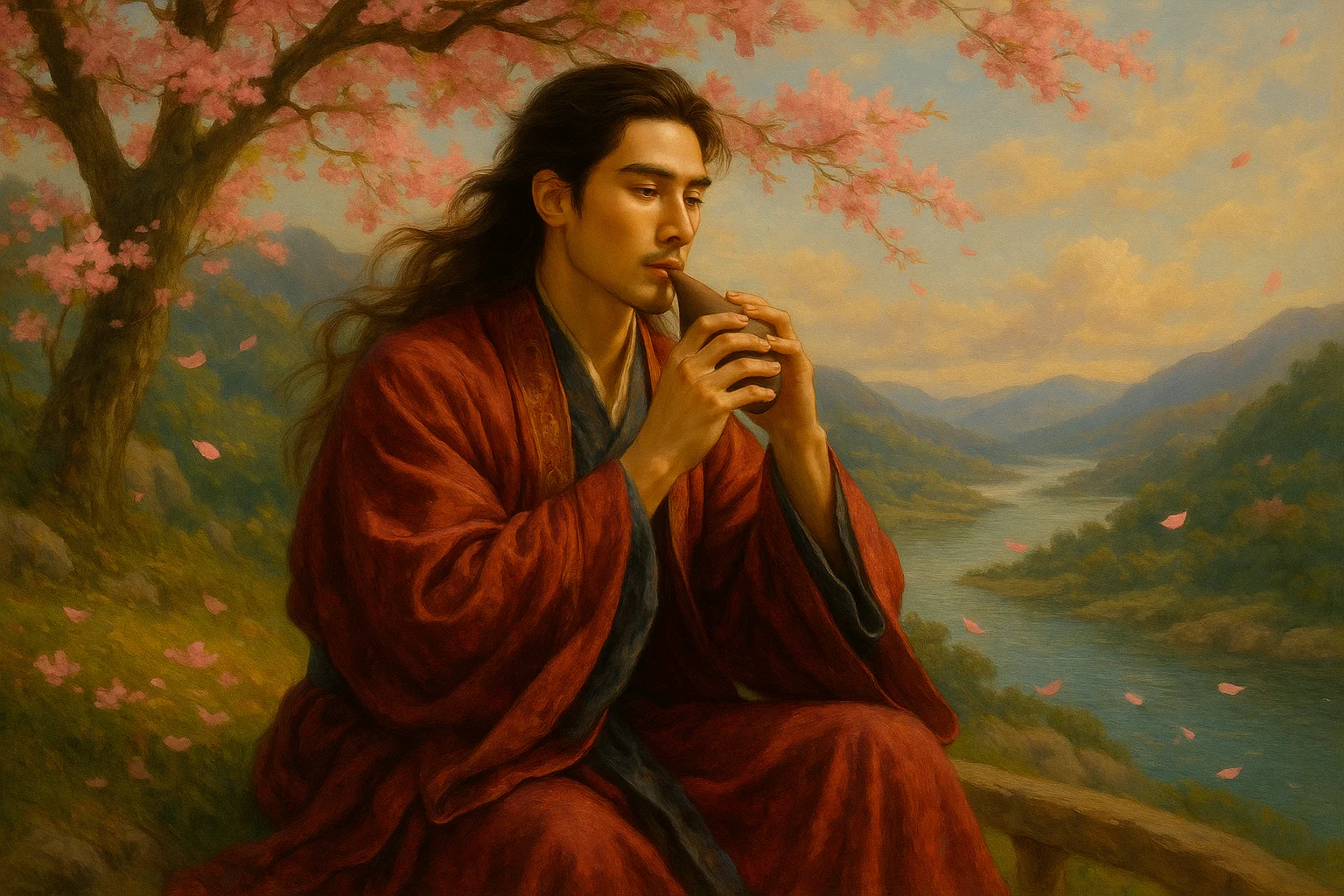
Yuan Zhen (元稹 779 - 831), a native of Luoyang, Henan Province, was a descendant of the Northern Wei imperial family and a renowned poet and statesman of the Mid-Tang Dynasty. As an important figure in Tang literary history, Yuan Zhen co-advocated the New Yuefu Movement with Bai Juyi. His poetic achievements are most distinguished in the yuefu (Music Bureau) style and erotic poetry. His romantic relationship with a woman named Yingying inspired the legendary tale The Story of Yingying. Yuan Zhen’s poetic style is characterized by its accessible clarity, occasionally interspersed with bold and striking expressions. During the transition from the Mid-Tang to the Late Tang, his accessible style exerted a profound influence, laying the foundation for the Yuan-Bai Poetic School.