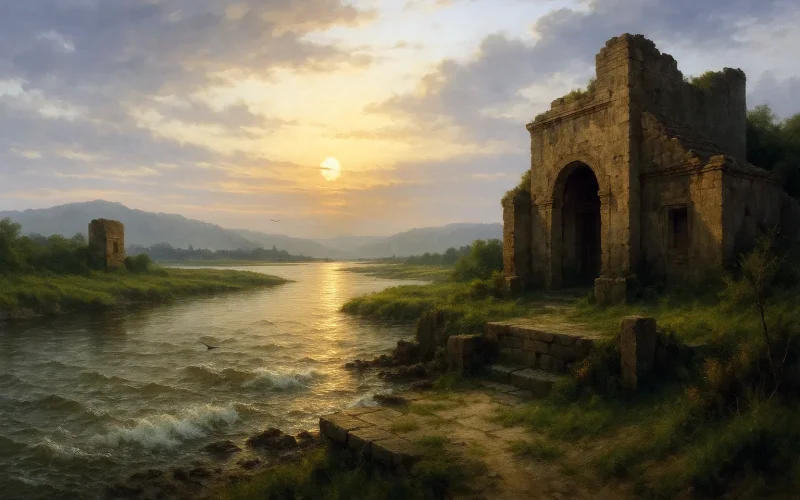



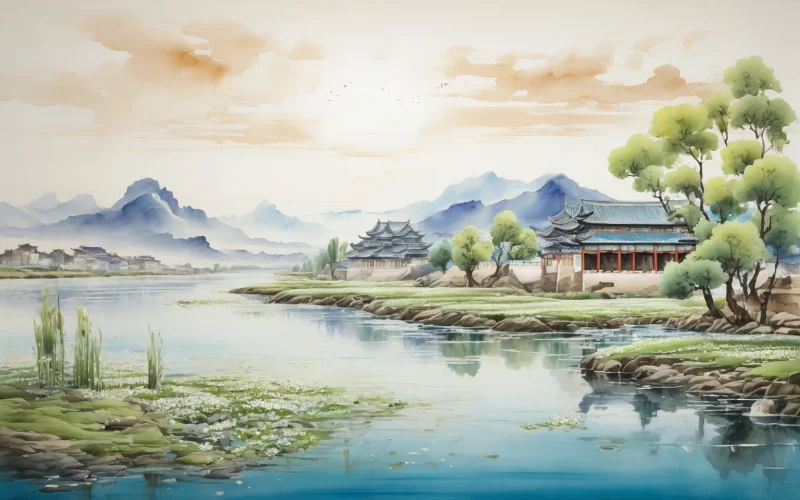
The River Bian flows eastward, overwhelmed with spring;
To dust have gone ruined palaces and their king.
Don't gaze afar from the long bank of willow trees!
The willow down will grieve your heart when blows the breeze.
Original Poem
「汴河曲」
李益
汴水东流无限春,隋家宫阙已成尘。
行人莫上长堤望,风起杨花愁杀人。
Interpretation
The Bian River, the canal into which Emperor Yang of Sui poured the empire's resources, stretched from the Central Plains to the southeast, a witness to the rise and fall of dynasties. In its day, dragon barges stretched across its waters, banners blotted out the sun, and pleasure palaces lined its banks, boasting the height of worldly luxury. Yet, in little more than thirty years, the Sui house toppled, its palaces turned to dust, leaving only the Bian waters flowing east, still carrying the spring scenery of both shores.
When Li Yi passed by these Bian waters, it was the Mid-Tang era. After the An Lushan Rebellion, the Great Tang, though continuing in name, was severely weakened in substance. Military governors held independent power, border troubles were frequent, and the imperial court no longer possessed the bearing of the High Tang era. As a low-ranking Assistant Magistrate of Zheng County, his post was minor yet close to the people, giving him a clearer view of the empire's situation and the people's hardships than the high officials at court. Traveling now by the Bian River, seeing the spring waters unchanged, the willows like mist, while the palaces of old were now wild grass, what welled up in his heart was surely more than mere criticism of the Sui emperor. The ceaselessly east-flowing Bian waters had washed away not only the Sui palaces but countless tales of rise and fall since antiquity. Standing alone on the long dike, watching willow catkins fall, listening to the spring wind's silence, a thousand feelings condensed into a single word: "sorrow" (愁, chóu)—a sorrow that was personal, yet also of the age; immediate, yet also historical.
First Couplet: "汴水东流无限春,隋家宫阙已成尘。"
Biàn shuǐ dōng liú wúxiàn chūn, Suí jiā gōngquè yǐ chéng chén.
Eastward the River Bian flows on with springtime without end;
The Sui's great palaces and courts have turned to dust, their day gone by.
The opening juxtaposes two images: the Bian River and the Sui palaces; nature and human affairs; the eternal and the transient. The phrase "springtime without end" (无限春, wúxiàn chūn) is wonderfully evocative—spring's beauty returns each year, the Bian River flows east each season; nature's vitality never ceases. Yet, the phrase "have turned to dust" (已成尘, yǐ chéng chén) lightly erases the once-overweening imperial foundations. The poet offers no commentary, simply placing this scene before the reader to feel the immense contrast.
Second Couplet: "行人莫上长堤望,风起杨花愁杀人。"
Xíngrén mò shàng cháng dī wàng, fēng qǐ yánghuā chóu shā rén.
Wayfarer, do not climb the Long Dike and gaze afar:
The wind-whirled willow catkins can kill a man with grief.
This couplet shifts from scene to emotion, from past to present. "Wayfarer" (行人, xíngrén) could refer to the poet himself or to all later travelers passing the Bian River. "Do not climb the Long Dike and gaze afar" is a warning, a self-admonition—that dike was built by Emperor Yang, those willows planted in his time; to see them is to recall that history, that vanished splendor. "Wind-whirled willow catkins" (风起杨花, fēng qǐ yánghuā) is both a real scene and a historical metaphor. The willow catkins drift, rootless, untethered, scattered by the wind, just like the fate of the Sui, and indeed like all worldly glory. The poet says this sight "can kill a man with grief"—the grief is not for the catkins themselves, but for the history turned to dust behind them, and for the warning that history holds for the present.
Holistic Appreciation
This is a poem reflecting on the past, and also a work of concern for its time. In four lines and twenty-eight characters, it starts with the spring scene at the Bian River, moves to a lament for the Sui's rise and fall, and concludes with "The wind-whirled willow catkins can kill a man with grief," transforming history's weight into a wisp of spring breeze's sorrow.
The first two lines present a contrast between past and present, using bold, sweeping strokes. The eastward flow of the Bian is the present reality; the Sui palaces turned to dust are historical recollection. The juxtaposition of "springtime without end" and "have turned to dust" writes nature's permanence against human transience with startling clarity. The last two lines shift from scene to emotion, from history back to the present. "Do not climb the Long Dike and gaze afar" is an admonition and a self-warning; "The wind-whirled willow catkins can kill a man with grief" describes the scene, and also the heart.
It is worth noting that the poet does not directly comment on the reasons for the Sui's fall, nor does he state his political stance. He simply combines the images—the Bian waters, the Sui palaces, the long dike, the willow catkins—and lets them speak for themselves. This reserved expression carries more power than explicit criticism.
Artistic Merits
- Past-Present Contrast, Profound Meaning: Contrasting the Bian River's eternity with the Sui palaces' perishability highlights history's vicissitudes. The technique is concise yet powerful.
- Concluding with Scenery to Express Emotion, Lingering Resonance: The final line, "The wind-whirled willow catkins can kill a man with grief," concludes with a scenic phrase, fusing historical reflection and personal feeling into a single image. It is subtle and evocative.
- Dual-Meaning Imagery, Rich Connotation: Willow catkins are both a spring scene and a metaphor for the Sui's fate; the willow (杨, yáng) homophones with the "Yang" (炀) in Emperor Yang of Sui (隋炀帝, Suí Yángdì), alluding subtly to the historical figure.
- Concise Language, Deep Feeling: The poem's twenty-eight characters contain no direct commentary, yet every line holds feeling, every word meaning, inviting contemplation.
- Using the Past to Criticize the Present, Far-Reaching Intent: Superficially about the Sui's rise and fall, it implicitly contains anxiety about the Mid-Tang political situation, giving the poem dual contemporary relevance.
Insights
This poem writes of the Sui, but thinks of the poet's own time. Standing by the Bian River, Li Yi saw not only the rise and fall of a century past, but the crises of his present. In twenty-eight characters, he tells the reader: Splendor fades easily; history repeats.
"汴水东流无限春"—nature may be eternal, but the palaces of men are not. In his day, Emperor Yang of Sui traveled three times to Jiangdu; barges crowded the canal, willows lined the banks—what splendid spectacle! And now? Only dust remains. This reminds us: All splendor has its term; all grandeur passes. In moments of pride, one would do well to remember this.
"风起杨花愁杀人"—Willow catkins are a sight of spring, and also a metaphor for history. Drifting, rootless, scattered by the wind, they are like the power and wealth that once seemed unassailable. The poet says this sight "can kill a man with grief." The grief is not for the catkins, but for what has vanished behind them, and for what is vanishing now.
On a deeper level, the poem touches an eternal question: How do humans face the passage of time? The Bian River, heedless of the Sui's fate, flows east regardless; spring arrives, heedless of human change. Nature is heartless; humans have feeling. Because they have feeling, they grieve, they sigh, they write poetry. This grief, this sigh, this poetry, is humanity's only resistance to time.
Poem Translator
Xu Yuanchong (许渊冲)
About the Poet
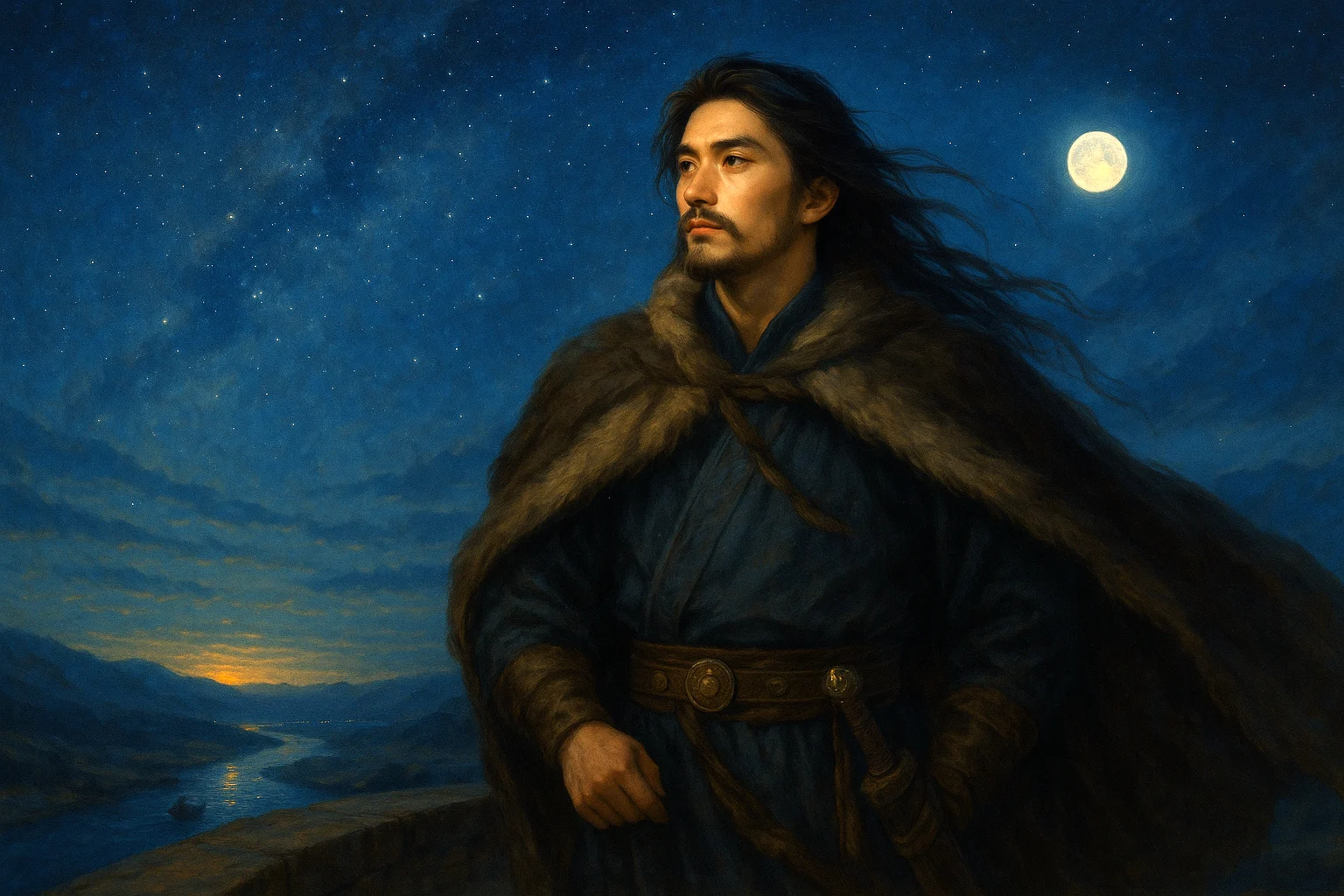
Li Yi (李益 748 - 829), a native of Wuwei, Gansu Province, was a representative poet of the Frontier Fortress School in the Mid-Tang period. He became a jinshi (presented scholar) in the fourth year of the Dali era (769 AD) and served through the reigns of Emperor Xianzong and Emperor Wenzong, eventually rising to the position of Minister of Rites. His poetry is particularly renowned for its seven-character quatrains, characterized by a style that is both solemn and poignant, blending the grandeur of High Tang frontier poetry with the plaintive elegance of the Mid-Tang. Inheriting the legacy of Wang Changling and inspiring later poets like Li He, his frontier poems carved out a unique and distinctive place in the Mid-Tang literary world.