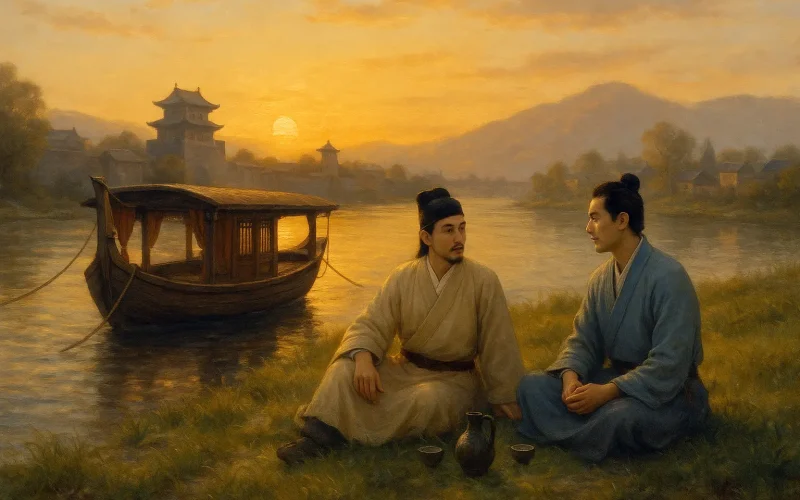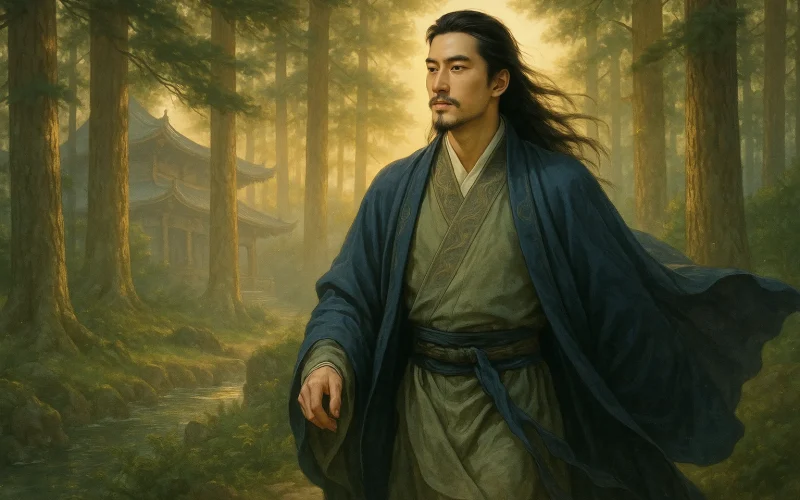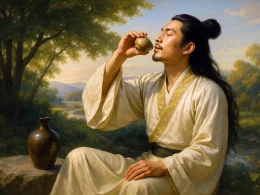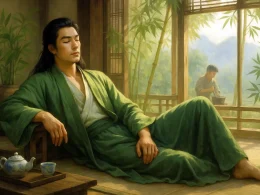



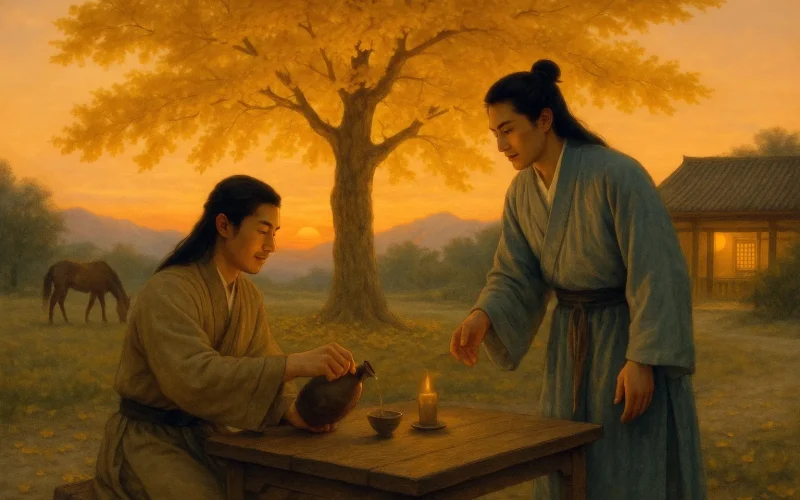
I dismount and proffer you a cup of wine.
“Where are you bound?” I ask, hoping you’ll tell.
You answer, “Life has failed this hope of mine;
I shall retire by the Southern Hill.
Press me no more — just let me take my leave.
White clouds drift there, endless and free.”
Original Poem
「送别」
王维
下马饮君酒,问君何所之。
君言不得意,归卧南山陲。
但去莫复闻,白云无尽时。
Interpretation
This poem is a classic example of Wang Wei's five-character ancient verse, achieving remarkable depth through profound simplicity. It is considered the ultimate expression in classical Chinese poetry of "emotion beyond words" and "Zen enlightenment without a trace." It is not a conventional social farewell poem, but rather a miniature spiritual dialogue by the roadside, a poignant confrontation of life's philosophies concerning "public service" versus "reclusion," and "questioning" versus "acceptance." Framed within an extremely concise dialogue, it explores profound themes of life's disappointments, spiritual solace, and ultimate consolation. Its language is stripped of all ornament, yet its artistic conception reaches for the heavens.
First Couplet: 下马饮君酒,问君何所之。
Xià mǎ yǐn jūn jiǔ, wèn jūn hé suǒ zhī.
Dismount and drink a cup of wine with me. / May I ask where you are bound?
The opening feels like a chance encounter on the street, filled with casual, everyday warmth. "Dismount" is a gesture of pausing, halting the rush of the journey for a momentary stay. "Drink a cup of wine with me" is a ritual of sharing, instantly bridging the distance between two souls. The seemingly ordinary concern of "May I ask where you are bound?" is, in reality, the key that unlocks the floodgates of the heart. The poet does not ask where the friend has come from, only where he is going. This very inquiry already implies a sensitive awareness of the friend's current state of being and a deep concern for his future.
Second Couplet: 君言不得意,归卧南山陲。
Jūn yán bù déyì, guī wò nán shān chuí.
You say: "Life has brought me no satisfaction; / I shall retire and rest by the southern mountains' edge."
The friend's reply is direct and frank, forming the emotional turning point of the entire poem. The three words, "brought me no satisfaction" (不得意), carry immense weight. They encapsulate the shared plight of countless individuals thwarted in their official careers and ideals—a crystallized expression of the individual's sense of defeat within the structure of his time. "Retire and rest by the southern mountains' edge" is the active response and chosen path away from this sense of defeat. "Retire" marks a reversal of direction; "rest" assumes a posture of stillness; "the southern mountains' edge" is a geographical and spiritual periphery, a final destination. In these brief five characters, a declaration of a fundamental life shift is made: from society's center to nature's margin, from action to contemplation.
Final Couplet: 但去莫复问,白云无尽时。
Dàn qù mò fù wèn, bái yún wú jìn shí.
Just go now, and ask no more. / The white clouds, there, are boundless, without end.
This couplet is the poet's response and the soul's sublimation of the entire poem. "Just go now, and ask no more" is not indifference, but deeper understanding and complete release. The poet understands that true reclusion requires inner resolve, and excessive words of inquiry may only become a hindrance. With the silence of "ask no more," he grants his friend the most profound form of letting go and blessing. "The white clouds, there, are boundless, without end" is the ultimate, wordless answer and consolation offered. White clouds: without intention, without thought, without beginning, without end. They symbolize nature's eternal, cyclical rhythm, surpassing all human gains and losses. Compared to the transient distress of "brought me no satisfaction," the "boundless, without end" quality of the clouds provides a different scale of time and value—the individual's disappointment will ultimately dissolve and find peace before the vastness of nature and the endlessness of time.
Holistic Appreciation
This is a philosophical poem structured as simply as a Zen koan, with an artistic conception as vast as a cosmic panorama. The entire poem can be seen as a complete process of spiritual tending: the first line is the meeting and concern (observation, listening, inquiry), the second is the confession of ailment (dissatisfaction), and the final lines are the prescription and the transcendent vision ("ask no more" is the mental method, "boundless, without end white clouds" is the object of contemplation). In the role of a friend, the poet acts as listener, confidant, and guide.
Wang Wei's genius lies in offering neither worldly comfort (like urging a comeback) nor shared lament (like "we are both fellows in misfortune"). Instead, he instantly places the personal "brought me no satisfaction" against the cosmic backdrop of the "boundless, without end white clouds," accomplishing an expansion of spirit and elevation of perspective. The "white clouds" here, like those in "sitting watching the clouds rise" from "My Retreat at Zhongnan," are not mere scenery but a medium for Zen insight and a symbol of spiritual freedom. Wordless, they express everything; ever-changing, they reveal permanence. His friend, retiring to the mountains, will likely confront precisely these "boundless, without end" white clouds, and in gazing upon them, may heal the wounds of "brought me no satisfaction" and discover existential calm.
Artistic Merits
- Zen-like Resonance in Dialogic Form: The entire poem is built on question and answer, yet all extraneous narration is stripped away, like a figure sketch with ample negative space. It is within this space that emotion and thought resonate powerfully, inviting the reader to imagine the specifics of that dissatisfaction and the possibilities awaiting after retiring to rest.
- The Ultimate Symbolism of a Single Image: The "white clouds" are the poem's sole scenic image, bearing its ultimate philosophical weight. They contrast worldly satisfaction and dissatisfaction, their endlessness juxtaposed with life's finitude, their unintentional nature against the attachments of the human heart. They are the most direct manifestation of the Way of Nature.
- Extreme Linguistic Purity and Latent Tension: Not a word is obscure, not a phrase ornate; the diction is almost conversational. Yet, "brought me no satisfaction" and "boundless, without end" create tremendous emotional and temporal tension. The resolve in "ask no more" and the serenity of the "white clouds" form a profound counterpoint. Beneath the extremely simple language lies a rich emotional and philosophical structure.
- Structural Cadence and Sublimation: The poem moves from the plain courtesy of "Dismount and drink a cup of wine" to the emotional weight of "brought me no satisfaction," to the decisive release of "ask no more," and finally the ethereal leap to "boundless, without end white clouds." The emotion turns, the artistic conception ascends layer by layer, achieving within four lines a spiritual ascent from human feeling to cosmic principle.
Insights
This work is like a timeless prescription for the soul, especially pertinent for spirits feeling dissatisfied in any age. It suggests that facing life's setbacks, the true path may not lie in redoubled struggle on the original road (asking more questions), but in the courage to retire and rest—to make a fundamental turn, to place the heart within the context of a vaster, more eternal existence (the "boundless, without end white clouds").
In our present age, saturated with success narratives and pervasive anxiety, this poem offers a precious "wisdom of withdrawal." It does not advocate passive escape but reminds us: when thwarted on society's track of satisfaction, perhaps we should lift our gaze to the "boundless, without end" white clouds in the sky—symbolizing the possibility of another time, another value, another rhythm of life. "The white clouds, there, are boundless, without end" is the ultimate solace for all sorrow born of finitude and a poetic hint at life's infinite possibilities.
With this poem, Wang Wei bids farewell not only to a friend but also to a certain kind of fixation, quietly pointing toward that small path amid the white clouds that leads to spiritual freedom and enduring peace.
Poem translator
Kiang Kanghu
About the poet
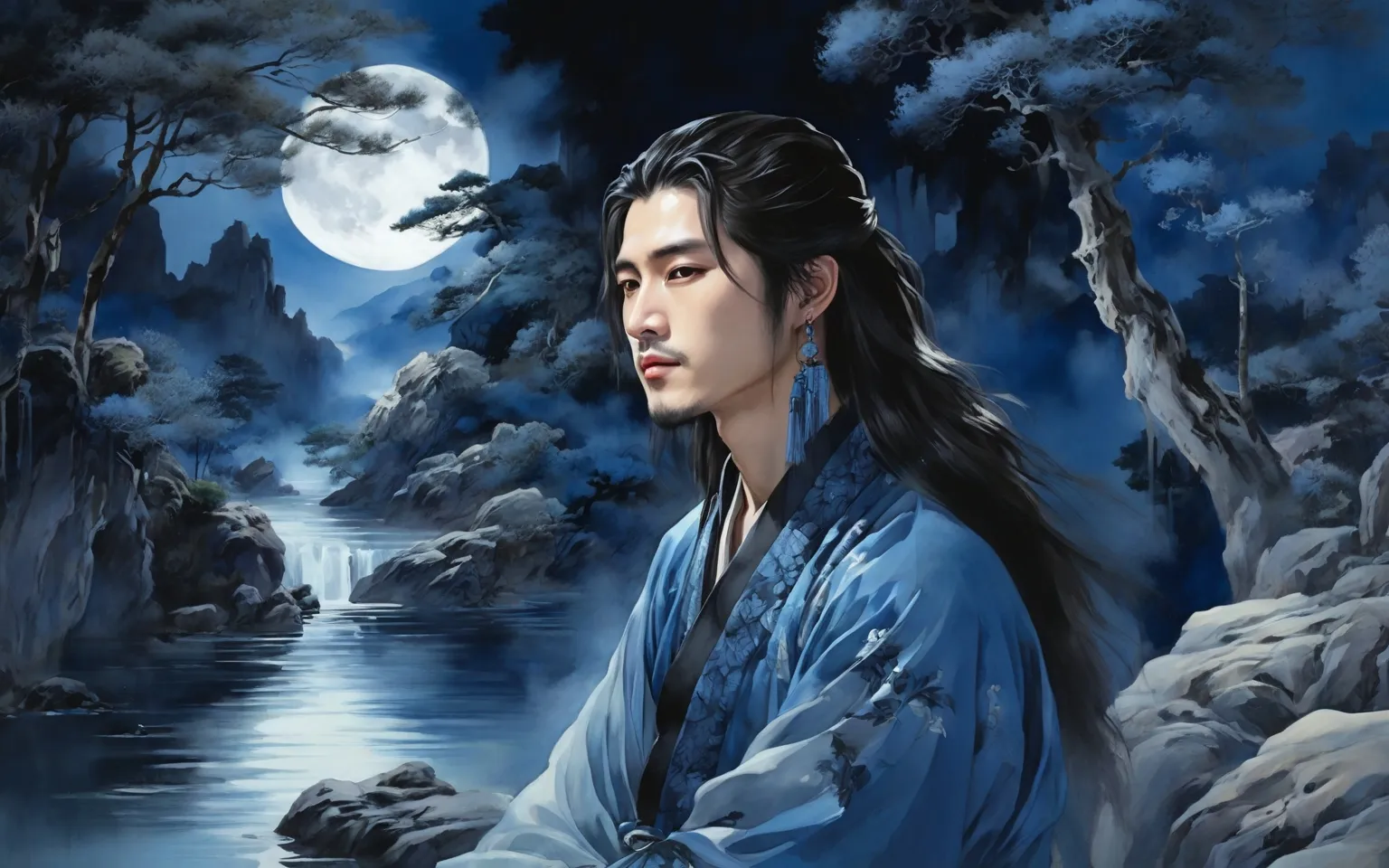
Wang Wei (王维), 701 - 761 A.D., was a native of Yuncheng, Shanxi Province. Wang Wei was a poet of landscape and idylls. His poems of landscape and idylls, with far-reaching images and mysterious meanings, were widely loved by readers in later generations, but Wang Wei never really became a man of landscape and idylls.