


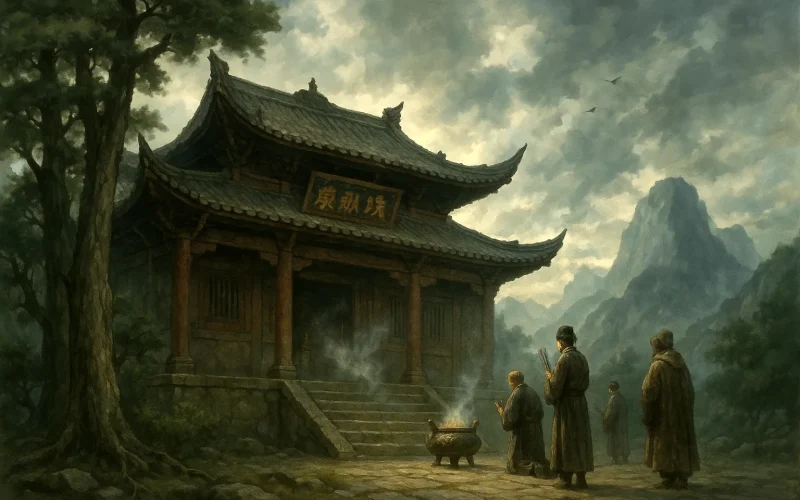
Even in this world the spirit of a hero
Lives and reigns for thousands of years.
You were the firmest of the pot's three legs;
It was you who maintained the honour of the currency;
You chose a great premier to magnify your kingdom...
And yet you had a son so little like his father
That girls of your country were taken captive
To dance in the palace of the King of Wei.
Original Poem
「蜀先主庙」
刘禹锡
天地英雄气,千秋尚凛然。
势分三足鼎,业复五铢钱。
得相能开国,生儿不象贤。
凄凉蜀故妓,来舞魏宫前。
Interpretation
This poem was composed around 817 AD during the Yuanhe era of Emperor Xianzong of Tang, when Liu Yuxi was serving as the Prefect of Kuizhou. Kuizhou was near the Shu region, the heartland of the former Shu Han regime. Passing by the Temple of the First Ruler of Shu (i.e., the temple of Liu Bei), the poet, reflecting on the past and present, was filled with emotion and wrote this famous historical poem. By this time, the Tang dynasty had already passed its zenith and was in decline. After the An Lushan Rebellion, the empire was plagued by separatist military governors, eunuch dominance, and factional strife among court officials; the glory of its former golden age was long gone. Liu Yuxi himself had experienced even more hardship—since the failure of the Yongzhen Reforms, he had fallen from a rising star at court to an exiled official, drifting for over twenty years amidst the rivers and mountains of Ba and Chu. Now, standing in the Temple of the First Ruler of Shu, facing the memory of Liu Bei, who was once hailed as a "hero between heaven and earth," what welled up in the poet's heart was not only nostalgia for history but also deep concern for the present reality.
Liu Bei, starting as a mere mat-weaver and sandal-seller, ultimately established one of the three contending kingdoms, relying on his heroic spirit and his discernment in employing talent. Yet, was the decline of the Tang dynasty not also due to a lack of worthy successors and the obscuring of talent? The lament in the poem, "He found a premier to found a state, but begot a son less worthy than his sire," is both a reflection on the lesson of Shu Han's rise and fall and a veiled admonition to the rulers of his own time. To sing of history is to satirize the present; to reflect on the past is precisely to worry about the times—this is the deeper intent of Liu Yuxi's poem.
First Couplet: "天地英雄气,千秋尚凛然。"
Tiāndì yīngxióng qì, qiānqiū shàng lǐnrán.
The hero’s spirit that fills heaven and earth
Is awe-inspiring still after his death.
The opening is grand and imposing, establishing a commanding perspective. The words "heaven and earth" (天地) express the vastness of space; "a thousand autumns" (千秋) express the remoteness of time. Within this infinite spatio-temporal framework, Liu Bei's heroic spirit remains "awe-inspiring" (凛然) as if of yesterday. The word "still" (尚) is both an affirmation of Liu Bei's character and an implicit sigh for the present age—the ancient hero is gone, but his spirit endures; in the way of the world today, are there still such men? This line subtly alludes to Cao Cao's saying, "The only heroes in the world are you, my lord, and I," but does so without a trace, placing Liu Bei between heaven and earth, across a thousand autumns, and endowing him with a character that transcends history.
Second Couplet: "势分三足鼎,业复五铢钱。"
Shì fēn sānzúdǐng, yè fù wǔzhūqián.
The world, a tripod, on its three feet, he propped,
Wished the old cash, the five-zhu, to be copped.
This couplet follows from the "heroic spirit," specifically describing Liu Bei's achievements. "The world, a tripod, on its three feet, he propped" speaks of his military feats, how amidst the contending heroes he finally propped up one leg of the tripod. "Wished the old cash, the five-zhu, to be copped" speaks of his civil governance, his political ideal of restoring the old institutions of the Han. The "five-zhu cash" (五铢钱) was a currency minted during the reign of Emperor Wu of Han and continued in use into the Eastern Han; here it refers to the institutions and legitimacy of the Han house. The two lines, one on military, one on civil, one on founding a state, one on restoring legitimacy, summarize Liu Bei's heroic achievements with great concision. The words "Wished… to be copped" (业复) especially point to the lifelong ambition of Liu Bei—he was not a typical warlord seeking a fief, but a statesman who took the restoration of the Han as his mission.
Third Couplet: "得相能开国,生儿不象贤。"
Dé xiàng néng kāi guó, shēng ér bú xiàng xián.
He found a premier to found a state, but begot a son less worthy than his sire,
This couplet makes a sudden turn, shifting from praise to lament, from the height of prosperity to the beginning of decline. "He found a premier to found a state" is a recognition of Liu Bei's ability to know and employ the worthy—he made three calls to the thatched cottage to secure Zhuge Liang, and thus established his rule. "But begot a son less worthy than his sire" is a painful regret for the lack of a worthy successor—Liu Shan (A Dou) was fatuous and incompetent, leading to the state's fall. The term "less worthy than his sire" (不象贤) alludes to a line in the Book of Rites: "The setting up of the feudal lords, one after another, was to give them the opportunity of imitating the worthies of former times," meaning that descendants could emulate the virtue of their forebears. The poet uses this contrast to reveal the key to Shu Han's rise and fall: founding a state requires a worthy minister; preserving it requires a worthy heir. One cannot do without the other. This is both a lesson of history and a warning to the present age.
Final Couplet: "凄凉蜀故妓,来舞魏宫前。"
Qīliáng shǔ gù jì, lái wǔ wèi gōng qián.
To see the singing girls of his old state now sing and dance before the captor’s hall!
The final couplet concludes the poem with a specific image, pushing the pain of a fallen state to its extreme. According to the Records of the Three Kingdoms, after Liu Shan surrendered to Wei, he was moved to Luoyang. Sima Zhao had performers put on a show of Shu music and dance. The old ministers of Shu were all moved to sorrow, but Liu Shan alone "laughed and enjoyed himself as before." The poet does not write of Liu Shan's numbness, but only of the "singing girls of his old state" and their "sadness" (凄凉)—those innocent singing girls, forced to sing and dance in the court of the enemy state; their humiliation is the very epitome of a fallen state. The word "sad" (凄凉) expresses sympathy for the singing girls, but is even more a critique of Liu Shan's unworthiness, concluding the whole piece with a concrete image, subtle yet powerful, leaving endless reflection.
Holistic Appreciation
This historical poem begins with "heroic spirit" and ends with "sadness," completing its meditation on history through the contrast of prosperity and decline. The first couplet opens grandly, placing Liu Bei between heaven and earth and across a thousand autumns, with magnificent spirit. The second couplet details his achievements, military and civil, summarizing with precision. The third couplelet makes a sudden turn, moving from gaining a worthy minister to begetting an unworthy son, revealing the key to rise and fall. The final couplet concludes with an image, making concrete the pain of a fallen state, evoking a sigh.
The poem's structure is rigorous, its layers clear. The first four lines describe the rise of Shu Han, focusing on praise; the last four lines describe its fall, focusing on lament. What runs throughout is a profound contrast between "hero" and "unworthy," "gaining the worthy" and "losing the heir." The poet uses the past to satirize the present, expressing deep concern for the reality of the Tang dynasty through the historical lesson of Shu Han's rise and fall—can the court of his time employ the worthy it finds? Can it have worthy heirs to preserve it? These questions are both a historical inquiry and a warning for the present.
Artistic Merits
- Vivid Contrast, Profound Meaning: The founding and the fall, gaining a minister and begetting a son, heroic spirit and sad singing girls—multiple contrasts run through the poem, making the principles of rise and fall clear.
- Concise Language, Strong Conciseness: The two lines, "The world, a tripod, on its three feet, he propped, / Wished the old cash, the five-zhu, to be copped," highly condense Liu Bei's life achievements. The two lines, "He found a premier to found a state, but begot a son less worthy than his sire," articulate the key to rise and fall in a single phrase.
- Natural Allusion, Seamless Integration: The allusions to Cao Cao's comment on heroes, the reference to the "five-zhu cash," the source of the phrase "less worthy than his sire"—all are woven into the poem, becoming a natural whole.
- Subtle Conclusion, Lingering Resonance: The image of "the singing girls of his old state now sing[ing] and danc[ing] before the captor’s hall" concludes the poem. It does not state the criticism, yet the criticism is there; it does not state the regret, yet the regret is apparent.
Insights
The most important insight this poem offers is about the difficulty of talent succession and preserving a legacy. Liu Bei, a man of great talent and bold vision, found a Zhuge Liang and founded a state, yet it fell because of the unworthiness of Liu Shan. This tells us: While establishing a foundation is hard, preserving it is even harder. The success of one person cannot ensure the continuity of a family; the struggle of one generation cannot replace the responsibility of the next. The cycles of historical rise and fall often hinge on the gap between "finding a minister" and "begetting a son."
In the present, this insight still holds practical significance. Whether in the transmission of a cause or the continuation of a spirit, it requires that successors possess the ability to be "worthy" of their forebears—not simple imitation, but a true understanding and development of the core spirit of the predecessors. The tragedy of Liu Bei reminds us: Selecting successors, nurturing the next generation, is key to the sustainable development of any enterprise. This poem also makes us think about the complex relationship between heroes and their times. Liu Bei, living in a time of chaos, was able to found one of the three contending kingdoms through his own effort. Yet his son, living in a relatively stable environment, squandered the legacy and led the state to ruin. This shows: Heroic spirit requires both innate endowment and the tempering of the times. Liu Shan's mediocrity certainly had its own reasons, but it was also not unrelated to his growing up in comfort. This teaches us: True transmission is not giving later generations a safe harbor, but allowing them to grow through experience into people capable of shouldering great responsibility.
Finally, the image of the "sad… singing girls of his old state" in the poem also shows us that the cost of a fallen state is ultimately borne by ordinary people. Those singing girls of Shu—how had they ever participated in state affairs? Yet they were forced to feign smiles in the court of the enemy, becoming the symbol and sacrifice of a fallen state. This reminds us: Behind the rise and fall of politics lie the fates of countless ordinary people. This should never be forgotten.
Poem translator
Kiang Kanghu
About the poet
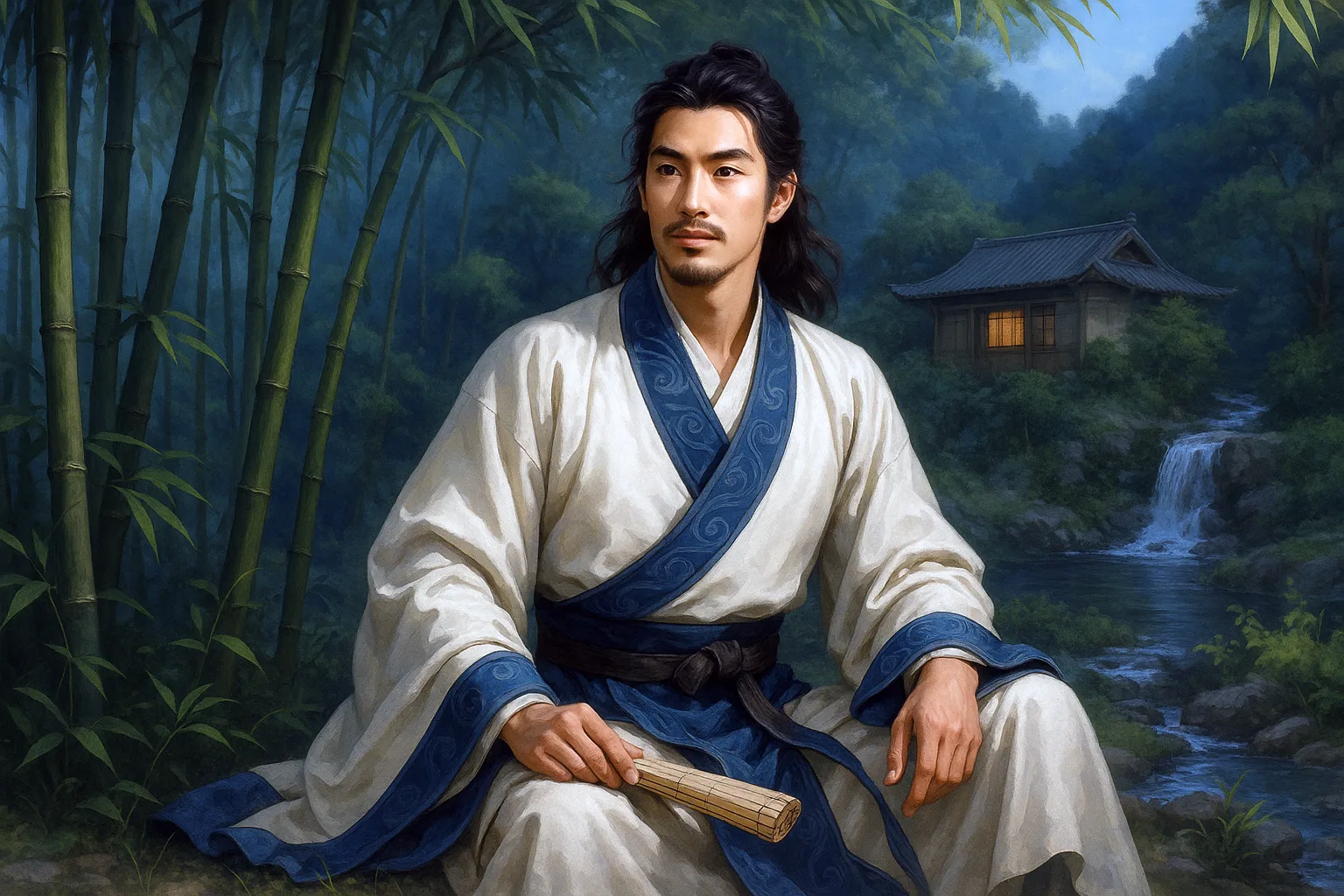
Liu Yuxi(刘禹锡), 772 - 842 AD, was a native of Hebei. He was a progressive statesman and thinker in the middle of the Tang Dynasty, and a poet with unique achievements in this period. In his compositions, there is no lack of poems reflecting current affairs and the plight of the people.