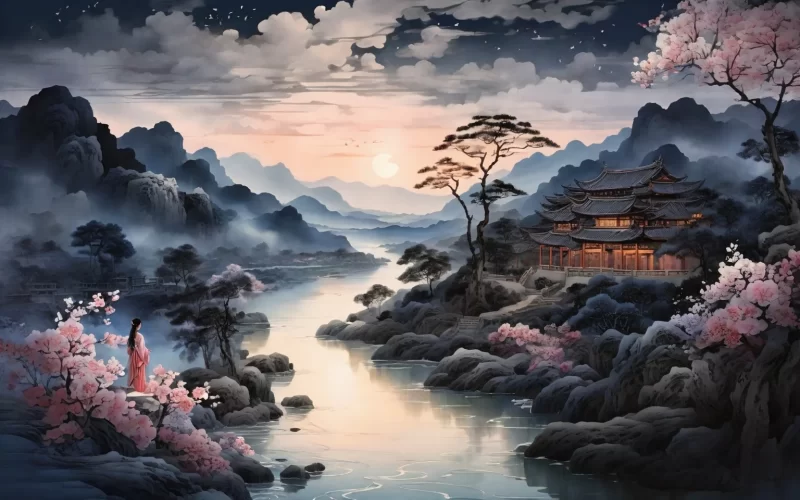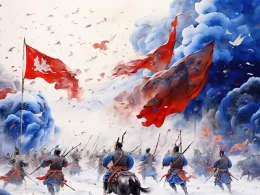



A single carriage goes to the frontier;
An envoy crosses northwest mountains high.
Like tumbleweed I leave the fortress drear;
As wild geese I come under Tartarian sky.
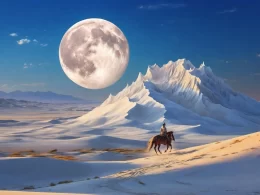
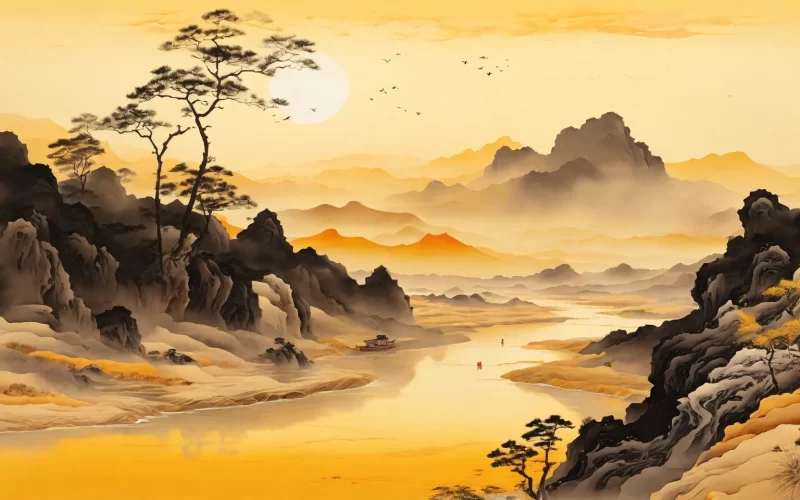
In boundless desert lonely smokes rise straight;
Over endless river the sun sinks round.
I meet a cavalier at the camp gate;
In northern fort the general will be found.
Original Poem
「使至塞上」
王维
单车欲问边,属国过居延。
征蓬出汉塞,归雁入胡天。
大漠孤烟直,长河落日圆。
萧关逢侯骑,都护在燕然。
Interpretation
This poem was composed in the 25th year of the Kaiyuan era of Emperor Xuanzong of Tang (737 AD). Wang Wei was then thirty-six years old, serving as an Investigating Censor dispatched by imperial order to Liangzhou to convey the emperor's regards to Deputy Military Commissioner Cui Xiyi, who had recently triumphed over the Tibetans. This journey carried a subtle sense of political distancing. Bearing complex emotions, the poet left the capital Chang'an for the remote frontier. Along the way, he recorded his observations and feelings in verse, depicting both the majestic grandeur of the frontier landscape and hinting at a faint desolation stemming from his personal rootlessness and longing for home. Within the framework of a travelogue, the entire poem traces a spiritual journey from loneliness to expansiveness, from drifting to stability. It stands as a exemplary work of High Tang frontier poetry, where scenery masterfully conveys inner states with a perfectly integrated, grand artistic conception.
First Couplet: 单车欲问边,属国过居延。
Dān chē yù wèn biān, shǔ guó guò Jūyán.
A single carriage sets off to visit the distant frontier; / Passing through lands once tributary, far beyond Juyan.
Explication: The opening line establishes the vast, lonely tone for the entire poem with the phrase "A single carriage." The poet is not a high commissioner with a grand entourage but travels light, hinting at the particular nature of his mission and the solitude of his personal state of mind. "Sets off to visit the distant frontier" clarifies the purpose, while "Passing through… far beyond Juyan" uses a geographical name to stretch the sense of space—Juyan was located at the extreme northwestern frontier, a tributary state since Han times, and a potent symbol of the borderlands in the Tang. In just ten characters, the couplet states the reason for the journey while also sketching a spatiotemporal trajectory from the center to the periphery, from prosperity to desolation, providing the vast geographical and psychological backdrop for the poem's unfolding.
Second Couplet: 征蓬出汉塞,归雁入胡天。
Zhēng péng chū Hàn sài, guī yàn rù Hú tiān.
Like tumbleweed, I drift beyond the Han frontier passes; / While southbound wild geese enter the Tartar sky's vast spaces.
Explication: This couplet deepens the sense of rootless wandering away from homeland through exquisite parallelism and intertextuality. "Tumbleweed" is a metaphor for the poet himself—rootless, blown far by the wind, aptly conveying the feeling of being at the mercy of circumstance and an uncertain future on this official journey. "Southbound wild geese" represents the other—geese that can migrate north and south freely, returning home, contrasting with the poet's constraint and helplessness as an imperial envoy bound by duty. "Drift beyond the Han frontier passes" and "enter the Tartar sky" create a directional tension: the poet leaves the homeland and exits the frontier, while the geese return home and enter the sky. In this movement of "exiting" and "entering," the juxtaposition of personal fate with natural rhythm intertwines the feeling of personal fortune with the boundlessness of time and space.
Third Couplet: 大漠孤烟直,长河落日圆。
Dà mò gū yān zhí, cháng hé luò rì yuán.
In boundless desert, a lone plume of smoke rises straight; / Over the long river, a round sun sinks at a steady rate.
Explication: This couplet comprises famous lines recited through the ages for their scenery. Their charm lies in using minimal lines and geometric imagery to outline the most authentic, most awe-inspiring visual impression of the frontier. "Boundless desert" unfolds a vast horizontal plane; "a lone plume of smoke rises straight" erects a single vertical column of smoke within it, constituting the sole vertical coordinate between heaven and earth, silent and steadfast, hinting at the lonely integrity of frontier garrisons and the solemnity of signaling. "The long river" is a winding curve; "a round sun sinks" is a full circle. The curve and the arc meet within the immense desert, creating a dusk scene that blends warmth and desolation. The characters "straight" and "round" seem plain but are actually a highly refined distillation of natural forms from the poet's keen observation, endowing the scene with a near-sacred geometric beauty and a sense of eternity.
Fourth Couplet: 萧关逢侯骑,都护在燕然。
Xiāo guān féng hóu jì, dūhù zài Yānrán.
At Xiaoguan, I meet a mounted patrolman, who tells: / The General is ahead, where Mount Yanran's peak swells.
Explication: The final couplet shifts from magnificent natural scenery to human affairs, yet it does not diminish the poem's scale. Instead, it further extends the frontier's depth. "I meet a mounted patrolman" is a small node in the journey, introducing the frontier's distinctive military atmosphere. "The General is ahead, where Mount Yanran's peak swells" uses an allusion (referring to the Han dynasty general Dou Xian, who defeated the Xiongnu and inscribed a monument at Mount Yanran) to expand the poetic realm into historical depth through implied imagery, subtly containing expectations and praise for the Tang army's achievements. Learning this news, the poet does not write about whether he arrives himself but ends abruptly, leaving an aftertaste of a mission still ongoing and the frontier extending endlessly.
Holistic Appreciation
This poem is a model of conquering time with space and elevating emotion through imagery. Using the journey as a thread, the emotion deepens layer by layer with the scenery: from the solitary clarity of departure in the first couplet, to the rootless wandering en route in the second, to the awe and sublimation before vast nature in the third, culminating in the resolution and expansiveness of merging into the grand frontier narrative in the fourth. The poet skillfully places his personal journey of a "single carriage" within the epic spaces of "boundless desert," "long river," "Tartar sky," and "Mount Yanran," granting the subtle sentiments of an official's travels a dual sense of historical and geographical weight.
Particularly worth savoring is how the scenery in the poem possesses a strong symbolic quality: "tumbleweed" and "southbound wild geese" are traditional poetic codes for travel and homesickness; "lone plume of smoke" and "setting sun" are typical images of the frontier's desolate yet magnificent beauty; "Xiaoguan" and "Mount Yanran" carry heavy military and historical connotations. Wang Wei carefully weaves these symbols, not only painting vivid pictures but also constructing a richly meaningful symbolic world, allowing readers to touch the poet's heart and Chan (Zen) spirit—one that seeks transcendence within solitude and discovers solemnity within the remote wilderness—while appreciating the frontier landscape.
Artistic Merits
- Broad, Impressionistic Composition with Linear Quality: Viewing the scene with the eye of both a poet and painter, especially in the third couplet, Wang Wei creates an image akin to an ink-wash frontier landscape. Using basic lines and shapes—"straight smoke," "round sun," "long river," "flat desert"—he constructs a balanced, stable, and profound picture, embodying the highest ideal of "painting in poetry."
- Indirect and Symbolic Expression of Emotion: The poem does not directly express sorrow or heroism in a single word. Yet, through the lonely imagery of "single carriage" and "tumbleweed," the boundless scenes of "lone plume of smoke" and "setting sun," and the sense of mission in "visit the distant frontier" and "The General is ahead," it perfectly fuses three layers of meaning: personal feelings of wandering, the awe-inspiring power of nature, and the national enterprise of the frontier.
- Layered and Dynamic Spatial Choreography: The poetic space expands continuously from near to far, from concrete to implied: from the very near point of "single carriage," to the distant location of "Juyan," to the limitless vista of "Tartar sky," "boundless desert," "long river," finally landing in the imagined historical space of "Mount Yanran." This masterful handling of space, capable of expansion and contraction, gives the poem its grand artistic conception.
- Highly Condensed and Texturally Rich Language: Verbs like "sets off," "passing through," "drift beyond," "enter," "meet" are precise and concise. Nouns like "tumbleweed," "geese," "smoke," "sun" are vivid images. Adjectives like "single," "lone," "straight," "round" are intensely textural. Together, they create a language quality that is clean yet full of tension.
Insights
This work transcends the typical melancholy or heroism of frontier poetry. It reveals to us that true magnificence is often born from a dialogue between solitude and vastness. When an individual is placed before boundless nature and immense history, a sense of insignificance may arise, but it can also simultaneously evoke a profound recognition of life's solemn dignity. What Wang Wei saw in the desolate desert—the "lone plume of smoke rises straight" and the "round sun sinks"—is a beauty stripped of all ornamentation, a fundamental truth. It reminds those entangled in worldly affairs that perhaps only when the mind and vision are equally open can one perceive the simplest, most solemn forms of all things.
This poem is also a metaphor for "journeying" and "discovery." Many journeys in life inevitably involve the loneliness of "A single carriage sets off" and the rootlessness of "Like tumbleweed, I drift beyond." What matters is not the bleakness of the starting point or the solitude of the road, but whether, on the long journey, we maintain the eyes that can see "a lone plume of smoke rises straight" over the desert and "a round sun sinks" over the long river, and the heart that can ultimately comprehend the far-reaching implication of "The General is ahead"—to see and resonate with a greater order and mission within individual limitations. This is perhaps the most precious gift Wang Wei's journey offers to later travelers.
Poem translator
Kiang Kanghu
About the poet
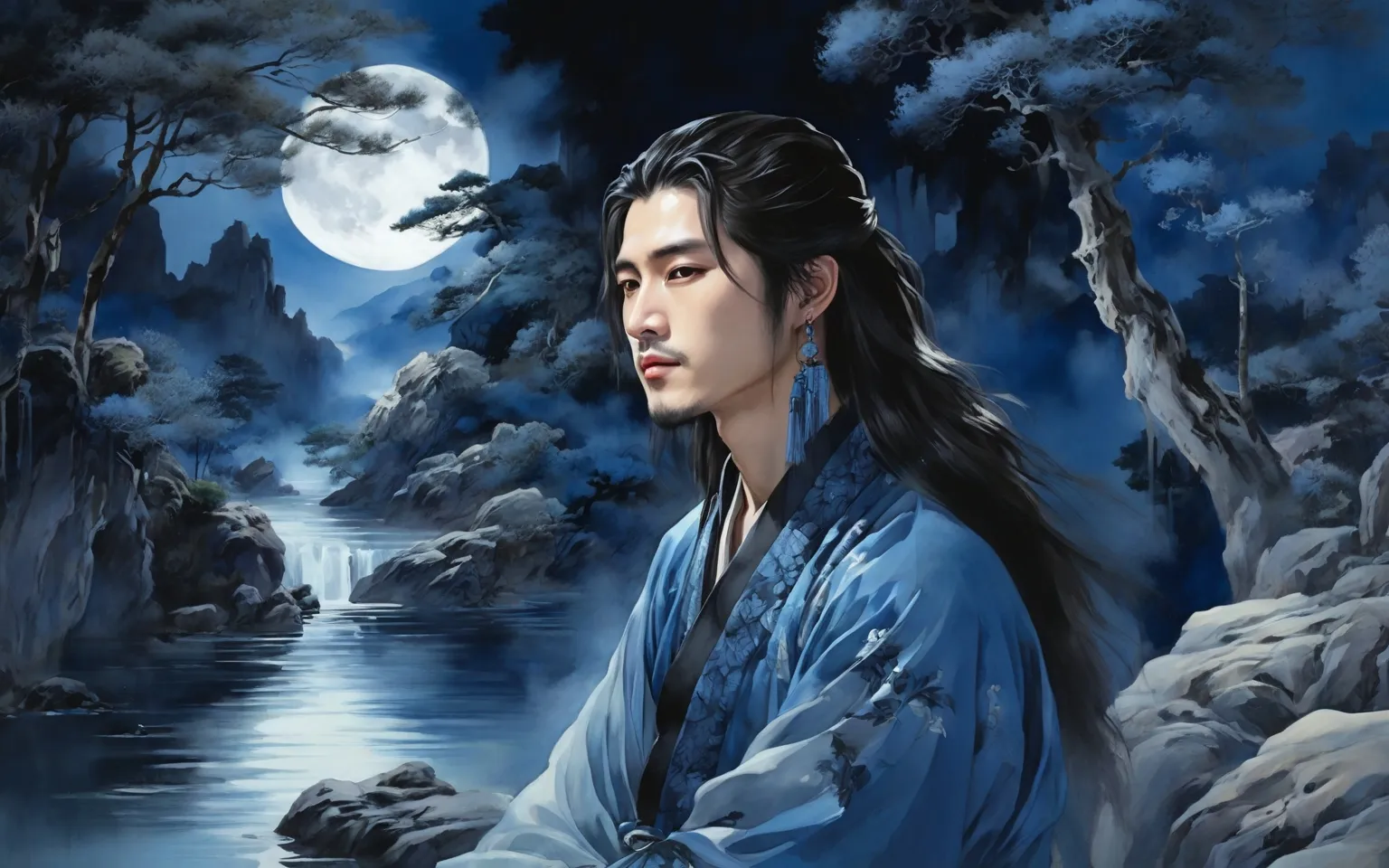
Wang Wei (王维), 701 - 761 A.D., was a native of Yuncheng, Shanxi Province. Wang Wei was a poet of landscape and idylls. His poems of landscape and idylls, with far-reaching images and mysterious meanings, were widely loved by readers in later generations, but Wang Wei never really became a man of landscape and idylls.