


Gone with yellow chrysanthemums last year,
You come back when cicada's song I hear.
Your soughing wakes me from dreams at midnight,
A year's wrinkles are seen in mirror bright.

Steeds missing frontier grass with bristles rise;
Eagles longing for clouds open sleepy eyes.
I'll gaze my fill into the boundless sky;
Though ill, for you I'll mount the tower high.
Original Poem
「始闻秋风」
刘禹锡
昔看黄菊与君别,今听玄蝉我却回。
五夜飕飗枕前觉,一年颜状镜中来。
马思边草拳毛动,雕盼青云睡眼开。
天地肃清堪四望,为君扶病上高台。
Interpretation
This poem was composed after the second year of the Baoli era (826 AD), during Liu Yuxi's journey from his post in Hezhou back to Luoyang. The exact year is uncertain, but it belongs to his late years. By this time, Liu Yuxi was an old man around sixty. Following the failure of the Yongzhen Reform, he was exiled to Langzhou for a decade, then successively to Lianzhou, Kuizhou, and Hezhou, drifting for over twenty years. This northward return from Hezhou was the last time he would leave a place of exile in his life. What awaited him was not reinstatement, but a sinecure in the Eastern Capital's Department of State Affairs—the title of Advisor to the Crown Prince. The court no longer intended to employ him.
Yet it was this white-haired old man who, awakened by the sound of the wind on an autumn night, wrote this poem. There is not a trace of dejection in it, only the soaring spirit of a steed yearning for the frontier or a sleeping eagle opening its eyes. In this poem, he personifies the autumn wind as an old friend who arrives punctually every year. Along the twenty-three-year road of exile, only the autumn wind had never failed him. And so, supporting his ailing body, he ascends the high terrace to gaze upon heaven and earth with this old friend.
First Couplet: "昔看黄菊与君别,今听玄蝉我却回。"
Xī kàn huáng jú yǔ jūn bié, jīn tīng xuán chán wǒ què huí.
Last year, watching golden chrysanthemums, I bid you farewell;
Now, hearing the dark cicadas, I, the wind, return.
The opening is strikingly original. The poet personifies the "autumn wind" as "I" and refers to himself as "you", creating a dramatic sense of reunion between man and autumn. "Golden chrysanthemums" evoke late autumn of the previous year, while "dark cicadas" are the sound of early autumn this year. The seasons change, but the affection between the poet and the autumn wind remains constant. The brilliance of this opening lies in the shift in perspective. The poet does not say "I hear the autumn wind"; instead, he says "I, the wind, return"—as if he himself were the wind, free to come and go. This dislocation grants the entire poem a transcendent tone: I am not a man passively enduring the turn of the seasons; I am the one actively keeping the rendezvous.
Second Couplet: "五夜飕飗枕前觉,一年颜状镜中来。"
Wǔ yè sōuliú zhěn qián jué, yī nián yán zhuàng jìng zhōng lái.
At the fifth watch, its soughing rouses me before my pillow;
A year's change in my face and form arrives from within the mirror.
The focus turns inward. "Its soughing at the fifth watch" is the autumn wind knocking at his window, the direct cause of the poet's awakening from dreams. The three words "rouses me before my pillow" make the sound of the wind almost tangible. "A year's change… arrives from within the mirror" brings a sudden descent. The reflection shows he has aged another year. The wind returns yearly; his appearance declines yearly. The poet does not avoid this fact. He simply places both side by side with equanimity—the autumn wind has returned, and I have aged further. And then? Then we read the next couplet.
Third Couplet: "马思边草拳毛动,雕盼青云睡眼开。"
Mǎ sī biān cǎo quán máo dòng, diāo pàn qīng yún shuì yǎn kāi.
The steed, missing frontier grass, feels its matted mane bristle;
The eagle, longing for blue clouds, opens its slumbering eyes.
This couplet is the explosive point of the poem's spirit. "The steed, missing frontier grass" and "The eagle, longing for blue clouds"—these two images are the metaphors Liu Yuxi finds for himself. He is not merely the old man of "a year's change in my face"; he is also that battle-steed whose mane stiffens at the sound of a frontier bugle, that fierce eagle who opens its eyes and spreads its wings at the sight of the sky. "Feels its matted mane bristle" is a subtle tremor, yet it stores the power to gallop; "opens its slumbering eyes" is an instant of awakening, yet it foretells a soaring posture. Using the instinctive reactions of animals, the poet writes of all the inner turmoil stirred within him upon hearing the autumn wind. For him, the autumn wind is not merely a signal of the changing seasons; it is proof that life still stirs within.
Fourth Couplet: "天地肃清堪四望,为君扶病上高台。"
Tiāndì sùqīng kān sì wàng, wèi jūn fú bìng shàng gāo tái.
Heaven and earth, stern and clear, are fit for gazing all around;
For you, old friend, I, leaning on my sickness, climb the high terrace.
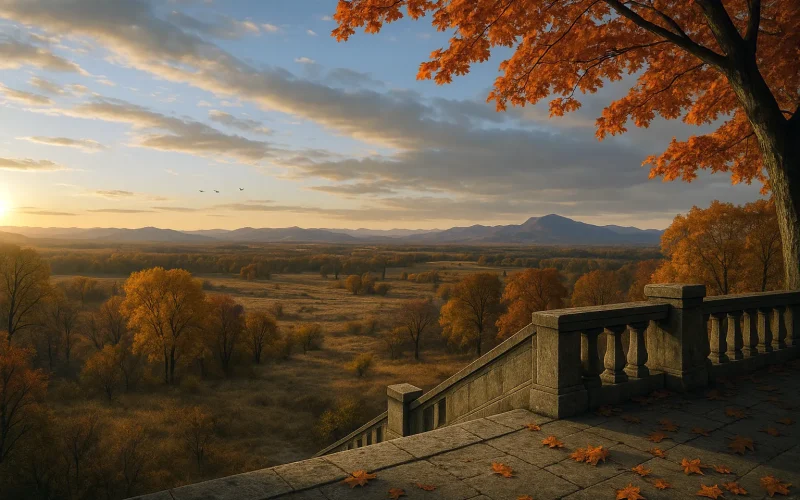
The conclusion is an action. "Heaven and earth, stern and clear" is autumn's gift—after the myriad trees have shed their leaves, the vista opens up instead. "Are fit for gazing all around" is the poet's response to this gift—I will gaze as far as I am able. The "you" in "For you, old friend" echoes the first couplet, referring to the autumn wind. The poet does not climb the terrace to prove anything; he climbs to keep his rendezvous with an old friend. The sickness is real, and climbing the terrace while supporting his ailing body is also real. The autumn wind knows of his sickness, and knows he will surely come.
Holistic Appreciation
This poem is an epitome of Liu Yuxi's poetic realm in his late years—still standing tall amidst age and sickness, still keeping the rendezvous amidst parting. The poem's four couplets are structured as clearly as a musical movement: the first sets the theme, using personification to describe the reunion of man and autumn; the second turns, moving from the sound of the wind to the face in the mirror; the third rises vigorously, using the steed and eagle to metaphorize an undimmed, heroic heart; the fourth concludes, completing a spiritual ritual with the action of ascending the terrace to gaze afar.
The most moving aspect of the poem is that sense of unyielding spirit. Liu Yuxi knows he is old, sick, and his official career has reached its end. Yet when he hears the autumn wind, the first thought that springs to his mind is not "another year has passed," but "The steed, missing frontier grass" and "The eagle, longing for blue clouds." This is not self-consolation; it is the last ember within him being ignited by the autumn wind. Clutching this ember, he supports his sickness and climbs the high terrace.
Artistic Merits
- Creative Reversal of Personified Perspective: By casting the autumn wind as "I" and himself as "you", the poet creates a dialogic relationship between the natural season and the man. This shift in perspective grants the poem a universality that transcends personal sentiment—it is not Liu Yuxi speaking of his own affairs; it is the autumn wind speaking for all who are unwilling to succumb to age.
- Precise Selection of Metaphorical Imagery: "The steed, missing frontier grass" and "The eagle, longing for blue clouds" are images commonly used in Tang frontier poetry, but Liu Yuxi employs them here not to write of ambitions for achievement, but to depict a more fundamental state of being—the instinct to move upon hearing a call, to yearn to fly upon seeing the sky. This has nothing to do with age.
- Duet of Temporal Awareness: Two kinds of time resonate simultaneously in the poem: "a year's change in my face" represents linear, irreversible time leading to decay; "The steed, missing frontier grass" represents cyclical, soaring time reawakened each autumn. The interweaving of these two times constitutes the true state of the poet's physiology and psychology.
- Structural Echo Between Opening and Close: The "you" of the first couplet and the "you" of the final couplet distantly correspond; the development of the two middle couplets unfolds within this echoing framework. The autumn wind is the thread running through the entire poem and the object upon which the poet's emotions are projected.
- Robust, Unyielding Quality of Language: The poem's diction is extremely precise: "soughing," "matted mane bristle," "slumbering eyes," "leaning on my sickness"—not a single soft phrase. This robust, unyielding quality of language is in complete alignment with the spiritual posture the poet seeks to express.
Insights
The enduring vitality of this poem lies in its capture of a universal human condition—that which is about to be extinguished yet still burns. Liu Yuxi was in his sixties when he wrote of the autumn wind, his body failing, his official hopes gone. Yet the self he portrays is not a dying candle or withered tree, but a battle-steed whose mane trembles slightly, a fierce eagle whose eyes snap suddenly open. This state of "not yet fully old, not yet fully at rest" holds profound insights for contemporary people. We live in an era of premature surrender: people say they are old at thirty, resign themselves to fate at forty. Liu Yuxi, at sixty, still "leaning on my sickness, climb[s] the high terrace." Not because his body was strong, but because that "steed" in his heart was not yet dead.
The word "bristles" in "Steeds missing frontier grass with bristles rise" is the poem's most subtle calibration. It is not galloping or neighing; it is merely a slight tremor. But this tremor proves that life remains. What modern people often lack is not the ability to gallop, but this instinct for the "slight tremor." We let ourselves grow still too early, persuade ourselves "let it be" too soon.
Ultimately, the "you" in "Though ill, for you I'll mount the tower high." is both the autumn wind and that unyielding thought within his own heart that refuses to disperse. This represents a noble attitude towards life: it differs from stubborn bravado because it acknowledges "leaning on my sickness"; it also differs from resigned acceptance because it still "climb[s] the high terrace." In today's world that worships efficiency and youth, this solemnity of keeping a rendezvous despite sickness and pain is perhaps the very dignity we should preserve when facing old age.
This poem stands like a high terrace erected in autumn. It tells every person in their twilight years: No matter how the body decays, certain needs of the heart are eternal and ever-new. We need to feel our hearts stir still upon hearing the wind, to yearn to open our eyes still upon seeing the sky, and we need that battle-steed with its slightly trembling mane to prove we have not yet been tamed.
Poem translator
Xu Yuanchong (许渊冲)
About the poet
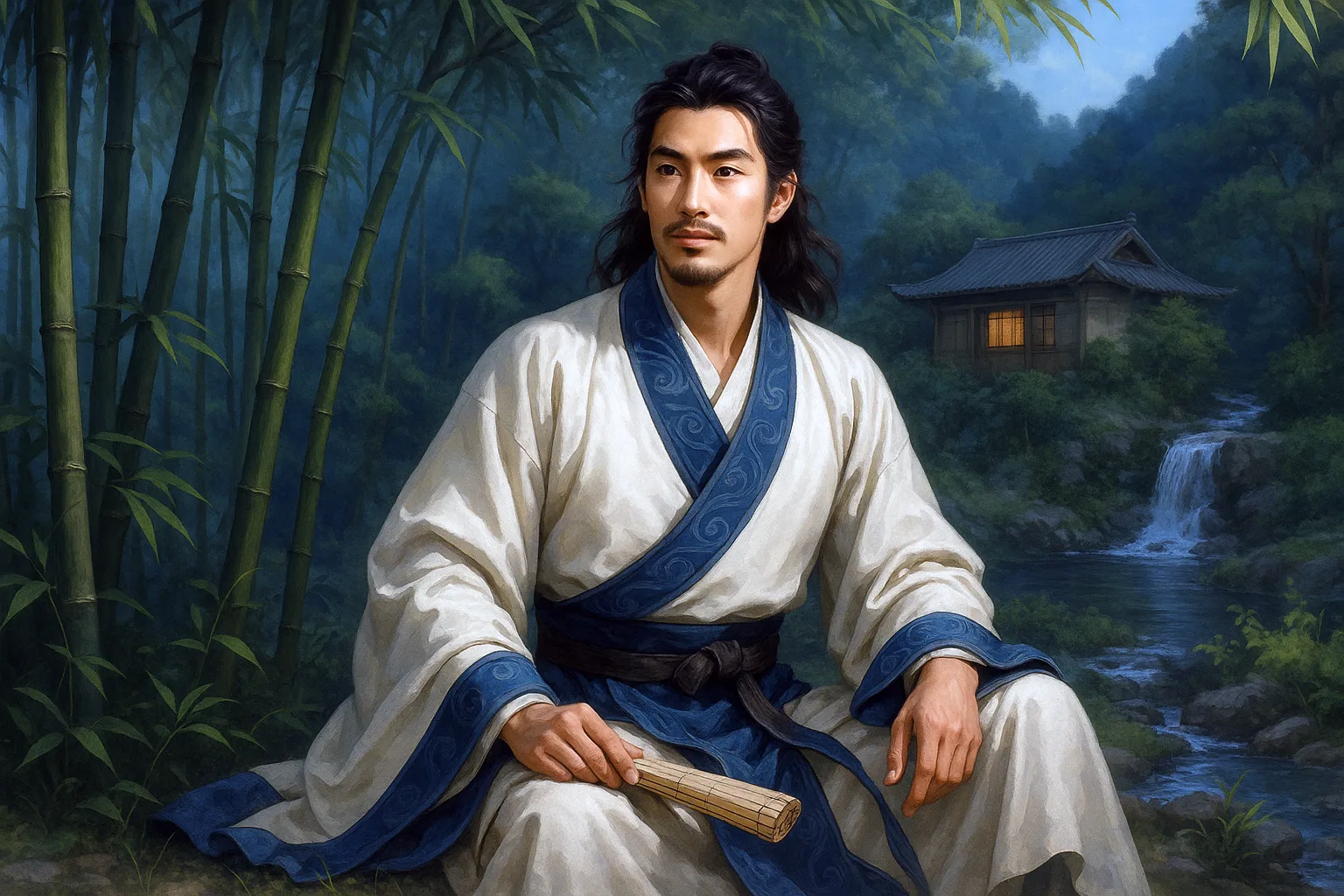
Liu Yuxi(刘禹锡), 772 - 842 AD, was a native of Hebei. He was a progressive statesman and thinker in the middle of the Tang Dynasty, and a poet with unique achievements in this period. In his compositions, there is no lack of poems reflecting current affairs and the plight of the people.