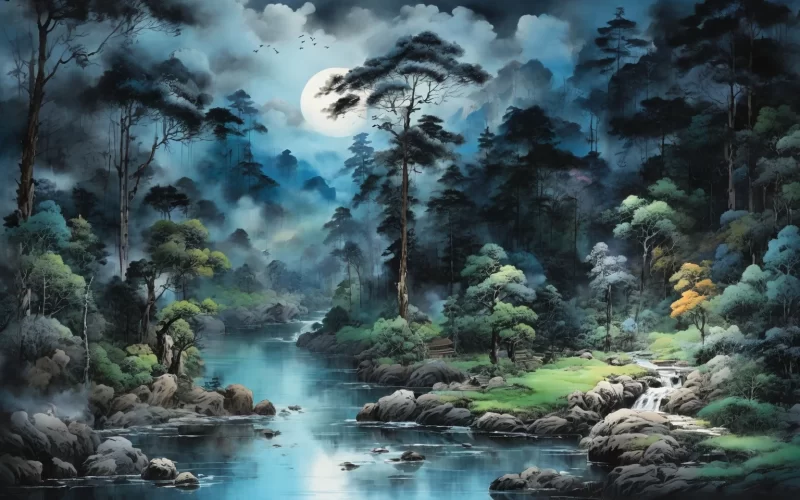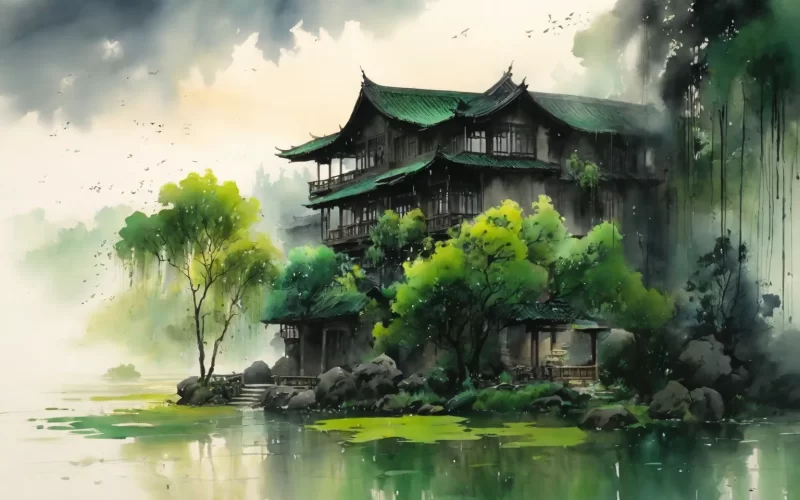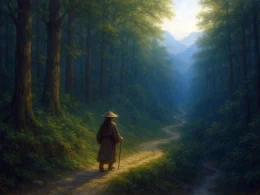



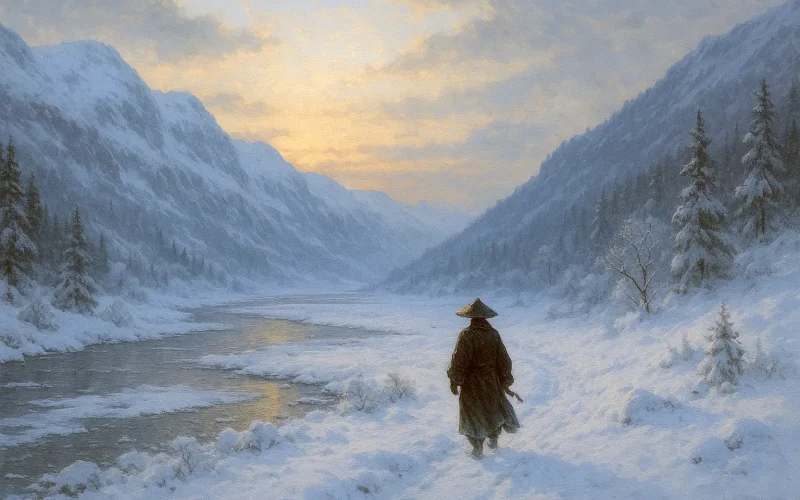
I watched you down the hill until you disappeared;
At dusk, alone, I closed my wicket door.
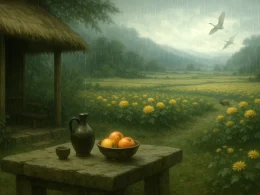
Spring grass will turn green again, year after year —
But will you, my noble friend, ever return?
Original Poem
「山中送别」
王维
山中相送罢,日暮掩柴扉。
春草明年绿,王孙归不归。
Interpretation
This poem is a masterpiece of utmost conciseness and profound depth among Wang Wei's five-character quatrains, representing the pinnacle of Chinese classical poetry's artistic realm of "unwritten expression and wordless emotion." Composed during his reclusive years at Wangchuan, the poet captures the moment after seeing off a friend, returning alone to his mountain dwelling. He elevates a specific parting into a silent meditation on the eternal human themes of time, farewell, and return. In merely twenty characters, the poem resembles a landscape sketch with evocative negative space, where the simplest actions and plainest question contain emotional turbulence and endless philosophical resonance.
First Couplet: 山中相送罢,日暮掩柴扉。
Shān zhōng xiāng sòng bà, rì mù yǎn chái fēi.
I have just seen my friend off in the hills; / At sunset, I close my wicker gate.
This couplet captures, with diary-like simplicity, two consecutive actions and a timeless moment. "I have just seen my friend off in the hills" is as plain as recounting daily events, yet it contains everything: the journey walked together, the parting words, the waving figure—all gently concluded by the word "done" (罢), leaving vast emotional space. "At sunset, I close my wicker gate" pulls the focus back to the poet: sunset is the vastness of time; the wicker gate is a spatial boundary. The action "close" is psychologically weighty—it is both the resumption of daily life (shutting the gate, returning home) and the closing of an emotional world (shutting the sorrow of parting outside, or shutting oneself inside solitude). The sound of the wicker gate closing is audible in the twilight, a sound soaked in the stillness of the now-empty hills and the poet's inner contemplation. Not a word directly expresses emotion, yet the emptiness, longing, and solitary quietude after parting permeate every line.
Final Couplet: 春草明年绿,王孙归不归。
Chūn cǎo míng nián lǜ, wángsūn guī bù guī.
Next year when green grass comes to life, / My friend, will you come back or not?
This couplet is the soul of the poem, the soliloquy after silence, and a tender gaze across time. "Next year when green grass comes to life" is the certainty of nature's cycle, time's unfeeling promise—regardless of human meetings and partings, plants will revive with spring. The word "green" brims with vitality, yet it contrasts with the uncertainty of human affairs. "My friend, will you come back or not?" is the quiet question posed to the chance within certainty, the unknown within the pattern. "My friend" (王孙, literally "prince's descendant") is an elegant term for the friend, and also a token for all who depart. This question, seemingly plain, holds endless nuances: it is both hope and anxiety; it asks the friend, but also questions fate and time itself. The unanswered query leaves the poetic sentiment suspended between hope and loss, becoming a farewell song forever awaiting an echo.
Holistic Appreciation
This is a poem of the moment, about the "after" and the "before." It uniquely avoids the emotional outpouring of the farewell scene itself, focusing all its power on the critical point "after seeing off" (相送罢), where the emotional aftermath begins to ripple. The poet, like a masterful director, keeps the camera on the one who stays, not the one who leaves: he returns alone, closes the gate, stands still, and then gazes toward the invisible future (next year's green grass). This internalized perspective and delayed processing of emotion gives the poem astonishing psychological depth.
Here, Wang Wei practices his aesthetic principle of "emptiness thus holds ten thousand scenes." The immense emotional capacity of the poem stems precisely from the extreme economy of language and the careful use of negative space in imagery. "Hills," "sunset," "wicker gate," "green grass"—these images are not unusual in themselves, but through the poet's juxtaposition and questioning, they form a field of meaning full of evocative power: the hills are both separation and embrace; the twilight is both ending and gestation; the wicker gate closes but also awaits opening; the green grass is rebirth after withering and hope after parting. The soft question, "will you come back or not?" is like a pebble dropped into a still lake, sending endless ripples through this field of imagery, allowing limited words to lead toward infinite reflection.
Artistic Merits
- Leaps in Narrative Time, Continuity of Emotional Logic: From "after seeing off" (completed past) to "close my wicker gate" (ongoing present) to "next year… green" (future indication) to "will you come back" (future question). Time leaps three times within four lines, yet the emotional thread—the solitary present and the hoped-for future—remains unbroken, creating powerful inner tension.
- Symbolic Action and Concrete Psychology: "Close my wicker gate" is the only external action, yet it symbolizes the gathering-in of the heart and temporary withdrawal from the world; "ask" (will you come back) is the only verbal action, yet it reveals the unrest that cannot be hidden within. Using external stillness to reveal inner movement is the poem's exquisite technique for portraying psychology.
- Emotional Double Meaning of Natural Imagery: "Green grass" is both an objective seasonal phenomenon and a subjective emotional anchor—the grass will surely turn green, the person's return is uncertain. This contrast between nature's "certainty" and human affairs' "uncertainty" is the core mechanism of the poem's enduring poignancy.
- Ambiguity of Address and Universality of Emotion: "My friend" (王孙) can refer specifically to a certain friend, or generally to any departed kindred spirit. This ambiguity of address frees the poem from a specific event, making it the shared utterance of all who have experienced parting and waiting.
Insights
This poem is like a quiet window into a shared human emotional experience. It reveals that the deepest pain of parting often lies not in the moment of clasping hands with tearful eyes, but in the moment when the bustle subsides and one faces a familiar, yet suddenly empty, world alone. That moment of "closing the wicker gate" is where emotion truly begins to be processed and to ferment.
In our fast-paced, hyper-connected modern society, we may have grown accustomed to hurried goodbyes and instant communication, perhaps losing the capacity for that profound emotional experience: savoring longing in the silence after "closing the wicker gate at sunset," and nurturing hope through long waiting. This poem invites us to relearn a kind of "slow parting" and "deep waiting": to cherish the solitude of recollection after farewell, for it is necessary for the settling of feeling; to dare to ask the question, "Next year when green grass comes to life, my friend, will you come back?"—for that is trust in the resilience of friendship and a simple faith in reunion.
In twenty characters, Wang Wei safeguards a precious element of human emotion: "uncertainty" and the "right to hope." It tells us that some gates (wicker gates) are closed so they may be opened again for someone in some future spring; some questions (will you come back) have no answer, but the asking itself fills the waiting with warm poetry. In an age of certainty and instant gratification, this ancient poetics of waiting may be the very antidote we need against the shallowing of our feelings.
Poem translator
Kiang Kanghu
About the poet

Wang Wei (王维), 701 - 761 A.D., was a native of Yuncheng, Shanxi Province. Wang Wei was a poet of landscape and idylls. His poems of landscape and idylls, with far-reaching images and mysterious meanings, were widely loved by readers in later generations, but Wang Wei never really became a man of landscape and idylls.