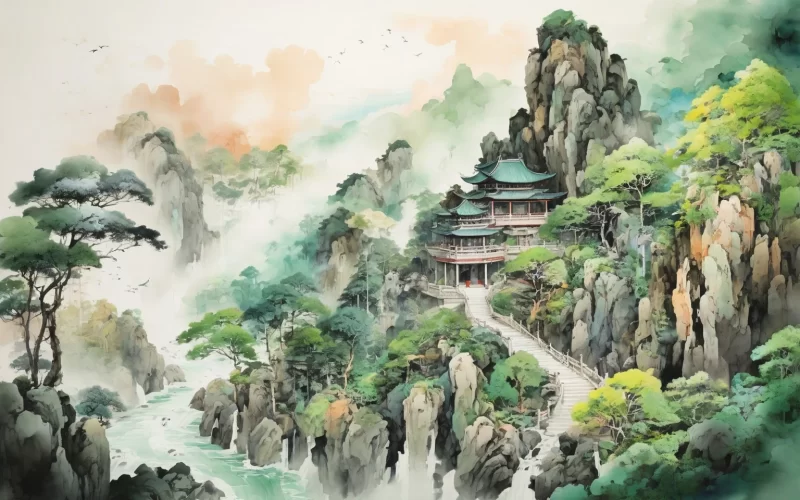

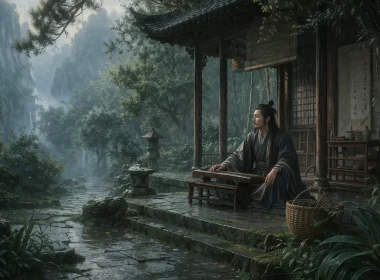
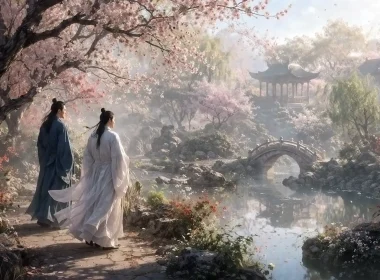

Far up the cold mountain the stone path winds;
In the deep deep clouds there a household finds.
I stop my cart, by maple woods detained;
Frost-bitten leaves outbloom spring flowers designed.
Original Poem
「山行」
杜牧
远上寒山石径斜,白云深处有人家。
停车坐爱枫林晚,霜叶红于二月花。
Interpretation
This poem is a radiant gem among Du Mu's landscape and travel verses. While its exact year of composition is difficult to ascertain, judging by the luminous state of mind and vigorous vitality it projects, it likely belongs to the poet's middle age, a period of relative stability in his official career and extensive travel through mountains and rivers. By this time, Du Mu's poetic art had reached maturity. Particularly when engaging with nature, he often transcended the confines of personal circumstance, revealing a vast cosmic awareness and unique aesthetic discoveries.
The late Tang poetic atmosphere was generally permeated with a sense of melancholy and despondency born from national decline and thwarted official careers, making "lamenting autumn" an enduring theme. However, Du Mu, with his characteristic boldness, clarity, and historical perspicacity, often managed to perceive vitality within desolation and glimpse permanence within flux. The creation of this poem can be seen as a poetic counterpoint to the collective sentiment of his era. Through a specific mountain journey, the poet not only captured the visual beauty of an autumnal forest but also accomplished a redefinition of life force. The maple leaves, growing more vivid after frost, with their intense color surpassing spring blossoms, proclaim the beauty of maturity and tempering. This discovery stems less from a chance aesthetic encounter and more from the poet's profound insight into the patterns of historical prosperity and decline, transformed into a positive perspective on the individual life process. In Du Mu's eyes, the cold mountains and red maples of autumn might metaphorically represent the late Tang political situation and the spiritual power that could still blossom within it, reflecting his unique character and poetic voice—finding splendor within decay, transcendence within limitation.
First Couplet: 远上寒山石径斜,白云深处有人家。
Yuǎn shàng hán shān shí jìng xiá, báiyún shēn chù yǒu rén jiā.
On and up the cold mountain, the stone path slants away; Where clouds are born, some homes are found, glimpsed through the misty gray.
This couplet sketches the overall spatial structure of a deep mountain journey with simple, understated strokes. "On and up" describes both the winding mountain path and implies a leisurely, extended excursion. "Cold mountain" specifies the season, lending the scene a clear, crisp texture. "The stone path slants" gives the static mountain a dynamic guiding line, drawing the gaze and thoughts upward. The next line, "Where clouds are born, some homes are found," is a stroke of genius, dotting a transcendent landscape with traces of human habitation. These cloud-veiled dwellings not only break the wilderness's solitude but also imbue nature with warmth and mystery through their human presence, instantly animating the scene and sparking imagination.
Final Couplet: 停车坐爱枫林晚,霜叶红于二月花。
Tíng chē zuò ài fēng lín wǎn, shuāng yè hóng yú èr yuè huā.
I halt my carriage, for I love the maple woods at dusk; The frost-reddened leaves outshine the blooms of spring in flush.
This couplet is the focal point of poetic epiphany, elevating a common outing into an aesthetic revelation. "I halt my carriage, for I love" uses action to declare intense feeling; the word "for" (indicating cause) highlights the poet's active immersion and unreserved engagement. "The maple woods at dusk" captures the moment of day—twilight—when light and shadow are richest and colors most saturated. And the line "The frost-reddened leaves outshine the blooms of spring" breaks like thunder, utterly subverting the classical aesthetic paradigm of "spring glory, autumn decay." Through a direct, visceral comparison, the poet proclaims the unique intensity of life and concentration of color forged by autumn's frost—a fervor that even surpasses the tender brilliance of spring. This is not merely scenery-painting; it is a celebration of the beauty of mature life.
Holistic Appreciation
This heptasyllabic quatrain uses a specific "mountain journey" to accomplish an aesthetic reconstruction of autumn's imagery. The poem follows a narrative rhythm of "journeying—discovering—halting—marveling," with emotion building progressively, culminating in a bold declaration of color.
Du Mu's brilliance lies in not avoiding the "cold" essence of autumn, but upon this foundation, using the warmth of "homes" and the fervor of "maple leaves" to construct a unique autumnal realm that is cold yet not desolate, vivid yet not vulgar. The first two lines are sparse and suggestive, like an ink wash; the last two are rich and intense, like oil paint. The judgment "outshine the blooms of spring" is based not only on visual truth but also on the poet's deep understanding of life's process—that red, deepened by frost, represents sedimentation, combustion, the ultimate splendor life emits when challenged. The poem's language is clear and conversational, yet its artistic conception is profound and expansive, achieving within twenty-eight characters a complete sublimation from travel to insight, from observing objects to contemplating the heart.
Artistic Merits
- The Ultimate Use of Contrast: The poem contains multiple implicit contrasts—the temperature contrast between "cold mountain" and "red maples," the color contrast between the pale "white clouds" and the rich "frost-reddened leaves," and the cross-seasonal aesthetic contrast between "autumn leaves" and "spring blooms." These contrasts are not oppositions but mutually enhancing collisions, collectively shaping the complex beauty of the autumnal mountain forest—both stark and vibrant.
- Seamless Fusion of Narrative and Lyricism: The verses use actions like "on and up" and "halt my carriage" as narrative threads, making the progression natural and fluid. Words like "love" and "outshine" directly pour forth emotion. Action serves as the vessel for feeling; feeling is the soul of the action. Their close integration makes the poetry both palpably real and deeply moving.
- Precise Diction and Expansion of Conception: The word "slants" animates the mountain path; "born" (in "where clouds are born") expands space; "dusk" concentrates time; the phrase "outshine" establishes a new standard through comparison, with the force of a single word overturning a millennium of aesthetic inertia. This precise command of language is the foundation for the successful expansion of the poem's artistic conception.
- A Poetic Declaration of Positive Aesthetics: This poem can be seen as a succinct "declaration of positive aesthetics." It does not shy away from desolation ("cold mountain") but strives to discover and celebrate the unique, irreplaceable brilliance life can attain at a specific stage ("red maples"). This vision of finding splendor within decay and recognizing permanence within flux is the most vital spiritual core of Du Mu's poetry.
Insights
This work offers us far more than an autumnal landscape. It resembles a metaphor: every stage of life possesses its own unique, incomparable moment of "outshining the blooms of spring." Youth possesses the beauty of freshness, but maturity, tempered by experience, can possess another kind of profound radiance.
It enlightens us that true aesthetic perception and wisdom lie in breaking free from rigid frameworks of comparison (such as spring being superior to autumn) to discover and affirm the inherent completeness and value of each state of existence. Life, too, is like journeying through the seasons. One need not lament the passing of youth but should, like the poet, find within one's own "late autumn" that grove of "maple trees" fervent and bright enough to make one "halt my carriage, for I love." This is a philosophy of life that confronts time and embraces process, reminding us to maintain the passion for discovering beauty and the courage for self-affirmation at every stage of our journey.
About the poet
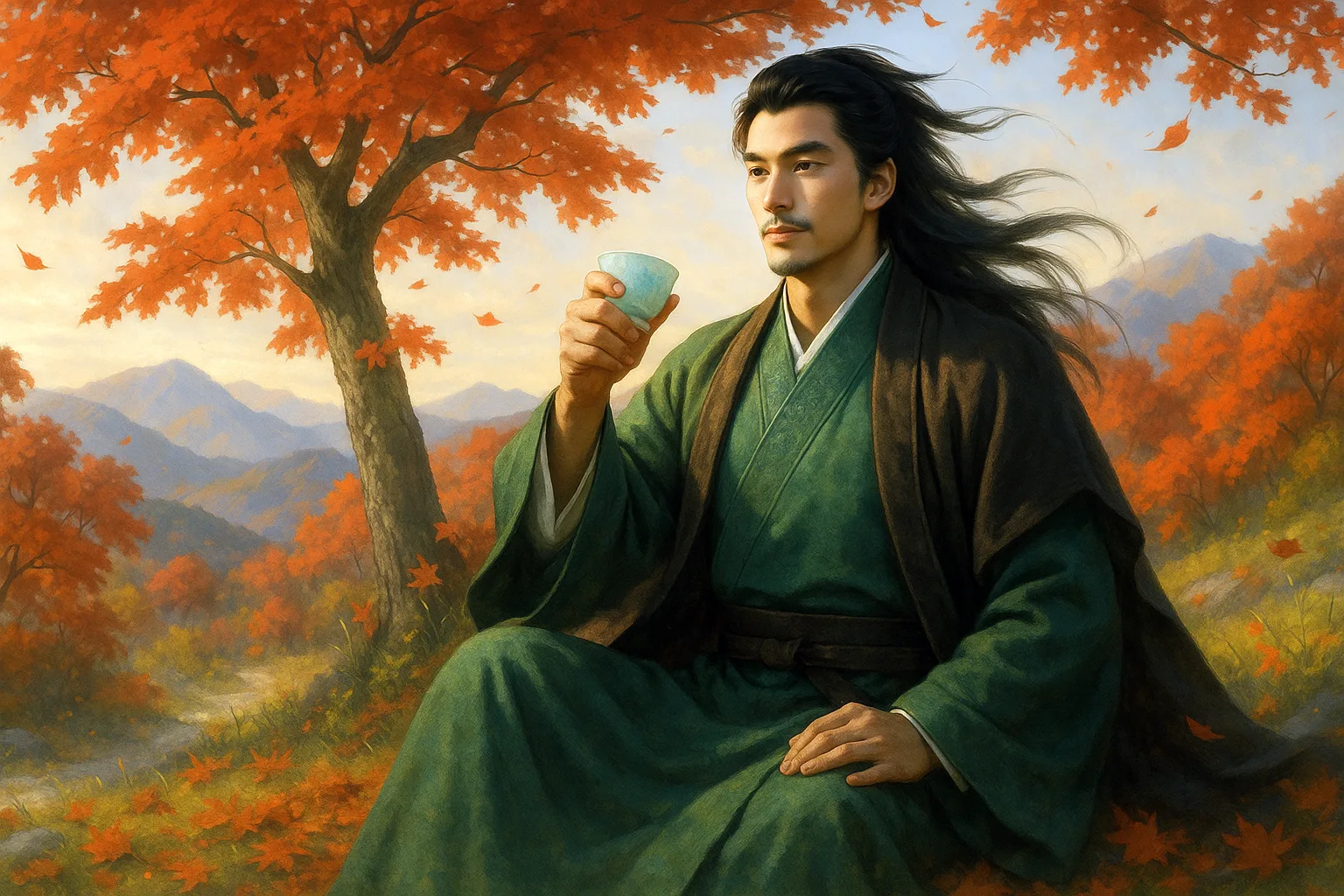
Du Mu (杜牧), 803-853 AD, was a native of Xi'an, Shaanxi Province. Among the poets of the Late Tang Dynasty, he was one of those who had his own characteristics, and later people called Li Shangyin and Du Mu as "Little Li and Du". His poems are bright and colorful.