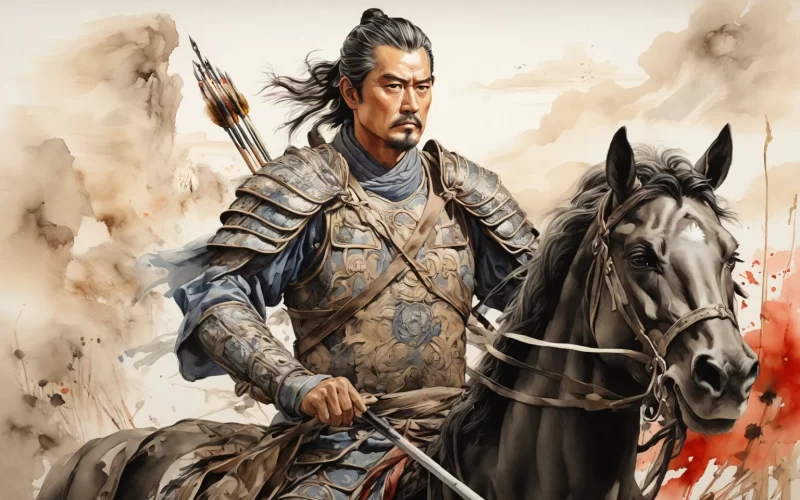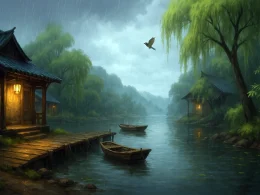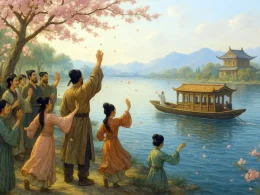



In snow our men did fight,
Half of them died at night.
But letters came next day:
Winter clothes on the way.
Original Poem
「塞下曲」
许浑
夜战桑乾北,秦兵半不归。
朝来有乡信,犹自寄寒衣。
Interpretation
This poem is an excellent frontier poem by the late Tang poet Xu Hun. Xu Hun, renowned for his skill in writing on historical themes and parting, frequently reflects on traces of the past, lamenting the rise and fall of dynasties. His language is elegant and pure, his conception profound and far-reaching, earning him praise like "A thousand poems by Xu Hun, a lifetime of sorrow by Du Fu." Living in the tumultuous late Tang period, he had a deep observation of and compassion for the suffering war inflicted upon the common people.
The Sanggan River, located in present-day Hebei and Shanxi, was an important geographical point on the ancient frontier and a frequent site of conflict between the Central Plains and northern nomadic tribes. This poem takes a night battle north of the Sanggan River as its backdrop, using extremely economical language to express profound sorrow. The poem does not describe the clash of two armies, nor the generals' strategies; it only records the cruelest statistic—"半不归" (half would not come back), and the most tender detail—"寄寒衣" (sent winter clothes). Those soldiers who died in battle will never receive the winter clothes sent from home; the family members who sent the winter clothes are still gazing towards the frontier, awaiting a reply. By juxtaposing this cold statistic with a warm detail, Xu Hun captures the cruelty of war and the uncertainty of life with piercing clarity, making everyone who reads it ache for the two words "犹自" (still/continue to).
First Couplet: "夜战桑乾北,秦兵半不归。"
Yè zhàn Sānggān běi, Qín bīng bàn bú guī.
We fought a night battle north of River Sanggan; Half of the warriors of the Qin would not come back again.
The poem opens with stark narration. "夜战" (night battle) indicates the time of the battle—fighting in the dark makes the carnage even more intense. "桑乾北" (north of River Sanggan) specifies the location—a crucial frontier point, a place of warfare since ancient times. The next line, "秦兵半不归" (Half of the warriors of the Qin would not come back), uses the word "半" (half) to convey the severity of the casualties. This word "半," without embellishment or modification, is just a cold statistic, yet it forces the reader to imagine the scene behind that "half": how many families lost sons, how many wives lost husbands, how many children lost fathers. The poet does not say "tragic" or "heroic," he only says "半不归" (half would not come back), and the tragedy and heroism are already contained within that number.
Second Couplet: "朝来有乡信,犹自寄寒衣。"
Zhāo lái yǒu xiāng xìn, Yóu zì jì hán yī.
At dawn came a letter from their homeland, alas! Winter clothes were sent them, but they could not be received, alas!
This couplet is the soul of the poem, using the warmest detail to depict the cruelest tragedy. "朝来" (At dawn came) connects temporally with the preceding "夜战" (night battle)—the battle ended last night; the letter from home arrives this dawn. "有乡信" (a letter from their homeland)—three words express the family's concern. That letter from home is perhaps filled with exhortations, longing, and hopes for reunion. However, the next line, "犹自寄寒衣" (Winter clothes were sent them), uses the two words "犹自" (still/continue to) to highlight the futility of this concern. The winter clothes were sent when the man was already dead; the letter arrived when he would not return. These two words "犹自" are the most poignant point in the entire poem: the family is still sending him clothes, still worrying about his warmth, not knowing he can no longer feel the cold or warmth of this world. The previous line's "半不归" (half would not come back) is a cold statistic; the next line's "寄寒衣" (sent winter clothes) is a tender detail. The juxtaposition of this statistic and detail presents the cruelty of war and the uncertainty of life in the simplest yet most shocking way before the reader's eyes.
Holistic Appreciation
This is a divine work among Xu Hun's frontier poems. The entire poem consists of four lines and twenty characters. Using a night battle as a starting point, it juxtaposes the brutality of war with the warmth of family, showcasing the poet's deep compassion for the suffering caused by war.
Structurally, the poem shows a progression from the external to the internal, from the public to the private. The first couplet describes the battlefield—a night battle at Sanggan, half the Qin soldiers not returning—the brutality of public space. The second couplet describes the family—a letter from home at dawn, winter clothes still sent—the warmth of private space. Between the two lines, the poem moves from battlefield to family, from death to concern, from coldness to warmth, creating a powerful contrast that shocks the heart.
Thematically, the core of this poem lies in the interplay between the word "半" (half) and the word "犹" (still). The "半" in "半不归" (half would not come back) is the cruelty of war, the abrupt end of countless lives. The "犹" in "犹自寄" (still sending) is the persistence of familial love, the futility and pointlessness of concern. Between this "半" and "犹" lies the poet's most profound indictment of war: those who died in battle will never again receive the warmth of home; those who sent the winter clothes will never again wait for the one who should receive them. The poet does not speak of sorrow, yet sorrow is evident; he does not speak of condemnation, yet condemnation is already within it.
Artistically, the poem's most moving aspect lies in the contrasting technique of "using warmth to depict cruelty." The poet does not describe the battlefield's river of blood, nor the wretched state of the dead; he only writes of a letter from home and a set of winter clothes. Precisely this most ordinary warmth makes the cruelty seem even more cruel; precisely this simplest concern makes death seem even more unacceptable. The detail of "寄寒衣" (sent winter clothes) makes every reader wonder: if that soldier were still alive, how warm he would feel receiving the clothes; if that family knew he had already died in battle, what their feelings would be while sending the clothes. This use of negative space allows the poem's meaning to extend infinitely in the reader's imagination.
Artistic Merits
- Vivid Contrast, Powerful Juxtaposition: Juxtaposing the brutality of the battlefield with the warmth of the family, the contrast between death and concern creates immense emotional impact.
- Simple Language, Deep Meaning: The entire poem uses not a single ornate phrase, yet each word is poignant, using the simplest language to express the deepest sorrow.
- Small Details Reflecting Larger Themes: Using the sacrifice of one soldier and the delayed arrival of one letter from home to reflect the universal tragedy of countless families shattered by war.
- Skillful Use of Negative Space, Lasting Resonance: Not describing the family's reaction, not describing the soldier's remains, only describing the action of "寄寒衣" (sending winter clothes), allowing the reader to imagine, complete, and feel the pain for themselves.
Insights
This poem, through a night battle and a letter from home, speaks to an eternal theme—The cruelty of war lies not in the corpses strewn across the battlefield, but in those letters from home that will forever wait in vain for a reply, those winter clothes that will never reach the intended hands.
First, it lets us see "the lives behind the numbers." "半不归" (half would not come back)—a simple statistic, behind which are countless living people, countless shattered families. When we read this word "半" (half), do we consider how many mothers' tears, wives' despair, children's bewilderment are hidden within that "half"? It reminds us: The cost of war is never a cold statistic, but the end of every specific life, the shattering of every specific family.
On a deeper level, this poem makes us contemplate "the futility of concern." When the family sent the winter clothes, they did not know he had already died in battle; their concern became a warmth that could never arrive. This "futility" is more heartbreaking than death itself. It tells us: The cruelest aspect of war is not killing people, but rendering love and concern meaningless.
And what is most touching is that "critique without a word of critique" in the poem. The poet does not say war is wrong, does not say the court should not have waged it; he simply tells a story calmly—night battle, half return, letter from home, winter clothes. Yet it is precisely this calm narration that makes everyone who reads it ask: Why? By what right? This technique of "not speaking critique, yet critique naturally appearing" is more powerful than any impassioned indictment.
This poem writes of the frontier in the late Tang, yet allows everyone in times of peace to read a warning from it. The tragedy of "半不归" (half would not come back) is the norm of war. The concern of "寄寒衣" (sending winter clothes) is the instinct of familial love. The poignancy of the two words "犹自" (still) is the chasm between war and familial love that can never be bridged. This is the vitality of poetry: it writes of the wars of the ancients, but one reads the longing for peace shared by all people.
About the poet
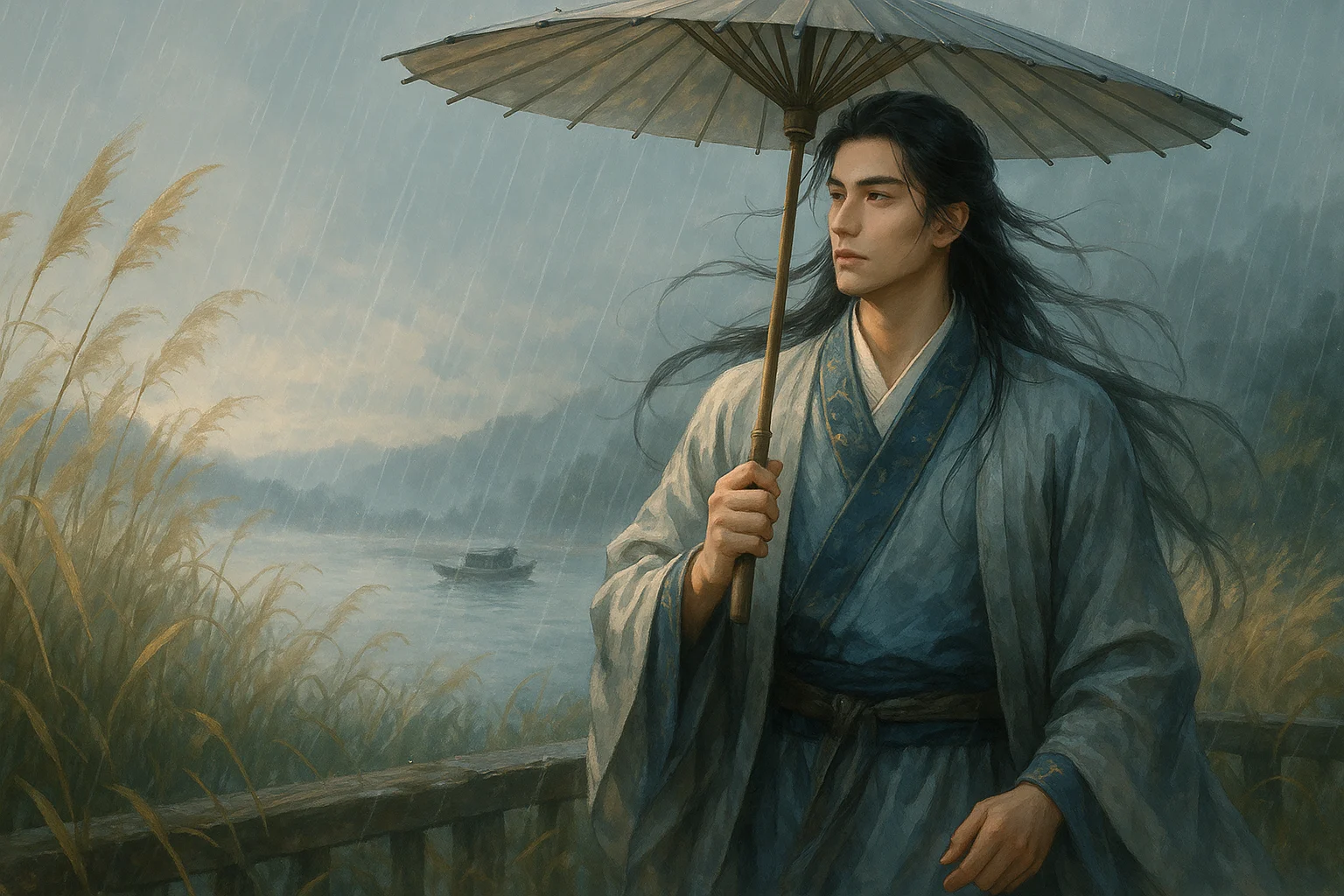
Xu Hun (许浑 c. 788 - c. 858), a native of Danyang, Jiangsu Province, was a renowned poet of the late Tang Dynasty. His ancestor was Xu Yushi, a chancellor during the reign of Empress Wu Zetian, and his family once held prominent status but had declined by Xu Hun's time. He obtained the jinshi degree in the sixth year of the Taihe era (832 AD) and successively served as magistrate of Dangtu and Taiping counties, eventually rising to the position of Vice Director of the Forestry and Crafts Bureau. As an important representative of the late Tang poetic circle, Xu Hun was celebrated for his mastery in depicting water and rain. His poetry often features nostalgic reflections on history, characterized by a desolate and solemn style. He excelled particularly in seven-character regulated verse, with language that is concise, refined, and harmonious in rhythm. Standing apart from Du Mu and Li Shangyin, he established his own distinctive school, exerting a profound influence on later poets such as Wei Zhuang and Luo Yin.