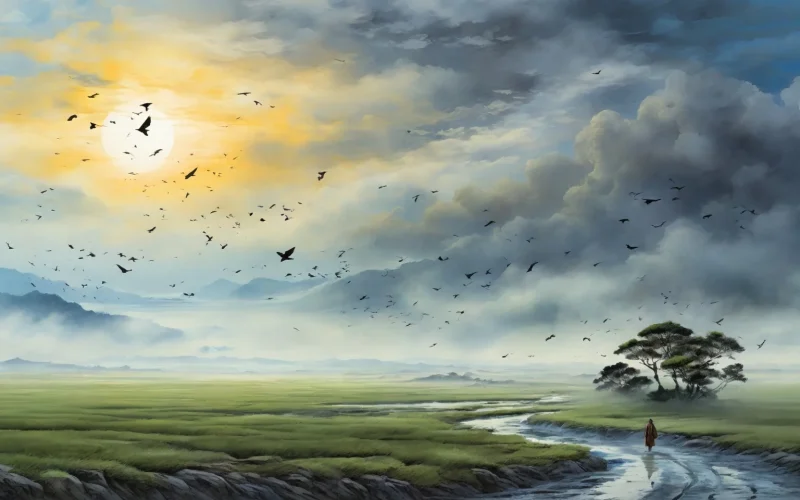
Spring fades when petals on petals fly as they please;
It grieves me to see dots on dots waft in the breeze.
Enjoy the blooms passing away before your eyes;
Do not refuse to drown your grief in wine and sighs!
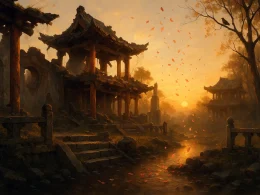
In the riverside halls kingfishers build their nest;
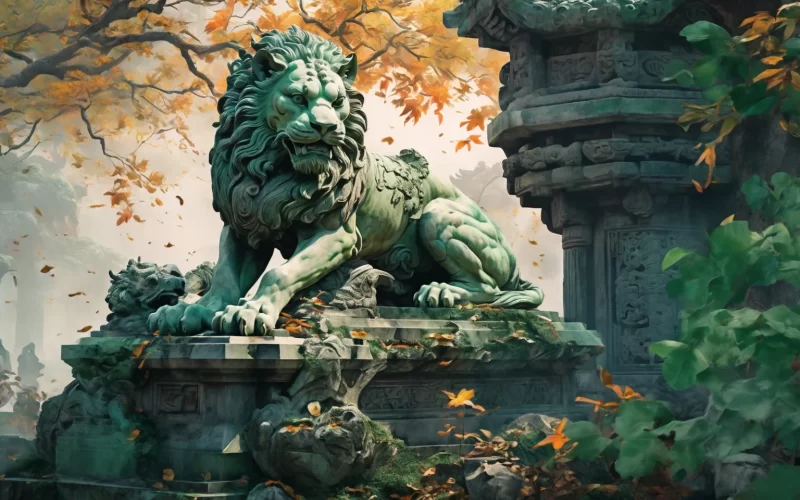
Before the tomb the stone animals lie at rest.
The law of Nature tells us to enjoy as we may.
Why spoil our joy by sheer vanity of the day?
Original Poem
「曲江二首 · 其一」
杜甫
一片花飞减却春,风飘万点正愁人。
且看欲尽花经眼,莫厌伤多酒入唇。
江上小堂巢翡翠,苑边高冢卧麒麟。
细推物理须行乐,何用浮名绊此身。
Interpretation
This poem was composed in the spring of 757 CE, the second year of the Zhide era under Emperor Suzong, while Du Fu was serving in the recaptured capital, Chang'an, as a Reminder of the Left. Although the city had been retaken from the An Lushan rebels, the state remained fragile, and the scars of war were everywhere. In his role as a remonstrance official, Du Fu had provoked the emperor's displeasure by defending the fallen minister Fang Guan and was now sidelined, his ambitions thwarted. The Winding River (Qujiang), once the vibrant symbol of imperial prosperity, lay desolate in the war's wake. Here, Du Fu mourns the passing of spring, yet his true lament is not for the season but for the collapse of a glorious era and the shattering of his own ideals. The poem intertwines profound disillusionment with a stark, philosophical clarity about survival.
First Couplet: “一片花飞减却春,风飘万点正愁人。”
Yī piàn huā fēi jiǎn què chūn, fēng piāo wàn diǎn zhèng chóu rén.
A single drifting petal tells that spring is on the wane; / Ten thousand more wind-blown but deepen the soul's pain.
The opening captures the inexorable passing of spring through a poignant logic of incremental loss and a vision of overwhelming dissolution. "A single drifting petal" exhibits a hyper-sensitive attention to detail, a sharp capturing of the first, faint erosion of spring's perfection. The phrase "tells that spring is on the wane" ingeniously gives the abstract season a tangible, quantifiable quality. Immediately, the image expands to "ten thousand more wind-blown," presenting a grand spectacle of swirling decay where individual, nuanced melancholy is subsumed by a vast, epochal sorrow. The concluding phrase, "deepen the soul's pain," directly anchors this external spectacle to the poet's inner world, establishing the poem's somber, reflective foundation.
Second Couplet: “且看欲尽花经眼,莫厌伤多酒入唇。”
Qiě kàn yù jìn huā jīng yǎn, mò yàn shāng duō jiǔ rù chún.
Then watch the flowers, nearing their end, drift past the eye; / Do not disdain the wine that drowns a grief so high.
This couplet presents a resigned declaration and a form of passive resistance in the face of annihilation. The injunction "Then watch" is a form of almost ruthless observation, demanding a steady gaze upon the entire process of beauty moving toward its "end." This reflects Du Fu's characteristic courage in confronting suffering directly. The second line, "Do not disdain the wine that drowns a grief so high," adopts the classic posture of seeking solace in drink. However, the causal link implied between the depth of sorrow ("a grief so high") and the act of drinking suggests a pain beyond the power of wine to soothe; the drinking itself becomes a tragic, knowing gesture of futility. Watching the falling flowers represents a spiritual endurance, while drinking offers a physical numbing—together, they sketch the poet's state of strained coping within profound disillusionment.
Third Couplet: “江上小堂巢翡翠,苑边高冢卧麒麟。”
Jiāng shàng xiǎo táng cháo fěicuì, yuàn biān gāo zhǒng wò qílín.
By the river, small halls where kingfishers now nest and breed; / By the park, high burial mounds where stone kirins lie, gone to seed.
The focus shifts decisively from nature to the human world, presenting a stark tableau of past glory reduced to present decay. The "small halls by the river" were once elegant pavilions for leisure along the famed Winding River; that they have become nesting grounds for wild "kingfishers" signals the utter absence of human society and the complete obliteration of former cultural refinement. The "high burial mounds by the park" belong to the aristocracy, and the "stone kirins lie"—the mythical guardian beasts toppled beside the tomb paths—visibly declare the ruin of monuments meant to signify eternal power and honor. These silent, fallen kirins speak volumes about the ultimate vanity of worldly achievement. Rendered with dispassionate precision, these lines perform a thorough deconstruction of conventional values like status, fame, and posterity.
Fourth Couplet: “细推物理须行乐,何用浮名绊此身。”
Xì tuī wùlǐ xū xínglè, hé yòng fúmíng bàn cǐ shēn.
Ponder the way of things, and you will see we should seek joy today. / Why let mere hollow fame our mortal lives betray?
Against the layered backdrop of the preceding lines—the passing of spring, the ineffectual solace of wine, the palpable ruins of human ambition—the philosophical conclusion drawn here carries immense weight. It is not frivolous hedonism, but a painful wisdom hard-won from witnessing decay and personal failure. The act of "ponder[ing] the way of things" represents Du Fu's characteristic mode of deep reflection, reasoning out the universal principles of growth, flourishing, and inevitable decline. The deduced imperative, "should seek joy today," does not advocate for mere pleasure, but proposes a life stance of cherishing the tangible present and seeking liberation from attachment, based on the clear-eyed acceptance of transience. The final rhetorical question, "Why let mere hollow fame our mortal lives betray?" is a direct and impassioned rejection of the very pursuit of worldly reputation that has defined his official life. It is both a cry of political frustration and a decisive, if anguished, declaration of a sought-after spiritual freedom.
Holistic Appreciation
This work stands as a pinnacle among Du Fu's regulated verses for its fusion of deep sorrow, philosophical contemplation, and a hard-won, precarious semblance of detachment. It transcends a simple lament for spring, functioning instead as a condensed philosophical epic that "observes the fate of history and the self through the lens of the natural cycle."
The structure is masterfully coherent, with emotion and thought progressing in logical stages: The first couplet uses the imagery of falling blossoms to introduce the theme of impermanence, setting a tone of sorrow. The second couplet, through the dual gestures of watching and drinking, depicts a complex, strained posture in the face of loss. The third couplet employs potent symbols of human ruin—abandoned halls and toppled tomb guardians—to extend the theme of decay from nature to civilization, delivering a silent yet devastating historical critique. The final couplet, building upon this comprehensive vision of dissolution, deduces a personal philosophy of "seeking joy" and renouncing "hollow fame." The movement is from scene to emotion, from emotion to reasoned understanding, achieving a sublimation from visceral lament to a form of intellectual and spiritual resolution.
The poem's core power derives from the sustained tension between "utter despondency" and "consciously willed resilience." The sorrow of the "ten thousand wind-blown" petals, the flowers "nearing their end," the荒芜 spectacle of "stone kirins" in the grass—all point toward a profound existential despair. Yet the conclusion to "seek joy" and spurn "hollow fame" represents a conscious effort to construct a new basis for meaning upon the very ground of that acknowledged despair. The resulting detachment is heavy, fragile, and etched with the lines of suffering, making it profoundly authentic and moving.
Artistic Merits
- The Startling Conception and Logical Precision of the Opening: The line "A single drifting petal tells that spring is on the wane" is a feat of imaginative logic, concretizing and quantifying the abstract season. Using the minimal (a single petal) to signify the maximal (the whole of spring) is a brilliantly economical and poignant conceit that has been celebrated for its depth of feeling.
- The Potent Metaphorical and Symbolic Force of the Imagery: "Halls where kingfishers now nest" and "mounds where stone kirins lie" are not mere descriptions of desolation. They function as powerful, concentrated symbols for the collapse of a flourishing civilization and the vanity of human striving for legacy. These small, specific vistas carry immense historical and critical weight.
- Exquisite Parallelism Laden with Meaning: The parallel structure of the two central couplets is crafted with supreme skill. "Then watch" parallels "Do not disdain" (action vs. attitude). "Flowers, nearing their end" parallels "a grief so high" (object vs. internal cause). "By the river" / "small halls" / "kingfishers now nest" is meticulously balanced against "By the park" / "high burial mounds" / "stone kirins lie" (contrasting spaces and states of being—cultural neglect vs. the ruin of power). This formal elegance serves as the vessel for profound historical melancholy.
- Deeply Personal and Tragic-Inflected Philosophical Reasoning: The dictum "Ponder the way of things, and you will see we should seek joy today" is worlds apart from glib exhortations to carpe diem. It is the fruit of Du Fu's characteristic "pondering," undertaken only after the visceral experience of profound sorrow and the clear-eyed witnessing of historical ruin. It bears the indelible stamp of his personal disappointment and his era's trauma, a quintessential expression of his "deeply poignant and powerfully controlled" poetic style.
Insights
This masterpiece offers enduring insight into "how to reconstruct a sense of purpose and meaning in the aftermath of catastrophic loss and profound disillusionment." Confronting the decay of nature, the ruin of the capital, and the collapse of his public career, Du Fu does not succumb to nihilism. His enacted process is: First, to gaze unflinchingly upon the process of dissolution ("Then watch the flowers, nearing their end"**). Next, to see through and discard the false values exposed by that dissolution (the vanity of *"hollow fame"* embodied in the "high burial mounds"). Finally, to find a basis for life in the clear-sighted acceptance of the way things are ("the way of things"), choosing thereby to "seek joy"—that is, to commit to the tangible reality and value of the present moment.**
For the modern reader, this poem stands as a powerful reminder that genuine resilience and liberation—when confronting personal failure, societal upheaval, or the collapse of long‑cherished ideals—do not arise from escape or from a posture of forced optimism. As Du Fu’s verse demonstrates, they require the unflinching, clear‑eyed understanding that comes from “ponder[ing] the way of things,” and the courage to relinquish the “hollow” attachments that confine us. Only through such honest reckoning can one discover an authentic, grounded way of “seek[ing] joy” within the honest limits of a fragile, transient existence. Ultimately, this “joy” is nothing less than the courage to affirm life once its tragic dimensions have been fully comprehended.
Poem translator
Xu Yuanchong (许渊冲)
About the poet

Du Fu (杜甫), 712 - 770 AD, was a great poet of the Tang Dynasty, known as the "Sage of Poetry". Born into a declining bureaucratic family, Du Fu had a rough life, and his turbulent and dislocated life made him keenly aware of the plight of the masses. Therefore, his poems were always closely related to the current affairs, reflecting the social life of that era in a more comprehensive way, with profound thoughts and a broad realm. In his poetic art, he was able to combine many styles, forming a unique style of "profound and thick", and becoming a great realist poet in the history of China.