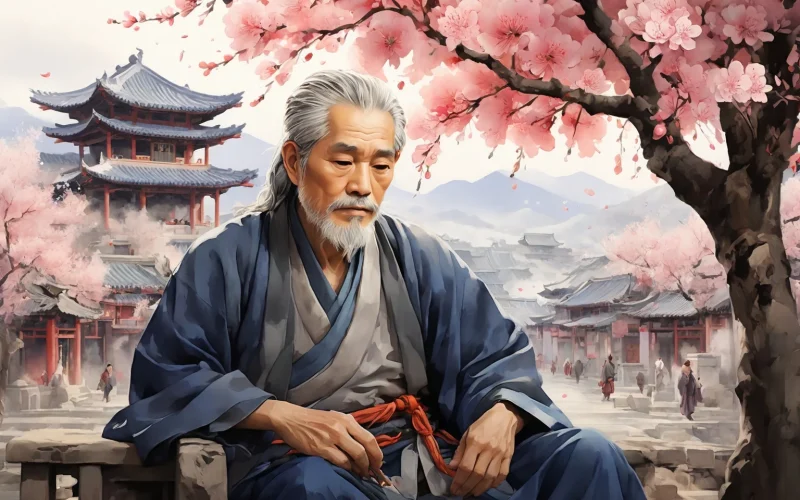



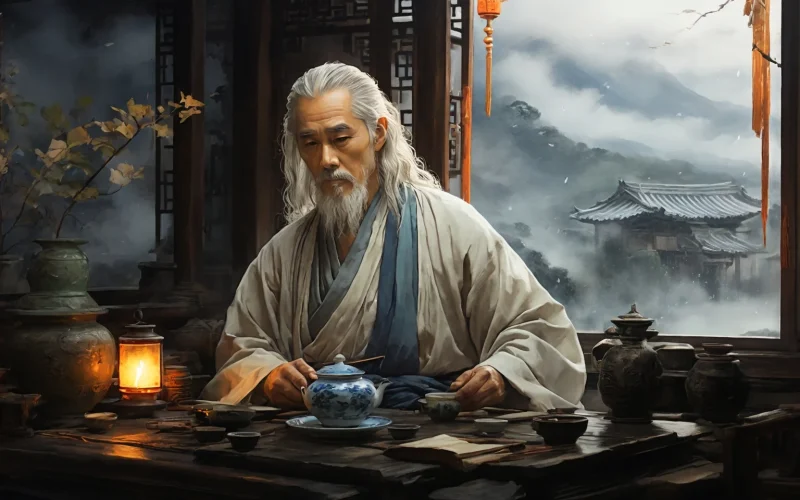
Sitting alone, I grieve over my hair white;
In empty room it approaches midnight.
With the rain I hear in the mountain fruit fall;
By lamplight the insects chirp in my hall.

I cannot blacken my white hair while old,
Nor can I turn a metal into gold.
If you want to get rid of ills of old age,
You can only learn from the Buddhist sage.
Original Poem
「秋夜独坐」
王维
独坐悲双鬓,空堂欲二更。
雨中山果落,灯下草虫鸣。
白发终难变,黄金不可成。
欲知除老病,唯有学无生。
Interpretation
This poem is a quintessential representation of Wang Wei's late style, marked by a profound fusion with Chan (Zen) Buddhist enlightenment. Having endured the political trauma and spiritual anguish of the An-Shi Rebellion, the poet committed himself to Buddhism in his later years. Retiring to his Wang River estate, he delved deeply into Buddhist doctrine. This work is not a conventional lament on autumn and aging. It is a structured, multi-layered Chan contemplation and philosophical inquiry into the essence of life, conducted from within the emptiness of an autumn night's hall. It documents a complete inner journey, beginning with "sorrow," progressing through "contemplative observation," and ultimately arriving at "awakening."
First Couplet: 独坐悲双鬓,空堂欲二更。
Dú zuò bēi shuāng bìn, kōng táng yù èr gēng.
Alone I sit, grieving my temples turned to frost; / The empty hall holds the deep night, the second watch near crossed.
Explication: The opening immediately establishes the posture of Chan meditation—"Alone I sit"—and the central emotion. "Grieving my temples turned to frost" is the direct lament for the body's decay. "The empty hall" describes both the physical solitude of the space and the initial, palpable sense of mental void. "The second watch near crossed" uses the precise advancement of the nocturnal hour to imply the duration of silent sitting and the profound depth of the night, crafting a vessel of time for introspection. These lines establish the poem's foundational tone of isolation, self-reflection, and a penetrating clarity.
Second Couplet: 雨中山果落,灯下草虫鸣。
Yǔ zhōng shān guǒ luò, dēng xià cǎo chóng míng.
Through the rain, I hear mountain fruits their final descent make; / Beneath my lamp, grass-dwelling insects their tiny songs awake.
Explication: This couplet marks the pivotal poetic turn, shifting from inward "sorrow" to outward, focused "observation." With preternatural auditory acuity, the poet apprehends two subtle, natural sounds: "mountain fruits their final descent make" signifies the inevitable, conclusive end of a cycle of growth—a weighty, final fall. "Grass-dwelling insects their tiny songs awake" is the fragile, persistent sound of life in its present, fleeting activity. One sound signifies cessation, the other persistent being; together, they compose the fundamental rhythm of constant arising and passing away within the autumn night's cosmos. These are no longer mere scenic details but the perceived reality of life's momentary appearance and disappearance, known through tranquil attention. The finite pool of lamplight against the boundless dark of the rainy night creates the perfect contemplative field.
Third Couplet: 白发终难变,黄金不可成。
Bái fà zhōng nán biàn, huáng jīn bù kě chéng.
These white hairs, in the end, can never be made black again; / And yellow gold cannot be wrought into an elixir then.
Explication: The focus moves from observing nature's cycles to a clear, rational understanding of human limitation. The first line connects directly to "grieving my temples," using the definitive "can never be made black again" to utterly negate any fantasy of reversing physical aging. The second line extends this negation further: "cannot be wrought into an elixir" dismisses the Daoist alchemical pursuit of physical immortality as a vain delusion. These two lines form a powerful, double negation, sweeping aside worldly attachments to permanence and longevity, thereby clearing the intellectual and spiritual ground for the final realization.
Fourth Couplet: 欲知除老病,唯有学无生。
Yù zhī chú lǎo bìng, wéi yǒu xué wú shēng.
If you would understand how to end age and suffering's blight, / This alone is the way: learn the truth of the Unborn, the sight.
Explication: This couplet delivers the poem's conclusion and resolution, pointing toward the path beyond suffering. "To end age and suffering's blight" does not promise freedom from physical decline, but rather points to a spiritual transcendence—a release from the fear and clinging associated with aging and illness. The phrase "This alone is the way" is absolute, admitting no alternative. "Learn the truth of the Unborn" is the conceptual core of the poem. It points to the essential Buddhist insight into the "unborn" nature of all phenomena—the understanding that arising and ceasing are empty of inherent existence—which liberates one from the fundamental anguish of the cycle of birth and death. Here, the poet's inner state completes its transformation: from personal "sorrow" (first couplet), to attentive "awareness" (second), to discerning "negation" of illusions (third), and finally to transcendent "understanding" (fourth).
Holistic Appreciation
This poem is a meticulously structured "lyric of Chan contemplation and insight." Using "sitting alone" as its formal premise and the "autumn night" as its setting, it delineates four sequentially deepening realms of understanding: the first is the sorrow born of self-attachment; the second is the awakened awareness born of serene observation; the third is the discerning wisdom that shatters delusion; the fourth is the liberating insight that returns to fundamental truth. The four couplets are interlocked, with emotional tone and intellectual reasoning advancing in strict progression. A personal, nocturnal experience is thereby elevated into a philosophical and religious resolution to life's ultimate questions. In poetic form, Wang Wei masterfully illustrates the Buddhist contemplative process where calm concentration gives rise to penetrating wisdom. The resulting poetic atmosphere is one of crystalline stillness and profound depth.
Artistic Merits
- Intense Sensory Focus and Atmospheric Craft: The poet concentrates perception almost exclusively on the sense of "hearing" (the rain, the falling fruit, the insect song). Against a backdrop where sight is naturally limited (by lamplight and night), this auditory focus creates a dimension of immense depth, resonant with the quiet truths of coming-into-being and passing-away. It reflects the powerful focus and penetrating clarity of meditative absorption.
- Philosophical Resonance of Imagery: The natural images carry profound metaphorical weight. "Mountain fruits" in their final fall resonate with the poet's "white hairs," both embodying the inevitable conclusion of a life cycle. The "insects"' present-tense song mirrors the immediate, restless quality of "sorrow." This symbolic correspondence ensures the philosophical exposition remains firmly rooted in the world of sensory experience.
- Logical Precision and Forceful Transitions: The progression from "sorrow" to "observation," to "negation," and finally to "understanding" forms a lucid, compelling intellectual arc. Definitive terms like "can never," "cannot," and "alone" lend the verse a tone of resoluteness, reflecting both the rigor of the poet's discernment and the firmness of his conviction on the path.
- The Austere Maturity and Chan Spirit of the Style: The language is pared down and unadorned, stripped of all ornament, reminiscent of a elder master's discourse—calm on the surface yet potent in meaning. The overall style is serene, cool, and penetrating, exemplifying the characteristics of Wang Wei's final period: "lucid and tranquil, refined and precise," yet possessing a "lofty and profound tone."
Insights
This work rises above ordinary poetic melancholy in the face of mortality. It maps a conscious spiritual path for confronting aging and death. Wang Wei suggests that to face life's inevitable decay, one must first directly acknowledge and feel the attendant sorrow. One must then, through serene, focused attention on the natural world, come to recognize the universal pattern of arising and ceasing that governs all things. This recognition allows one to dismantle the vain fantasies of immortality and permanence. Ultimate peace is found not in defying this pattern, but in awakening to a wisdom that sees through it—the understanding of the "Unborn."
In a contemporary world often gripped by anxiety over aging and the relentless pursuit of youth, this poem offers a profoundly different perspective. It implies that the true answer to time's passage may not lie in a futile struggle against physical change, but in a cultivation of spirit and an awakening of insight that comprehends the deeper nature of existence itself, thereby securing an inner autonomy and peace. The wisdom of "learning the truth of the Unborn" is not passive resignation, but the deepest form of understanding and liberation. It stands as Wang Wei's enduring legacy—a response, steeped in Eastern philosophy, to the great human question of how to live a finite life.
Poem translator
Xu Yuanchong (许渊冲)
About the poet
Wang Wei (王维), 701 - 761 A.D., was a native of Yuncheng, Shanxi Province. Wang Wei was a poet of landscape and idylls. His poems of landscape and idylls, with far-reaching images and mysterious meanings, were widely loved by readers in later generations, but Wang Wei never really became a man of landscape and idylls.