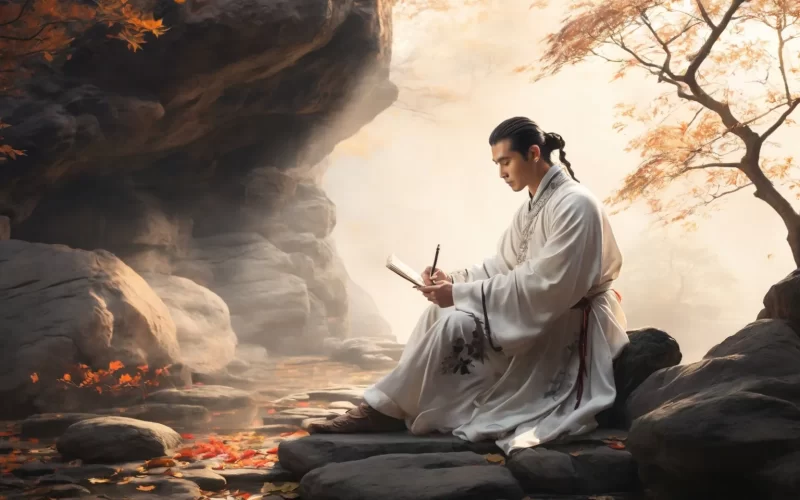

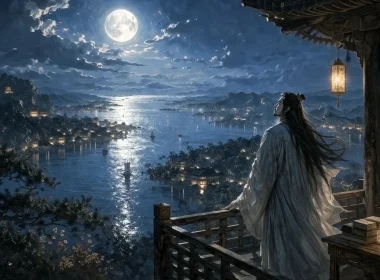
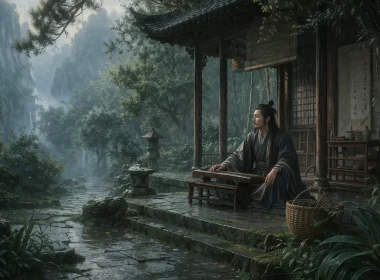
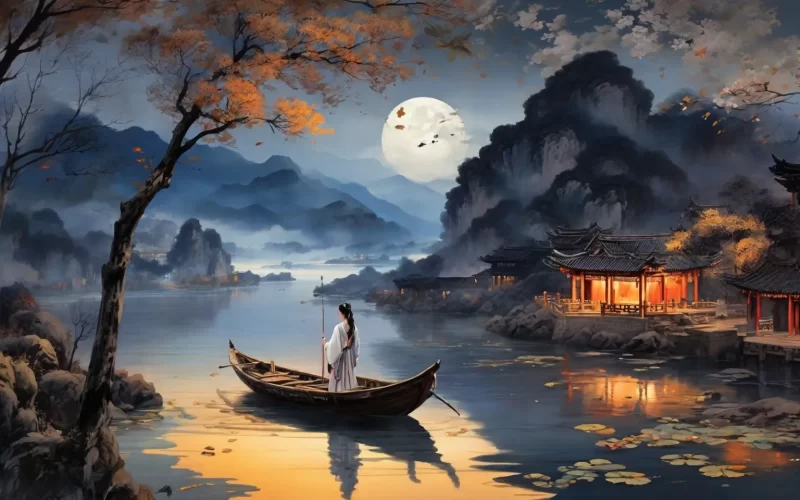
Red leaves whisper at close of day;
At the roadside inn, wine‑gourd I sway.
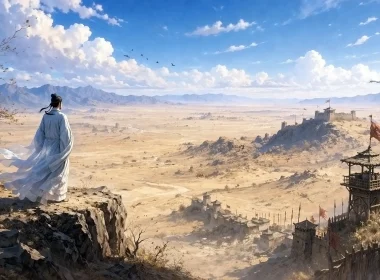
Last clouds drift to Mount Hua’s high crest;
Light rain sweeps the Mid‑Ridge, then to rest.

Tree‑hues fade where the mountains run;
River‑sound seeks the sea, never done.
Tomorrow the capital will be won —
Yet I dream of my fishing‑rod, still, in the sun.
Original Poem
「秋日赴阙题潼关驿楼」
许浑
红叶晚萧萧,长亭酒一瓢。
残云归太华,疏雨过中条。
树色随山迥,河声入海遥。
帝乡明日到,犹自梦渔樵。
Interpretation
This poem is a renowned travel poem by the late Tang poet Xu Hun, composed when he passed through Tong Pass on his way to the capital for the imperial examination. Xu Hun, renowned for his skill in writing on historical themes and parting, is often ranked alongside Du Mu. He frequently reflects on traces of the past, lamenting the rise and fall of dynasties. His language is elegant and pure, his conception profound and far-reaching, earning him praise like "A thousand poems by Xu Hun, a lifetime of sorrow by Du Fu." His official career was fraught with difficulties, repeatedly failing the exams. Though he finally attained the jinshi degree in his later years, he was already disillusioned, possessing a deep understanding of the contradiction between official service and reclusion.
Tong Pass, located in present-day Tongguan County, Shaanxi, lies on the banks of the Yellow River at the foot of the Qinling Mountains. It is the eastern gate of the Guanzhong Plain, a strategic location contested by military strategists since ancient times, and also a place where literati ascended and inscribed poems. The poet was on this journey precisely to go to Chang'an for the imperial examination, seeking fame and fortune. Yet when he ascended the post house tower at Tong Pass and gazed into the distance, what appeared before his eyes was the autumn scenery of "At dusk red leaves are flying," the magnificent landscape of "Lonely clouds sail o'er Mount Hua high; A patch of rain passes o'er Mount Zhongtiao fine." What stirred in his heart, however, was not merely the anticipation of reaching the capital, but also a deep yearning for a life of reclusion. The solitude of "At Riverside Pavilion I drink a cup of wine alone", the vastness of "The verdure of trees merges in mountains green; The river’s roar is lost in ocean’s brine", the reality of "Tomorrow I’ll arrive in royal capital", and the inner world of "Still, I dream of fishermen and woodmen fine" constitute a profound tension. The poet is on the road to the capital, but his heart is in the dream of fishermen and woodcutters; tomorrow he will reach the imperial city, yet tonight he still longs for the mountains and forests. This contradictory state of mind between seeking fame and yearning for reclusion is the most moving aspect of Xu Hun's poem, and also the shared spiritual dilemma of countless Chinese scholars.
First Couplet: "红叶晚萧萧,长亭酒一瓢。"
Hóng yè wǎn xiāo xiāo, cháng tíng jiǔ yì piáo.
At dusk red leaves are flying; At Riverside Pavilion I drink a cup of wine alone.
The poem opens with desolate autumn scenery setting the tone for the traveler's solitude. "红叶晚萧萧" (At dusk red leaves are flying)—five characters depict the desolation of late autumn. Red leaves are the splendor of autumn, yet the phrase "萧萧" (flying) imbues them with a sense of drifting, describing both the scene before the eyes and the feeling in the heart. The next line, "长亭酒一瓢" (At Riverside Pavilion I drink a cup of wine alone), uses "长亭" (Riverside Pavilion) to indicate the place of parting, the site of travel. "酒一瓢" (drink a cup of wine alone) expresses the solitude of drinking alone. This "一瓢" (a cup) and "萧萧" (flying) echo each other, using simple, restrained strokes to convey deep travel melancholy, establishing the poem's desolate yet restrained tone.
Second Couplet: "残云归太华,疏雨过中条。"
Cán yún guī Tài Huá, shū yǔ guò Zhōngtiáo.
Lonely clouds sail o’er Mount Hua high; A patch of rain passes o’er Mount Zhongtiao fine.
This couplet shifts from near to far, pushing the gaze towards the distant mountains and rivers. "残云归太华" (Lonely clouds sail o’er Mount Hua high) describes the scene looking south—Mount Taihua (i.e., Mount Hua) towers majestically; lonely clouds drift towards it. The word "归" (sail o'er) gives the clouds a destination, also subtly containing the poet's own contemplation on finding a destination. "疏雨过中条" (A patch of rain passes o’er Mount Zhongtiao fine) describes the scene looking north—the Zhongtiao Mountain range stretches across; a patch of rain has just passed over it. The word "过" (passes o'er) conveys the rain's hurriedness, also hinting at the passage of time. Between this "归" (sail o'er) and "过" (passes o'er), the clouds have a destination, the rain comes and goes, but what of the poet himself? Tomorrow he will reach the imperial city, but is that his destination? The poet does not say, yet the meaning is already present.
Third Couplet: "树色随山迥,河声入海遥。"
Shù sè suí shān jiǒng, hé shēng rù hǎi yáo.
The verdure of trees merges in mountains green; The river’s roar is lost in ocean’s brine.
This couplet is the highlight of the entire poem, with a grand, expansive realm. "树色随山迥" (The verdure of trees merges in mountains green) describes the extension of vision—the mountain terrain undulates, and the verdure of the trees also stretches with it, reaching the horizon. "河声入海遥" (The river’s roar is lost in ocean’s brine) describes the imagination of hearing—the Yellow River surges, its roar seems to flow all the way to that distant sea. The words "随" (merges) and "入" (is lost)—one describes the vastness of space, the other the magnitude of force—capture the magnificence and vastness of the landscape of Tong Pass in the poet's brush. Standing atop the high tower, what the poet sees with his eyes and hears with his ears is extremely expansive, and his mind broadens accordingly. Yet within this grandeur, there is also a trace of boundlessness—the mountains and rivers are endless, yet human life is finite; the river's roar enters the sea, but where will he himself return?
Fourth Couplet: "帝乡明日到,犹自梦渔樵。"
Dì xiāng míng rì dào, yóu zì mèng yú qiáo.
Tomorrow I’ll arrive in royal capital; Still, I dream of fishermen and woodmen fine.
The final couplet concludes the entire piece with a sudden turn, the soul of the whole poem. "帝乡明日到" (Tomorrow I’ll arrive in royal capital) points out the destination of the journey—Chang'an is just ahead, fame and fortune are almost within reach. Yet the next line, "犹自梦渔樵" (Still, I dream of fishermen and woodmen fine), gently overturns this dream of fame about to be realized. The two words "犹自" (still) are the "poetic eye" of the entire poem: tomorrow I will arrive at the imperial city, yet in my heart I still dream of fishermen and woodcutters; my body is on the road to the capital, but my heart is in the dream of reclusion. This word "梦" (dream) is both a yearning for pastoral life and a hesitation about the path of fame; it is both the voice from the depths of the heart and the poet's ultimate confirmation of his own identity. Tomorrow he will reach the imperial city, yet tonight he dreams of returning to the mountains and forests—this psychology of looking back towards pastoral life just as he is about to reach the pinnacle of fame articulates the shared spiritual dilemma of countless scholars: body in the official world, heart in the rivers and lakes; hastening to the imperial city, dreams remain with fishermen and woodcutters.
Holistic Appreciation
This is a famous piece among Xu Hun's travel poems. The entire poem consists of eight lines and forty characters. Using the journey to the capital in autumn, passing through Tong Pass, as a starting point, it merges the magnificent scenery before the eyes with the inner thoughts of reclusion, showcasing the poet's contradictory state of mind between fame and reclusion.
Structurally, the poem shows a progression from near to far, from scene to emotion, from the concrete to the abstract. The first couplet begins with the immediate scene of "红叶晚萧萧" (At dusk red leaves are flying), uses "长亭酒一瓢" (At Riverside Pavilion I drink a cup of wine alone) to identify the traveler, and evokes the solitary atmosphere of autumn travel. The second couplet expands the view with "残云归太华,疏雨过中条" (Lonely clouds sail o’er Mount Hua high; A patch of rain passes o’er Mount Zhongtiao fine), turning the gaze towards distant Mount Hua and Zhongtiao Mountain. Amidst the flowing clouds and rain, the dynamic beauty of the scene and the subtle fluctuations in the poet's heart reflect each other. The third couplet pushes the view to its extreme with "树色随山迥,河声入海遥" (The verdure of trees merges in mountains green; The river’s roar is lost in ocean’s brine)—the verdure of trees extends with the mountain terrain; the river's roar is lost in the distant sea and sky. The vastness of space and the grandeur of momentum converge here. The fourth couplet shifts from the concrete to the abstract. "帝乡明日到" (Tomorrow I’ll arrive in royal capital) points out the journey's destination, but "犹自梦渔樵" (Still, I dream of fishermen and woodmen fine) provides a sudden turn, gathering the poem's emotion into a yearning for reclusive life. Across the four couplets, the poem moves from near to far, from external to internal, from concrete to abstract, each layer deepening, forming a seamless whole.
Thematically, the core of this poem lies in the three words "梦渔樵" (dream of fishermen and woodmen). The first six lines describe the magnificence of the mountains and rivers, the distance of the journey, the proximity of the imperial city, as if the poet is eagerly heading towards fame. Yet the single line of the final couplet, "犹自梦渔樵" (Still, I dream of fishermen and woodmen fine), gently overturns all of this—tomorrow he will arrive at the imperial city, but what he cannot forget in his heart is the dream of fishermen, woodcutters, and pastoral life. This word "梦" (dream) is both a yearning for reclusive life and a hesitation about the path of fame; it is both the voice from the depths of the heart and the poet's ultimate confirmation of his own identity. This psychology of looking back towards pastoral life just as he is about to reach the pinnacle of fame articulates the shared spiritual dilemma of countless scholars—body in the official world, heart in the rivers and lakes; hastening to the imperial city, dreams remain with fishermen and woodcutters.
Artistically, the poem's most moving aspect lies in the skillful conception of "using scenery to convey emotion, revealing the intent in the final couplet." The first six lines are purely scene description, yet each line builds momentum for the turn in the final couplet. The autumn feeling of "红叶萧萧" (red leaves are flying) reflects inner solitude. The imagery of "残云归山" (Lonely clouds sail o’er Mount Hua) is a metaphor for thoughts of a destination. The hurriedness of "疏雨过山" (A patch of rain passes o’er Mount Zhongtiao) symbolizes the passage of time. The grandeur of "树色河声" (The verdure of trees...; The river’s roar...) is a portrayal of an expansive mind. Every scene is a setup for the emotion; every stroke of scene description lays the groundwork for the final word "梦" (dream). The final couplet concludes abruptly with "犹自梦渔樵" (Still, I dream of fishermen and woodmen fine), revealing the emotion accumulated in the first six lines all at once, making the reader, after the surprise, feel even more deeply the poet's profound and complex inner world. This technique of revealing the intent in the final couplet is precisely the highest realm of classical Chinese poetry's "adding the finishing touch."
Artistic Merits
- Structure Rigorous, Layers Clear: From near to far, from scene to emotion, from concrete to abstract. The four couplets are interlinked, progressing layer by layer.
- Diction Exquisite, Imagery Vast: The word "归" (sail o'er) describes clouds having a destination; "过" (passes o'er) describes rain having movement; "随" (merges) describes the mountain terrain stretching; "入" (is lost) describes the river's roar surging. Each word carries immense weight, the artistic conception vast and far-reaching.
- Revealing Intent in Final Couplet, Powerful Turn: The first six lines emphatically describe the journey to the capital; the final couplet turns abruptly to write of the dream of reclusion. The two words "犹自" (still) reveal the poem's central theme, with lasting resonance.
- Scene and Emotion Blended, Subtle and Profound: Not directly stating the inner contradiction, but conveying it through images like "残云归太华" (Lonely clouds sail o’er Mount Hua) and "河声入海遥" (The river’s roar is lost in ocean’s brine). The language of scenery is the language of emotion; the images of objects are images of the heart.
Insights
This poem, through a journey to the capital, speaks to an eternal theme—While on the road to fame, the heart often harbors the dream of reclusion.
First, it lets us see "the self on the journey." The autumn scenery of "红叶晚萧萧" (At dusk red leaves are flying), the solitude of "长亭酒一瓢" (At Riverside Pavilion I drink a cup of wine alone), the boundlessness of "残云归太华" (Lonely clouds sail o’er Mount Hua), the grandeur of "河声入海遥" (The river’s roar is lost in ocean’s brine)—these are what the traveler sees with his eyes and feels in his heart. It reminds us: Every journey is a conversation with oneself; every landscape may reflect the heart's truest longing.
On a deeper level, this poem makes us contemplate the eternal contradiction between "fame and reclusion." The poet will reach the imperial city tomorrow to pursue fame and fortune, yet in his heart he dreams of fishermen, woodcutters, and pastoral life. This contradiction is not Xu Hun's alone; it is the shared spiritual dilemma of countless Chinese scholars—body in the imperial court, heart in the rivers and lakes; body in the official world, heart in the pastoral fields. It makes us understand: The hardest thing in life is not making a choice, but being unable to let go of another possibility even after choosing.
And what is most evocative is that "犹自" (still) persistence in the poem. Tomorrow he will reach the imperial city, yet in his heart he still dreams of fishermen and woodcutters. These two words "犹自" (still) are both an attachment to pastoral life and a loyalty to oneself. The true self is often not found in glorious achievements, but in those dreams that one "犹自" (still) does not forget.
This poem writes of a journey to the capital in the late Tang, yet allows everyone rushing on life's road to find resonance within it. The autumn scenery of "红叶萧萧" (red leaves are flying) is the landscape in every traveler's eyes. The solitude of "长亭酒一瓢" (At Riverside Pavilion I drink a cup of wine alone) is the taste in every solitary traveler's heart. The persistence of "犹自梦渔樵" (Still, I dream of fishermen and woodmen fine) is the deepest secret in the heart of every dream-chaser. This is the vitality of poetry: it writes the heart's matters of one poet, but one reads the hearts of all those wavering between fame and reclusion.
About the Poet
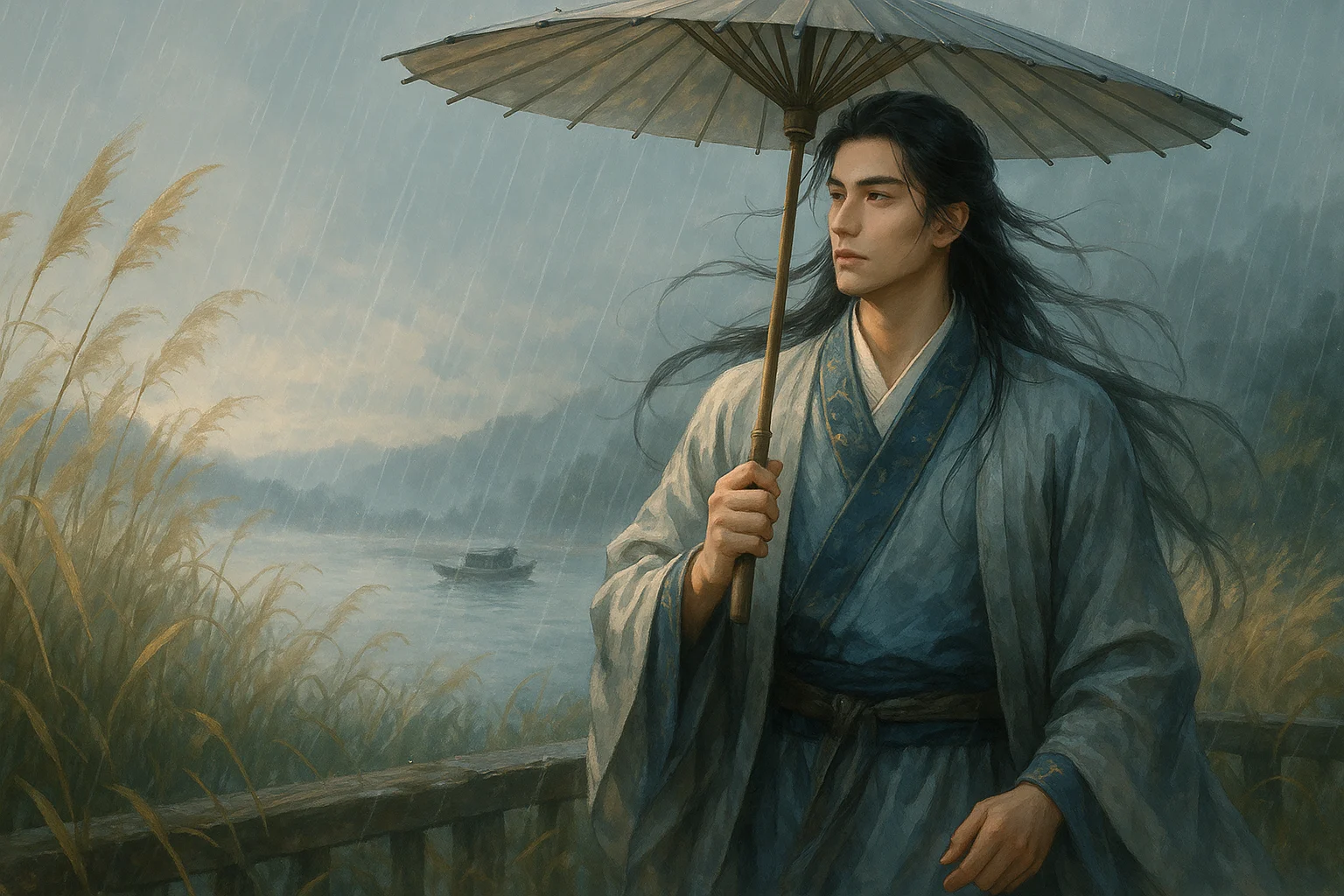
Xu Hun (许浑 c. 788 – c. 858), a native of Danyang, Jiangsu Province, was a renowned poet of the late Tang Dynasty. His ancestor was Xu Yushi, a chancellor during the reign of Empress Wu Zetian, and his family once held prominent status but had declined by Xu Hun's time. He obtained the jinshi degree in the sixth year of the Taihe era (832 AD) and successively served as magistrate of Dangtu and Taiping counties, eventually rising to the position of Vice Director of the Forestry and Crafts Bureau. As an important representative of the late Tang poetic circle, Xu Hun was celebrated for his mastery in depicting water and rain. His poetry often features nostalgic reflections on history, characterized by a desolate and solemn style. He excelled particularly in seven-character regulated verse, with language that is concise, refined, and harmonious in rhythm. Standing apart from Du Mu and Li Shangyin, he established his own distinctive school, exerting a profound influence on later poets such as Wei Zhuang and Luo Yin.