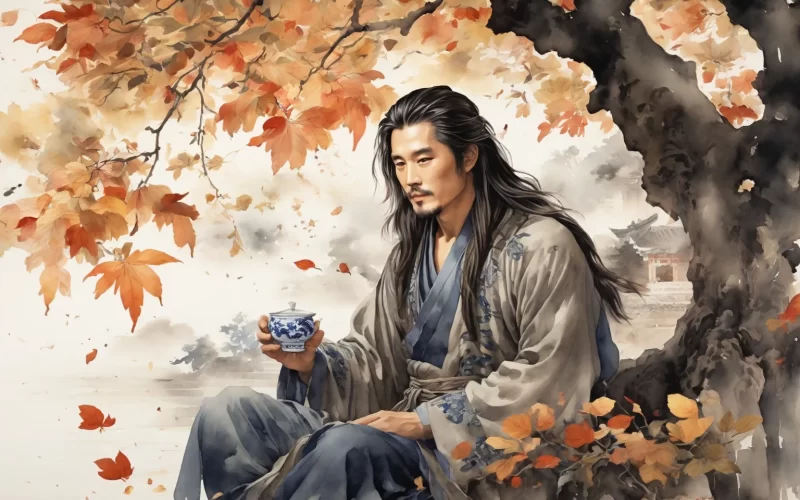




Through all the ages, autumn’s been saddled with lonely sorrow;
Ah, but I tell you, autumn beats the finest spring tomorrow!

Watch — one white crane, into the cloudless blue, ascends and breaks through!
And my soul, singing, follows it, into the boundless blue!
Original Poem
「秋词 · 其一」
刘禹锡
自古逢秋悲寂寥,我言秋日胜春朝。
晴空一鹤排云上,便引诗情到碧霄。
Interpretation
This poem was composed during the Yuanhe era of Emperor Xianzong of Tang, after Liu Yuxi, having participated in the failed "Yongzhen Reforms," was demoted to the position of Marshal of Langzhou. He was thirty-four that year, in the prime of his life, yet he had fallen from a rising star at court to a disgraced official relegated to a remote corner. Langzhou was an isolated, impoverished place, far removed from the political center; his former ambitions now seemed like mere bubbles. By conventional reasoning, such circumstances were enough to make anyone despondent and defeated—and autumn, precisely, was the season when literati traditionally poured out their sorrows. Yet, upon this double-layered backdrop of "sorrow," Liu Yuxi wrote a vibrant, uplifting ode to autumn. He rebelled against the millennium-old tradition of lamenting autumn, boldly establishing his argument with the two words "I, however, say," and using the image of "a lone crane against the clear sky" as a metaphor for his own aspiration, achieving a spiritual soaring amidst adversity. This short poem is a vivid portrayal of his unyielding character and magnanimous spirit.
First Couplet: "自古逢秋悲寂寥,我言秋日胜春朝。"
Zìgǔ féng qiū bēi jìliáo, wǒ yán qiū rì shèng chūn zhāo.
Since time began, autumn's been linked with gloom and sighs,
But I, however, say that autumn beats spring skies.
This couplet begins with a bold, declarative statement. The words "since time began" direct the thrust of his critique towards the entire literary tradition—from Song Yu's "How mournful is the autumn air!" to Du Fu's "A stranger ever mourning autumn's grief, far from home," for a thousand years autumn had been almost synonymous with sorrow. The poet proudly establishes his thesis with the words "I, however, say," pitched as a solitary 'I' against the entire tradition, his confidence and audacity leaping off the page. Even more powerful is the judgment that "autumn beats spring skies"—spring, in the traditional context, symbolizes vitality and hope, yet Liu Yuxi declares autumn superior. This is not merely an evaluation of seasons; it is a declaration of a life attitude: even in the midst of bleak circumstances, one can still live in a manner more splendid than spring.
Second Couplet: "晴空一鹤排云上,便引诗情到碧霄。"
Qíng kōng yī hè pái yún shàng, biàn yǐn shī qíng dào bì xiāo.
A lone crane cleaves the clouds, against the clear blue sky,
And draws my soaring verse up to the azure on high.
This couplet shifts from declaration to scene-painting, yet it transcends mere description. The words "clear blue sky" follow from the previous line's "autumn," highlighting the season's brightness and expansive height. "A lone crane cleaves the clouds" becomes the poem's most striking image. The word "cleaves" is immensely powerful—it is not a leisurely flight, but a forceful bursting through the barrier of clouds, soaring straight to the highest heavens. This crane can be seen as a symbol of the poet's spiritual self: though his exiled body might be confined to Langzhou, his ambition, his poetic spirit, like this white crane, can break through layer upon layer of obstruction, reaching the infinitely vast sky. The line "And draws my soaring verse up to the azure on high" perfectly fuses scene and spirit—as the crane flies towards the azure heights, poetic inspiration follows; object and self, scene and emotion, become one in this moment.
Holistic Appreciation
This short poem, a mere twenty-eight characters, accomplishes a leap of spirit between argument and imagery. The first two lines deconstruct: they break the age-old convention of lamenting autumn, establishing the new thesis that "autumn beats spring skies." The final two lines construct: with the image of the "lone crane against the clear sky," they provide a vivid proof for this claim. The poet does not remain in the realm of abstract reasoning; he allows the truth to reveal itself within the scene—the crane cleaving through the clouds is itself the best evidence that "autumn beats spring skies." The entire poem seamlessly blends reason and emotion with vivid imagery; it possesses both the sharpness of thought and the power of artistic expression, making it one of Liu Yuxi's most widely celebrated works.
Artistic Merits
- Novel Concept, a Rebellion Against Tradition: The poet overturns the literary motif of "lamenting autumn," confronting a millennium of tradition with the words "I, however, say." His viewpoint is unique, his courage extraordinary.
- Perfect Fusion of Argument and Scene-Painting: The first couplet states the thesis; the second provides evidence through imagery. Reason and emotion enhance each other.
- Vivid Imagery with Profound Symbolism: The image of "A lone crane cleaves the clouds, against the clear blue sky" is dynamic and charged with tension. It is both a depiction of autumn scenery and a symbol of the poet's spiritual self.
- Concise Language, Grand Momentum: The poem contains no wasted words; its rhythm is bright and vigorous. Reading it opens one's mind and invigorates the spirit.
Insights
The most important lesson this poem offers is about how to view adversity. When Liu Yuxi wrote this, he was in the midst of exile—politically frustrated, his future uncertain, his ambitions seemingly shattered. By convention, he should have lamented autumn and filled the page with sorrow. Yet he declared, "I, however, say that autumn beats spring skies." This is not blind optimism, but a conscious choice: he chose to see autumn's expansive heights, not its desolation; he chose to be like the crane cleaving through the clouds, not like a withered leaf drifting in the wind.
In our current era, fraught with uncertainty, each of us will encounter our own "autumn"—career bottlenecks, life's pressures, setbacks to our ideals. Through this short poem, Liu Yuxi reminds us: Our circumstances do not determine our state of mind; what truly matters is how we choose to view our circumstances. Autumn can make one lament loneliness, or it can allow one to see a lone crane against a clear sky; adversity can make one despondent, or it can temper a stronger spirit.
Looking deeper, the crane that "cleaves the clouds" also prompts us to contemplate the dignity and transcendence of the individual. When Liu Yuxi imagined himself like the crane, breaking through the clouds to reach the azure heights, he was accomplishing a spiritual flight—though his exiled body was confined to Langzhou, his poetic spirit, his ambition, his dignity as a human being could transcend all the fetters of reality. This spiritual uprightness maintained even amidst hardship is precisely the strength we most need to draw upon when facing life's heavy pressures.
Finally, the poem's composure in solitary communion with the spirit of heaven and earth is especially captivating. Confronting the age-old tradition of lamenting autumn, Liu Yuxi stood proudly opposed with a single word, "I." Facing the adversity of reality, he achieved self-transcendence through the image of a crane. He did not wail or lament; he simply wrote twenty-eight characters quietly beneath the clear sky, yet allowed readers for centuries to come to feel that uplifting and magnanimous energy transcending time and space. This is the mark of true spiritual strength.
About the poet
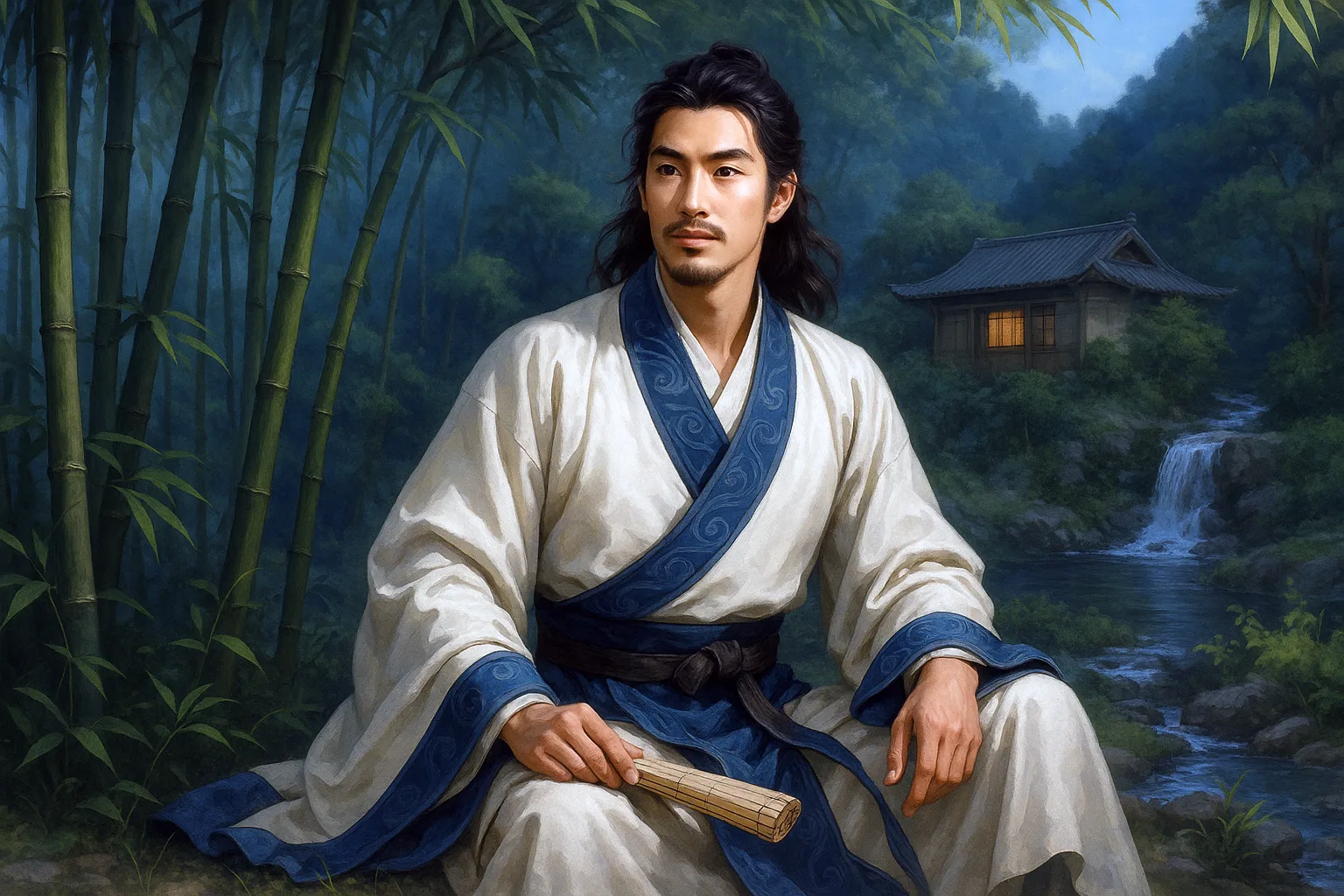
Liu Yuxi(刘禹锡), 772 - 842 AD, was a native of Hebei. He was a progressive statesman and thinker in the middle of the Tang Dynasty, and a poet with unique achievements in this period. In his compositions, there is no lack of poems reflecting current affairs and the plight of the people.