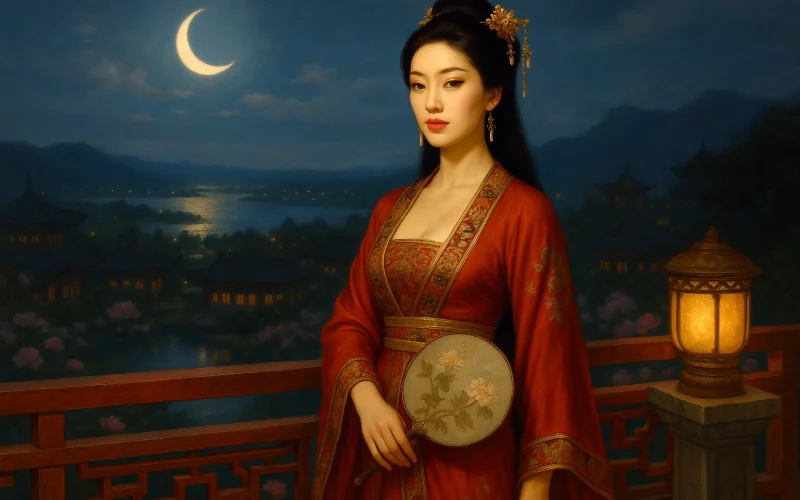



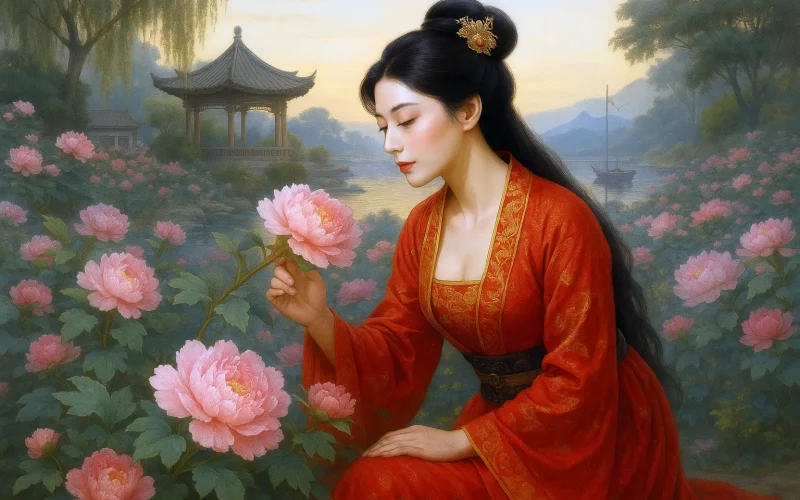
Her robe is a cloud, her face a Ro wer;
Her balcony, glimmering with the bright spring dew,
Is either the tip of earth's Jade Mountain
Or a moon-edged roof of paradise.
Original Poem
「清平调 · 其一」
李白
云想衣裳花想容,春风拂槛露华浓。
若非群玉山头见,会向瑶台月下逢。
Interpretation
This poem was composed in the spring of 743 CE during the Tianbao era. At the time, Li Bai served as a Hanlin academician in Chang'an and was commissioned to compose poems extemporaneously for Emperor Xuanzong and Consort Yang as they admired peonies by the Aloeswood Pavilion in Xingqing Palace. This is the first of three poems in the set. Within the specific context of a court-commissioned work, Li Bai, with his extraordinary imagination and poetic genius, elevated the imperial couple's earthly enjoyment into a celestial realm. Fulfilling the requirement to praise the sovereign while showcasing his unique romantic style, the poem became a groundbreaking masterpiece among Tang court poetry.
First Couplet: “云想衣裳花想容,春风拂槛露华浓。”
Yún xiǎng yīshang huā xiǎng róng, chūnfēng fú kǎn lù huá nóng.
Seeing clouds, one thinks of her gown, flowery and light; Seeing blooms, one imagines her face, a dazzling sight. Spring breeze strokes the balustrade, dew-rich blossoms glow; In morning's radiance, their lush beauty starts to show.
The opening establishes the poem's tone with two exquisite associations. The word “thinks of” is key—it is not mere simile (“like”) but implies an active mental process: seeing clouds evokes thoughts of her robes; seeing flowers conjures her face. This praises Consort Yang’s beauty as inspiring endless reverie while subtly portraying the captivated state of the viewers (the Emperor and the poet himself). “Spring breeze strokes the balustrade, dew-rich blossoms glow” deftly specifies time and place: a spring morning at an imperial pavilion. “Dew-rich blossoms glow” realistically depicts the dewy, radiant peonies while metaphorically suggesting the Consort thriving under imperial favor, in the full bloom of her life.
Second Couplet: “若非群玉山头见,会向瑶台月下逢。”
Ruò fēi qún yù shān tóu jiàn, huì xiàng yáotái yuè xià féng.
If not seen atop Jade-Gem Mountain's height, Then surely met beneath Jade Terrace's moonlight.
The poet elevates praise to its zenith, ascending from the mortal realm to the immortal. “Jade-Gem Mountain” and “Jade Terrace” are both mythical abodes of the Queen Mother of the West, representing the supreme celestial realm. The construction “If not… then surely…” uses a definitive hypothetical to assert that such transcendent beauty belongs not to the mortal world but only to the immortal spheres. This is the highest form of flattery, embodying Li Bai’s characteristic romantic thinking—linking the most beautiful things with mythological imagery, thereby granting them eternal, sacred qualities.
Holistic Appreciation
The poem’s success lies in Li Bai’s achievement of artistic flight within the strict confines of a court commission. Tasked with praising Consort Yang, he eschewed direct description, employing metaphor, association, and mythological symbolism throughout to construct an ethereal, magnificent aesthetic space. In the poem, “clouds,” “blooms,” “spring breeze,” and “dew-rich blossoms” belong to the real world, while “Jade-Gem Mountain” and “Jade Terrace’s moonlight” belong to the imaginary immortal realm. Using Consort Yang’s beauty as the bridge, the poet perfectly connects the tangible and the intangible, making her beauty feel both palpably present (like the flowers and clouds before one’s eyes) and distantly divine (like immortal mountains and jade towers). This approach meets the courtly demand for “nobility” while avoiding sycophantic flattery, resulting in an elegant, ethereal tone. In just four lines, the poem completes a full progression from visual association to spatial transcendence, showcasing Li Bai’s masterful skill in condensing time and space and transforming reality into illusion.
Artistic Merits
- Exquisite Fusion of Metaphor and Association: The metaphors are not static “A is like B” but dynamic “seeing A makes one think of B.” This “interactive” metaphor better engages the reader’s participation and imagination.
- Trinity of Woman, Flower, and Immortal: The poem consistently interweaves three images: Consort Yang, the peony, and the immortal. The “flower” is a metaphor for the Consort, who in turn is the mortal incarnation of the “immortal.” The three reflect and substitute for one another, blurring boundaries and greatly enhancing the praise’s depth and mystique.
- Subtle Court Narrative: Not a single word directly mentions Emperor Xuanzong, yet “spring breeze” and “dew-rich blossoms” hint at imperial favor; “Jade-Gem” and “Jade Terrace” align with the emperor’s longing for an immortal realm of longevity. The Emperor’s role as admirer and possessor subtly exists behind the lines, conforming to the restrained decorum expected of a subject before the sovereign.
Insights
This work shows that true genius can find a crevice for brilliance even in the most constrained creative circumstances. Li Bai’s “Qing Ping Diao” transcends ordinary courtly encomiums, becoming a unique footnote to the High Tang spirit and romantic poetic soul. It reminds us that beauty possesses a transformative power capable of elevating worldly pleasure (an imperial couple admiring flowers) into enduring artistic imagery. Simultaneously, the imagination that attributes ultimate beauty to the immortal realm implies a latent intuition that “perfect things are rarely long preserved in the mortal world,” adding a faint, almost imperceptible strand of philosophical reflection on eternity and impermanence to this resplendent ode.
Poem translator
Kiang Kanghu
About the poet
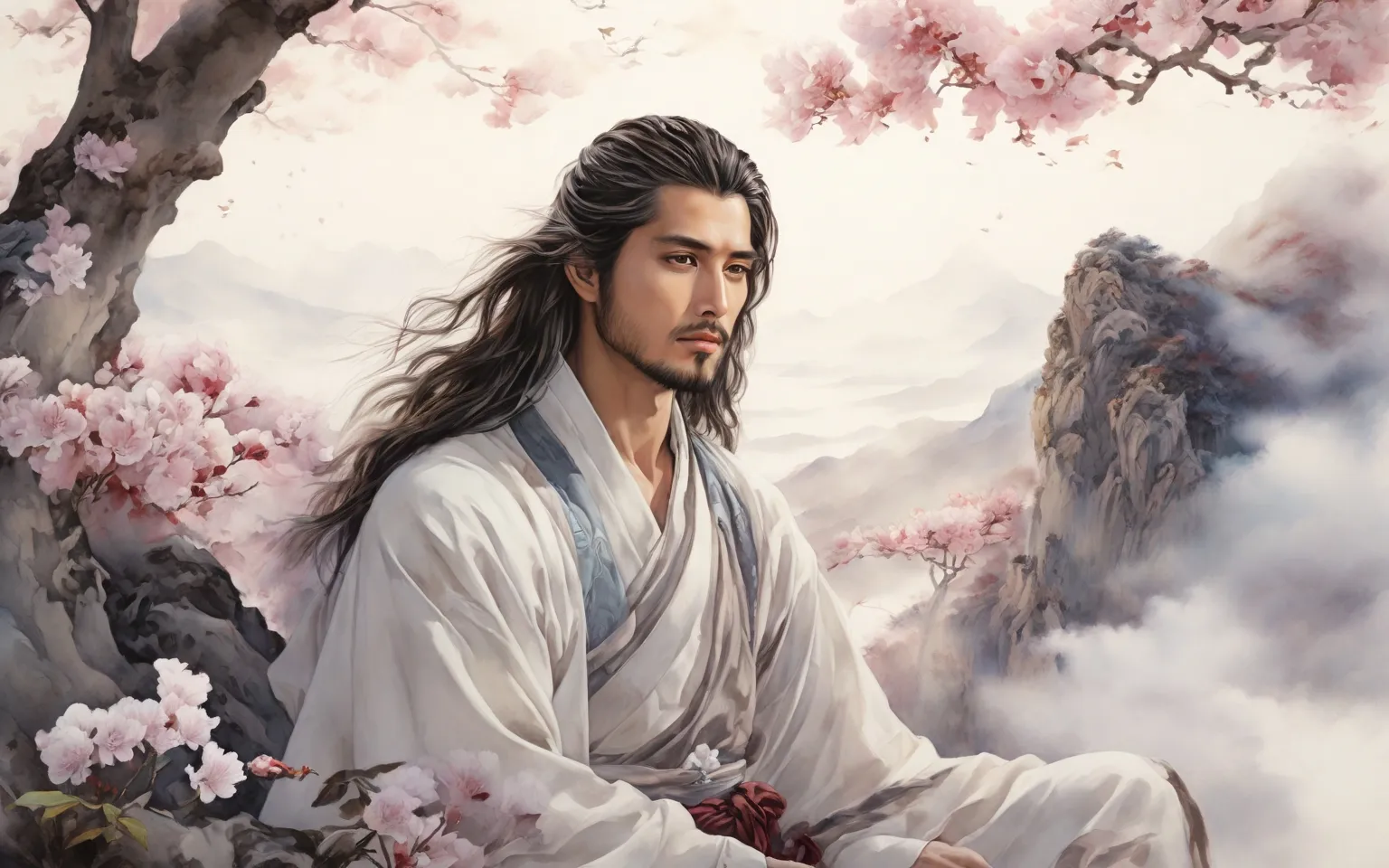
Li Bai (李白), 701 - 762 A.D., whose ancestral home was in Gansu, was preceded by Li Guang, a general of the Han Dynasty. Tang poetry is one of the brightest constellations in the history of Chinese literature, and one of the brightest stars is Li Bai.