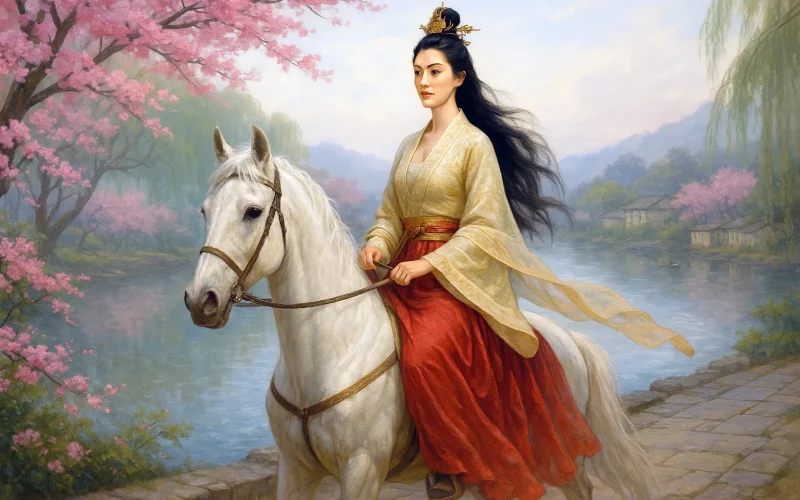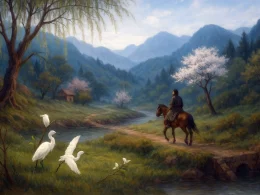

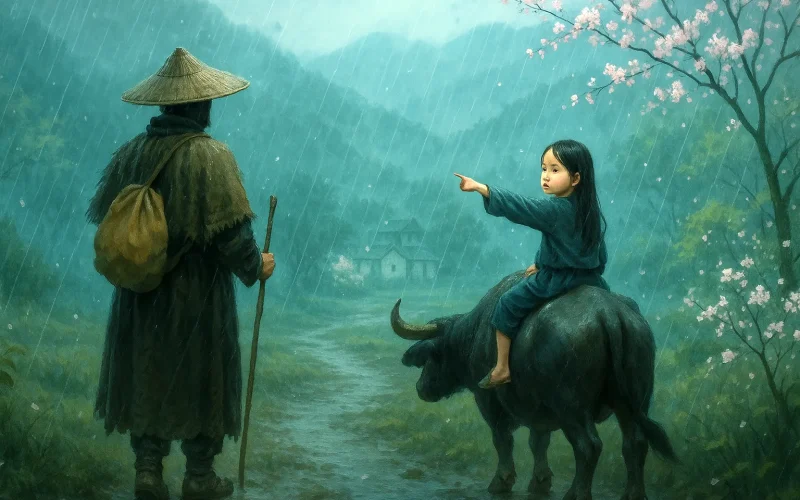
It drizzles thick and fast on the Mourning Day;
The traveller’s heart is breaking on his way.
“Is there a public house somewhere, cowboy?”
He points at Apricot Bloom Village far away.
Original Poem
「清明」
杜牧
清明时节雨纷纷,路上行人欲断魂。
借问酒家何处有,牧童遥指杏花村。
Interpretation
This poem is believed to have been composed during the Taihe reign period of Emperor Wenzong of Tang (approximately 827-835 AD), a time when Du Mu was in his youth, serving as an official and traveling in the Jiangnan region. Although its precise date of composition cannot be firmly established, the emotions and artistic conception it conveys deeply resonate with the poet's state of mind during his early years of itinerancy. As one of the most widely disseminated and profoundly influential works in classical Chinese poetry, this poem has far transcended ordinary literati lyricism, evolving into a shared cultural memory and emotional touchstone for the nation at a specific season.
The poem's classic status stems first from its unparalleled visual immediacy and emotional universality. It captures the most characteristic weather of the Qingming season (the continuous drizzle) and a quintessential human state (the traveler's profound melancholy), using exceptionally accessible yet precise language to merge the natural scenery of a specific solar term with the universal flavor of life's journey. Secondly, it creates an infinitely extendable poetic space—"Apricot Blossom Village" is not a specific geographical location but a literary image embodying warmth, solace, and hope, allowing readers across generations to project their own emotions and imaginations onto it. Precisely because of this, the poem has broken through temporal and spatial constraints to become the quintessential literary expression of the Qingming Festival within Chinese culture, its influence even extending into the realms of folklore, wine culture, and commercial branding (e.g., Xinghuacun wine). With merely twenty-eight characters, Du Mu accomplished an exquisite and enduring distillation and shaping of collective sentiment.
First Couplet: 清明时节雨纷纷,路上行人欲断魂。
Qīngmíng shíjié yǔ fēnfēn, lùshàng xíngrén yù duànhún.
A drizzling rain falls like tears on the Mourning Day; The mourner's heart is breaking on his way.
The opening line establishes the theme, layering elements to set the atmosphere. "Mourning Day" (Qingming) specifies the time; "drizzling rain falls like tears" describes the weather. Their combination immediately anchors the poem's distinct seasonal context and visual tone. The phrase "falls like tears" not only depicts the dense, misty quality of the spring rain but also conveys a psychological texture of pervasive, lingering sorrow. Within this backdrop of generalized springtime melancholy, the "mourner" (traveler) appears. "Is breaking" is the emotional core of the entire poem. Through vivid, somewhat hyperbolic language, it condenses the fatigue of travel, the loneliness of solitude, the wistfulness of the season, and even an awareness of life's transience into a visceral, almost physical, psychological weight. These three characters carry immense emotional force, yet are rendered through straightforward description, achieving a classic expression of grief that is profound yet restrained, sorrowful yet not despairing.
Second Couplet: 借问酒家何处有?牧童遥指杏花村。
Jièwèn jiǔjiā hé chù yǒu? Mùtóng yáo zhǐ Xìnghuā Cūn.
Where is a tavern to drown his sorrows, someone pray? A cowboy points to Apricot Bloom Village far away.
Against the heavy sorrow established in the previous couplet, these lines introduce a turn, a shift toward hope, through dynamic dialogue. "I ask" represents an active gesture seeking respite. Here, wine is not merely sustenance against the chill but a cultural symbol for soothing the spirit and temporarily easing cares. The choice of the respondent, a "cowboy," is highly artful: his innocence and simplicity stand in sharp contrast to the traveler's heavy-heartedness; his rustic identity also suggests the simple and unadorned nature and reliability of his answer. Most masterful is the gesture toward "Apricot Bloom Village far away." The act of pointing into the distance itself creates a sense of space and pictorial quality, while "Apricot Bloom Village" is a composite image appealing to sight (blossoms), smell (fragrance), warmth (the wine), and human community (village). It is not an immediately visible reality but a distant destination symbolizing warmth and refuge, a place one must journey toward. This gesture points not merely to a location but to a thread of hope, a possibility, lifting the poem from somberness toward openness, from despondency toward promise.
Holistic Appreciation
This heptasyllabic quatrain resembles an exquisitely concise yet infinitely suggestive Song dynasty ink sketch, or a subtle, meaningful miniature drama full of poignant turns. It successfully captures and crystallizes the most classic poetic moment of the Qingming season and, within this frame, traces a complete emotional journey from "being enveloped by rain" to "seeking solace in wine" to "glimpsing the village."
The two couplets form a delicate contrast in mood and rhythm. The first is heavy, dense, and inwardly contracting ("drizzling," "breaking"); the second is lighter, brighter, and outwardly directed ("I ask," "points… far away"). This contrast is not a rupture but a natural evolution and elevation of emotion: it is precisely the extremity of sorrow conveyed by "heart is breaking" that generates the pressing need expressed in "Where is a tavern?"; and the cowboy's gesture in response offers a poetic outlet for that sorrow. Against the gray backdrop of "rain," the poem sketches the lonely figure of the "mourner," concluding with the bright prospect of "Apricot Bloom Village," finding hope within melancholy and warmth within bleakness, achieving the highest aesthetic ideal of expressing sorrow with restraint and conveying depth through suggestion.
Artistic Merits
- Profound Simplicity, Eternal Accessibility: The poem uses no obscure characters or recondite allusions, relying purely on the plainest language to depict a scene and outline a dialogue. Yet words like "drizzling," "breaking," and "points… far away" are chosen with perfect precision, bearing immense emotional and imaginative weight within an extremely simple form, accomplishing the highest artistic challenge: profound meaning expressed with simplicity. This is the fundamental reason for its enduring popularity.
- Classical and Symbolic Imagery: "Qingming rain," "traveler on the road," "tavern," "cowboy," "Apricot Bloom Village"—each image is an archetype distilled from common life. Combined, they create a highly concentrated, deeply resonant emotional template, enabling readers from different eras and circumstances to find a point of connection, thereby elevating personal sentiment into collective resonance.
- Perfect Fusion of Narrative and Imagery: The poem contains a complete miniature narrative: setting the temporal scene, describing a figure's state, a dialogue, and a gesture. Simultaneously, each line forms a distinct visual image, together woven into a compact, richly evocative poetic vignette. This quality of possessing both narrative flow and pictorial stillness lends the poem a vivid, almost cinematic quality.
- The Expansive Space of Poetic Suggestion: The poem ends abruptly with "points to Apricot Bloom Village far away." Does the traveler reach it? What is the tavern like? Is his sorrow eased? The poet leaves this unsaid. This deliberate silence places the answers and lingering resonance entirely with the reader, allowing "Apricot Bloom Village" to become an open-ended, warmly suggestive poetic destination, enabling the poem's artistic conception to expand infinitely within the reader's imagination.
Insights
This short poem of only four lines has endured for a millennium and touched countless hearts precisely because it reveals a timeless metaphor for life and circumstance: Life is a journey, and we inevitably encounter moments of hardship akin to "a drizzling rain," sinking into moods as low as "the heart is breaking." The "Qingming rain" in the poem is both a natural phenomenon and a symbol of the unforeseen adversity, uncertainty, and sorrow encountered in life.
However, Du Mu's wisdom lies in not allowing the traveler to drown in grief. The line "Where is a tavern to drown his sorrows?" embodies a resilience that actively seeks comfort and a path forward. It tells us that when feeling that the "heart is breaking," what matters is not to be utterly consumed by emotion but to maintain the will and take action to seek warmth and support from the world outside. The response, "A cowboy points to Apricot Bloom Village far away," symbolizes that hope often appears in simple, unadorned forms; it may come from a chance encounter, pointing toward a possibility that is perhaps not so distant and is full of vitality.
Ultimately, this poem offers us a philosophy for living that finds warmth within desolation and holds hope amidst hardship. It reminds us that life's "Mourning Days" may come often, but we need not remain forever "heartbroken." We can be the "traveler" who asks for directions in the rain, preserving a longing for warmth; we can also be the "cowboy" who points the way, offering others a thread of guidance and hope. And that "Apricot Bloom Village" need not be a concrete destination; it more profoundly represents the undying belief in beauty, peace, and solace within our own hearts—as long as we hold this belief and are willing to take steps in search of it, even the most persistent drizzle will eventually lead toward a place where spring warms and flowers bloom.
About the poet
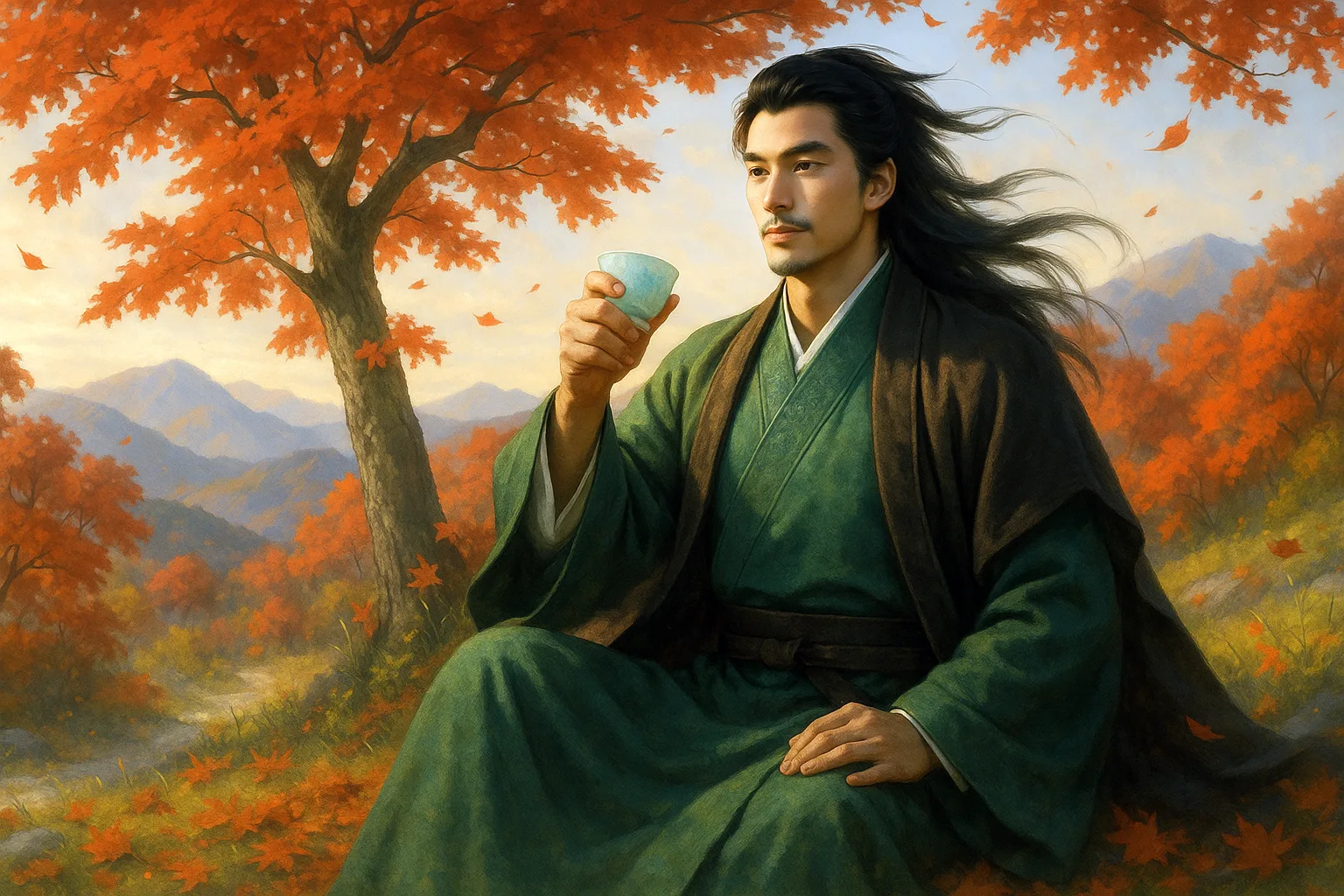
Du Mu (杜牧), 803 - 853 AD, was a native of Xi'an, Shaanxi Province. Among the poets of the Late Tang Dynasty, he was one of those who had his own characteristics, and later people called Li Shangyin and Du Mu as "Little Li and Du". His poems are bright and colorful.