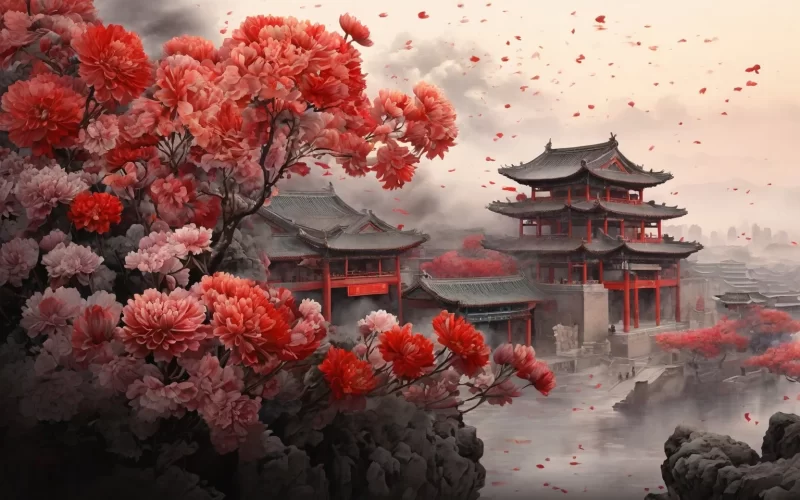



Like rugged hills hangs gilt-edged cloud;
The sunset sheds departing ray.
The wicket gate with birds is loud,
When I come back from far away.
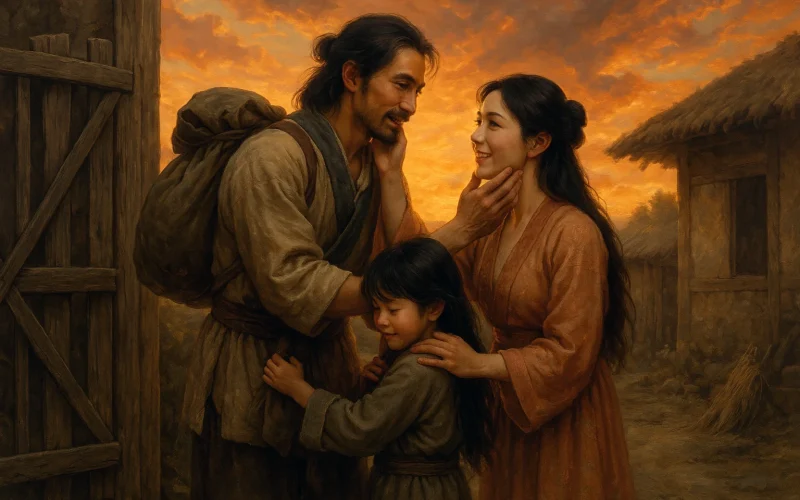
At my appearance starts my wife;
Then calming down, she melts in tears.Happy,
I come back still in life,
While people drift in bitter years.
My neighbors look over the wall;
They sigh and from their eyes tears stream.
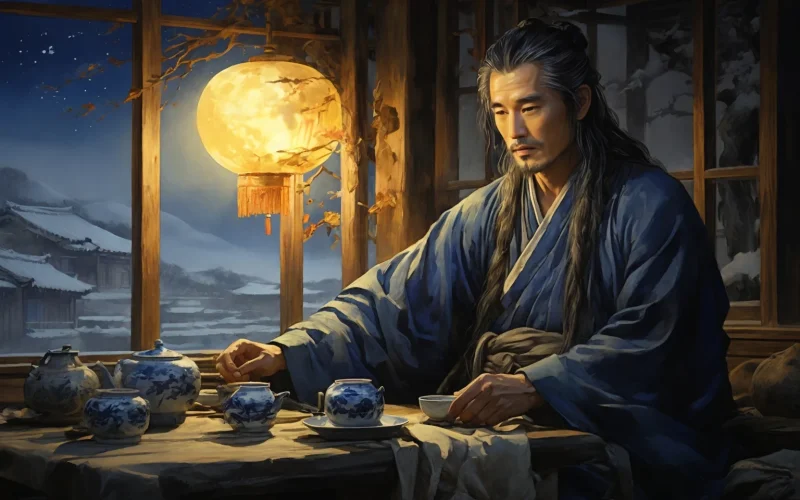
When night comes, candles light the hall;
We sit face to face as in dream.
Original Poem
「羌村 · 其一」
杜甫
峥嵘赤云西,日脚下平地。
柴门鸟雀噪,归客千里至。
妻孥怪我在,惊定还拭泪。
世乱遭飘荡,生还偶然遂。
邻人满墙头,感叹亦嘘欷。
夜阑更秉烛,相对如梦寐。
Interpretation
In 757 CE, the second year of the Zhide era under Emperor Suzong, Du Fu offended the emperor by pleading on behalf of Fang Guan and was consequently sent away from court to visit his family in Qiang Village, Fuzhou. The An Lushan Rebellion was at its peak, the land was shattered, and the people lived in destitution. Having endured the ordeal of being trapped in Chang'an, fleeing on foot, receiving and then losing an official post, the poet finally made his way home through the cracks of war. This poem, the first of the "Three Poems from Qiang Village," was composed upon his initial return. With the plainest brushstrokes, it etches a scene of mingled grief and joy in a chance reunion amidst the chaos of the age, reflecting a slice of fate common to ordinary families of that time.
First Couplet: 峥嵘赤云西,日脚下平地。
Zhēngróng chì yún xī, rìjiǎo xià píngdì.
Like crimson peaks, the western clouds are massed in fiery state; / The sun's last footsteps tread across the level fields, now late.
The poem opens with majestic language depicting evening. "Like crimson peaks" describes the cloud formations, tinged with red, suggesting the dust of the journey and inner turmoil. "The sun's last footsteps tread" personifies the setting sun, as if heaven and earth are welcoming the traveler home. The imagery is vast yet desolate, establishing the poem's intertwined基调 of sorrow and subdued joy.
Second Couplet: 柴门鸟雀噪,归客千里至。
Cháimén niǎo què zào, guī kè qiānlǐ zhì.
By the wicket gate, the birds are clamoring, loud and clear; / The wanderer returns, a thousand li are ended here.
The focus draws closer to the home. "The birds are clamoring" uses sound to contrast stillness, depicting both a typical village dusk and seemingly echoing the traveler's unsettled heart. "A thousand li are ended here" is plain as speech, yet it condenses all the peril, solitude, and longing of the journey through war-torn lands. The wicket gate remains, the birds clamor as usual, but the man has traversed a long road of life and death through a world in chaos.
Third Couplet: 妻孥怪我在,惊定还拭泪。
Qī nú guài wǒ zài, jīng dìng huán shì lèi.
My wife and children start to see in me a stranger's guise; / Then, shock subsiding, wonder melts to tears within their eyes.
This couplet strikes directly at the dramatic moment of reunion. "Start to see in me a stranger's guise" is the most genuine emotional response in troubled times—the reunion is so unexpected that bewilderment and unfamiliarity arise before joy. "Then, shock subsiding, wonder melts to tears" captures the moving detail of delayed emotional release: only after the initial shock settles do grief and joy break through, and the tears truly belong to the reunion. Within these ten characters lies the渺小 and fragility of the individual amidst war.
Fourth Couplet: 世乱遭飘荡,生还偶然遂。
Shì luàn zāo piāodàng, shēng huán ǒurán suì.
In a world disordered, tossed about, I drifted like a weed; / That I've returned alive is but a chance, a lucky deed.
The poet steps back from the scene to utter a heavy, reverberating sigh. This is a summation of his personal experience, yet even more, a condensation of the era's destiny. The two words, "a chance," weigh a thousand pounds, stripping away all veneer of luck and tenderness to lay bare the randomness and无常 of life in wartime. The tragedy of a chaotic age lies not only in being adrift, but in the fact that mere "survival" must rely on "chance."
Fifth Couplet: 邻人满墙头,感叹亦嘘欷。
Línrén mǎn qiáng tóu, gǎntàn yì xūxī.
The neighbors crowd atop the wall, a full and watching ring; / They sigh, and for my fortune, their lamenting murmurs bring.
The brushstroke turns to the surroundings. The neighbors climbing the wall to look on is not mere curiosity; in an age of war, such survival and reunion had become a form of communal solace and a focus for collective emotion. The composition, "crowd atop the wall," is simple like folk mural art, yet vividly conveys the emotional warmth of mutual reliance within the village community during upheaval.
Sixth Couplet: 夜阑更秉烛,相对如梦寐。
Yèlán gèng bǐng zhú, xiāngduì rú mèngmèi.
So deep the night, we trim the candle's wick to make more light; / We sit and face each other, dazed as in a dream this night.
The poem closes with a scene of profound psychological depth. The flickering candlelight illuminates their faces, and the sense of unreality washes over them again—"dazed as in a dream." The reality of reunion requires confirmation by candlelight and the long night; it needs repeated recognition in silent facing. War shatters daily life and also shatters a person's certainty of reality. This line fully captures the shared psychological trauma and emotional fragility of those who survive catastrophe.
Holistic Appreciation
This poem resembles a "Painting of a Survivor's Nocturnal Reunion," executed with simple, unadorned brushstrokes yet saturated with intense emotion. With a diary-like fidelity, Du Fu records the scenery, events, and feelings of his first evening home, yet within this plain narration unfolds a profound narrative of the era and an inquiry into human nature.
The poem progresses naturally with time and gaze: from the distant crimson clouds to the birds at the wicket gate, from the startled tears of wife and child to the sighs of neighbors, finally arriving at sitting face-to-face by candlelight deep into the night. Superficially a linear account, it is internally woven with multiple tensions—vast nature versus the insignificant individual, external clamor versus internal bewilderment, chance survival versus the inevitable chaos of the age, private grief and joy versus public lament. The poet never directly describes the horrors of war, yet allows every detail to be permeated by its shadow; he never shouts for the joy of reunion, yet allows every gaze and fallen tear to bear the weight of life.
Here, Du Fu reveals another aspect of his "poetic historian" technique: not relying on grand events, but on a single meal, a single candle, a stream of tears, a wall, he captures the true texture and pulse of his time. This poem is not only a record of a personal homecoming but also a microcosm of the fate and emotion of millions of families during the An Lushan Rebellion.
Artistic Merits
- Plain Description, Vivid Detail
The poem eschews ornament, using only plain description. Lines like "start to see in me a stranger's guise," "crowd atop the wall," and "dazed as in a dream" read like verbatim speech, yet strike the heart precisely in their most ordinary places, demonstrating Du Fu's supreme skill in "using common words to convey deep feeling." - Layered Emotion, Moving from External to Internal
The emotion deepens layer by layer: from the personal grief-and-joy of "shock subsiding… tears" to the collective empathy of "neighbors… lamenting murmurs," and finally to the existential bewilderment of "dazed as in a dream." The focus elevates from specific situation to a contemplation of the universal human condition. - Interplay of Concrete and Abstract, Meaning Beyond Image
"A chance" is an abstract reflection, yet it is grounded in the concrete experience of "tossed about"; "dazed as in a dream" is a psychological state, yet it is supported by the concrete scene of "trim the candle's wick." The poet excels at revealing intangible experience within tangible scenes, making the poetic world both grounded and ethereal. - Natural Rhythm, Mirroring the Heart
The contrasts in the poem—between "birds are clamoring" and "shock subsiding… tears," between "crowd atop the wall" and "dazed as in a dream"—create a rhythm of motion and stillness, tension and release, like breathing. This rhythm mirrors the inner cadence of the returning wanderer's unsettled spirit and intermixed grief and joy upon arriving home.
Insights
This work allows us to see that within the great ruptures of history, the most moving moments are often not heroic epics, but the shattered and reassembled daily life of ordinary people. What Du Fu's poetic brush preserves is precisely the "specific person" nearly obliterated by war—their shock, their tears, the candlelight around which they sit, their reunions they can scarcely believe.
The poem reminds us: The weight of life often takes shape between "chance" and "as in a dream." No stability is to be taken for granted; every reunion deserves to be gazed upon by candlelight. In a world filled with uncertainty, the poet, with the line "dazed as in a dream," bequeaths to us an eternal injunction concerning珍惜, survival, and the effort to piece life back together amidst the fragments.
Poem translator
Xu Yuanchong (许渊冲)
About the poet
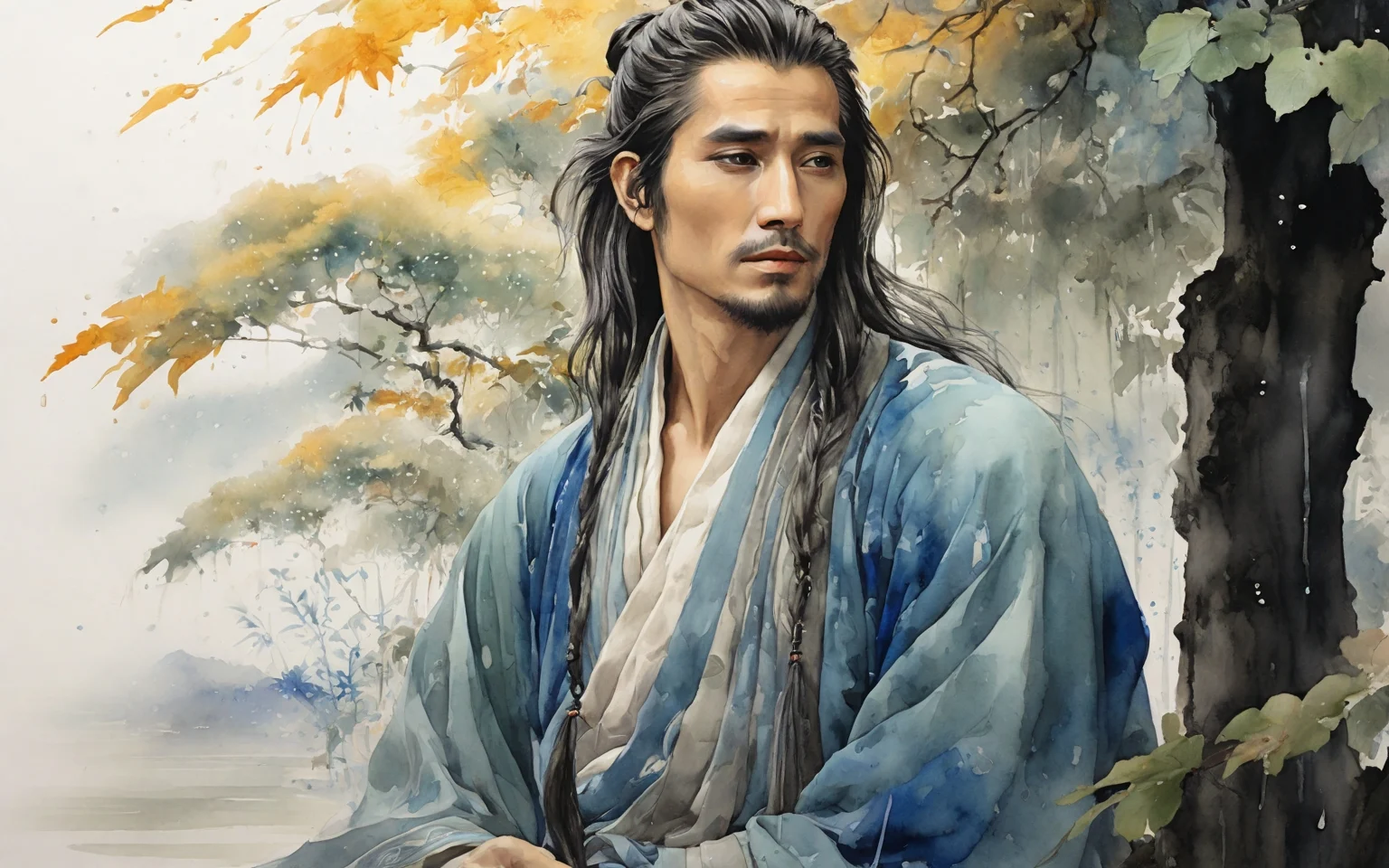
Du Fu (杜甫), 712 - 770 AD, was a great poet of the Tang Dynasty, known as the "Sage of Poetry". Born into a declining bureaucratic family, Du Fu had a rough life, and his turbulent and dislocated life made him keenly aware of the plight of the masses. Therefore, his poems were always closely related to the current affairs, reflecting the social life of that era in a more comprehensive way, with profound thoughts and a broad realm. In his poetic art, he was able to combine many styles, forming a unique style of "profound and thick", and becoming a great realist poet in the history of China.