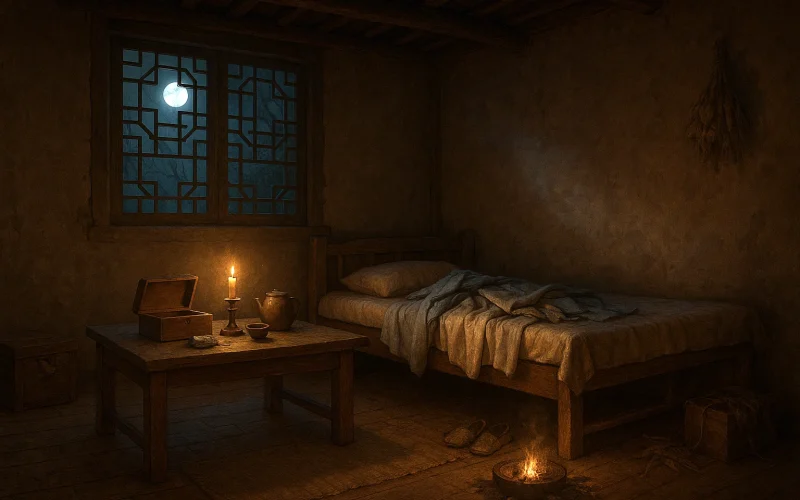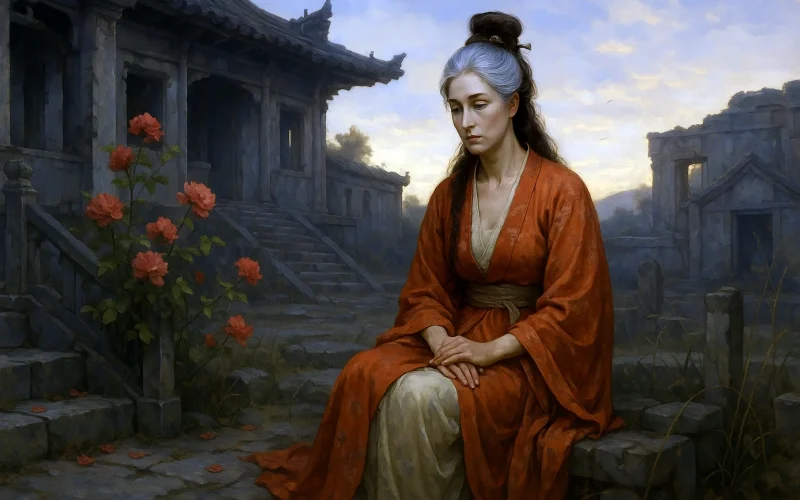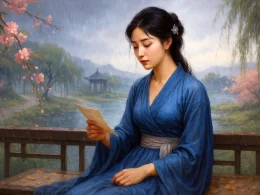


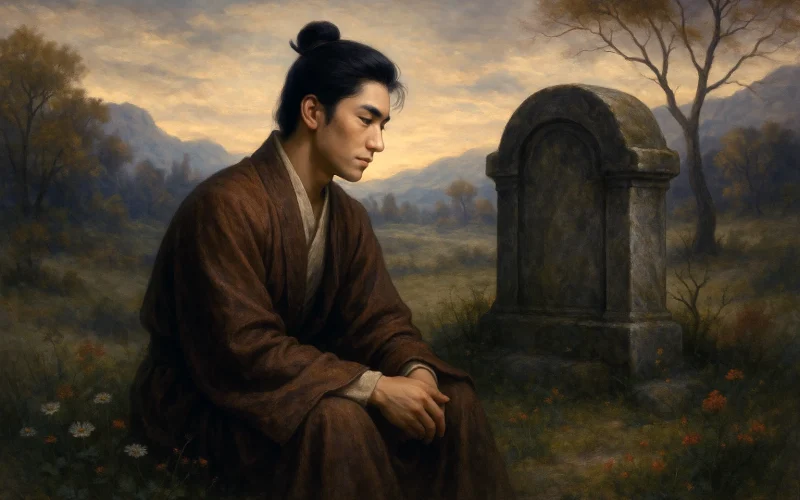
I sit here alone, mourning for us both.
How many years do I lack now of my threescore and ten?
There have been better men than I to whom heaven denied a son,
There was a poet better than I whose dead wife could not hear him.
What have I to hope for in the darkness of our tomb?
You and I had little faith in a meeting after death-
Yet my open eyes can see all night
That lifelong trouble of your brow.
Original Poem
「遣悲怀 · 其三」
元稹
闲坐悲君亦自悲,百年都是几多时?
邓攸无子寻知命,潘岳悼亡犹费词。
同穴窅冥何所望?他生缘会更难期。
惟将终夜长开眼,报答平生未展眉。
Interpretation
This set of poems is by the Mid-Tang poet Yuan Zhen, mourning his deceased wife Wei Cong. It was composed about a year after Wei Cong's death, around the fifth year of the Yuanhe period (810 AD), when Yuan Zhen was serving as a Censor. Yuan Zhen and Bai Juyi passed the imperial examination in the same year and advocated the New Yuefu Movement; together they are known as "Yuan-Bai." His poetic language is plain, his emotions deep and sincere, and he is especially known for the profoundly moving series mourning Wei Cong.
Wei Cong was the youngest daughter of Wei Xiaqing, the Junior Guardian of the Heir Apparent. She married Yuan Zhen at twenty. At that time, Yuan Zhen had not yet achieved fame, and their life was austere. Wei Cong did not despise the poverty, content with a simple life. The couple supported each other through hardship, their affection profound and sincere. However, heaven did not grant them many years. In the fourth year of Yuanhe (809 AD), Wei Cong passed away from illness at the young age of twenty-seven. At this time, Yuan Zhen had already been demoted to Jiangling for offending the eunuchs. Disappointed in his official career, physically and mentally exhausted, he then suffered the pain of losing his wife—his sorrow can be imagined.
This set of poems is a deep emotional recollection of Yuan Zhen's deceased wife's life. This is the third, the final poem of the set, and also the most emotionally intense and profound in thought. Unlike the first two, which recall the past and describe reality, this poem uses philosophical reflection as its thread. Starting with the lament on life and death in "Sitting idly, I mourn for you, and for myself I sigh," and employing the allusions of Deng You's childlessness and Pan Yue's elegies, it exhaustively expresses helplessness against fate's unpredictability and despair for a reunion after death. It concludes with "I can but pass the long night with open eyes / As slight return for your sad life with unlifted brows," transforming his endless longing for the rest of his life into the only "return" he can offer his deceased wife. The entire poem elevates personal grief to a philosophical inquiry into life, fate, and love, making it a model work among elegiac poems for "using reason to express emotion."
First Couplet: "闲坐悲君亦自悲,百年都是几多时?"
Xián zuò bēi jūn yì zì bēi, Bǎi nián dōu shì jǐ duō shí?
Sitting idly, I mourn for you, and for myself I sigh; How long, in truth, is a man’s life, though it seem nigh?
The poem opens with the words "闲坐" (Sitting idly), depicting the poet's listless state. "悲君亦自悲" (I mourn for you, and for myself I sigh)—these five words express a double sorrow: mourning for his deceased wife, and also mourning for his own fate; mourning her early death, and mourning the remainder of his own life. The next line, "百年都是几多时" (How long, in truth, is a man’s life, though it seem nigh?), shifts from sorrow to sigh, elevating the longing for his wife into a lament on the brevity of life. A hundred years of life sounds long, but truly lived, one knows it is but a fleeting moment. This question is directed both at heaven and at himself; it is both a sigh and a sense of helplessness. In this couplet, the poet uses extremely plain language to merge personal grief with a universal lament.
Second Couplet: "邓攸无子寻知命,潘岳悼亡犹费词。"
Dèng Yōu wú zǐ xún zhī mìng, Pān Yuè dào wáng yóu fèi cí.
Deng You, sonless, at last learned Heaven’s will. Pan Yue’s verse mourned his wife, but words are vain still.
This couplet uses two allusions to express the poet's helplessness against fate and his sense of the futility of mourning. "邓攸无子" (Deng You, sonless) alludes to Deng You of the Western Jin Dynasty, who, to save his nephew, abandoned his own son and ultimately died without an heir—the poet says this is fate's arrangement, not to be forced. "潘岳悼亡" (Pan Yue’s verse mourned his wife) alludes to Pan Yue of the Western Jin Dynasty, who wrote three famous elegies mourning his wife—the poet says, even with such deep feeling, it is still just a waste of words; what good does it do the deceased? These phrases, "寻知命" (learned Heaven’s will) and "犹费词" (words are vain still), represent the poet's resignation to fate and also his self-questioning of the act of mourning: what use is writing poetry? What use is longing? The dead will never return. This couplet uses allusions to express despair, writing the poet's inner sense of futility to the marrow.
Third Couplet: "同穴窅冥何所望?他生缘会更难期。"
Tóng xué yǎo míng hé suǒ wàng? Tā shēng yuán huì gèng nán qī.
What hope in the dark, dark grave for our reunion? To meet again in after-life is a vain illusion.
This couplet moves from despair in this life to disillusionment with the next. "同穴窅冥何所望" (What hope in the dark, dark grave for our reunion?) writes of the poet's hope for burial together after death—however, the words "窅冥" (dark, dark) depict the obscurity and unknowability of the world after death; this "hope" is ultimately a vain hope. "他生缘会更难期" (To meet again in after-life is a vain illusion) writes of the poet's hope for rekindling their bond in a future life—however, the phrase "更难期" (is a vain illusion) completely shatters this slender hope. This life is gone, hope for a shared grave is vain; the next life is obscure, a meeting is an illusion. The poet negates all hopes one by one, driving himself into an abyss of despair. This couplet is one of the most poignant lines in the three Thinking of My Deceased Wife poems; with the calmest tone, it writes of the deepest despair.
Fourth Couplet: "惟将终夜长开眼,报答平生未展眉。"
Wéi jiāng zhōng yè cháng kāi yǎn, Bào dá píng shēng wèi zhǎn méi.
I can but pass the long night with open eyes As slight return for your sad life with unlifted brows.
The final couplet is the soul of the entire poem and the ultimate conclusion of the three Thinking of My Deceased Wife poems. "惟将终夜长开眼" (I can but pass the long night with open eyes) writes that for the rest of his life, the poet will stay awake all night—this "长开眼" (with open eyes) is the ultimate expression of longing and also the ultimate expression of pain; it is both insomnia born of inability to sleep and steadfastness born of unwillingness to sleep. The next line, "报答平生未展眉" (As slight return for your sad life with unlifted brows), points to the reason for this "long open eyes"—during Wei Cong's life, due to the hardships of life and her husband's struggles, she often wore a worried brow, seldom relaxed and smiling. Now, all the poet can do is use this all-night vigil of longing to repay her for a lifetime of laboring and worrying for him. The word "报答" (return) is the poet's final promise to his deceased wife, and also his sole solace for the remainder of his own life. In this couplet, the poet uses the simplest language to express the deepest longing and the most poignant guilt.
Holistic Appreciation
This is a divine work among Yuan Zhen's elegiac poems, the third in the set, and also the most emotionally intense and profound in thought. The entire poem consists of eight lines and fifty-six characters. Starting with "Sitting idly, I mourn for you, and for myself I sigh" and concluding with "I can but pass the long night with open eyes," it melds longing for his wife, lament for life, helplessness against fate, and disillusionment with the afterlife into one, showcasing the poet's inextricable grief and deep affection.
Structurally, the poem presents a progression from emotion to reason, from reason to despair, and from despair to deep affection. The first couplet begins with "Sitting idly, I mourn for you, and for myself I sigh," juxtaposing longing for his wife with lament for human life. The second couplet uses the allusions of Deng You and Pan Yue to write of helplessness against fate and a sense of the futility of mourning. The third couplet, with the disillusionment of "What hope in the dark, dark grave" and "To meet again in after-life is a vain illusion," pushes despair to its extreme. The final couplet concludes with "I can but pass the long night with open eyes," transforming all despair into lifelong, all-night-long longing. Between the four couplets, the poem moves from emotion to reason, from reason to despair, from despair to deep affection, each layer deepening, forming a seamless whole.
Thematically, the core of this poem lies in the word "报" (return). That "报答" (return) in "As slight return" is the poet's final promise to his deceased wife, and also his reckoning for the rest of his own life. This word "报" is both a confession of deep affection and a sigh of helplessness—all he can do is this all-night vigil of longing; all he can give is this irreparable "return." With this word "报," the poet transforms all the despair, futility, and disillusionment of the previous six lines into the deep affection of lifelong, all-night-long longing, making the entire poem blossom a flower of deep affection amidst despair.
Artistically, the poem's most moving aspect lies in the ingenious conception of "using reason to express emotion, using allusions to convey meaning." The poet does not directly write how he longs, but uses "How long, in truth, is a man’s life" to write of life's brevity, uses "Deng You, sonless" and "Pan Yue’s verse mourned his wife" to write of fate's helplessness, and uses "What hope in the dark, dark grave" and "To meet again in after-life is a vain illusion" to write of the afterlife's illusoriness. These philosophical reflections progress layer by layer, driving the poet into an abyss of despair; and it is precisely within this despair that the deep affection of "I can but pass the long night with open eyes" appears格外动人 (especially moving). This technique of "using reason to express emotion" elevates the poem beyond personal mourning, giving it universal philosophical depth.
Artistic Merits
- Using Reason to Express Emotion, Profound Philosophy: Using "How long, in truth, is a man’s life" to write of life's brevity, using "Deng You, sonless" and "Pan Yue’s verse mourned his wife" to write of fate's helplessness, using "What hope in the dark, dark grave" and "To meet again in after-life is a vain illusion" to write of the afterlife's illusoriness, elevating personal grief to a philosophical inquiry into life and fate.
- Natural Use of Allusion, Deep Meaning: Using the allusions of Deng You and Pan Yue to write of helplessness and futility, the allusions match the person, the allusions blend with the emotion, with no sense of forcedness.
- Progressive Emotion, Layer by Layer Deepening: Moving from sorrow to sigh, from sigh to helplessness, from helplessness to despair, from despair to deep affection, the emotion between the four couplets progresses layer by layer, striking directly at the heart.
- Concluding with Emotion, Lingering Resonance: The final couplet, "I can but pass the long night with open eyes / As slight return for your sad life with unlifted brows," concludes the entire piece, transforming all despair into affection, condensing endless longing within the three words "长开眼" (with open eyes), where the words end but the meaning is inexhaustible.
Insights
This poem, through a vigil of eternal night, speaks to an eternal theme—When all hope has been shattered, only longing remains the sole connection between the living and the dead.
First, it lets us see "deep affection within despair." The poet negates the hope of a shared grave, negates the expectation of an afterlife, shatters all consolations one by one, driving himself into an abyss of despair. Yet it is precisely within this despair that he finds the only thing he can do for the rest of his life—"pass the long night with open eyes." It tells us: The deepest affection often does not bloom within hope, but is persevered in within despair.
On a deeper level, this poem makes us contemplate "the meaning of return." "As slight return for your sad life with unlifted brows" —the poet knows that no matter what he does, he cannot make up for his wife's toil and worry during her lifetime; yet he still must "return." This "return" is not for her, but for himself; not because she needs it, but because he cannot not do it. It makes us understand: True deep affection is not calculating gain and loss, but doing what one must even knowing it is futile.
And what is most moving is that persistence of "长开眼" (with open eyes) in the poem. Staying awake all night, not because he cannot sleep, but because he is unwilling to sleep; not due to insomnia, but due to longing. These three words, "长开眼," are the poet's final promise to his deceased wife, and also his only reckoning for the rest of his own life—he will use every night of his remaining life to long for her, to accompany her, to "return" to her.
This poem writes of an elegy in the Mid-Tang, yet allows everyone who has lost a loved one and experienced despair to find resonance within it. That double sorrow of "I mourn for you, and for myself I sigh" is the shared sigh of every person who longs. That disillusionment of "What hope in the dark, dark grave" is the shared helplessness of everyone facing death. That perseverance of "I can but pass the long night with open eyes" is the only persistence for the rest of every deeply affectionate person's life. This is the vitality of poetry: it writes of Yuan Zhen's longing for Wei Cong, but one reads of people in all eras who, even in despair, remain deeply affectionate.
Poem translator
Kiang Kanghu
About the Poet
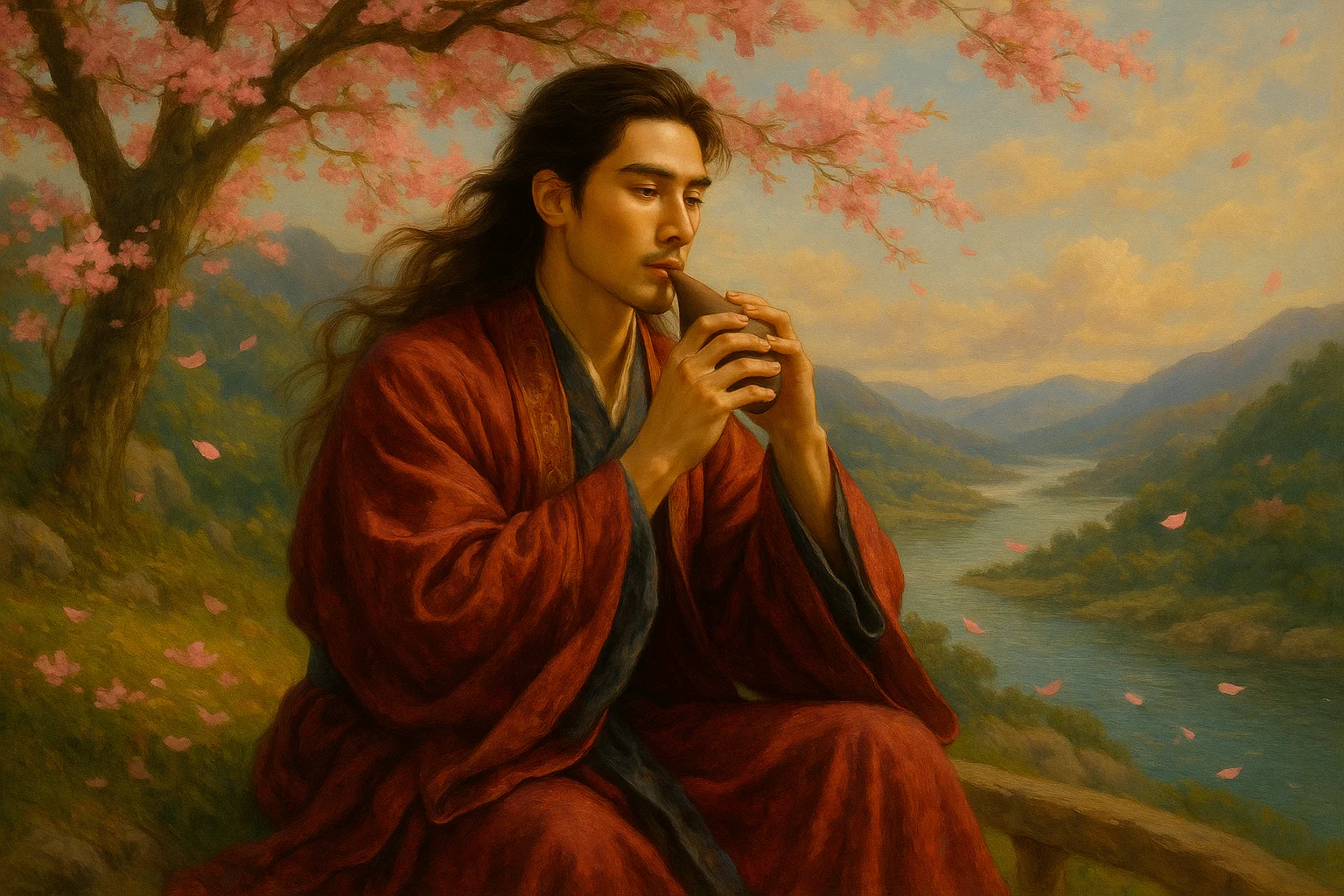
Yuan Zhen (元稹 779 - 831), a native of Luoyang, Henan Province, was a descendant of the Northern Wei imperial family and a renowned poet and statesman of the Mid-Tang Dynasty. As an important figure in Tang literary history, Yuan Zhen co-advocated the New Yuefu Movement with Bai Juyi. His poetic achievements are most distinguished in the yuefu (Music Bureau) style and erotic poetry. His romantic relationship with a woman named Yingying inspired the legendary tale The Story of Yingying. Yuan Zhen’s poetic style is characterized by its accessible clarity, occasionally interspersed with bold and striking expressions. During the transition from the Mid-Tang to the Late Tang, his accessible style exerted a profound influence, laying the foundation for the Yuan-Bai Poetic School.