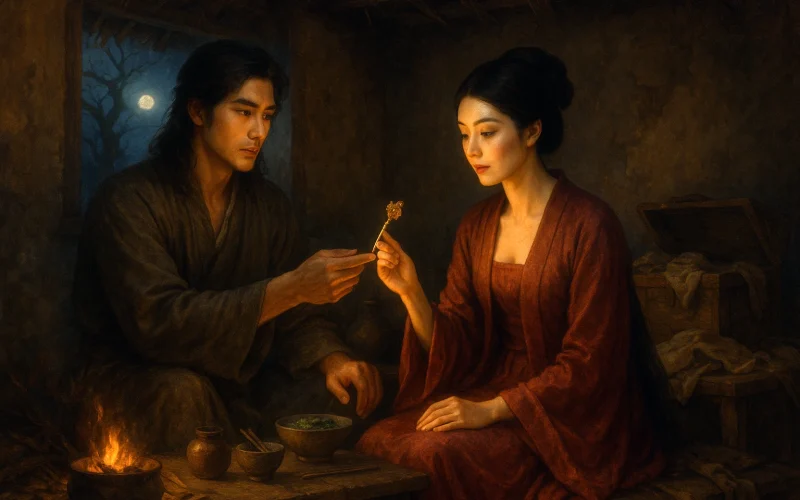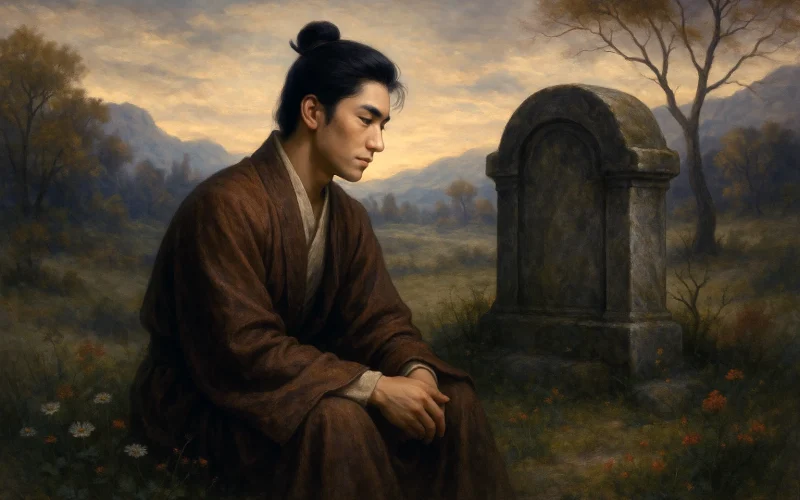


We joked, long ago, about one of us dying,
But suddenly, before my eyes, you are gone.
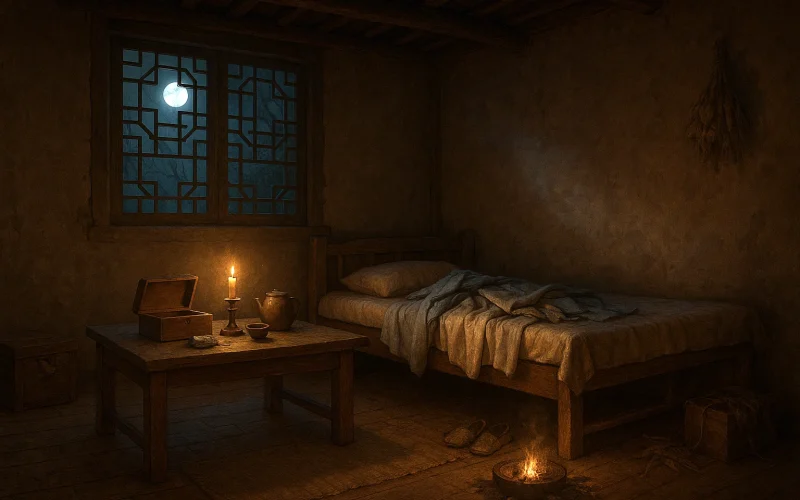
Almost all your clothes have been given away;
Your needlework is sealed, I dare not look at it...
I continue your bounty to our men and our maids --
Sometimes, in a dream, I bring you gifts.
...This is a sorrow that all mankind must know --
But not as those know it who have been poor together.
Original Poem
「遣悲怀 · 其二」
元稹
昔日戏言身后事,今朝都到眼前来。
衣裳已施行看尽,针线犹存未忍开。
尚想旧情怜婢仆,也曾因梦送钱财。
诚知此恨人人有,贫贱夫妻百事哀。
Interpretation
This poem is the third in a series by the Mid-Tang poet Yuan Zhen, mourning his deceased wife Wei Cong. It was composed about a year after Wei Cong's death, around the fifth year of the Yuanhe period (810 AD), when Yuan Zhen was serving as a Censor. Yuan Zhen and Bai Juyi passed the imperial examination in the same year and advocated the New Yuefu Movement; together they are known as "Yuan-Bai." His poetic language is plain, his emotions deep and sincere, and he is especially known for the profoundly moving series mourning Wei Cong, Thinking of My Deceased Wife (three poems) and Parting Thoughts (five poems).
Wei Cong was the youngest daughter of Wei Xiaqing, the Junior Guardian of the Heir Apparent. She married Yuan Zhen at twenty. At that time, Yuan Zhen had not yet achieved fame, and their life was austere. Wei Cong did not despise the poverty, content with a simple life. The couple supported each other through hardship, their affection profound and sincere. However, heaven did not grant them many years. In the fourth year of Yuanhe (809 AD), Wei Cong passed away from illness at the young age of twenty-seven. At this time, Yuan Zhen had already been demoted to Jiangling for offending the eunuchs. Disappointed in his official career, physically and mentally exhausted, he then suffered the pain of losing his wife—his sorrow can be imagined.
This poem is a deep emotional recollection of Yuan Zhen's deceased wife's life. This is the third one, taking the poet's state of mind and philosophical reflections after his wife's death as its starting point. Through introspective questions and the use of historical allusions, it explores the ultimate sorrow of life and death. The poem culminates in the poignant couplet, "I can but open my eyes wide throughout the long night / To requite you for the sadness of your lifelong plight," expressing the poet's resolution to live with eternal grief for the rest of his life. The entire poem, with its plain language, probes the deepest philosophical sorrows, and with its allusions, universalizes personal grief, making it a model work among elegiac poems for "using philosophical contemplation to express the deepest pain."
First Couplet: "闲坐悲君亦自悲,百年多是几多时。"
Xián zuò bēi jūn yì zì bēi, Bǎi nián duō shì jǐ duō shí.
Sitting idly, I grieve for you and also for myself; How long, after all, is the span of a hundred years of life?
The poem opens with the poet's self-reflection in idleness, immediately establishing a tone of profound sorrow. "闲坐悲君亦自悲" (Sitting idly, I grieve for you and also for myself) writes that in quiet moments, his grief for his wife naturally turns into grief for himself. The phrase "亦自悲" (also for myself) elevates the personal sorrow of bereavement to a contemplation of the sorrow inherent in life itself. The next line, "百年多是几多时" (How long, after all, is the span of a hundred years of life?), is a rhetorical question directed at life's brevity. A hundred years seems long, but for the deceased, it is gone in an instant; for the living, it is filled with endless sorrow. The poet, grieving for his wife, suddenly realizes the fleeting nature and ultimate sorrow of all life, shifting the poem's theme from personal mourning to a lament for the human condition. This couplet uses the simplest language to ask the most fundamental questions, setting a solemn and deeply contemplative tone for the entire poem.
Second Couplet: "邓攸无子寻知命,潘岳悼亡犹费词。"
Dèng Yōu wú zǐ xún zhī mìng, Pān Yuè dào wáng yóu fèi cí.
Deng You, childless, learned to accept Heaven’s decree. Pan Yue wrote immortal verse to mourn his deceased wife.
This couplet uses two historical allusions to express the helplessness and limitations of mourning. "邓攸无子寻知命" (Deng You, childless, learned to accept Heaven’s decree) alludes to Deng You of the Eastern Jin Dynasty, who, in a time of war, abandoned his own son to save his nephew, ultimately dying without an heir. Later generations saw this as the workings of fate. The poet uses this to suggest that having no children might be destiny, a form of helpless self-consolation. "潘岳悼亡犹费词" (Pan Yue wrote immortal verse to mourn his deceased wife) alludes to the Western Jin poet Pan Yue, famous for his elegiac poems mourning his wife. The phrase "犹费词" (immortal verse) implies that even the most beautifully written elegies are ultimately just words, unable to bring back the deceased. By citing these two figures—one who accepted fate, the other who expressed grief through writing—the poet reflects on the ultimate futility of both resignation and expression in the face of death, deepening the sense of sorrow and helplessness.
Third Couplet: "同穴窅冥何所望,他生缘会更难期。"
Tóng xué yǎo míng hé suǒ wàng, Tā shēng yuán huì gèng nán qī.
In the dark, dark grave what can I hope for our reunion? More vain is the hope of a future life’s communion.
This couplet turns from historical figures and the limitations of words to ponder the possibilities of reunion after death, pushing the contemplation of grief to a deeper level. "同穴窅冥何所望" (In the dark, dark grave what can I hope for our reunion?) questions the hope of sharing a grave. Even if buried together, in the profound darkness of the tomb, what kind of reunion can truly be hoped for? This is a direct negation of the common hope for posthumous togetherness. The next line, "他生缘会更难期" (More vain is the hope of a future life’s communion), goes further, dismissing the hope for reunion in a next life as even more elusive. The words "何所望" (what can I hope for) and "更难期" (More vain is the hope) use rhetorical questions to express utter despair, negating all possibilities of reunion after death, whether in the grave or in a future life. This couplet thoroughly dispels any illusion of transcendence, leaving the poet—and the reader—confronted with the stark, unbridgeable finality of death.
Fourth Couplet: "惟将终夜长开眼,报答平生未展眉。"
Wéi jiāng zhōng yè cháng kāi yǎn, Bào dá píng shēng wèi zhǎn méi.
I can but open my eyes wide throughout the long night To requite you for the sadness of your lifelong plight.
The final couplet concludes the poem's philosophical contemplations and returns to the poet's personal vow, expressing his unique way of mourning. "惟将终夜长开眼" (I can but open my eyes wide throughout the long night) writes of the poet's resolution. "长开眼" (open my eyes wide) has a double meaning: literally, to stay awake all night; allusively, it refers to the legend that widowed fish never close their eyes, symbolizing a widower's resolve never to remarry. "报答平生未展眉" (To requite you for the sadness of your lifelong plight) explains the purpose of this resolution: to repay his wife for a lifetime of hardship and worry, during which she seldom had a carefree, smiling brow ("未展眉"). Faced with the helplessness of fate, the futility of words, and the impossibility of an afterlife, the poet finds his only path: to live forever in grief, staying awake through the long nights, in remembrance of her and as penance for his inability to give her happiness in life. This vow is sorrowful yet resolute, expressing the deepest form of love and mourning—a lifelong, unwavering memory.
Holistic Appreciation
This is a divine work among Yuan Zhen's elegiac poems, the third of the three Thinking of My Deceased Wife. The entire poem consists of eight lines and fifty-six characters. Taking the poet's post-bereavement state of mind and philosophical reflections as its starting point, it moves from personal sorrow to a lament on life and death, ultimately returning to a personal vow, presenting the ultimate form of mourning for a deceased spouse.
Structurally, the poem presents a progression from the self to the universal, and back to a personal resolution. The first couplet, beginning with "Sitting idly, I grieve," starts with personal sorrow and extends it to a lament on the brevity of life ("How long... is the span of a hundred years?"). The second couplet uses the allusions of Deng You and Pan Yue to place personal grief within the broader context of historical and cultural expressions of mourning, contemplating their shared helplessness. The third couplet turns to ponder the afterlife, negating hopes for reunion in the grave or in future lives, confronting the finality of death. The final couplet returns from these universal contemplations to the poet's personal, resolute vow: to live forever in grief. The four couplets form a complete cycle: from sorrow, to questioning, to despair, and finally to a resolution, seamlessly integrating deep feeling with philosophical depth.
Thematically, the core of this poem lies in the progression from "grieving for you" to "grieving for myself" to the final resolution. The initial "grieving for you" is the personal pain of loss. "Grieving for myself" expands this to a sorrowful reflection on the human condition itself—its brevity, its helplessness in the face of fate ("Deng You"), the limitations of even the most beautiful expressions of grief ("Pan Yue"), and the ultimate finality of death ("同穴," "他生"). Having traversed this philosophical terrain and found no solace or hope, the poet arrives at his only possible response: the vow contained in "惟将终夜长开眼, 报答平生未展眉." This vow is not a solution to death's riddle, but a way of living with its unanswerable truth—to eternize grief itself as the only fitting tribute and requital. This elevates the poem from personal lament to a profound statement on love, loss, and remembrance.
Artistically, the poem's most moving aspect lies in its "deepening of emotion through philosophical contemplation and the skillful integration of allusions." The poet does not remain at the level of describing grief-stricken actions or intense longing. Instead, he begins with sorrow, then questions the value of life, reflects on historical precedents of misfortune and mourning, and contemplates the illusions of an afterlife, ultimately concluding that in the face of life's ultimate sorrows, the only meaningful act is a lifelong commitment to remembrance. The allusions to Deng You and Pan Yue are not mere displays of erudition; they universalize the poet's personal pain, connecting it to shared human experiences of fate and expression. Furthermore, the phrase "长开眼" carries a beautiful and sorrowful double meaning, alluding to the widowed fish and expressing a vow of lifelong fidelity, making the concluding resolution both culturally rich and intensely personal.
Artistic Merits
- From Personal to Universal, Profound in Thought: The poem begins with personal sorrow ("grieve for you"), expands it to a lament on life ("grieve for myself," "How long... a hundred years?"), and uses allusions to connect with historical figures, giving personal grief philosophical depth and universal resonance.
- Skillful Use of Allusion, Natural Integration: The allusions to Deng You and Pan Yue are not forced; they serve the poem's thematic development. Deng You represents resigned acceptance of cruel fate, while Pan Yue represents the ultimately futile beauty of elegiac expression, together deepening the poem's meditation on helplessness and the limits of mourning.
- Layered Questioning, Structural Ingenuity: The poem successively questions the brevity of life, the examples of history, hopes for the afterlife, and finally finds a form of answer in a personal vow, creating a tightly structured, deeply contemplative progression.
- Plain Language, Profound Emotion: The entire poem's language remains unadorned, yet the emotions expressed—from sorrow, to doubt, to despair, and finally to resolute commitment—are incredibly intense, using the simplest language to explore the deepest sorrows.
Insights
This poem, through a widower's contemplation after his wife's death, speaks to an eternal theme—The ultimate form of mourning is not forgetting, but living forever within the grief; the ultimate form of love is not following in death, but living a life of eternal remembrance.
First, it lets us see "the philosophical dimension of sorrow." The poet's grief for his wife ("悲君") naturally leads to grief for the human condition ("自悲"), to reflections on fate ("Deng You"), on the limits of expression ("Pan Yue"), and on the finality of death ("同穴," "他生"). It reminds us: The deepest personal pain often compels us to confront the most fundamental questions of existence—the meaning of life, the cruelty of fate, the inevitability of death.
On a deeper level, this poem makes us ponder "the way to face ultimate sorrow." Faced with the helplessness revealed by the allusions and the despair found in contemplating the afterlife, the poet does not choose to end his own life, nor does he lose himself in madness or numbness. Instead, he chooses to "open my eyes wide throughout the long night"—to live consciously with the grief, to use a lifetime of solitude and remembrance as his tribute. It shows us: In the face of life's greatest helplessness and sorrow, a person can still make a choice—to choose how to live with that sorrow.
And what is most moving is the profound love contained within that vow of "repaying a lifetime of sadness." "To requite you for the sadness of your lifelong plight"—his wife spent her life in hardship, seldom smiling. Now that she is gone, the poet's "repayment" is to forever live in the darkness of grief, to keep his eyes open through the long nights, to remember. This is not a transaction, but the deepest form of love and penance: I cannot give you happiness in life, so I give you my entire life of sorrowful remembrance after your death.
This poem writes of a widower's thoughts in the Mid-Tang, yet allows everyone who has experienced irreparable loss and confronted life's ultimate questions to find resonance within it. The sorrow of "grieving for you and also for myself" is the shared sigh of all who have seen life's brevity through loss. The helplessness of "Deng You" and "Pan Yue" is the shared feeling of all who have faced fate's cruelty. The despair of "what can I hope for" and "More vain is the hope" is the shared realization of all who have seen through the illusions of an afterlife. The vow of "opening my eyes wide throughout the long night" is the shared choice of all who choose to remember forever. This is the vitality of poetry: it writes of Yuan Zhen's thoughts for Wei Cong, but one reads of all people in all eras who, in the long night, keep their eyes open wide.
Poem translator
Kiang Kanghu
About the Poet
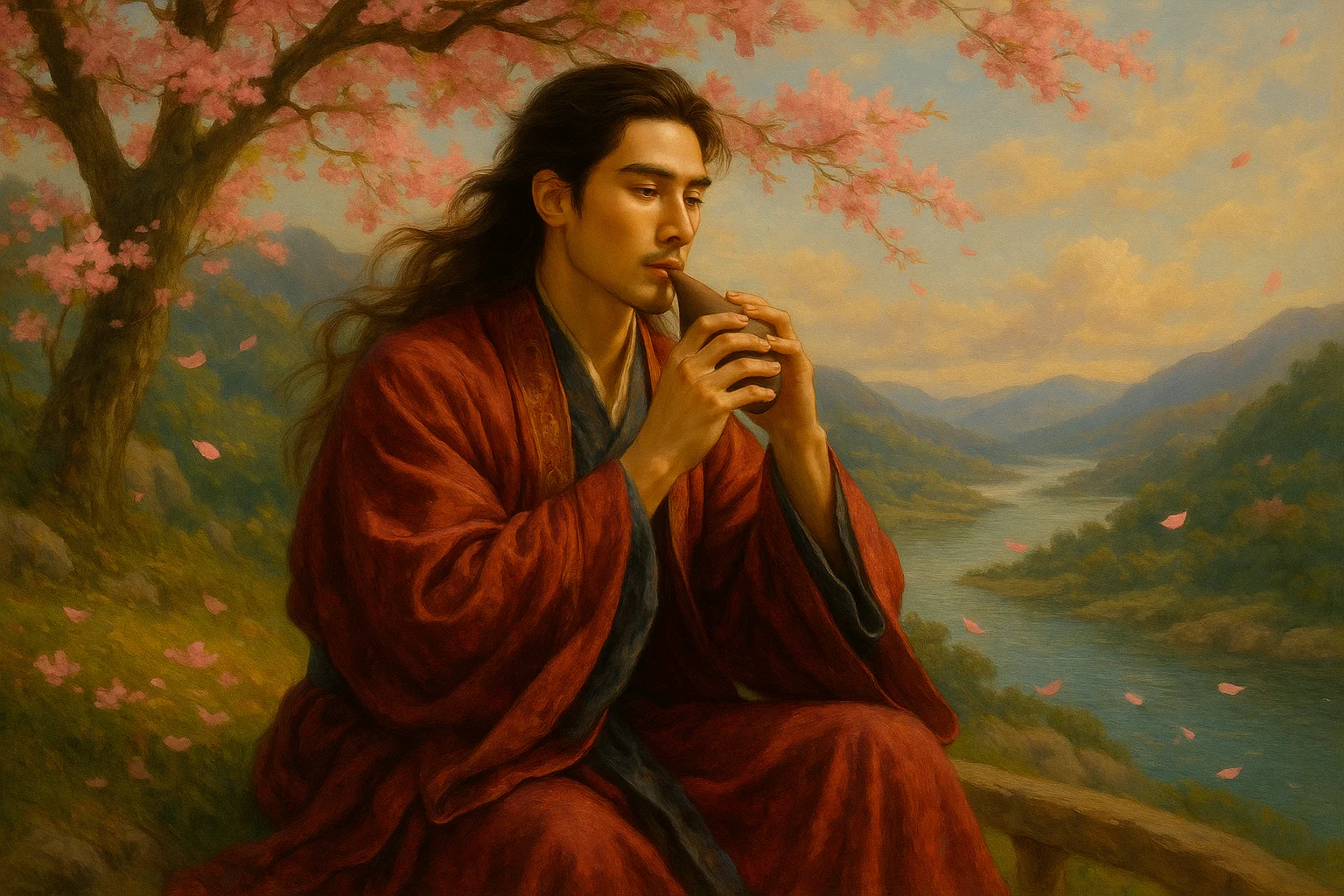
Yuan Zhen (元稹 779 - 831), a native of Luoyang, Henan Province, was a descendant of the Northern Wei imperial family and a renowned poet and statesman of the Mid-Tang Dynasty. As an important figure in Tang literary history, Yuan Zhen co-advocated the New Yuefu Movement with Bai Juyi. His poetic achievements are most distinguished in the yuefu (Music Bureau) style and erotic poetry. His romantic relationship with a woman named Yingying inspired the legendary tale The Story of Yingying. Yuan Zhen’s poetic style is characterized by its accessible clarity, occasionally interspersed with bold and striking expressions. During the transition from the Mid-Tang to the Late Tang, his accessible style exerted a profound influence, laying the foundation for the Yuan-Bai Poetic School.