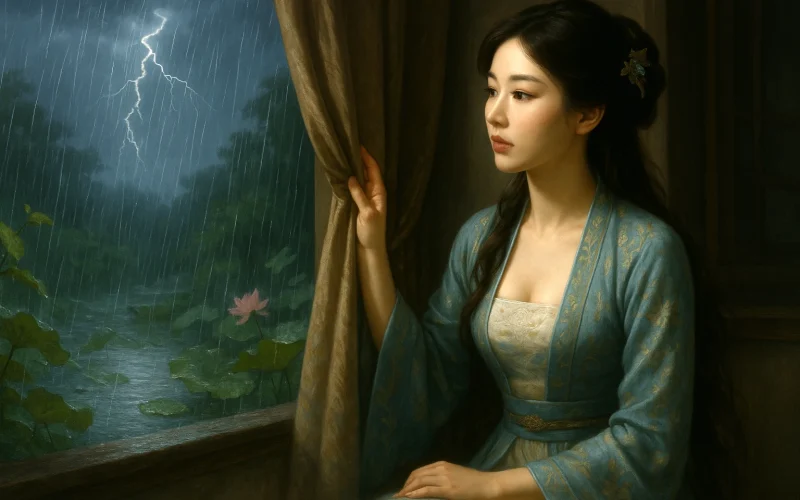

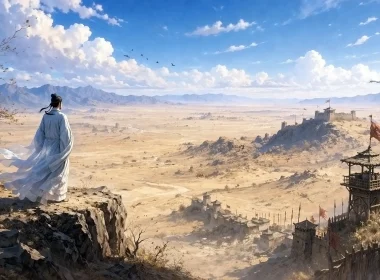
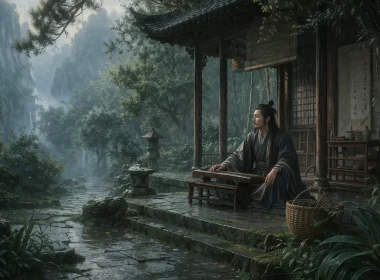
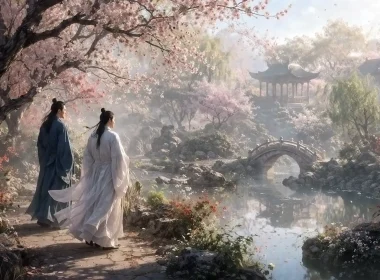

Yongshou’s gates unclosed at night when troops broke in;
The golden lotus steps left no trace within.
Liang’s music stopped at midnight, still and deep —
The wind swings nine bronze bells where court ladies weep.
Original Poem
「齐宫词」
李商隐
永寿兵来夜不扃,金莲无复印中庭。
梁台歌管三更罢,犹自风摇九子铃。
Interpretation
This poem stands as a sober and incisive work among Li Shangyin's historical quatrains, composed in 857 AD during the late Tang Dynasty. By this time, Li Shangyin had endured years of itinerant life as a staff member in regional governors' offices, and his own life was nearing its twilight. While traveling near Jinling (present-day Nanjing), he beheld the old palace sites of the Six Dynasties. Facing this land that had witnessed the rapid rise and fall of successive short-lived dynasties, reflections on historical cycles and anxieties for the present intertwined in his mind. The Tang state was in decline, internal factional strife persisted, and the emperor's devotion to Buddhism drained resources, while a culture of indulgent pleasure-seeking remained. Through the lens of the former Qi and Liang dynasties, Li Shangyin not only expressed a sense of profound historical change but also embedded a trenchant critique and warning for his own time. The poet selects moments from the successive Southern Qi and Liang dynasties, using a detached, observational tone to reveal the shockingly similar trajectory of negligence and decay in the transition of power. Though his gaze rests upon former courts, his deep concern is anchored firmly in the present.
First Couplet: 永寿兵来夜不扃,金莲无复印中庭。
Yǒng shòu bīng lái yè bù jiōng, jīn lián wú fù yìn zhōng tíng.
To Yongshou Palace the rebel troops came, its gates that night left unbarred;
The prints of golden lotus blooms, in the courtyard, are seen no more.
Explication: This couplet directly portrays the scene of the Southern Qi's fall. The phrase "gates that night left unbarred" is recorded with the冷静 precision of a historian's brush, fully capturing the ruler's麻痹 and lack of defense. "Golden lotus" alludes to the tale of the deposed Emperor of Qi who had golden lotus flowers inlaid in the floor for his favorite consort to tread upon—a symbol of extreme licentiousness. The words "are seen no more" imply the utter disappearance of a life of lavish extravagance with the dynasty's collapse. The sequence from "came" to "seen no more" creates a violent shift in historical scene, where opulence and ruin are separated by a mere instant.
Final Couplet: 梁台歌管三更罢,犹自风摇九子铃。
Liáng tái gē guǎn sān gēng bà, yóu zì fēng yáo jiǔ zǐ líng.
From Liang's high towers, music and song ceased only with the night's third watch;
Yet in the wind, the nine-son bells—their jangling lingers on.
Explication: The narrative subtly shifts to the Liang dynasty, which succeeded the Qi. "Music and song ceased only with the night's third watch" reveals a continuation of the predecessor's revelrous ways. The line "Yet in the wind, the nine-son bells—their jangling lingers on" is the poem's masterstroke. The nine-son bells were originally ornamental trinkets adorning the palace of the deposed Qi emperor. Now, they still hang from the eaves of the Liang palace, sounding of their own accord in the wind. Their ringing is like a ghost from history, suggesting that the new dynasty has failed to learn the true lessons of the old. In the same halls, amidst similar pleasures, it seems destined to follow a similar path.
Holistic Appreciation
The poem's most striking artistic feature is its use of a minute object to trace a vast historical arc. In only twenty-eight characters, it employs the "nine-son bells" to link the Qi and Liang dynasties into a complete allegorical loop. The poet offers no direct commentary on the dynastic falls. Instead, he juxtaposes the laxity of the unbarred gates on Qi's final night with the clamor of the all-night Liang palace feast. He sets the vanished prints of the golden lotus dance against the persistent, wind-tossed ringing of the bells in the succeeding court. Historical judgment is rendered self-evident through this contrast of scenes and the continuity of objects.
Li Shangyin excels at infusing static imagery with a sense of flowing time and historical weight. The nine-son bells serve as witnesses to the extravagance of both the Qi and Liang dynasties, and as symbols of history’s ruthless, relentless inertia. Their wind-blown ringing resembles a tolling alarm, yet those who should heed it remain lost in music and song, utterly unaware.
Artistic Merits
- Meaningful Juxtaposition of Scenes: The parallel presentation of Qi's "gates left unbarred" and Liang's "song ceased with the third watch" implies that negligence and indulgence are part of a continuous legacy. The force of the critique is embedded within the narrative rhythm itself.
- Anchoring History in Objects, Revealing the Grand through the Minute: The poem is structured around two courtly artifacts: the "golden lotus" (opening) and the "nine-son bells" (closing). Behind these small objects lies the grand narrative of dynastic rise and fall, exemplifying the superb technique in historical poetry where the objects themselves become the history.
- Contrast of Atmosphere, Chilling Resonance: The first couplet describes the silent arrival of troops and the permanent end of a dance—a realm of "vanishing." The final couplet describes the clamor of revelry and the incessant ringing of bells—a scene of "heedless immersion." The interplay between this silence and sound allows a bleak awareness of historical cycles to permeate the verse.
Insights
Through the moment of transition from Qi to Liang, this poem exposes a suffocating repetitiveness in history: succeeding powers often imitate the extravagance of their predecessors while ignoring the lessons of their collapse. The nine-son bells ringing pointlessly in the wind are like the persistent warnings issued by history, which rulers immersed in present pleasures so often choose to ignore.
What Li Shangyin chronicles is not merely an anecdote of the Six Dynasties, but a profound observation of all structures of power: when those in authority lose themselves in self-repeating rituals (song and dance) and decorative symbols (golden lotuses, bells), becoming desensitized to real crises (the unbarred gates), decline has already drawn near. Thus, the "wind-blown nine-son bells" in the poem become a timeless metaphor—those overlooked details, repeated errors, and unheeded warnings will eventually chime again in the wind, challenging every present moment.
About the poet
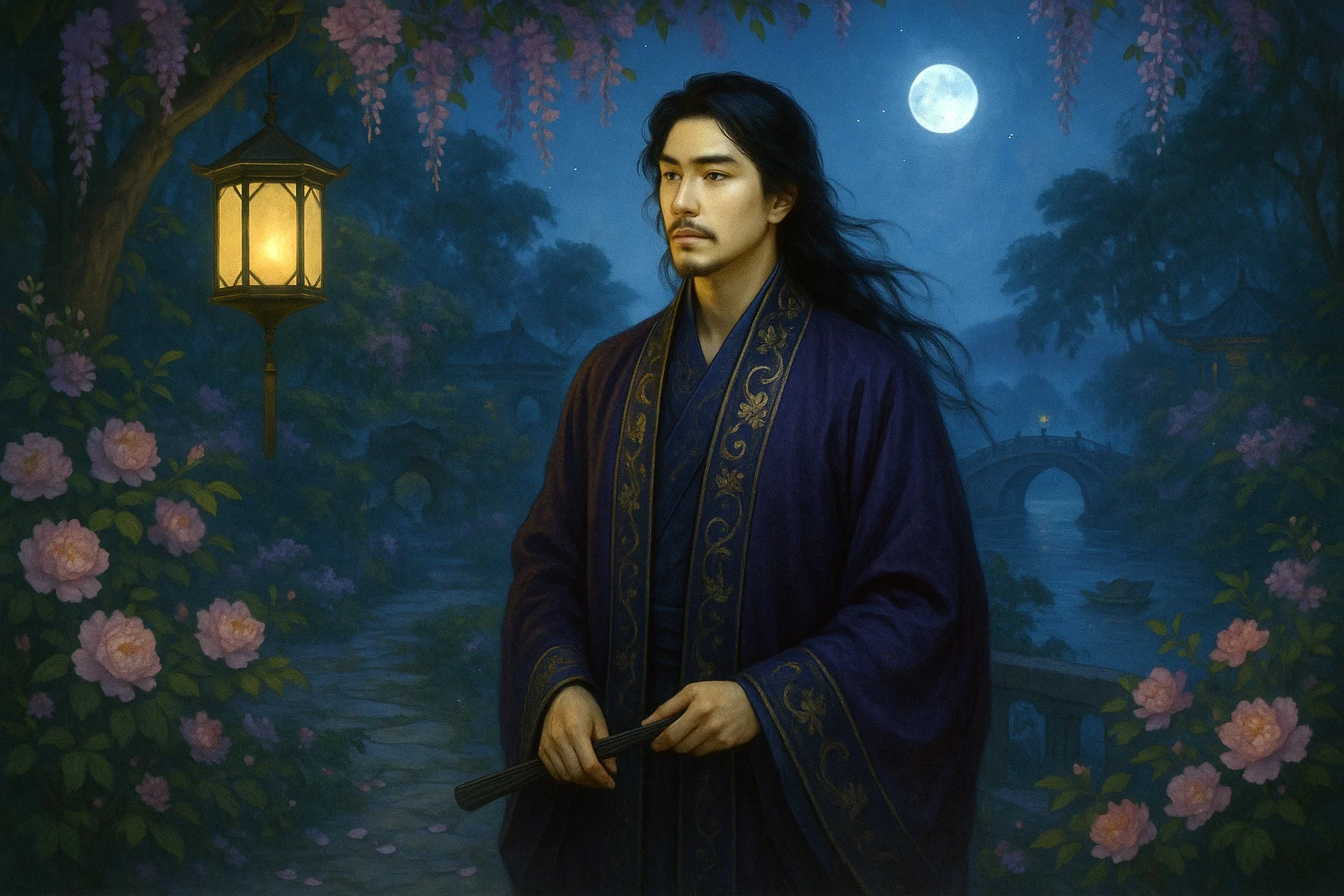
Li Shangyin (李商隐), 813 - 858 AD, was a great poet of the late Tang Dynasty. His poems were on a par with those of Du Mu, and he was known as "Little Li Du". Li Shangyin was a native of Qinyang, Jiaozuo City, Henan Province. When he was a teenager, he lost his father at the age of nine, and was called "Zheshui East and West, half a century of wandering".