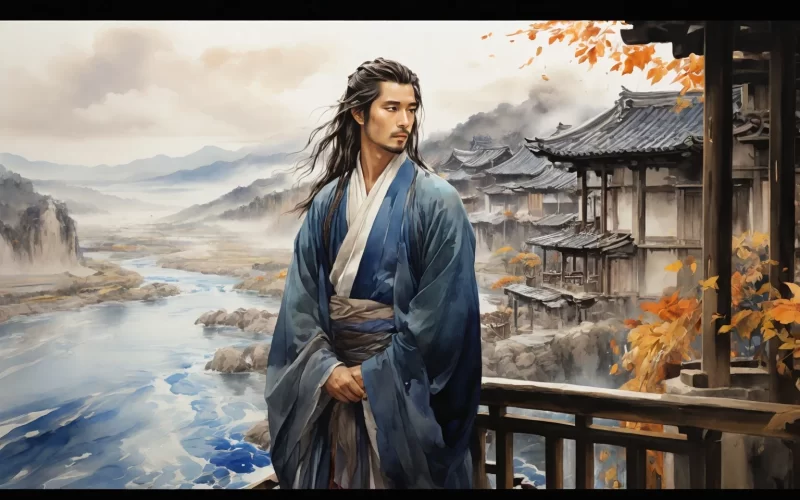




A hero can't foretell victory or defeat.
Why should a loser not stand again on his feet?
There are so many talents on the Southern shore.
Who dare say, once defeated, he can't win the war?
Original Poem
「题乌江亭」
杜牧
胜败兵家事不期,包羞忍耻是男儿。
江东子弟多才俊,卷土重来未可知。
Interpretation
This poem was composed in the year 841 AD, when Du Mu was transferred from the position of Prefect of Huangzhou to Prefect of Chizhou. During his journey, he passed by the Blacksmith River Pavilion in Hezhou—the very site where Xiang Yu, the Conqueror of Western Chu, met his defeat and took his own life. Though this reassignment was a lateral move, it occurred during the mid-to-late Tang period, a time of intensifying strife between the Niu and Li factions and a gradual decline in the nation's vigor. Du Mu, who always harbored ambitions to contribute to the world and often viewed reality through a historian's lens, was not merely engaging in conventional reflections on the past when his thoughts turned to Xiang Yu at this site. Rather, he was using this historical case to launch a profound meditation on failure, dignity, and possibility.
In traditional culture, Xiang Yu's end is often imbued with the romantic aura of a tragic hero. His choice to take his own life because he "had no face to see again the elders east of the River" is typically seen as the epitome of preserving one's integrity and honor. Here, however, Du Mu proposes a view starkly different from the common one. This stems both from his own understanding of political reality—that endurance and the accumulation of strength in adversity are often more difficult than a heroic death—and reflects his coldly penetrating gaze as a historian: history is made by living people and concrete choices, not by a predetermined script. Therefore, this poem can be seen as a highly condensed "revisionist historical argument," its thrust aimed directly at the traditional conception of heroism that prioritizes momentary victory, defeat, or "face" over long-term strategy.
First Couplet: 胜败兵家事不期,包羞忍耻是男儿。
Shèng bài bīngjiā shì bù qī, bāo xiū rěn chǐ shì nán'ér.
For commanders, victory, defeat—none can foretell their hour. To bear shame, swallow disgrace, defines a hero's power.
The opening couplet establishes its thesis, using the coolly rational brushstroke of a historian to break the conventional mold. The phrase "none can foretell" strips victory and defeat of their mystique and moral weight, restoring them to the realm of contingency and normality. The next line then proposes an untraditional standard for heroism: "To bear shame, swallow disgrace." Against the backdrop of a value system that prized "a scholar may be killed but not humiliated," Du Mu deliberately champions a more resilient and strategic wisdom for survival. He asserts that a true "hero" is defined not by whether he meets with failure, but by whether he can maintain clarity and accumulate strength within failure and humiliation. This is both a critique of Xiang Yu and a call for a more mature and robust ideal of character.
Second Couplet: 江东子弟多才俊,卷土重来未可知。
Jiāngdōng zǐdì duō cáijùn, juǎntǔ chónglái wèi kě zhī.
East of the River, many talented men abound. Who knows if he could not have rallied them and turned things round?
Building upon the thesis of the previous couplet, this one develops a concrete historical hypothesis. Du Mu points to the valuable resource Xiang Yu possessed yet casually abandoned—the "many talented men" east of the River. This is no empty claim; the core of Xiang Yu's initial uprising force came precisely from that region. The line "Who knows if he could not have rallied them and turned things round?" employs a powerfully subjunctive mood, reopening the "what was" of history into the uncertainty of "what could have been." It does not deny the established outcome but emphasizes how, at history's pivotal moments, the subjective choices of individuals profoundly influence its course. Xiang Yu chose an end, and thus history solidified; but had he chosen endurance and return, the story might have been entirely different.
Holistic Appreciation
This heptasyllabic quatrain uses Blacksmith River Pavilion as its spatiotemporal coordinate to deliver an exceptionally concise and profound historical commentary. In merely four lines, it contains a complete logical chain of thesis, counter-argument, evidence, and inference, showcasing Du Mu's exceptional ability to "use argument as poetry" without losing poetic flavor.
Du Mu's brilliance lies in not dwelling on the specific tactical errors of Xiang Yu's defeat, but in pointing directly at the psychological and character roots behind that failure—an inability to bear "shame," leading to the voluntary abandonment of an alternative possibility history offered. The poet elevates Xiang Yu's individual case to a universal proposition concerning how to face adversity and how to define dignity. In the poem, historical pathos is replaced by cool analysis; the traditionally praised "integrity" is questioned by a more constructive "resilience." This historical perspective, filled with realism and a proactive spirit, appears particularly valuable and potent within the increasingly dispirited intellectual atmosphere of the late Tang.
Artistic Merits
- Deep Fusion of Historical Insight and Poetic Sentiment: Du Mu expresses a historian's argument in poetic form, wrapping rational historical judgment within refined verse. Phrases like "none can foretell" and "who knows" preserve historical open-endedness while brimming with the tension of poetic language.
- Original Thesis and Revisionist Perspective: This poem is a classic "revisionist poem," aiming to challenge and overturn established evaluations of a historical figure (Xiang Yu). The poet emphasizes judgment and advocacy over description, presenting a clear, sharp viewpoint that reveals a strong intellectual individuality.
- Historical Application of Hypothetical Thinking: The line "Who knows if he could not have… turned things round?" serves as the pivotal, illuminating stroke of the entire piece, introducing a mode of reasoning based on historical possibilities. This hypothesis is not mere fancy but is grounded in the factual basis of "many talented men east of the River," giving the argument both impact and persuasiveness.
- Vigorous Language and Forceful Spirit: The poem's diction is crisp and direct, unadorned. Phrases like "bear shame, swallow disgrace" and "turned things round" are resonant and powerful, filled with an inner strength that perfectly matches the resilient spirit the poem seeks to express.
Insights
Transcending a millennium, the poem's core insight remains sharp: How one views failure often defines a person's (or a group's) stature and outcome more than the failure itself. It redefines "dignity" from a momentary posture of "rather break than bend" to an enduring resilience of "able to bend and stretch" through prolonged adversity.
It reminds us that in the face of major setbacks, what is more precious than a tragic, self-terminating gesture is maintaining the capacity for calm assessment ("none can foretell"), forging formidable psychological endurance ("bear shame, swallow disgrace"), and skillfully identifying and relying on existing resources and hope ("many talented men") to preserve the ember and possibility for a future "who knows." Through the story of Xiang Yu, Du Mu essentially composed an eternal memorandum on survival in adversity and rational choice, admonishing later generations: the truly strong are not those who never fail, but those who, even in the depths, still believe in and strive to create the possibility of a "comeback."
Poem translator
Xu Yuanchong (许渊冲)
About the poet
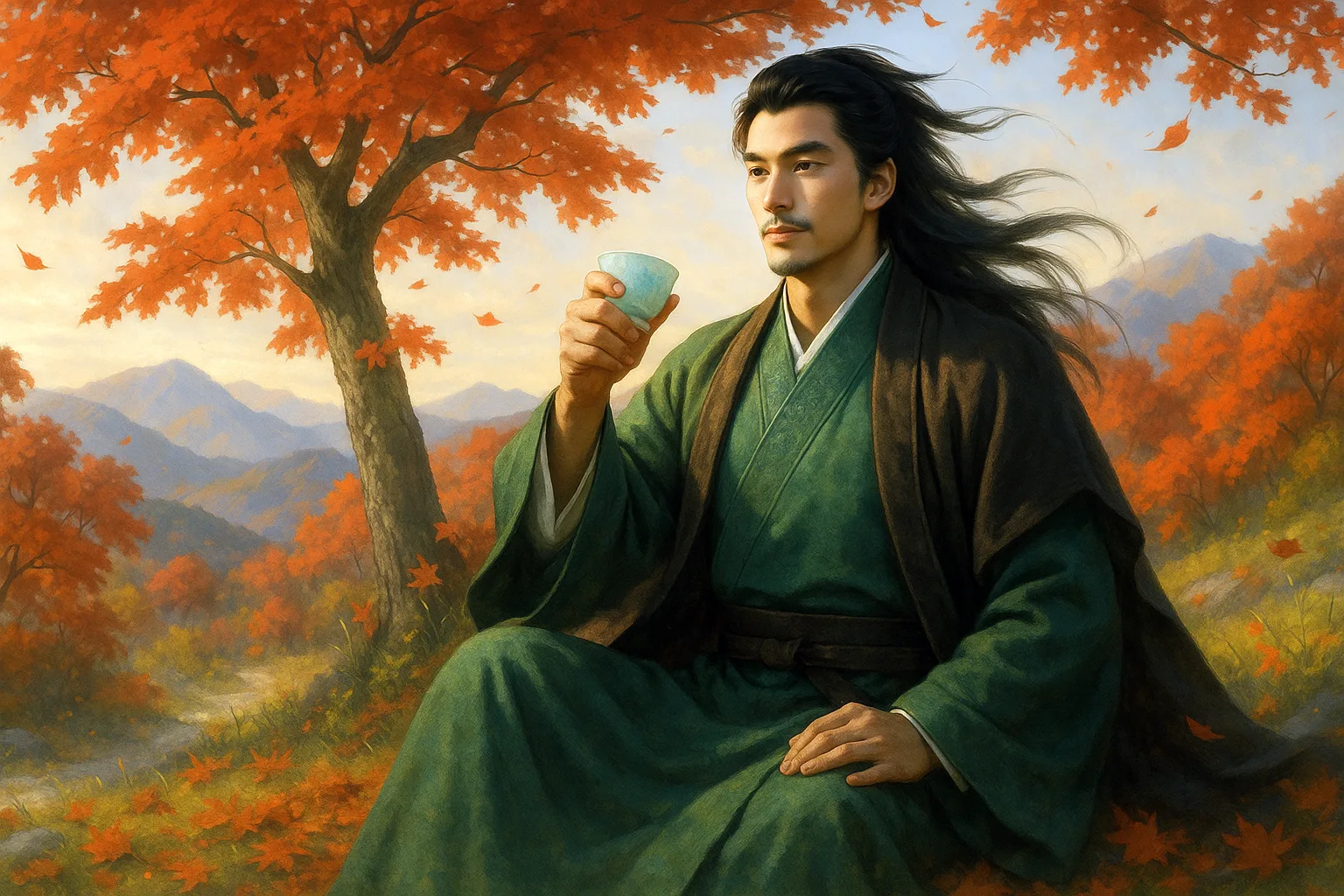
Du Mu (杜牧), 803 - 853 AD, was a native of Xi'an, Shaanxi Province. Among the poets of the Late Tang Dynasty, he was one of those who had his own characteristics, and later people called Li Shangyin and Du Mu as "Little Li and Du". His poems are bright and colorful.