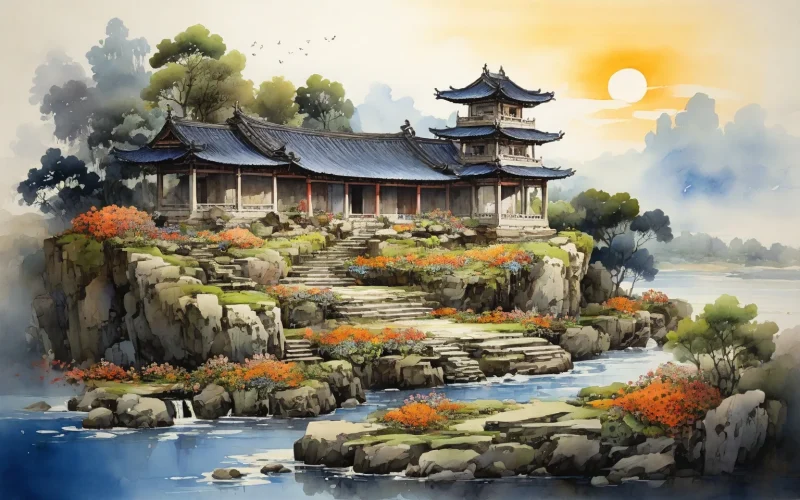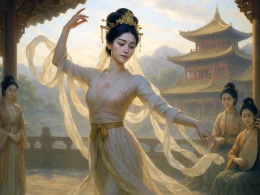



Tis said there is a fairyland over the sea.
When this life is no more, can there another be?
In vain the watchman beat at night the warning gong;
No cock would wake her from dream with morning song.
The six armies demanded her death left and right.
Could she still laugh at severed lover-stars at night?
Though the emperor reigned as long as forty years,
She's not so happy as a griefless maid appears.
Original Poem
「马嵬二首 · 其二」
李商隐
海外徒闻更九州,他生未卜此生休。
空闻虎旅传宵柝,无复鸡人报晓筹。
此日六军同驻马,当时七夕笑牵牛。
如何四纪为天子,不及卢家有莫愁。
Interpretation
This poem stands as a masterpiece of trenchant criticism, stark juxtaposition, and profound historical reflection within Li Shangyin’s body of historical poetry. Using the tragedy of Emperor Xuanzong and Lady Yang at Mawei as a lens to dissect the political decay of the late Tang, the poet does not stop at lamenting a tragic romance. Instead, with a sharp poetic brush, he peels back layer by layer the cruel paradoxes between power, love, promises, and historical reality, ultimately directing the spearhead of his critique at the very nature of imperial power and responsibility. The poem concludes with a rhetorical question, which, like a cold, clear mirror of history, reflects the absurdity of those at the pinnacle of power and the preciousness of ordinary human emotion.
First Couplet: 海外徒闻更九州,他生未卜此生休。
Hǎi wài tú wén gèng jiǔzhōu, tā shēng wèi bǔ cǐ shēng xiū.
Vain tales of lands beyond the seas, nine continents more;
Another life unknown—this one’s ties are severed.
Explication: The opening instantly dismisses, with the cold, dismissive “vain tales,” the legend of the Taoist finding Lady Yang’s spirit, puncturing Xuanzong’s self-deceptive comfort. “Lands beyond the seas, nine continents more” alludes to Zou Yan’s theory of the “Greater Nine Continents,” here symbolizing an illusory, otherworldly realm. The poet uses the fallacy of geography (lands beyond the seas) parallel to the fallacy of time (another life unknown), wielding a double-edged blade to sever all illusions for escaping reality. The three words, “this one’s ties are severed,” ring with finality, declaring the complete bankruptcy of Xuanzong’s love myth in the face of political reality, establishing the poem’s tone of bone-chilling sorrow and rational scrutiny.
Second Couplet: 空闻虎旅传宵柝,无复鸡人报晓筹。
Kōng wén hǔ lǚ chuán xiāo tuò, wú fù jī rén bào xiǎo chóu.
In vain, the guards’ night-watch clappers sound;
No more the cock-man’s call announcing dawn.
Explication: This couplet presents, through a concrete contrast of court rituals past and present, the collapse of the imperial order and the mundane world. “The guards’ night-watch clappers” represent the perilous, austere reality of the flight for survival; “the cock-man’s call announcing dawn” symbolizes the orderly, peaceful elegance of palace life in bygone days. “In vain” and “no more” form a sharp contrast, implying the emperor’s majestic authority has utterly vanished, leaving only panic and fear. The shift in auditory imagery (night clappers vs. dawn announcement) dramatizes the fall from a golden age to chaotic displacement, a “paradise lost.”
Third Couplet: 此日六军同驻马,当时七夕笑牵牛。
Cǐ rì liù jūn tóng zhù mǎ, dāng shí qīxī xiào qiānniú.
This day, the six armies halted, none would ride;
That night, of stars, we laughed at Herdboy, lone.
Explication: This couplet delivers the cruelest “flashback” and contrast on the timeline, forming the emotional climax and structural pivot of the poem. “This day” is the moment of bloody political reality (the Mawei mutiny); “that night” is the moment of intimate lovers’ whispers (the Qixi vow). “The six armies halted” is the cold, frozen will of collective violence; “we laughed at Herdboy” is the warm, fluid intimacy of a private world. Their past laughter at the Herdboy and Weaver Girl’s brief annual meeting ironically foreshadowed their own fate, denied even that “once a year” reunion. By placing the personal vow beneath the pressure of the imperial army, the poet exposes the extreme fragility of private sentiment before public political crisis, and the fundamental incompatibility between an emperor’s personal happiness and the fate of the state.
Final Couplet: 如何四纪为天子,不及卢家有莫愁。
Rúhé sì jì wéi tiānzǐ, bùjí lú jiā yǒu Mòchóu.
How is it that a Son of Heaven for four decades’ span
Could not guard his love as well as common man?
Explication: The final couplet strikes like thunder, elevating the poem’s tragic knot to the height of social critique and historical interrogation. “A Son of Heaven for four decades” emphasizes the longevity and supremacy of his power; “could not guard his love as well as common man” exposes his utter failure as a husband and protector. The word “How” is an accusation, a mockery, and, more deeply, a profound historical bewilderment and re-evaluation of values. The poet places emperor and commoner (the Lu family) on the same scale of value, and the emperor is found utterly wanting. This is not merely an indictment of Xuanzong personally, but a deep insight into how, under the imperial system, extreme power often leads to a dereliction of responsibility, an alienation of emotion, and a distortion of humanity. “Sorrow-Free” (Mochou) is both the name of the commoner’s wife and means “free of sorrow,” forming the ultimate irony against Xuanzong’s “everlasting regret.”
Holistic Appreciation
This is a “political-emotional dissection” poem, structured with surgical precision and burning with a cold flame. The four couplets analyze the Mawei incident from four progressively deepening dimensions: “mythical fantasy” (first), “the collapse of real-world order” (second), “temporal cause and effect” (third), and “judgment of value” (fourth). Each couplet contains a powerful contrast—past vs. present, illusion vs. reality, or exalted vs. humble—weaving together a suffocating net of reflection.
Li Shangyin’s singular brilliance lies in not simplistically attributing the tragedy to a single narrative of “a beauty causing calamity” or “a fatuous ruler.” By juxtaposing “we laughed at Herdboy” with “the six armies halted,” he deeply reveals the eternal, irresolvable contradiction between an emperor’s private realm and his public responsibility. Xuanzong was both a believer in love and a destroyer and victim of the imperial order. The concluding question extends the critique from the specific historical figures to a universal contemplation on the nature of power: Does absolute power necessarily entail absolute emotional impotence and moral dilemma?
Artistic Merits
- The Pinnacle of Contrast Art: The poem is replete with multiple contrasts—mythical continents beyond the sea vs. severed ties in this life (spatial illusion vs. temporal reality); guards’ night clappers vs. cock-man’s dawn call (time of chaos vs. golden age); six armies halting vs. laughter on Qixi (public violence vs. private sweetness); Son of Heaven for forty years vs. the Lu family’s Sorrow-Free (supreme power vs. common happiness). The density and sharpness of these contrasts constitute the poem’s powerful force of rational critique.
- Strategic Selection and Juxtaposition of Temporal Nodes: The poet selects four key moments: the illusory “another life,” the turbulent “this day” (night of flight), the bloody “this day” (mutiny), and the sweet “that night” (Qixi). Juxtaposing these nodes out of chronological sequence creates a potent sense of historical absurdity and ironic fate.
- Deep Integration of Allusion and Irony: Allusions like “lands beyond the seas,” “Herdboy on Qixi,” and “Sorrow-Free” are used not for scholarly display but to serve the poem’s thematic irony and depth. For instance, “we laughed at Herdboy” represents innocent happiness that later becomes fate’s merciless mockery.
- The Thunderous Force of the Rhetorical Question: The final couplet concludes with the unsparing, irrefutable rhetorical question, “How is it that… Could not…?”. This direct, core interrogation is the poet’s final verdict of historical judgment and the concentrated eruption of the poem’s critical spirit.
Insights
This work acts like a cold, gleaming historical lens, reflecting not only the personal tragedy of Tang Xuanzong but also the complex relationship between power, responsibility, and human emotion in extreme circumstances. It reveals that regardless of exalted status, if one cannot fulfill the most fundamental human responsibility (protecting a loved one), that power loses its human foundation, and may prove inferior to the secure companionship of common folk. For those in power, this is an eternal warning.
In a contemporary context, the poem’s critical edge remains sharp. It prompts us to consider: Do those in high positions, wielding resources—be they political leaders, corporate heads, or other figures of authority—also, in pursuit of grand goals or entrapment in self-mythology, neglect the most basic, concrete human responsibilities and emotional bonds? The interrogative, “Could not guard his love as well as common man?” transcends time, reminding all who hold influence that true success or failure may lie not in the scale of one’s achievements, but in the ability to guard the “Sorrow-Free” most precious in one’s life. Writing poetry as history, Li Shangyin bequeaths not merely a lament for a tragic love story, but a profound allegory about the eternal predicament of power and humanity.
Poem translator
Xu Yuanchong (许渊冲)
About the poet
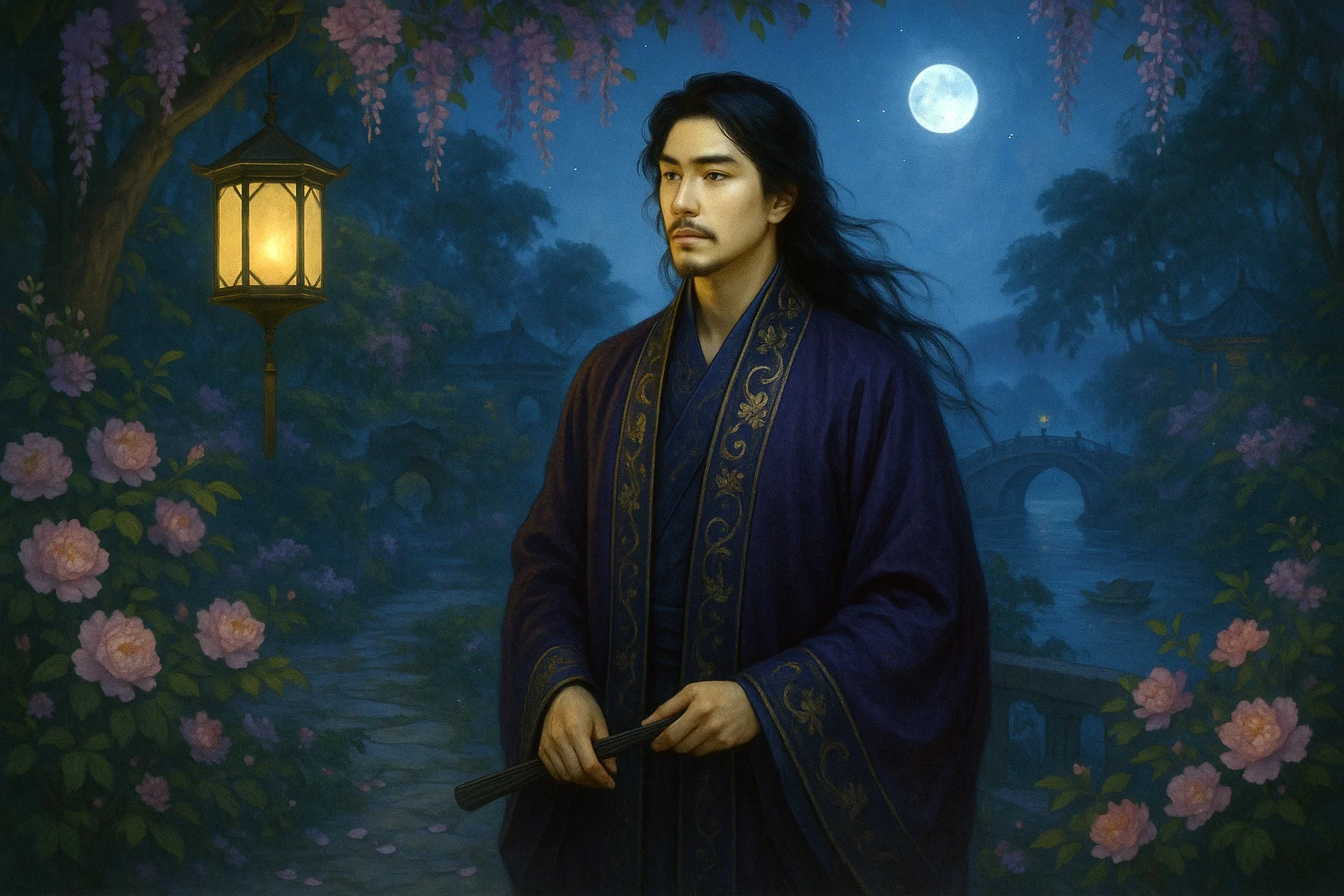
Li Shangyin (李商隐), 813 - 858 AD, was a great poet of the late Tang Dynasty. His poems were on a par with those of Du Mu, and he was known as "Little Li Du". Li Shangyin was a native of Qinyang, Jiaozuo City, Henan Province. When he was a teenager, he lost his father at the age of nine, and was called "Zheshui East and West, half a century of wandering".