


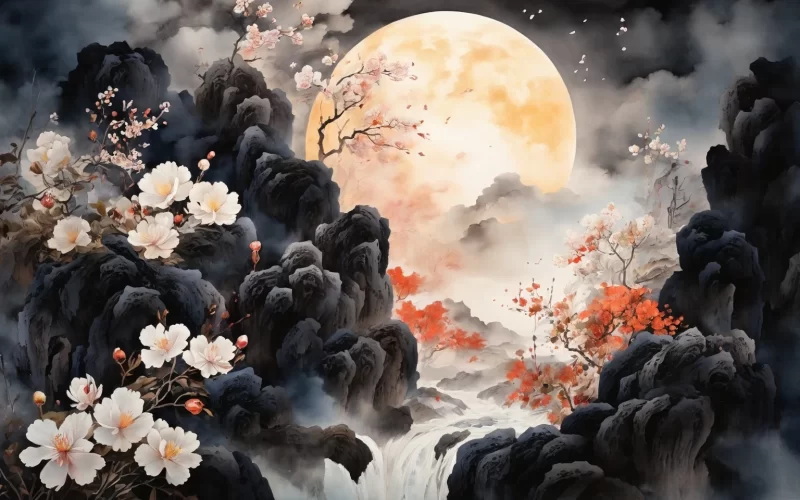
At ease, I sense sweet osmanthus blooms descend;
The night hushed, spring hills in solitude extend.
The rising moon surprises mountain birds in flight —
Their songs echo through the dale in the soft night.
Original Poem
「鸟鸣涧」
王维
人闲桂花落,夜静春山空。
月出惊山鸟,时鸣春涧中。
Interpretation
This poem is a classic from Wang Wei's Wang River Collection and a signature piece embodying his aesthetic philosophy of "infusing poetry with Zen" and "using stillness to command movement." The title itself, "The Dale of Singing Birds," contains a philosophy of movement and stillness giving rise to each other: the dale is the constant, silent backdrop, and the birdsong is the fleeting, lively note. In this poem, Wang Wei not only depicts the secluded beauty and tranquility of a spring mountain at night but also, through extremely subtle sensory orchestration and psychological suggestion, constructs a Zen world of "mind and object mutually containing each other, where emptiness is wondrous fullness." It showcases the philosophical and artistic heights attainable by High Tang landscape poetry.
First Couplet: 人闲桂花落,夜静春山空。
Rén xián guìhuā luò, yè jìng chūn shān kōng.
Idleness: the cassia petals fall. Vacant,
The spring hills in the stillness of the night.
This couplet governs imagery through mood, establishing a paradigm of "the state of mind is the poetic realm." "Idleness" (闲) is the prerequisite, referring not to having nothing to do but to an internal state of "collected spirit, with distracting thoughts completely quieted." Only with this can one perceive the subtle, nearly soundless movement of "the cassia petals fall"—perhaps the tactile sense of a few drifting petals, or the faintest sound of their landing, or, more likely, the mind's intuitive reflection on the passing of life. "The spring hills in the stillness of the night" expands the space from within outward: the night's "stillness" is an absence of sound; the hills' "vacant" is a dual experience of sight and psyche. "Vacant" (空) is not nothingness but the inherent clarity revealed when obscurities are removed, the open state where all things are as they are. These two lines are mutually causative: the idleness of the human mind allows the world's stillness to manifest; the vacancy of the world, in turn, deepens the idleness of the mind. The boundary between subject and object quietly dissolves here.
Second Couplet: 月出惊山鸟,时鸣春涧中。
Yuè chū jīng shān niǎo, shí míng chūn jiàn zhōng.
The moonrise startles birds on the hillside; their cries,
Now and again, echo across the springtime dale.
This couplet uses a momentary movement and sound to contrast and deepen the overarching silence, representing a philosophical sublimation of the concept "the birdsong makes the mountain more secluded." "The moonrise" is a visual event yet produces the auditory and psychological effect of "startles birds"—the moonlight's "startling" is not an alarm but an awakening, a gentle knock of nature's rhythm upon life. The phrase "now and again" (时) is masterful: "now and again" is irregular, sporadic, breaking expectations of pattern; "their cries" (鸣) are brief and clear, immediately returning to silence. These intermittent bird cries do not disrupt the tranquility; on the contrary, they become a measure for gauging the depth of the silence—only because it is utterly still can faint sounds be heard clearly, their resonance lingering. The spring dale is the resonance chamber for the sound, absorbing, containing, and transforming the momentary cries into a vaster silence. Movement is proof of stillness; sound is the echo of silence.
Holistic Appreciation
This is a mysterious poem about listening and manifestation. The poem's structure subtly corresponds to the Zen process of enlightenment: "beginning — unfolding — turning — completion." The first line, "Idleness," is the start of mind-cultivation (beginning); the second, "The spring hills… vacant," is the unfolding of the realm (unfolding); the third, "The moonrise startles," is the triggering of opportunity (turning); the final line, "echo across the springtime dale," is the harmonious realm attained after sudden insight (completion). The poet leads the reader through a spiritual experience that moves from introspection to outward gaze, from stillness to liveliness, and back to a deeper stillness.
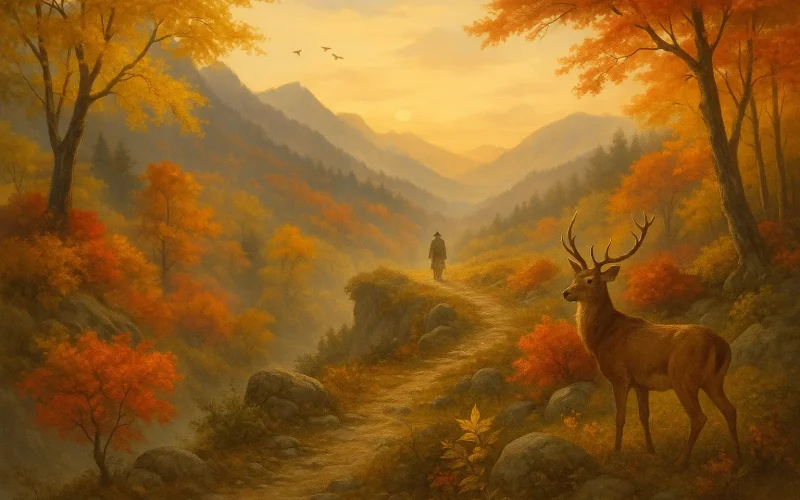
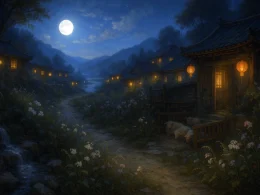
In this poem, Wang Wei practices his ultimate pursuit of "there is painting within the poetry, and Zen within the painting." On the pictorial level: cassia blossoms, spring hills, the moon, mountain birds, the stream dale—these constitute a richly layered painting of a secluded night landscape. On the philosophical level: the poem contains multiple dialectical unities of dualities—human idleness and falling blossoms (subjective and objective); night stillness and hill vacancy (time and space); moonrise and startled birds (light and sound); intermittent cries and the dale (the instant and the eternal). These opposing elements do not conflict; instead, within the poem's conception, they mutually give rise to and complete each other, jointly building a perfectly self-sufficient world. This is the Zen state of "both sound and form are extinguished" yet "both sound and form are fully revealed" in immediate experience.
Artistic Merits
- The Microscopic and the Magnified in Perception: The poet focuses perception on the minutest details (falling cassia blossoms, intermittent bird cries), yet through these details reflects the vastness of the cosmos (vacant spring hills, echoes in the dale). This is a poetic technique of "seeing the immense within the minute, the eternal within the instant."
- Meticulous Construction of Causal Chains: "Idleness" enables knowing the "fall"; "night stillness" reveals the "vacancy" of the hills; "moonrise" causes the "startling" of birds; "bird cries" cause the "echoing" in the dale. Every phenomenon has its antecedent, forming a tight network of psychological-physical linkages, making the poem's logic self-sufficient and profound.
- Zen-inflected Use of Verbs: "Fall" (落) is a downward fading; "vacant" (空) is an opening outward; "rise" (出) is an upward manifestation; "startle" (惊) is an internal-external vibration; "cries/echo" (鸣) is the propagation of sound. These verbs form a closed loop of energy circulation and artistic conception flow, where movement and stillness, birth and extinction, cycle endlessly.
- Layering and Function of Sound Description: The poem presents three layers of sound: the "sound of no-sound" of falling blossoms (requiring the heart to hear); the "triggering sound" of the moon startling birds; and the "resonant sound" of cries echoing in the dale. Together, they weave a web of sound grown from utmost silence—a web whose very purpose is to capture and illuminate silence.
Insights
This work is a key that unlocks the aesthetics of Eastern silence. It tells us: true tranquility is not the absence of sound but the capacity of the mind—when the mind is sufficiently broad and calm, birdsong, falling blossoms, moonrise, and indeed all sounds of nature can be peacefully accommodated and transformed into deeper stillness. What Wang Wei invites us to learn is precisely this art of living: "seeing stillness within movement, hearing silence within sound."
In our contemporary world surrounded by noise (both physical and informational), this poem holds special healing significance. It reminds us: perhaps what we need is not more sound or stronger stimuli, but the capacity for "idleness"—to withdraw the mind from distractions and restore its original sensitivity and tranquility. When we, too, can "hear" our own falling "cassia petals" amidst busyness, and feel that inner "vacant spring hill" amidst anxiety, perhaps the moon that startles birds will also rise in the night sky of our lives, bringing a clear cry echoing in the dale of our being.
In twenty characters, Wang Wei safeguards for us an eternal spiritual homeland. No matter how clamorous the age, as long as this poem is still recited, that spring hill, that night moon, that birdsong, that dale's echo will descend again, moistening every modern soul that longs for tranquility.
About the poet
Wang Wei (王维), 701 - 761 A.D., was a native of Yuncheng, Shanxi Province. Wang Wei was a poet of landscape and idylls. His poems of landscape and idylls, with far-reaching images and mysterious meanings, were widely loved by readers in later generations, but Wang Wei never really became a man of landscape and idylls.