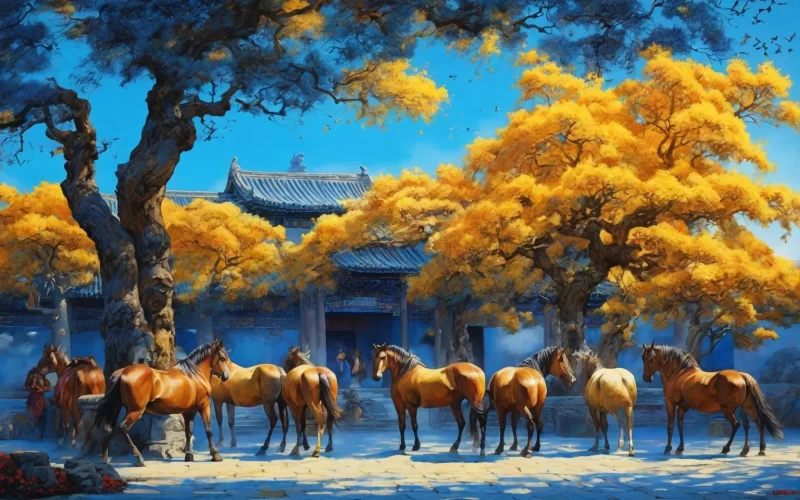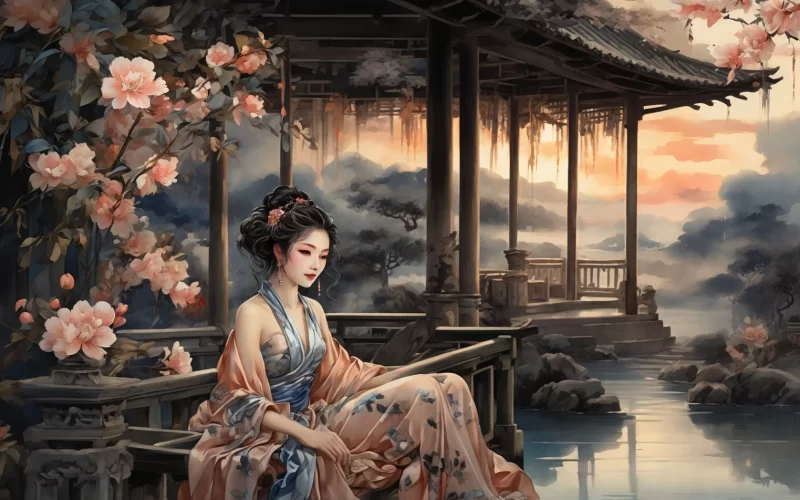

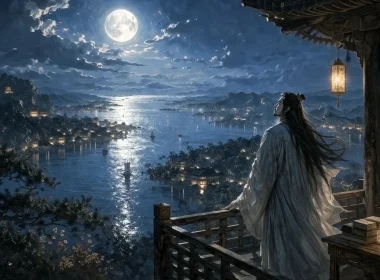
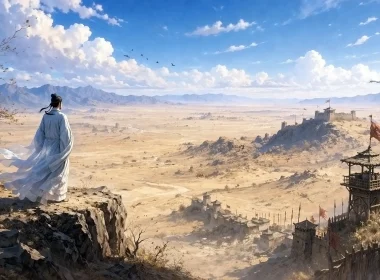
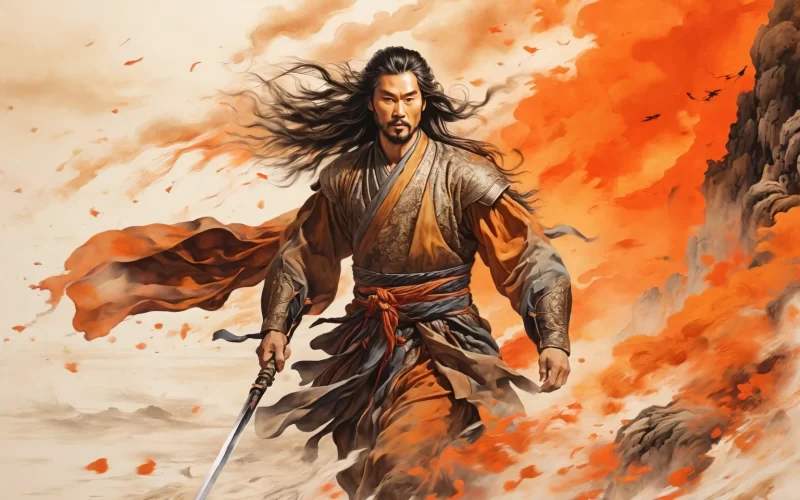
O why not gird the curved blade on, and be
A rider taking back the hills, all fifty, for the free?

Go, climb the Tower of the Cloud‑High Portraits, and look there —
Was e’er a book‑worm marquis in that bright, untroubled air?
Original Poem
「南园 · 其五」
李贺
男儿何不带吴钩,收取关山五十州。
请君暂上凌烟阁,若个书生万户侯。
Interpretation
This series of thirteen poems is a collection of pastoral verses composed by Li He after he resigned from office and returned to his hometown. The Southern Garden was the family estate located in his native place, Changgu. Unlike other poems in the series that describe the garden's bamboo shadows, flora, and spring scenery, this piece completely transcends the garden landscape to vent the poet's soaring ambition and deep-seated frustration. Li He's return was directly due to his frail health and hopeless career prospects. In 813 (the 8th year of the Yuanhe era), he resigned from his post as Ritual Ceremonialist and returned to Changgu. After three years in this minor ninth-rank position, he saw no hope for promotion or chance for distinction. Even earlier, he had been barred from the Jinshi examination due to naming taboo (his father's name contained a character with a similar pronunciation to "jin" in Jinshi), severing the normal path to an official career. For an ambitious 23-year-old, this was a devastating blow.
Retreating to a pastoral life was not his true desire. The rhetorical challenge in the poem, "男儿何不带吴钩", expresses less a heroic impulse than a profound dissatisfaction with his situation. "To win back the fifty districts lost beyond the passes" points directly to the contemporary reality of separatist warlords—during the Yuanhe era, the court directly controlled barely a hundred prefectures, while over fifty in Hebei and Henan were held by rebellious military governors. Repeated court campaigns yielded meager results. This was the nation's plight and also a projection of Li He's personal ambition: if the scholarly path was blocked, he would join the army and earn a noble title through military merit. But the final line, "Which one was a scholar, a lord of ten thousand homes?", douses half of this fervor. Among the twenty-four meritorious ministers honored in the Lingyan Pavilion, which one earned his marquisate by writing essays? This is a rhetorical question and also self-mockery; it is indignation, and also clear-sighted realism.
First Couplet: "男儿何不带吴钩,收取关山五十州。"
Nán'ér hé bù dài wú gōu, shōu qǔ guān shān wǔ shí zhōu.
Should a true man not take up the Wu-hook blade,
To win back the fifty districts lost beyond the passes?
The poem opens with a thunderous rhetorical question. The term "true man" refers both to the poet himself and issues a call to all men of ambition. The "Wu-hook" (吴钩, wú gōu), a curved blade from the ancient state of Wu, later symbolized fine weaponry. The poet challenges: why does a real man not take up arms to prove his worth on the battlefield?
The following line specifies the goal: reclaiming the fifty lost districts. This was the most pressing national crisis of the Yuanhe period and the ardent goal of countless patriots. By directly linking his personal aspiration to the nation's fate, the poet imbues the verse with potent contemporary relevance.
Second Couplet: "请君暂上凌烟阁,若个书生万户侯。"
Qǐng jūn zàn shàng Língyān gé, ruò gè shūshēng wàn hù hóu.
Let me ask you, sir, to climb the Lingyan Hall awhile:
Which one was a scholar, a lord of ten thousand homes?
This couplet turns from fervent passion to sober reflection, from outward projection to inward gaze. The "Lingyan Hall/Pavilion" (凌烟阁, Língyān Gé) was built by Emperor Taizong of Tang to honor the dynasty's founding meritorious officials, housing portraits of twenty-four figures like Zhangsun Wuji, Wei Zheng, and Yuchi Jingde. The poet says: go up and look—among those enfeoffed as marquises and appointed as chancellors, how many were mere bookish scholars?
The answer is obvious. Among the twenty-four, there were both civil and military officials, but the truly great "lords of ten thousand homes" almost invariably earned their titles through battlefield deeds. Even the civil official Wei Zheng had participated in military planning. A pure "scholar" of that era stood little chance of such nobility.
This line is both a summation of historical reality and the poet's lament for his own predicament. He knew that, given his health and the times, taking up arms was a vain hope; yet remaining a idle scholar at home was equally unbearable to his spirit.
Holistic Appreciation
This mere twenty-eight-character poem contains two diametrically opposed emotions: the first two lines are impassioned, the last two are somber; the first are outward-looking, the last are introspective; the first question the world, the last question the self.
The opening line, "Should a true man not take up the Wu-hook blade?", hits like a stern shout. The second line, "To win back the fifty districts...", grounds this cry in a concrete national mission. These two lines alone would suffice for any poet's legacy.
But Li He does not stop. The third line, "Let me ask you, sir, to climb the Lingyan Hall awhile", pulls the reader from the frontier back to the capital, from the future into history. The final line, "Which one was a scholar, a lord of ten thousand homes?", uses fact to answer the opening challenge: A man should take up the Wu-hook because without it, he cannot win a marquisate.
This answer reflects both cruel reality and the poet's clear-sightedness. He knew that even if he took up arms, his sickly frame might prevent success; even with success, a place in the Lingyan Hall was unlikely. Yet he could not help but ask, could not help but shout. This impulse to strive against the odds is the poem's most moving quality.
Artistic Merits
- A Rhetorical Opening that Commands Attention: Beginning with "Should... not..." creates a powerful, compelling momentum.
- Juxtaposition of Present and Past, Shifting Time and Space: From the contemporary "fifty districts" to the historical "Lingyan Hall", the poem traverses time and space within four lines, expanding its scope.
- A Rhetorical Conclusion with Lingering Depth: Ending with "Which one was a scholar..." answers the initial challenge while posing a deeper question to the reader.
- Sonorous Diction and Forceful Rhythm: The word choice is vigorous and impactful, the rhythm brisk, mirroring the poet's agitated state.
- Masterful Emotional Pivoting: The shift from heroic fervor to somber reflection within a short poem demonstrates superb artistic control.
Insights
In just twenty-eight characters, this poem captures the deepest dilemma of a scholar: Can studying truly change one's fate? In Li He's era, the answer was effectively "no." At least regarding the attainment of noble titles and high ministerial rank, a scholar held no advantage. The meritorious figures in the Lingyan Hall mostly rose through military exploits; those civil officials who entered service via the imperial examinations could at most reach the position of chancellor. The title "lord of ten thousand households" was a hereditary peerage requiring military merit. This reality may seem outdated today, but the question Li He poses remains potent: How does an individual find the path suited to them and realize their own value?
The poem provides no answer, leaving only two rhetorical questions. Yet these questions themselves constitute an attitude—a refusal to submit to fate, to compromise, to be content with the status quo. Even knowing the road ahead is faint, one must voice one's discontent. This spirit is more precious than any specific success.
About the Poet
Li He (李贺 790 - 816), a native of Yiyang, Henan, was a Romantic poet of the Mid-Tang dynasty. A descendant of the Tang imperial clan, he was barred from taking the national jinshi civil service examination due to a naming taboo (his father's name contained a character homophonous with "Jin"), which led to a life of frustration and poverty. He died at the age of twenty-seven. His poetry, renowned for its bizarre grandeur, chilling elegance, and fantastical imagination, earned him the title "Ghost of Poetry." He pioneered the distinctive "Changji Style" within Tang poetry, exerting a profound influence on later poets like Li Shangyin and Wen Tingyun and on the expansion of poetic imagery in subsequent eras.