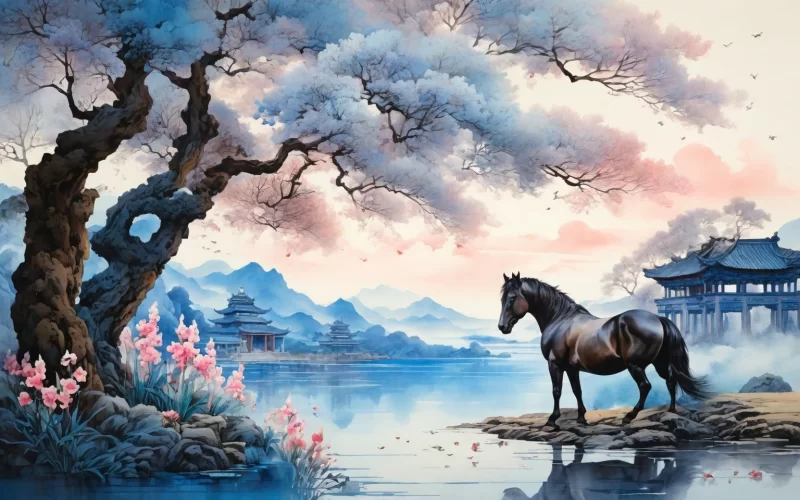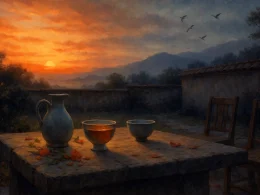

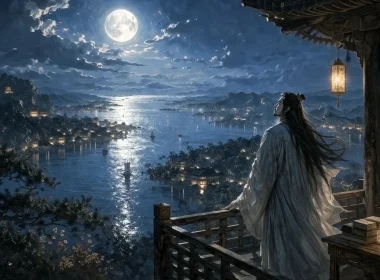
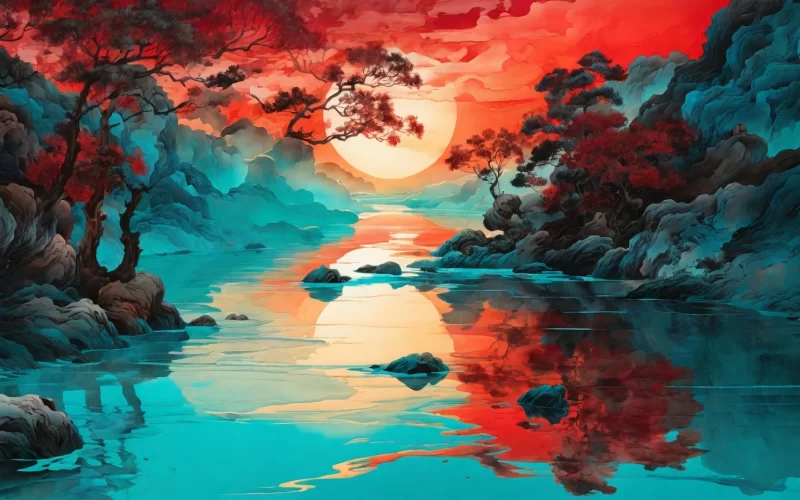
The departing sunbeams pave a way on the river;
Half of its waves turn red and the other half shiver.
How I love the third night of the ninth moon aglow!
The dewdrops look like pearls, the crescent like a bow.
Original Poem
「暮江吟」
白居易
一道残阳铺水中,半江瑟瑟半江红。
可怜九月初三夜,露似真珠月似弓。
Interpretation
This poem was written in the autumn of 822 CE, during the reign of Emperor Muzong, as Bai Juyi was traveling to Hangzhou to assume the post of Governor. Although this assignment was not a demotion, it did remove him from the political center of the court. The poet’s heart held a subtle mix of detachment from official life and eager anticipation for the landscapes south of the Yangtze. One day during his journey, as his boat was moored by the riverbank at the magnificent moment when dusk gives way to night, nature, with its most serene yet resplendent brushstrokes, soothed the traveler’s spirit. This heptasyllabic quatrain captures and crystallizes that very instant, where the poet’s inner world perfectly met the outer scene, preserving the incredible, tranquil beauty of the twilight transition. It stands as one of Bai Juyi’s most vividly colorful, harmoniously conceived, and widely circulated masterpieces of landscape poetry.
First Couplet: "一道残阳铺水中,半江瑟瑟半江红。"
Yī dào cán yáng pù shuǐ zhōng, bàn jiāng sè sè bàn jiāng hóng.
A beam of the setting sun spreads out upon the stream, / Half of the river turns a bluish-green, the other half agleam.
Explication: The opening paints the river’s most enchanting optical illusion with a grand yet meticulous touch. "A beam of the setting sun" is the light source, a dynamic projection. The verb "spreads out" is masterful; unlike "shines" or "strikes," it conveys the gentle, pervasive quality of the last sunlight stretching smoothly and broadly across the water’s surface, embodying ultimate tenderness. "Half of the river turns a bluish-green, the other half agleam" is the magical effect produced by this "spreading." "Bluish-green" originally referred to a type of green gem, here describing the deep green hue of the river surface untouched by the direct sunlight, while "agleam" (literally, red) describes the warm, brilliant color where the sunset saturates the water. One "bluish-green," one "red"; one cool, one warm; one in shadow, one in light—precisely divided yet seamlessly merged by the "half… half…" structure, composing a symphony of light and color that is both vividly contrasted and perfectly harmonious. This line not only depicts the scene but also implies a philosophical insight: the same river presents entirely different aspects due to slight differences in the angle of light, much like the manifold appearances of the world.
Second Couplet: "可怜九月初三夜,露似真珠月似弓。"
Kělián jiǔ yuè chū sān yè, lù sì zhēnzhū yuè sì gōng.
How lovely is the third night of the ninth moon! / The dew is like pearls, the crescent like a bow shining bright.
Explication: As the sun sinks completely, the poet’s gaze and spirit naturally turn to the emerging night. "How lovely" directly expresses his boundless delight and affection for the moment, establishing the joyful tone of the couplet. "The third night of the ninth moon" specifies the time—early autumn, when summer heat has receded, the sky is clear, and everything seems purified. The final two lines are linked by two crystal-clear similes: "The dew is like pearls" captures the dewdrops condensing on grass and leaves—their roundness, coolness, and way of catching the faint light—comparing a natural element to a human treasure. "The crescent like a bow" outlines the distinct, slender shape of the waxing crescent moon, comparing a celestial body to a man-made object (a bow), a novel and apt comparison. These two similes, one earthbound, one celestial; one a micro-view seen up close, the other a macro-view seen from afar; together weave an atmosphere of nocturnal tranquility, freshness, delicate beauty, and latent vitality. The poem completes a perfect visual transition from the warm-toned, grand spectacle of the "setting sun" to the cool-toned, minute focus on "dew" and "moon."
Holistic Appreciation
This quatrain is a "visual poem" that captures an eternal moment and a "lyric" that embodies a state of mind. Its artistic structure is meticulously crafted: the first two lines focus on the river at "dusk," using strong contrasts of light and color and a grand presentation to reveal nature’s splendor and mutability; the last two lines focus on the "early night" sky and earth, using delicate similes and keen observation to reveal the cosmos’s serenity and beauty. The four lines unfold like a masterfully shot film sequence: first, a wide-angle shot of the river (the sun spreading on the water), then a close-up on the color contrast (half bluish-green, half red), followed by a title card for the time (the third night of the ninth moon), and finally two juxtaposed close-ups (dewdrops, crescent moon). Not a single word directly expresses emotion, yet the poet’s intoxication with natural beauty, his cherishing of this peaceful moment, and the tranquility and joy in his traveler’s heart are completely infused in this play of light and shadow. The language is as bright as a painting, the conception fresh and transcendent, exemplifying Bai Juyi’s highest poetic ideal: "scenes before the eyes, words from the mouth, yet with resonance beyond the notes and flavor beyond the taste."
Artistic Merits
- A Painter’s Use of Light and Color: The contrast between "red" and "bluish-green" is a clash of hues; the warm light of the "setting sun" and the cool glow of the "dew" and "moon" represent a shift in luminosity. The poet acts like a perceptive Impressionist painter, precisely capturing and presenting the natural light and color of a specific moment, creating powerful visual appeal.
- Linked and Elevating Similes: "The dew is like pearls, the crescent like a bow" employs two similes in succession, constructing a complete, crystalline, and delicate nocturnal world from ground to sky. The similes are not just visually accurate; they convey the preciousness of the dew and the lively elegance of the crescent moon, representing a dual projection of aesthetic and emotional perception.
- Poetic Depiction of Temporal Flow: The poem clearly traces the passage of time from "setting sun" (evening) to "night." This transition is not abrupt but is achieved through a natural shift of visual focus (from river surface to sky and earth), giving the poem a gentle sense of sequence and narrative completeness.
- The Precise Beauty of Numbers and Time: The use of "a beam," "half… half…," and "the third night of the ninth moon" is not arbitrary. It gives the scene a concrete, perceptible scale and specificity, enhancing the realism of the image and the uniqueness of the captured moment, reflecting the poet’s meticulous observation.
Insights
This work has been recited for a millennium because it reveals that "poetry" is not always found in distant lands or spectacular views, but often in a paused instant on a journey, the moment when the gaze and the heart open simultaneously to nature. Bai Juyi teaches us an art of "attentive gazing": to embrace with all senses the spreading of "a beam of the setting sun," to discern the subtlety of "half of the river turns a bluish-green, the other half agleam," and to cherish the clear night where "the dew is like pearls, the crescent like a bow." This is an aesthetic approach to life—a state of being completely immersed in the present moment, breathing in unison with all things.
In the hurried rhythm of modern life, this poem is a gentle reminder: True peace and joy often reside in discovering and pausing to appreciate the subtle beauty of nature. We may not often find ourselves by a riverbank, but can we, on some evening after work, notice the changing colors of the clouds at the horizon? Can we, on some autumn night, look up at the crescent moon like a bow? Bai Juyi shows us that beauty possesses a powerful, soothing force. Those "lovely" moments are enough to cleanse worldly cares, making the spirit once again keen and fulfilled.
It encourages us, like the poet, to be a "singer" of life, using not just our eyes but our hearts to "chant" those ordinary yet moving sunsets and nights, finding within the flow of light and shadow our own inner realm of "half the river agleam" and a "moon like a bow." This deep affection for and recording of daily beauty is, in itself, the most positive praise of life.
Poem translator
Xu Yuanchong (许渊冲)
About the Poet
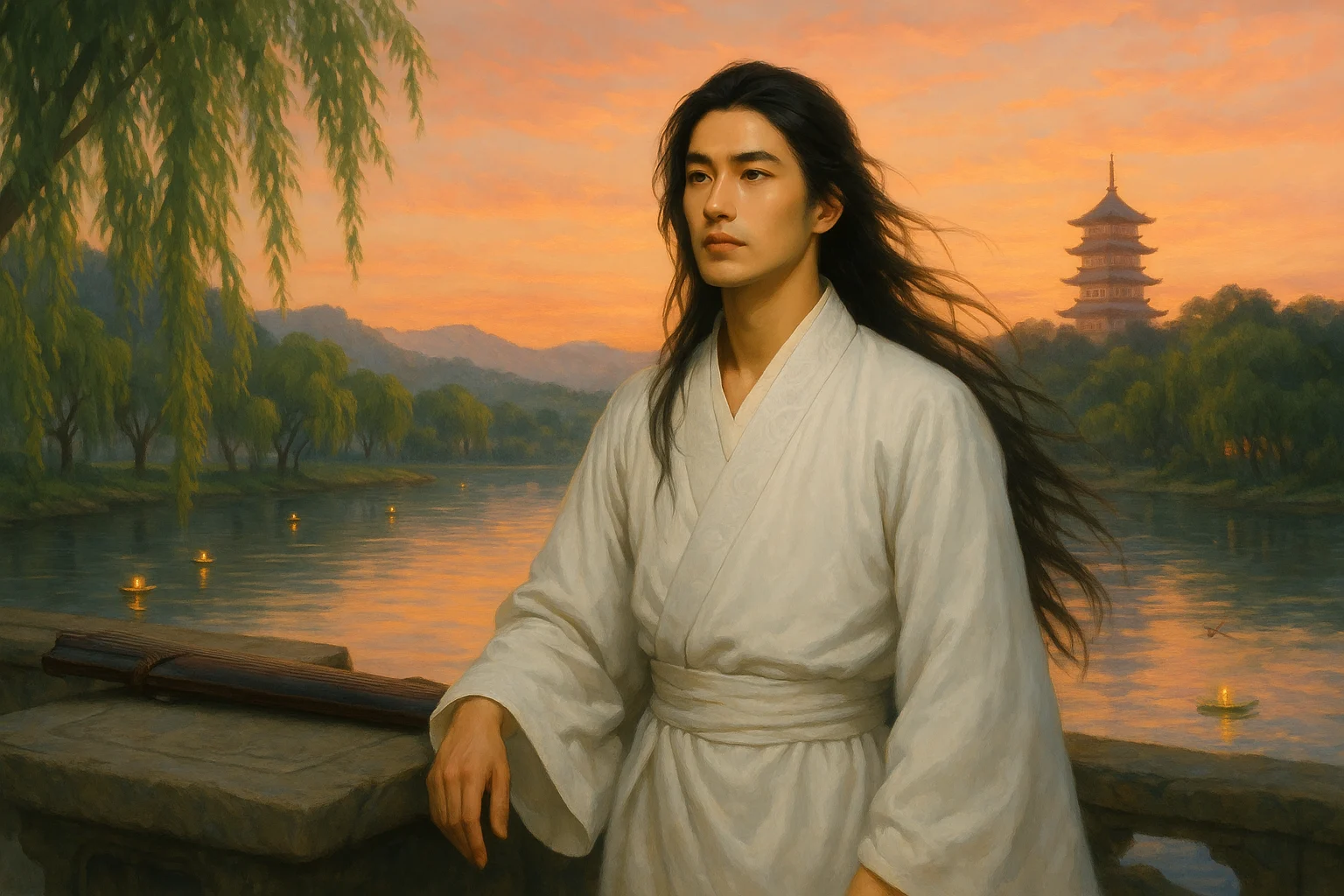
Bai Juyi (白居易), 772 - 846 AD, was originally from Taiyuan, then moved to Weinan in Shaanxi. Bai Juyi was the most prolific poet of the Tang Dynasty, with poems in the categories of satirical oracles, idleness, sentimentality, and miscellaneous rhythms, and the most influential poet after Li Bai Du Fu.