
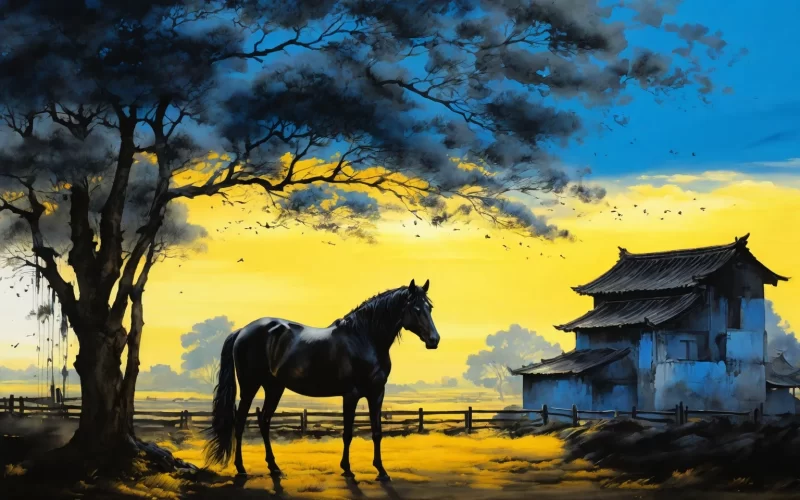
No common horse is this — its making is of that
Same stuff as the Chamber Star, which burns where heaven’s spheres are set.

Go, lay a hand upon the rack of its thin bones, and hark!
A music like struck brass yet lingers in the hollow dark.
Original Poem
「马诗 · 其四」
李贺
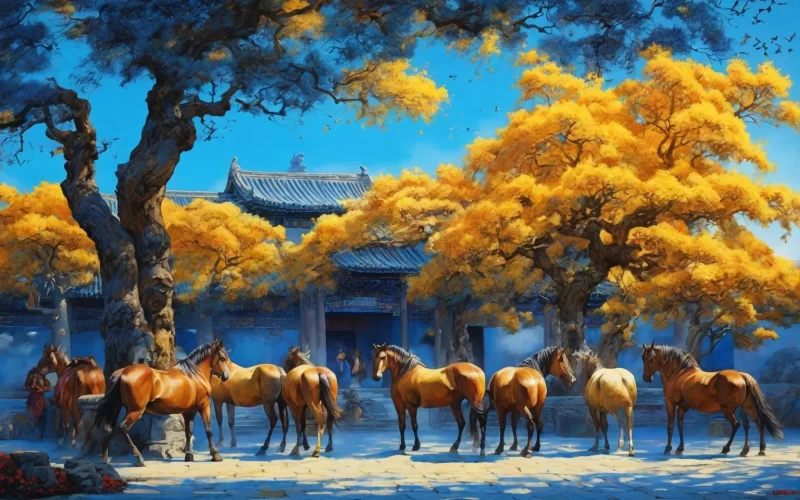
此马非凡马,房星本是星。
向前敲瘦骨,犹自带铜声。
Interpretation
"Horse Poems" is a series of twenty-three object-chanting poems written by Li He during his tenure in Chang'an; this is the fourth. Li He loved writing about horses. In his works, there are hungry horses ("In the twelfth month, grass roots taste sweet; / The capital streets piled with salt-like snow"), famous steeds ("A Red Hare finds no worthy master, / Needs a Lü Bu to be its rider"), and emaciated horses ("Go forward, tap its gaunt bones— / Still, a metallic, bronze-like sound it carries"). These horses take various forms, but most share a common trait: possessing talent yet meeting with no opportunity. "Fangxing" (the Room Star) is one of the twenty-eight lunar mansions; the ancients believed horses were the essence of this asterism. The Book of Jin's Treatise on Astronomy records: "The four stars of Fang... are also called the Celestial Quadriga, representing the Heavenly Horses, presiding over chariots." When the poet says of this horse, "The Room Star was, of course, a star," he is emphasizing its pedigree: it descended from the heavens, inherently no ordinary creature.
It is worth noting that the horse in the poem is not divinely robust; on the contrary, it is gaunt and bony. Yet the combination of "gaunt bones" and "bronze sound" creates a unique aesthetic tension—a haggard exterior housing an unyielding core. This mode of writing is not uncommon in Li He's poetry. He himself was sickly and frail in body, yet proud and lofty in spirit, unwilling to follow the crowd. The horse in the poem is, to some extent, a self-portrait. At that time, Li He served as a lowly Ritual Ceremonialist, his position minor and humble, sharing a certain similarity with the situation of this "extraordinary horse" fallen to the mortal world.
First Couplet: "此马非凡马,房星本是星。"
Cǐ mǎ fēi fán mǎ, fáng xīng běn shì xīng.
This steed is no common sort of horse;
The Room Star was, of course, a star.
The opening establishes the horse's celestial origin with assertive repetition. The parallel structure of "horse" (马) and "star" (星) creates a resonant, declarative rhythm. "No common sort" is a definitive, indisputable judgment. "The Room Star was, of course, a star" seems tautological but actually intensifies the claim—the Room Star, presiding over chariots, is inherently a celestial body. The poet thus clarifies its divine pedigree. However, the phrase "was, of course" holds a profound implication. "Was" signifies a past state, contrasting with a fallen present. It once was a star, but now it has descended to the mortal world, becoming an unappreciated horse. The poet leaves the grievance unspoken, but the reader keenly senses it.
Second Couplet: "向前敲瘦骨,犹自带铜声。"
Xiàng qián qiāo shòu gǔ, yóu zì dài tóng shēng.
Go forward, tap its gaunt bones—
Still, it carries a bronze-like ring.
This couplet is the poem's immortal, celebrated core. "Gaunt bones" depict its current, pitiable state—the horse is all skin and bones. But the action "Go forward, tap" embodies a probing curiosity, a testing expectation. The poet seems to seek verification: does this seemingly wretched horse still harbor something within? The answer is "Still, it carries a bronze-like ring." The tap yields not a hollow thud but a clear, metallic resonance. Bronze symbolizes hardness, resilience, and enduring quality. This sound is the echo of its skeletal frame, and metaphorically, the unbroken fortitude of its spirit.
The words "Still, it carries" are most evocative. They signify perseverance: despite its emaciation, its fallen state, and its obscurity, its intrinsic essence remains unaltered. That is its inborn nobility, its inherent tenacity, its indomitable core.
Holistic Appreciation
This poem comprises only twenty characters, yet it narrates a life's story. The first two lines speak of innate nobility, the last two of its present lot; the first of heavenly origin, the last of earthly reality; the first of destiny, the last of character. This horse, originally a descended star, is now gaunt and bony; yet it is not defeated—tap it, and it still resonates with a bronze sound.
Li He writes of a horse, and unmistakably, of himself. A descendant of the Tang imperial house, he was of "Room Star" lineage; yet, barred from the examinations by naming taboo, he could only secure the lowly post of Ritual Ceremonialist, navigating Chang'an with his frail form. But he did not yield or accept his fate. His poetry is his "bronze sound"—those strikingly original images, that austere and unyielding tone, that defiant spirit—all are the clear ring emitted when he is "tapped."
The poem's language is supremely concise, yet its tension is immense. The contrast between "extraordinary" and "gaunt bones," the resonance between "was, of course, a star" and "carries a bronze-like ring," are powerfully compressed. The poet does not complain or lament; he merely records, with cool detachment, the appearance of a horse and the sound of its bones. Yet this very detachment is more forceful than any outcry.
Artistic Merits
- Using the Horse as a Persona, Chanting an Object to Express Will: Superficially describing a horse, it is a profound self-portrait. The horse's lineage, plight, and unbroken spirit mirror the poet's own.
- Vivid Contrasts, Rich Tension: The first couplet asserts noble origin, the second depicts a lowly state. This stark contrast heightens the pathos of unrecognized talent.
- Precise Diction, Unique Imagery: "Gaunt bones" captures the outer form; "bronze-like ring" reveals the inner essence. The imagery is vivid, allowing the reader to visualize the horse and almost hear its metallic resonance.
- Extremely Concise Language, Profound Meaning: Twenty characters encapsulate lineage, circumstance, and character without a single wasted word, achieving remarkable depth and economy.
- Forceful Conclusion, Lingering Resonance: "Still, it carries a bronze-like ring" concludes the poem, serving as both an answer to the implied question and a defiant declaration to fate: despite adversity, true substance endures.
Insights
In twenty characters, this poem explores a timeless theme: true worth remains unchanged by circumstance. It reveals the chasm between "origin" and "lot." This horse was a star, yet is gaunt; Li He was of royal descent, yet lived in hardship. Such disparity is a common human experience. But the poet does not dwell in self-pity; instead, the "bronze-like ring" tells us: origin is merely a starting point, present circumstance merely a moment; what truly defines a being is the substance within its bones.
The action "敲瘦骨" invites deep reflection. Why tap? Because the essence is invisible. This horse's extraordinariness lies not in its hide or posture, but within its bones. It requires tapping to reveal its sound. This teaches us that true talent and character are often concealed beneath an unremarkable exterior, needing a discerning eye to discover and the right moment to reveal.
On a deeper level, the "铜声" is both a sound and an attitude. It is a metallic clang, the echo of bone, a declaration of defiance. With this phrase, the poet declares: you may reduce me to skin and bones, leave me in poverty and obscurity, but test me, and I will still ring true as bronze. Such integrity outlasts any worldly fame or achievement.
About the Poet
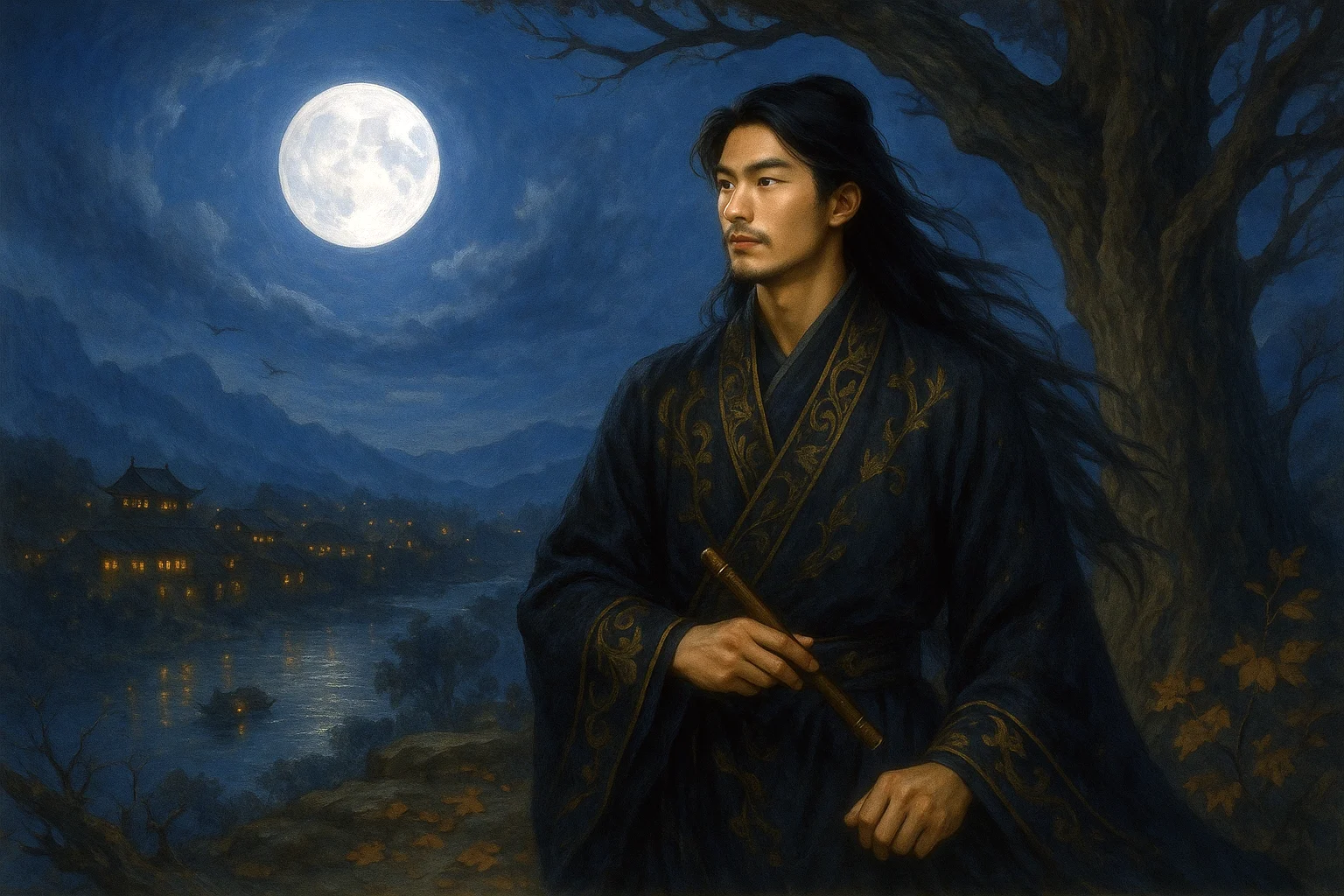
Li He (李贺 790 - 816), a native of Yiyang, Henan, was a Romantic poet of the Mid-Tang dynasty. A descendant of the Tang imperial clan, he was barred from taking the national jinshi civil service examination due to a naming taboo (his father's name contained a character homophonous with "Jin"), which led to a life of frustration and poverty. He died at the age of twenty-seven. His poetry, renowned for its bizarre grandeur, chilling elegance, and fantastical imagination, earned him the title "Ghost of Poetry." He pioneered the distinctive "Changji Style" within Tang poetry, exerting a profound influence on later poets like Li Shangyin and Wen Tingyun and on the expansion of poetic imagery in subsequent eras.