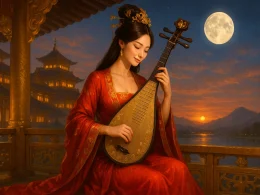



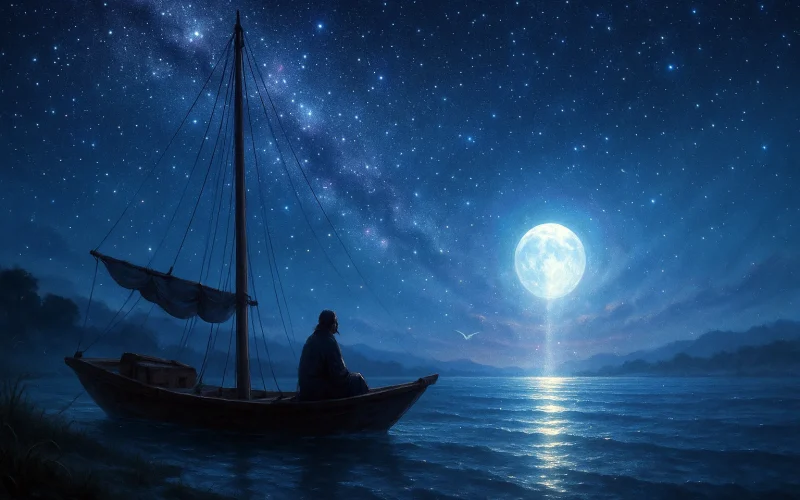
A light wind is rippling at the grassy shore...
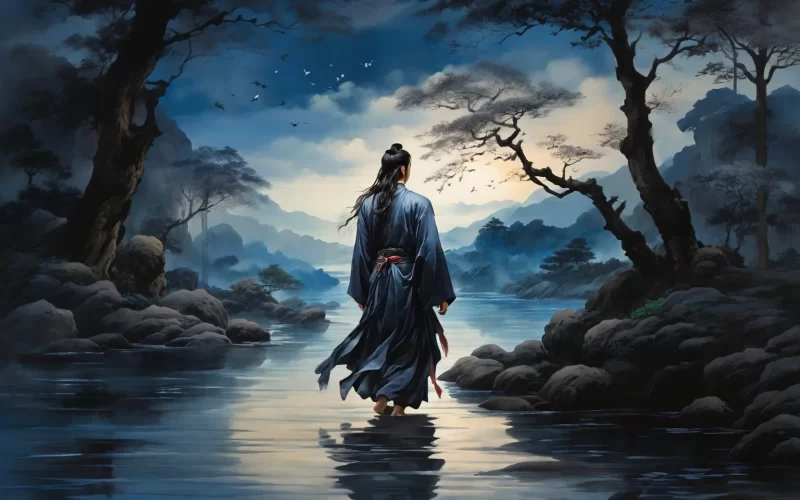
Through the night, to my motionless tall mast,
The stars lean down from open space,
And the moon comes running up the river.
...If only my art might bring me fame
And free my sick old age from office! --
Flitting, flitting, what am I like
But a sand-snipe in the wide, wide world!
Original Poem
「旅夜书怀」
杜甫
细草微风岸,危樯独夜舟。
星垂平野阔,月涌大江流。
名岂文章著,官应老病休。
飘飘何所似,天地一沙鸥。
Interpretation
This poem was composed in the autumn of 765 CE, the first year of the Yongtai era under Emperor Daizong of the Tang dynasty. That spring, Du Fu's close friend and patron in Chengdu, Yan Wu, had passed away. With his support gone, the poet left his Chengdu thatched cottage with his family, traveling east by boat through the regions of Yuzhou and Zhongzhou. Nearing sixty, in frail health, without reliable means of livelihood, and with his aspirations shattered, Du Fu found himself truly adrift, "wandering between heaven and earth in the southwest." On this night, with his boat moored by the riverbank and facing the vast starry sky and the ceaseless flow of the great river, he experienced a violent collision within—the insignificance of the individual, the desolation of fate, and the eternity of the cosmos—giving rise to this timeless masterpiece.
First Couplet: “细草微风岸,危樯独夜舟。”
Xì cǎo wēi fēng àn, wēi qiáng dú yè zhōu.
By riverside where slender grasses bend in breeze so light; / A lonely boat at night, its towering mast stands lone in sight.
The opening lines sketch, like a delicate drawing, the intimate scene of a solitary vessel moored at night. "Slender grasses bend in breeze" and "breeze so light" depict the setting's tranquility with a soft, subtle touch. "Towering mast" and "A lonely boat at night" highlight the stark prominence of the vessel and the utter solitude of the person aboard. The word "lonely" is the poem's central image, describing both the boat's isolation and, more profoundly, the poet's own inner solitude and lack of anchorage. Though the scene is small, a pervasive sense of solitary desolation is already established.
Second Couplet: “星垂平野阔,月涌大江流。”
Xīng chuí píng yě kuò, yuè yǒng dà jiāng liú.
Stars hang low, over the boundless wilds extending far and wide; / The moon swells up, on the Great River's endless, rolling tide.
This couplet stands as an unparalleled masterpiece of landscape depiction. The perspective shifts from near to far, from a close view to a grand, sweeping gaze. "Stars hang low" describes the expansive, drooping canopy of the night sky, accentuating the vastness of the "boundless wilds." "The moon swells up" imbues the moonlight with a dynamic, surging motion, mirroring the mighty, perpetual flow of the "Great River's tide." The verbs "hang low" and "swell up" transform stillness into potent movement, instilling a sense of tremendous vitality into the grand spatial expanse (the wilds, the river) and the eternal temporal sphere (stars, moon). While presenting a supremely magnificent vista, these lines are not mere scenic praise. Against the backdrop of the infinite cosmos, they instead throw into sharper, poignant relief the insignificance and rootlessness of the "lonely boat" from the opening, creating powerful emotional tension.
Third Couplet: “名岂文章著,官应老病休。”
Míng qǐ wénzhāng zhù, guān yīng lǎo bìng xiū.
Was fame ever truly won by written art alone? / An office lost—to age and sickness must I lay the blame I own.
The focus turns abruptly from the magnificent external scene to a somber inward confession, creating a dramatic emotional shift. This couplet uses rhetorical questioning and indirect expression to voice a deep-seated grievance. "Was fame ever truly won by written art alone?" is a bitter lament: Du Fu harbored grand political ambitions, aiming to "guide his sovereign to become a sage king." How could he be content with fame based merely on literary skill? This is, in truth, a sorrowful reflection on the failure of his lifelong aspirations. "An office lost—to age and sickness must I lay the blame" is self-mockery born of helplessness. He lost his post due to political exclusion, yet can only outwardly attribute it to "age and sickness." Beneath the resigned tone lies profound and unspoken bitterness. One line questions the premise of his renown, the other reluctantly accepts his circumstance; together, they articulate the painful chasm between ideal and reality.
Fourth Couplet: “飘飘何所似,天地一沙鸥。”
Piāo piāo hé suǒ sì, tiān dì yī shā ōu.
Drifting, ever drifting—what likeness fits my state? / A single gull, alone, between the earth and heaven's gate.
The poem concludes with a metaphor that crystallizes its entire mood and emotion into an enduring, iconic image. "Drifting, ever drifting" echoes the "lonely" of the first couplet and the vastness of the second, encapsulating his perpetual state of wandering. "A single gull, alone, between the earth and heaven" is a stroke of genius: the cosmos ("earth and heaven") is infinitely vast, the individual ("single gull") infinitesimally small; the cosmos is eternal, the gull fleeting and transient. This metaphor perfectly captures the poet's sense of solitary helplessness suspended between immutable space/time and an uncertain fate. The image is hauntingly beautiful and deeply resonant, elevating personal sorrow into a meditation on the human condition with universal significance.
Holistic Appreciation
This poem is a paradigm of Du Fu's five-character regulated verse, exemplifying his signature fusion of scene and emotion, characterized by somber depth and rhythmic force. Its structure is meticulously crafted: the first two couplets paint the scenery, the latter two express the feeling; the scenery progresses from the intimate and minute to the grand and boundless; the expression moves from rhetorical defiance to resigned self-mockery, culminating in symbolic imagery. Its artistic essence lies in "using the infinitude of the cosmos as a mirror for one's own insignificance; projecting inner solitude onto the grandeur of heaven and earth."
The poem establishes a stark contrast between two distinct imaginative realms: one is the eternal, magnificent vista of the second couplet—stars hanging low over boundless wilds, the moon swelling on the endless river; the other is the solitary, fragile world of the first and last couplets—slender grasses, a lonely boat, a single gull between earth and sky. The poet's consciousness oscillates between these realms. The more magnificent the former, the more desolate and poignant the latter becomes. Within this contrast, the pathos of personal fate acquires a metaphysical depth, transforming this lyrical travel sketch into a profound philosophical meditation on life, existence, and destiny.
Artistic Merits
- Vivid Contrast, Immense Tension
The poem juxtaposes the majestic imagery of "Stars hang low… / The moon swells up…" with the fragile, solitary imagery of "slender grasses" and "a single gull, alone." This creates a powerful spatial and emotional dichotomy, dramatically heightening the poet's feelings of rootlessness and isolation. - Exquisite Diction, Potent Verbs
The choice of verbs "hang low" and "swell up" imbues the static celestial bodies with dynamism and force, vividly animating the immense vitality and rhythm inherent in the cosmos. They are exemplary models of precise and evocative phrasing. - Seamless Transition, Fusion of Feeling and Thought
The shift from the grand external scenery (second couplet) to the intimate lament on personal fate (third couplet) occurs naturally, without a trace of artifice. Emotion arises organically from the scene, and reflective thought emerges seamlessly from the emotion, achieving a sublime integration of description, sentiment, and philosophy. - Concluding Metaphor, Culmination of Poetic Vision
The metaphor "A single gull, alone, between the earth and heaven's gate" is both strikingly apt and richly suggestive. It gives concrete, poetic form to the abstract sensation of existential drifting, masterfully concluding the entire poem with enduring resonance. It is the definitive image that encapsulates the poem's essence.
Insights
This work reveals that when an individual contemplates their own suffering against the vast backdrop of the universe, what emerges is not merely a sense of insignificance, but potentially a profound clarity and a uniquely poignant form of poetry. Du Fu teaches us: True solitude involves maintaining a keen awareness and honest expression of one's life condition, even after fully realizing one's own minute and rootless existence, like "a single gull, alone, between the earth and heaven."
The insight this poem offers modern readers is this: In life's inevitable state of "drifting," we will likely all experience moments where ideals are thwarted and we feel profoundly alone. What matters is not to deny or escape this feeling of smallness akin to the "single gull," but rather, like Du Fu, to find within the magnificent vista of "Stars hang low, over the boundless wilds" the immense perspective that can contain individual joy and sorrow. We must then refine this unique life experience into spiritual insights of universal significance. The poem assures us that even as a "single gull," its fleeting trace across the expanse of heaven and earth can become an enduring work of art.
Poem translator
Kiang Kanghu
About the poet
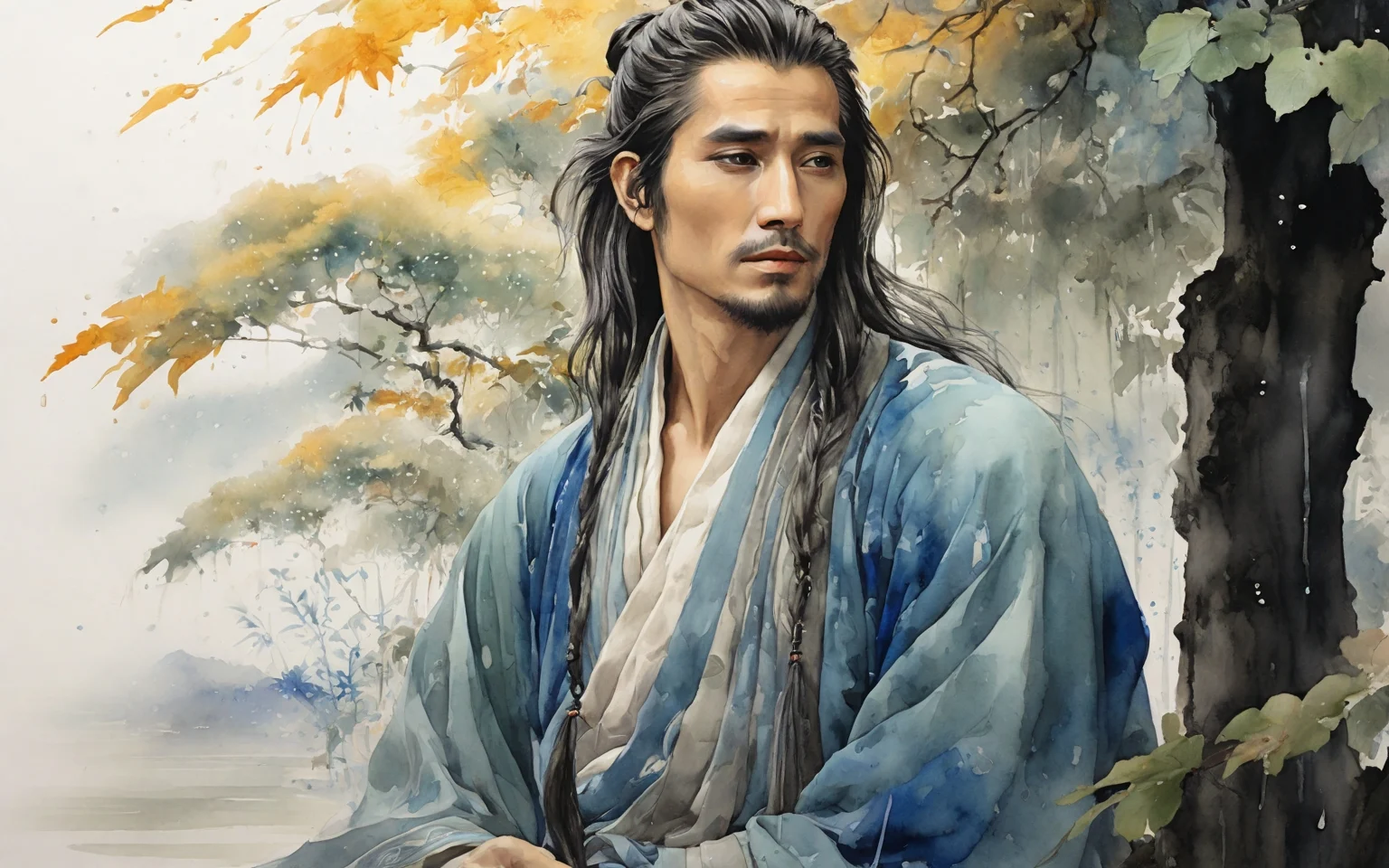
Du Fu (杜甫), 712 - 770 AD, was a great poet of the Tang Dynasty, known as the "Sage of Poetry". Born into a declining bureaucratic family, Du Fu had a rough life, and his turbulent and dislocated life made him keenly aware of the plight of the masses. Therefore, his poems were always closely related to the current affairs, reflecting the social life of that era in a more comprehensive way, with profound thoughts and a broad realm. In his poetic art, he was able to combine many styles, forming a unique style of "profound and thick", and becoming a great realist poet in the history of China.