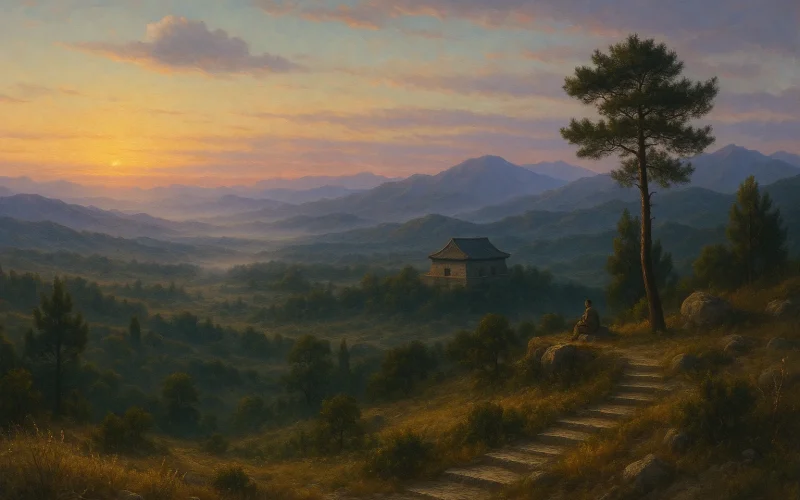
Solitary at the tavern,
I am shut in with loneliness and grief.
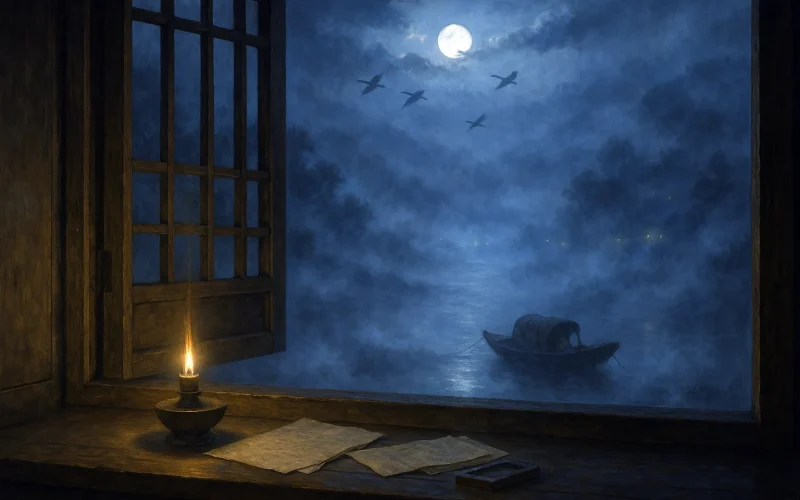
Under the cold lamp, I brood on the past;
I am kept awake by a lost wildgoose.
...Roused at dawn from a misty dream,
I read, a year late, news from home --
And I remember the moon like smoke on the river
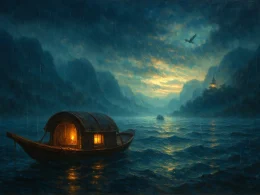
And a fisher-boat moored there, under my door.
Original Poem
「旅宿」
杜牧
旅馆无良伴,凝情自悄然。
寒灯思旧事,断雁警愁眠。
远梦归侵晓,家书到隔年。
沧江好烟月,门系钓鱼船。
Interpretation
The exact year of this poem's composition is difficult to ascertain. Based on its deeply restrained emotion and its refined, meticulously balanced structure within the regulated verse (lüshi) form, it likely belongs to Du Mu's later works, from his middle age, a period of official travels and wandering. The poet may have been moving between provincial administrative posts or lodging at an inn during an official journey. The careers of late Tang scholar-officials were often marked by frequent transfers and extended periods of travel, making the "inn" a crucial space for experiencing solitude and reflecting on life. Du Mu's poem stands as a profound exploration and poetic articulation of an individual's inner world within this common circumstance.
While perhaps not as widely known as his famed historical quatrains or other lyrical masterpieces, this work represents the most somber in tone and technically accomplished among Du Mu's pentasyllabic regulated verses. It eschews external historical references and ornate language, turning inward to capture subtle mental states and to construct the aesthetic atmosphere of travel weariness. What it presents is not a transient melancholy tied to a specific moment, but the universal predicament concerning solitude, nostalgia, the barriers of time, and spiritual belonging—an experience common to all wanderers. Thus, while lacking the startling historical insight or vivid, dazzling imagery of some of his other works, this poem, through its deep empathetic power and perfect fusion of feeling and scene, occupies a unique and significant place within the vast tradition of poetry on travel and solitude.
First Couplet: 旅馆无良伴,凝情自悄然。
Lǚguǎn wú liáng bàn, níng qíng zì qiǎorán.
At this wayside inn, I've no companion for my heart; With feelings pent, in solitude I dwell apart.
The opening lines directly address the core experience of travel—solitude. "No companion for my heart" indicates not merely the absence of company but a state of spiritual isolation, with no kindred spirit for conversation or shared understanding. "With feelings pent, in solitude I dwell apart" poetically deepens this state: "With feelings pent" suggests concentrated emotion and silent contemplation; "in solitude I dwell apart" depicts a quiet, self-absorbed stillness. This couplet uses spatial confinement (the inn) to evoke psychological stillness (solitude), establishing the poem's introspective and somber tone.
Second Couplet: 寒灯思旧事,断雁警愁眠。
Hán dēng sī jiù shì, duàn yàn jǐng chóu mián.
By the cold lamplight, thoughts of bygone days arise; A stray goose's cry alarms my sorrow-laden eyes.
This couplet shifts from static contemplation to dynamic mental activity, selecting two quintessential images of travel. "Cold lamplight" is a synesthetic image, blending visual and tactile sensation. A lamp provides light, but modified by "cold," it becomes both a realistic description of the chilly lamp in the deep night and an externalization of the poet's inner loneliness and desolation. Under its glow, "thoughts of bygone days arise" feels inevitable. The cry of the "stray goose" provides an auditory intrusion. "Stray goose" refers to a lost, solitary wild goose, a classic symbol of rootless wandering. The verb "alarms" describes both the sudden, startling nature of the sound and how it pierces the poet's already fragile, sorrow-filled repose. The lamp and the goose, one internal and static, the other external and dynamic, together weave the dense fabric of a traveler's melancholy thoughts on a long night.
Third Couplet: 远梦归侵晓,家书到隔年。
Yuǎn mèng guī qīn xiǎo, jiā shū dào gé nián.
My distant dream of home lasted till break of day; A letter from my folk would come next year, they say.
This couplet expresses emotion in a more complex and profound way, employing a double barrier in time to intensify the anguish. "My distant dream of home" offers an illusory compensation; dreams can transcend geography, allowing an instant "return." But this solace is brief, cut short by "break of day," signifying the fragility of sweet dreams and the immediate return of reality. "A letter from my folk would come next year" presents the harsh truth. With the slow pace of ancient communication, letters traveled with great delay. The phrase "next year" gives concrete, temporal form to the sense of despair created by vast spatial distance. Though "distant," the dream is accessible (in sleep); though longed for, the letter is "next year" away. This cruel juxtaposition of the near-yet-illusory and the desired-yet-deferred pushes the feeling of homesickness to an almost unbearable intensity.
Fourth Couplet: 沧江好烟月,门系钓鱼船。
Cāng jiāng hǎo yān yuè, mén xì diào yú chuán.
The river's broad expanse looks fine in mist and moon; A fishing boat is tethered by the tavern gate.
The final couplet seems to open outward, shifting to observe the tranquil beauty outside the window, yet in doing so, it drives the inner turmoil to an even deeper level. "The river's broad expanse looks fine in mist and moon" describes an objectively beautiful scene. But this beauty belongs to the river, to nature, and does not belong to the wandering traveler. Instead, its serene loveliness serves as a stark contrast to the traveler's inner unrest and lack of anchorage. "A fishing boat is tethered by the tavern gate" is the masterful concluding stroke. The tethered boat symbolizes mooring, stability, and homecoming. Yet it is a "fishing boat," pointing toward a life of reclusion and freedom amidst "rivers and lakes." This stands in sharp contrast to the poet's own constraints and rootlessness as an official traveler. It lies there quietly tethered, like a metaphor for a haven that seems within reach yet remains unattainable. All the loneliness and homesickness ultimately crystallize within this highly suggestive still life, leaving endless resonance.
Holistic Appreciation
This pentasyllabic regulated verse is a model of emotional expression in poetry of travel and solitude, tracing an inward-outward-inward emotional movement. Using the inn room as a psychological chamber, it meticulously portrays the flow of a lonely traveler's emotions through a single night.
The poem follows a rigorous emotional and chronological logic: from sitting alone in concentrated thought at nightfall (first couplet), to reminiscing by the lamp and being startled from troubled sleep by the goose's cry in the deep night (second couplet), to dreaming of home until dawn and waking to thoughts of long-delayed letters (third couplet), and finally concluding with a contemplative gaze upon the scene outside at daybreak (fourth couplet). Throughout this process, the poet's senses are fully engaged (the visually/coldly perceived lamp and moonlit mist, the auditory cry of the goose, the illusory dream), and his emotions intensify layer by layer: from loneliness, to nostalgia, to startled sorrow, to the dream of return, to the despair of deferred connection, and finally settling into a complex, contemplative melancholy when faced with eternal nature and an image of carefree life. Du Mu's mastery lies in forging such intricate psychological activity entirely within the framework of balanced parallelism, refined imagery, and a clear spatiotemporal structure. The result is a poem profoundly moving yet formally disciplined, expansive in atmosphere yet tightly composed.
Artistic Merits
- Classical Imagery with Profound Emotional Resonance: Images like "inn," "cold lamplight," "stray goose," "distant dream," "letter from home," "river's broad expanse," and "fishing boat" are all classics of travel poetry. Du Mu's excellence lies in his precise pairing of verbs and adjectives ("pent" feelings, "alarms" sleep, "lasted till" dawn, "next year" away, "tethered" boat), imbuing these common images with intense emotional tension and personal hue, making them perfect vessels for specific states of mind.
- Intensification Through Temporal and Spatial Juxtaposition: The poem juxtaposes the brief "dream" with the long "next year" in time; the illusory, accessible "dream of home" with the real, obstructed "letter from home" in space; and the poet's own rootlessness within the "inn" with the stability and reclusion symbolized by the "fishing boat" outside. This multi-layered technique of contrast greatly deepens and complicates the themes of homesickness and solitude.
- Cadenced Rhythm of Emotion: The poem's emotional flow has its ebbs and swells. The first couplet is low and subdued; the second, plaintive and startled; the third offers the fleeting hope of a "dream of home" only to plunge into the deeper disappointment of "next year"; the fourth uses the external scene's apparent "fine[ness]" to underscore the inner contemplative melancholy. This creates an emotional rhythm of restrained fluctuation and circularity, mirroring the true restlessness of a sleepless mind through the long night.
- Concluding with Scene to Convey Lingering Meaning: The final couplet is purely descriptive, not a word directly expresses feeling, yet emotion resides within the scene, meaning overflows beyond the words. The objective beauty of the “fine mist and moon” and the stillness of the “tethered” boat together form a world beyond that is both alluring (peaceful, anchored) and alien (not mine). All the poet’s travel-weariness, his sense of life’s journey, his longing for belonging are implicitly entrusted to this scene. The conclusion is resonant and lingering, possessing the beauty of understatement and implication.
Insights
This work serves as a window into the spiritual world of the ancient literati. It reflects not only Du Mu’s personal sorrows of travel but also a timeless, universal aspect of the human condition concerning solitude, wandering, and spiritual anchorage.
It prompts us to recognize that solitude is a condition in life difficult to avoid entirely. The “inn” in the poem can be seen as a symbol for any environment where one feels strange and isolated. In solitude, one instinctively “thinks of bygone days” and seeks dreams of return (a spiritual homecoming). But reality often resembles the “next year” letter, presenting seemingly insurmountable barriers. The true dilemma might lie here: when an alternative existence, as seemingly fine as the “mist and moon on the broad river” (symbolized by the “fishing boat” of reclusion), appears potentially within sight, the individual may remain unable to truly reach it due to various bonds (duties, social standing, circumstances).
Therefore, this poem expresses not only homesickness but, on a deeper level, touches upon the tension between human finitude and the eternal longing for the infinite (freedom, peace, belonging). It leads us to ponder: in a life journey inevitably destined to involve wandering or filled with limitations, how do we settle a heart yearning for a “mooring”? Do we rely on the solace of “distant dreams,” or do we cultivate a transcendent state of mind capable of appreciating “fine mist and moon” without being troubled by their unattainability? Du Mu provides no answer, but with poetic honesty, he presents the full weight and beauty of this dilemma, allowing readers across ages to glimpse their own “inn” state of mind at some moment within it.
Poem translator
Kiang Kanghu
About the poet
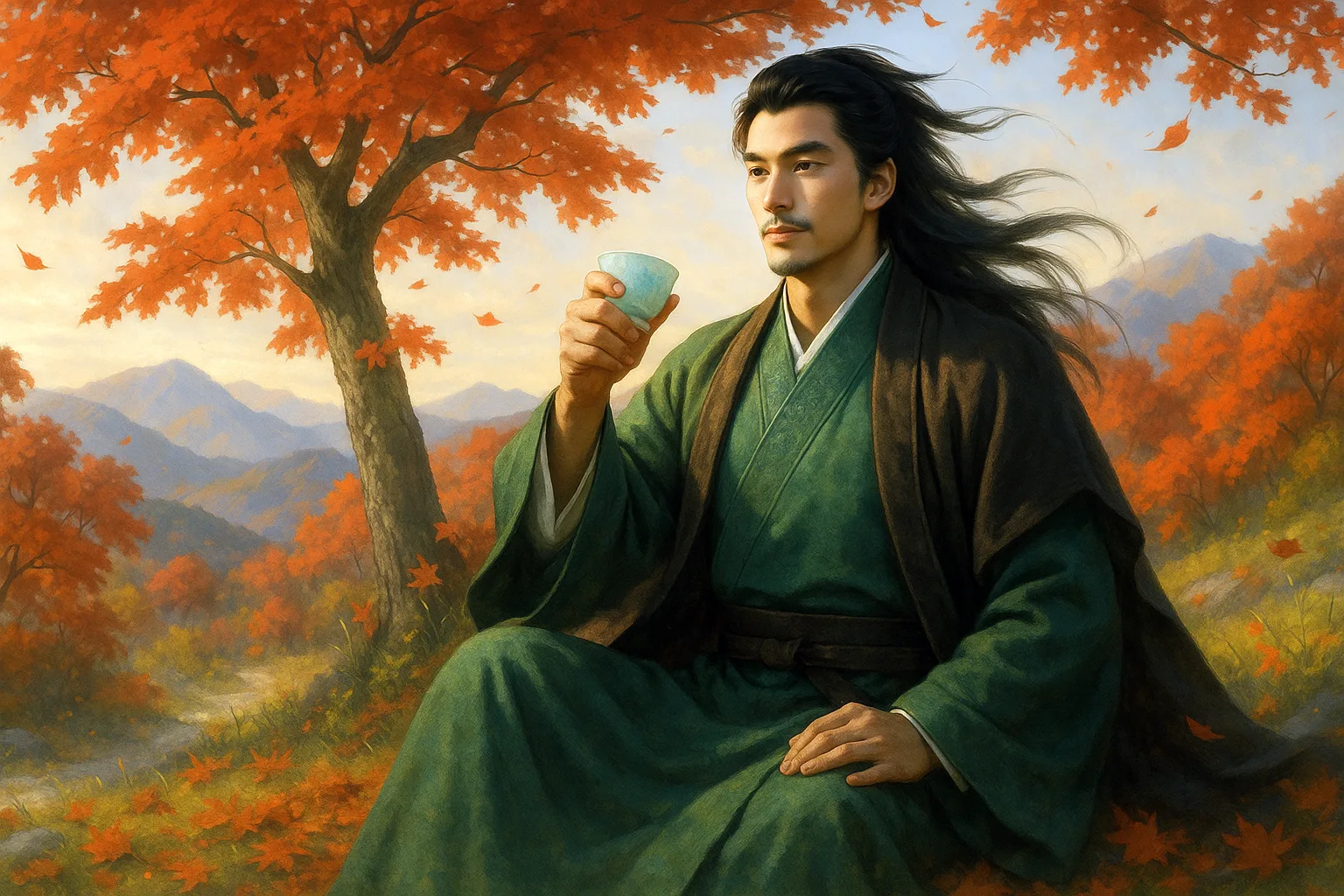
Du Mu (杜牧), 803-853 AD, was a native of Xi'an, Shaanxi Province. Among the poets of the Late Tang Dynasty, he was one of those who had his own characteristics, and later people called Li Shangyin and Du Mu as "Little Li and Du". His poems are bright and colorful.