


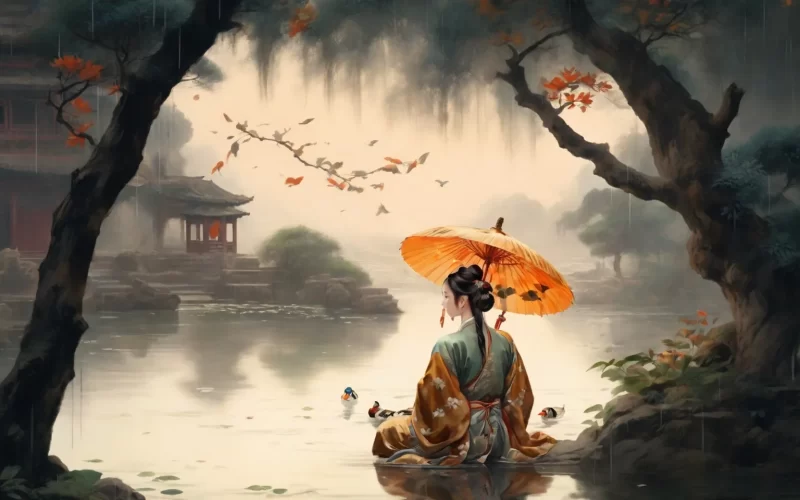
Lakka-trees ripen two by two
And mandarin-ducks die side by side.

If a true-hearted girl will love only her husband,
In a life as faithfully lived as theirs,

What troubling wave can arrive to vex
A spirit like water in a timeless well?
Original Poem
「列女操」
孟郊
梧桐相待老,鸳鸯会双死。
贞妇贵殉夫,舍生亦如此。
波澜誓不起,妾心井中水。
Interpretation
This is an archaizing or "old-style" work by the Mid-Tang poet Meng Jiao. "Lie Nü" (Faithful Wife) refers to a woman of chastity, steadfast in virtue and loyal unto death. Meng Jiao’s life was marked by poverty and repeated failure in the imperial examinations; he did not attain the jinshi degree until the age of forty-six and later suffered the grievous loss of a son. His poetry often dwells on hardship, loneliness, and the fickleness of the world. Renowned for his "bitter chanting" (kuyin)—a style of intense, painstaking composition—he is often paired with Jia Dao under the critical label "Meng’s chill, Jia’s gauntness" (Jiao han Dao shou). A man of solitary integrity and deep sincerity, his verses often reveal an almost obsessive commitment and steadfastness.
Taking the faithful wife’s upholding of chastity as its theme, the poem praises the woman’s unwavering fidelity to love and marriage. It begins with the imagery of "phoenix trees waiting to grow old together" and "lovebirds destined to die in pairs," states her resolve directly with "share her lord’s grave" and "give her life," and concludes with the image of "water in a well," building layer upon layer to etch the woman’s steadfastness to the bone. This extreme reverence for "chastity" reflects both the stringent demands feudal society placed on female virtue and the poet’s own idealized pursuit of noble sentiment. Meng Jiao’s life was fraught with hardship, yet he steadfastly upheld his own principles and integrity, refusing to bow to power or conform to vulgar trends. Some critics suggest that while the poem’s surface praises the faithful wife, it allegorically expresses the poet’s own ideal of an "unchanging, steadfast" character—like the water in the well, unrippled, remaining pure and firm within despite the changing winds and clouds of the external world.
First Couplet: "梧桐相待老,鸳鸯会双死。"
Wútóng xiāng dài lǎo, yuānyāng huì shuāng sǐ.
Phoenix trees wait for each other to grow old; Lovebirds, when one dies, the other’s fate is told.
The poem opens, employing two images from nature that symbolize fidelity. "梧桐" (Wútóng, Phoenix trees) with trunks intertwined, roots and leaves connected, were anciently believed to be of separate male and female strains, waiting for each other to grow; thus, they symbolize marital harmony and growing old together. "鸳鸯" (Yuānyāng, Mandarin ducks or lovebirds) are inseparable pairs; if one dies, the other will not live alone, symbolizing sharing life and death, vowing never to part. The six characters, "相待老" (wait to grow old) and "会双死" (destined to die in pairs), condense the ultimate expressions of human fidelity—growing old together and dying together—into the images of the phoenix tree and the lovebirds. Using these as the poem’s evocative beginning, the poet lays a deep emotional groundwork for the theme of the wife following her lord in death.
Second Couplet: "贞妇贵殉夫,舍生亦如此。"
Zhēn fù guì xùn fū, shě shēng yì rú cǐ.
A faithful wife finds glory in sharing her lord’s grave; So does she give her life, unflinching, true, and brave.
This couplet transitions from evocative imagery to direct statement, explicitly introducing the theme of "sharing the grave" (xùn fū). "贞妇贵殉夫" ("A faithful wife finds glory in sharing her lord’s grave")—the word "贵" (guì, value, find glory/ honor in) articulates the feudal ethical system’s value judgment on "chastity": sharing a grave is not an act of desperation but a noble virtue, something "honorable" and worthy of esteem. The next line, "舍生亦如此" ("So does she give her life"), uses "如此" (rú cǐ, like this/so) to echo the preceding "lovebirds destined to die in pairs," equating the faithful wife’s act with that of the lovebirds, emphasizing its righteousness and inevitability. In the poet’s rendition, the wife’s act is not forced but voluntary; not a tragedy but a sublime choice. This value orientation is a typical expression of the feudal concept of "chastity."
Final Couplet: "波澜誓不起,妾心井中水。"
Bōlán shì bù qǐ, qiè xīn jǐng zhōng shuǐ.
I vow no wave shall e’er my bosom have; My heart is as the water in a well, deep, still, and grave.
This couplet is the poem’s点睛之笔 (dotting the eyes), concluding with the image of "water in a well." "波澜誓不起" ("I vow no wave shall e’er my bosom have") uses a negative structure to express a resolute stance—it is not that waves do not rise, but that she vows they shall not, strengthening her firmness with an oath. The next line, "妾心井中水" ("My heart is as the water in a well"), uses a metaphor to materialize the abstract inner world. The water in an ancient well is deep and unseen, yet still and waveless; however the winds and clouds rage outside, the well’s depths remain utterly calm. These three words, "井中水" (water in a well), describe both the wife’s inner peace and steadfastness, and also imply the depth and immutability of her feeling. It is more subtle than "a heart of iron or stone," and deeper than "a heart like still water"—it is a stroke of genius born of Meng Jiao’s "bitter chanting."
Holistic Appreciation
This is Meng Jiao’s work on chastity, using an ancient theme. The poem’s six lines and thirty characters take the faithful wife’s upholding of chastity as its theme, blending the evocative imagery of nature with the direct statement of inner monologue to display feudal society’s extreme reverence for female chastity.
Structurally, the poem presents a progressive layering from object to person, from outer to inner. The first couplet uses the phoenix tree and lovebirds as evocative imagery, introducing the theme through natural symbols of fidelity. The second couplet shifts from object to person, explicitly stating the value of "the faithful wife sharing her lord’s grave." The final couplet moves from outer to inner, concluding with the image of "water in a well," fully revealing the wife’s inner world. Between the three couplets, the movement is from evocation to comparison, from comparison to exposition, deepening layer by layer into a seamless whole.
Thematically, the poem’s core lies in the word "贞" (zhēn, chaste, faithful, steadfast). The phoenix trees that "wait to grow old together" represent this chastity; the lovebirds "destined to die in pairs" represent it; the faithful wife who "gives her life" represents it; the "waveless" well water also represents it. This concept of "steadfast fidelity" runs through the entire poem, representing both feudal ethics’ demands on women and the poet’s own pursuit of noble sentiment. However, looking back from a modern perspective, behind this word "chastity" lie countless lives devoured by ritual doctrine, countless suppressed souls. Though the poem offers no direct critique, the starkness of "sharing the grave" and the dead stillness of the "well water" allow today’s reader to feel its heavy oppressiveness.
Artistically, the poem’s most moving feature is its technique of "using objects to symbolize people, building layer upon layer" through evocative imagery. The poet does not directly state the wife’s fidelity but uses the phoenix tree and lovebirds to evoke it, letting the reader sense the beauty of loyalty through natural imagery; he does not directly criticize feudal ethics but concludes with the image of well water, letting the reader comprehend the weight of oppression within a still picture. This technique of materializing abstract concepts is the highest realm of classical Chinese poetry’s "establishing images to exhaust meaning."
Artistic Merits
- Apt Evocative Imagery, Vivid Symbols: Using phoenix trees and lovebirds to symbolize marital fidelity, and well water to symbolize inner steadfastness—the objects are fitting, the implications profound.
- Concise Diction, Intense Emotion: The poem contains no superfluous words, yet each character carries great weight, etching the faithful wife’s resolve to the bone.
- Layered Progression, Rigorous Structure: Moving from object to person, from outer to inner, the three couplets are interlocked, forming a cohesive whole.
- Using Stillness to Convey Movement, Lingering Resonance: The final couplet concludes with the stillness of "water in a well," allowing the reader to sense both the wavelessness of the wife’s heart and the deathly stillness of feudal ethics in that silence.
Insights
Taking the faithful wife’s upholding of chastity as its theme, this poem speaks to a complex and weighty topic: Is chastity a noble sentiment, or a man-devouring ethical code?
First, it allows us to see the "halo of chastity." The phoenix trees that "wait to grow old together," the lovebirds "destined to die in pairs," the wife who "shares her lord’s grave," the stillness of the "well water"—in the poet’s rendition, all are endowed with a sublime aesthetic hue. From an ancient perspective, this is a noble sentiment worthy of praise, the ultimate expression of unwavering fidelity in love. The purity and steadfastness of such emotion possesses a moving quality in any era.
Yet on a deeper level, the poem allows us to see the "shadow behind the halo." The words "share her lord’s grave" signify the end of a vivid life; the metaphor of "well water" implies the complete solidification and death of emotion. When "chastity" is institutionalized and moralized, when women are required to prove their fidelity with their lives, this word "chaste" becomes a shackle, a butcher’s knife. True love should be a mutual journey, not a unilateral sacrifice; it should be the blossoming of life, not its termination.
Most thought-provoking is the poem’s potential for "self-allegory." Meng Jiao’s life was fraught with hardship, yet he steadfastly upheld his principles, refusing to bow to power. Some critics suggest the "faithful wife" in this poem is a portrait of the poet himself—that "waveless" well water is his own inner firmness, unmoved by the vulgar world; that resolute act of "giving her life" is his own stubborn adherence to his ideals and character. This interpretation of the faithful wife as self-allegory allows the poem to transcend a mere paean to chastity, granting it a deeper personal and moral significance.
This poem writes of a Tang Dynasty faithful wife, yet allows people of every era to read different meanings within it. Some read nobility, others read oppression; some read love, others read rigid ethics; some read praise for women, others read the objectification of women. This is the vitality of poetry: it is a mirror reflecting not only the ancient world but also our own positions and reflections.
About the Poet
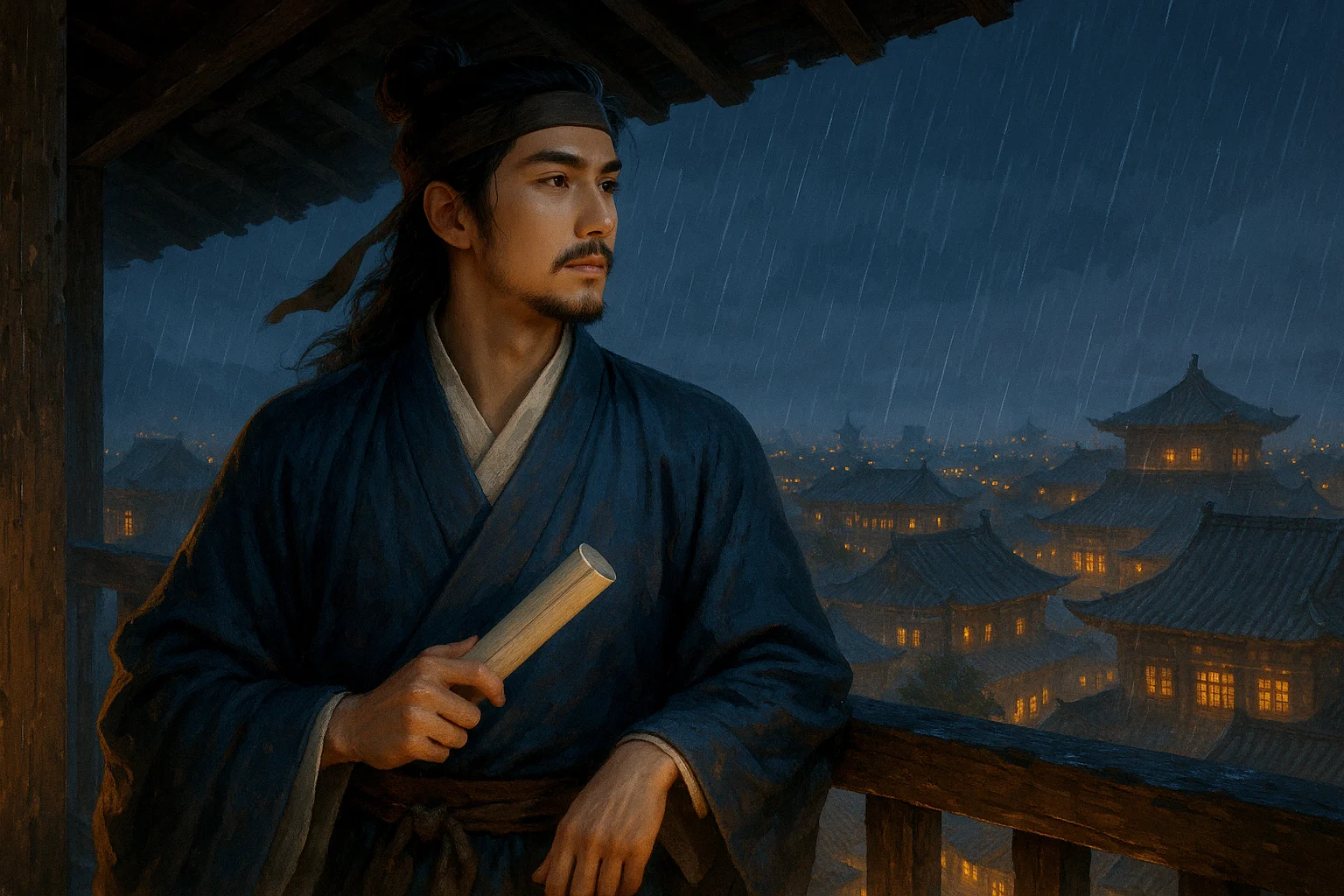
Meng Jiao (孟郊 751 - 814), a native of Deqing, Zhejiang Province, was a renowned poet of the Mid-Tang Dynasty. In his early years, he repeatedly failed the imperial examinations and only obtained the jinshi degree at the age of forty-six. He held minor posts such as Sheriff of Liyang, living a life of poverty and hardship. In his later years, he suffered the loss of his son and died while en route to a new official post. His poetry is renowned for its "bitter chanting" style, and he was often mentioned alongside Jia Dao, with Su Shi coining the famous phrase: "Jiao is lean, Jia is thin." His yuefu (Music Bureau) poems inherited the tradition of Du Fu and paved the way for Yuan Zhen and Bai Juyi, establishing a unique and distinctive place in the history of Tang poetry.