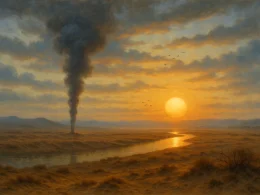



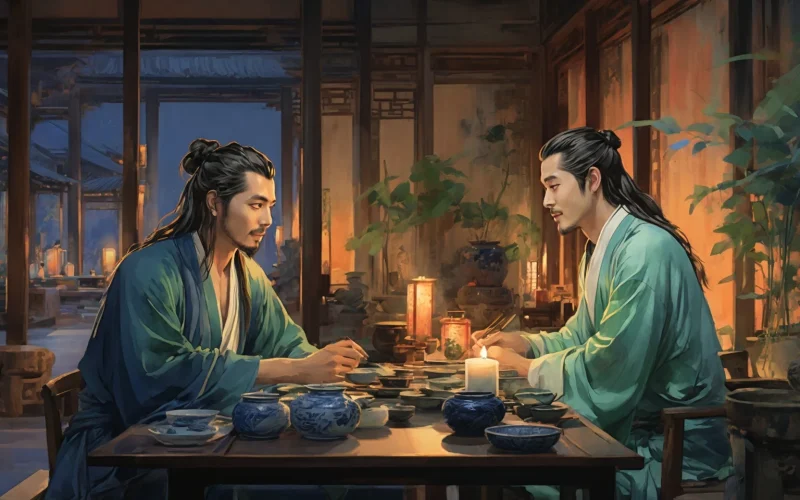
The crescent moon rises and hangs on city wall;
The rising moon on city wall shines over all.
There're a thousand homes in seven districts on frontier;
Half of the Tartars play pipa for us to hear.

The heart would be broken to hear the pipa song,
When the wind sheds leaves in showers and night is long.
West of the River I have so many compeers;
Many friends are separated from me for many years.
Before the flowery gate we see autumn grass.
Could we bear to see friends grow old like it? Alas!
How many times can we laugh in a life so fleet?
So let us drink our fill till drunken, now we meet!
Original Poem
「凉州馆中与诸判官夜集」
岑参
弯弯月出挂城头,城头月出照凉州。
凉州七里十万家,胡人半解弹琵琶。
琵琶一曲肠堪断,风萧萧兮夜漫漫。
河西幕中多故人,故人别来三五春。
花门楼前见秋草,岂能贫贱相看老。
一生大笑能几回,斗酒相逢须醉倒。
Interpretation
This poem was written in 754 AD, the thirteenth year of the Tianbao era under Emperor Xuanzong of Tang. It captures a moment during Cen Can's second expedition to the frontier, as he journeyed to assume a post at the Beiting Protectorate (in the area of present-day Jimsar, Xinjiang). His route took him through Liangzhou (modern-day Wuwei, Gansu). As the seat of the Hexi Military Governor, Liangzhou was a strategic hub for Tang control over the Western Regions and a vital link to the Central Plains. It was also a bustling, cosmopolitan city where merchants converged and Han Chinese lived intermixed with various ethnic groups from the west. During this stop, Cen Can unexpectedly reunited with old friends serving in the Hexi military administration. The poem was born from this night's gathering, infused with the distinctive flavor of the frontier.
Unlike Cen Can's other frontier poems, which often emphasize the extreme hardships and desolate beauty of remote borders, this work focuses on the internal bustle, prosperity, and cultural intermingling of a frontier city. It reveals that at the height of the High Tang, the empire's frontiers were not solely about garrisons and warfare but also pulsed with the vibrant energy of thriving markets and converging civilizations. The grand vista of "Liangzhou's seven-league span holds a hundred thousand homes" and the vivid detail of "Here, half the Hu-folk know the lute's tunes" combine to form a rich and colorful "genre painting of High Tang frontier life." Set against this backdrop, the joyful reunion of old friends sheds the typical melancholy of farewells. Instead, it brims with the heroic optimism of "In all our lives, how many times can we laugh so free?" and a carefree, carpe-diem spirit. This vividly embodies the era's uplifting, enterprising, and life-affirming ethos, as well as the personal charisma, characteristic of High Tang scholar-officials.
Opening Couplet: "弯弯月出挂城头,城头月出照凉州。"
Wān wān yuè chū guà chéng tóu, chéng tóu yuè chū zhào Liángzhōu.
A slender crescent moon climbs and hangs above the town wall; / The moon above the wall shines down on Liangzhou, lighting all.
The poem opens with anadiplosis, linking the lines through the repetition of "chéng tóu" (town wall). This technique mimics the visual progression of moonlight spreading from a single point to illuminate the entire scene. The flowing, repetitive cadence is like moonlight itself, instantly immersing the reader in the frontier city's tranquil, poetic moonlit atmosphere. This is more than scenic description; it establishes a bright and lyrical tone for the entire work.
Second Couplet: "凉州七里十万家,胡人半解弹琵琶。"
Liángzhōu qī lǐ shí wàn jiā, hú rén bàn jiě tán pípá.
Liangzhou's seven-league span holds a hundred thousand homes; / Here, half the Hu-folk know the lute's tunes, as custom roams.
The poet's gaze shifts from the celestial moon to the earthly city below. The hyperbolic "hundred thousand homes" within a "seven-league span" paints, with broad strokes, Liangzhou's astonishing scale and dense population, showcasing its wealth and prominence as a northwestern hub. The line "half the Hu-folk know the lute's tunes" is the masterstroke. Using the most iconic instrument of the Western Regions, it pinpoints the locale's unique character as a melting pot of ethnicities and a crossroads of cultures. Here, the sound of the pipa is not mere background music; it is the vibrant symbol of Liangzhou's open and lively soul.
Third Couplet: "琵琶一曲肠堪断,风萧萧兮夜漫漫。"
Pípá yī qǔ cháng kān duàn, fēng xiāo xiāo xī yè màn màn.
A single lute tune played could break the hearer's heart; / The night is long, the soughing wind reluctant to depart.
The focus narrows from the macro cityscape to the specific feast. Amidst the revelry, the poet hears a pipa melody that "could break the hearer's heart." This may reflect the tune's inherent sorrow, but more likely, the music stirs complex feelings of wandering at the world's edge and the relentless passage of time. "The night is long, the soughing wind…" evokes the mood of the Songs of Chu. It captures the actual feel of the frontier night while also amplifying a sense of vast, endless time and deepening sentiment, achieving a skillful transition from external clamor to internal reflection.
Fourth Couplet: "河西幕中多故人,故人别来三五春。"
Héxī mù zhōng duō gù rén, gù rén bié lái sān wǔ chūn.
In the Hexi headquarters are many of my friends of old; / Parted from these old friends for three or five springs, I'm told.
Here, the poet speaks directly, naming the core theme of the night—reunion with old friends. The simple phrase "many of my friends" reveals the breadth of his connections and depth of camaraderie. "Three or five springs" states plainly the years of separation, its understated tone hinting at unspoken感慨 and setting the stage for the emotional shift to come.
Fifth Couplet: "花门楼前见秋草,岂能贫贱相看老。"
Huā mén lóu qián jiàn qiū cǎo, qǐ néng pín jiàn xiāng kàn lǎo.
Before the Flowery Gate Tavern, I see autumn grasses sway; / Could we bear to gaze on each other, poor and aging, day by day?
This couplet marks the poem's emotional pivot and climax. The sight of "autumn grasses" is a seasonal marker and a potent metaphor for the withering of life and the flow of time. It triggers the poet's most profound anxiety about achievement and his awareness of mortality. The rhetorical challenge, "Could we bear to gaze on each other, poor and aging…?" is resolute and forceful, charged with the quintessential High Tang literati's thirst for merit, their enterprising drive, and a heroic refusal to accept obscurity. It elevates the joy of a private gathering into a shared vow of mutual encouragement and grand ambition.
Sixth Couplet: "一生大笑能几回,斗酒相逢须醉倒。"
Yī shēng dà xiào néng jǐ huí, dǒu jiǔ xiāng féng xū zuì dǎo.
In all our lives, how many times can we laugh so free? / Meeting now with jars of wine, we must drink to our own spree!
The final couplet drives the poem's emotion to its peak and concludes with a life-affirming declaration. "Laugh so free" represents an unreserved emotional release, a spirited response to life's brevity and the rarity of such pure joy. The question "how many times" underscores the supreme preciousness of this moment. "We must drink to our own spree" is the most direct and heroic way to honor and seize this precious reunion. These lines sweep away the melancholy often coloring frontier poetry. With an almost childlike enthusiasm and absolute resolve, they celebrate life's vitality, friendship's warmth, and the philosophy of living completely in the present, making them powerfully resonant and emblematic of the era's spirit.
Holistic Appreciation
This heptasyllabic song, set during a night feast in Liangzhou, perfectly blends frontier cityscape, exotic music, camaraderie, and philosophical reflection into a joyful symphony pulsating with High Tang vitality.
The structure flows naturally, like drifting clouds and flowing water: from the tranquil panorama of the rising moon over Liangzhou, to the vibrant close-up of its countless homes and lute-playing inhabitants; from the emotional undercurrent stirred by the poignant music and long night, to the specific joy of reunion and the impassioned vow to achieve greatness; finally culminating in the extreme revelry of "laugh so free" and "drink to our own spree." The emotional arc is clear: from stillness to activity, from scene to sentiment, from personal reflection to collective aspiration. This demonstrates Cen Can's superb skill in structuring longer poems and modulating their emotional flow.
Unlike the magnificent, starkly beautiful cold of "Song of White Snow," this poem emphasizes social customs and human atmosphere. Under Cen Can's brush, Liangzhou is not a distant battleground but a lively, bustling, worldly frontier city, a vivid testament to the High Tang's national strength and cultural influence. The friendship and laughter shared within this specific space are thus imbued with the spirit of the age, becoming a joyful and uplifting footnote to the High Tang ethos.
Artistic Merits
- Anadiplosis and Flowing Rhythm: The opening anadiplosis using "chéng tóu" (town wall) not only mimics the visual movement of moonlight but also creates a phonetic link between the lines. When read aloud, it flows like pouring moonlight, smooth and musical, instantly drawing the reader into the scene.
- Blend of Detailed Realism and Hyperbole: "A hundred thousand homes" within "seven leagues" uses exaggerated numbers to convey the city's grand scale, a common High Tang technique for expressing majesty. "Half the Hu-folk know the lute's tunes" captures the essence of Liangzhou's ethnic and cultural fusion through one highly representative, realistic detail. This interplay of the macro and micro renders the scene both vast and authentic.
- Undulating and Climactic Emotional Expression: The poem's emotion does not rise linearly but follows a winding path: "Tranquility (moonrise) — Bustle (cityscape) — Melancholy (heart-breaking lute) — Reflection (autumn grass, parting) — Heroic Abandon (laughter and drunkenness)." This modulation makes the final outburst of feeling more believable and impactful.
- Direct Expression of the High Tang Spirit: The ambition in "Could we bear to gaze on each other, poor and aging…?" and the carpe-diem joy in "how many times can we laugh so free?" may seem contradictory but are unified in the core High Tang scholar-official spirit: active engagement with the world, a love for life, and the desire to create the greatest value within a finite lifetime. This spirit gives the poem its bright, healthy, and powerful tone.
Insights
This poem is a time capsule from the High Tang, preserving the prosperous scene of a frontier city and the vigorous spirit of its literati. It teaches us that true strength and prosperity are reflected not only in territorial expanse but also in the vitality, openness, and confident cultural intermingling that can flourish even in borderlands. Liangzhou, a frontier city, with its massive population of "a hundred thousand homes" and the widespread skill of "half" its people playing the pipa, stands as clear proof of this civilizational magnetism.
On a personal level, the poem's celebration of friendship and joyous gathering, especially the poignant question "how many times can we laugh so free?" and the decisive call to "drink to our own spree," advocates for a keen awareness and wholehearted embrace of life's exquisite moments. It reminds us that amidst striving and pursuit, we must not overlook those moments of genuine connection and pure joy, for they are essential to a meaningful life.
Ultimately, what Cen Can conveys in this poem is the wisdom of actively seizing the "present moment" within a vast world and a finite life: neither forgetting the warnings of time and the call to achievement signaled by the "autumn grasses," nor failing to cherish the affection and warmth brought by "friends of old," and finally, offering life itself the most fervent and sincere tribute through a session of unbridled "laughter" and determined "drunkenness." This life attitude—both ambitious and broad-minded, both deeply feeling and heroic—transcends a thousand years, still capable of offering us profound resonance and inspiration today.
Poem translator
Xu Yuanchong (许渊冲)
About the poet
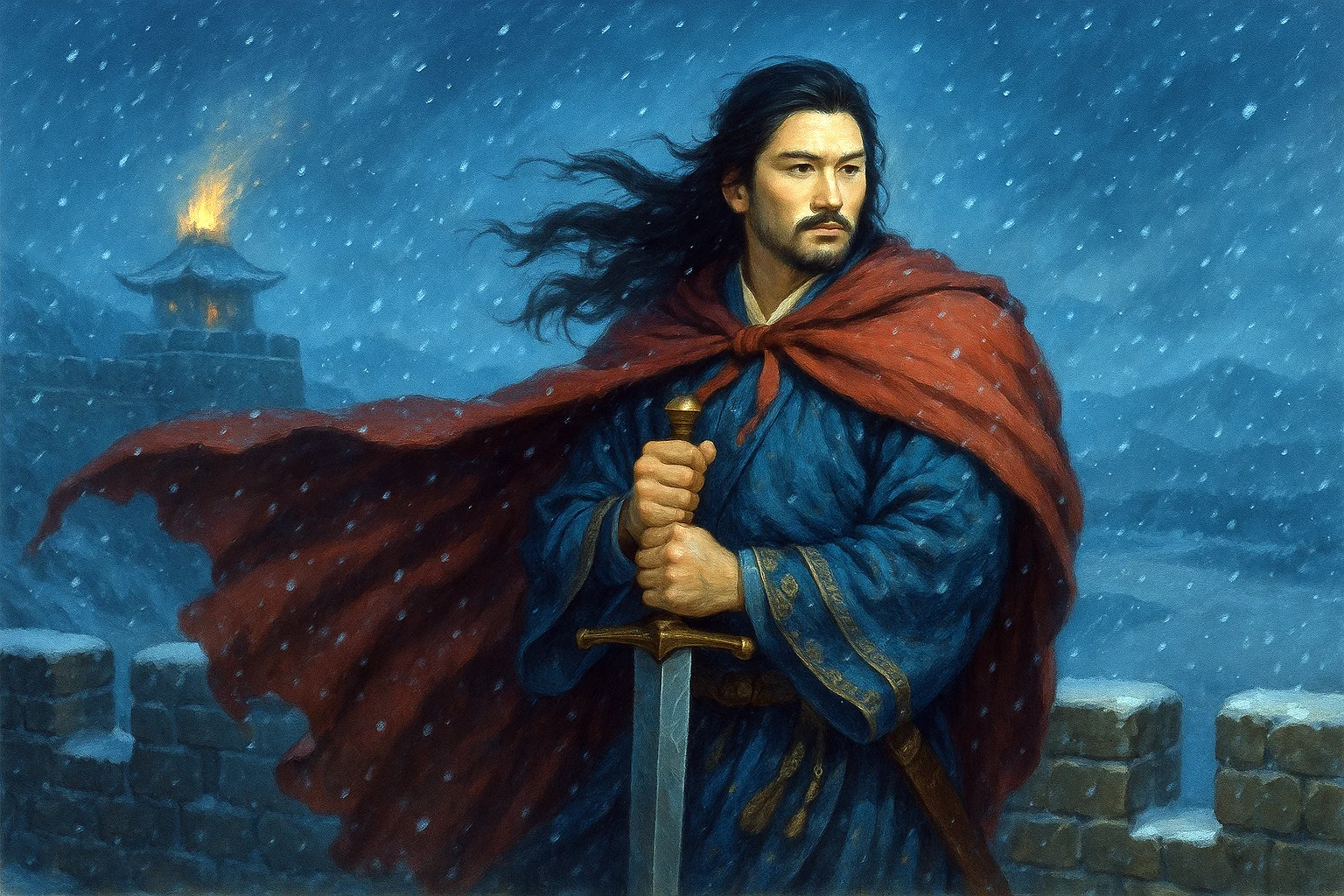
Cén Cān(岑参), 715 - 770 AD, was a native of Jingzhou, Hubei Province. He studied at Mt. Songshan when he was young, and later traveled to Beijing, Luoyang and Shuohe. Cén Cān was famous for his border poems, in which he wrote about the border scenery and the life of generals in a majestic and unrestrained manner, and together with Gao Shi, he was an outstanding representative of the border poetry school of the Sheng Tang Dynasty.