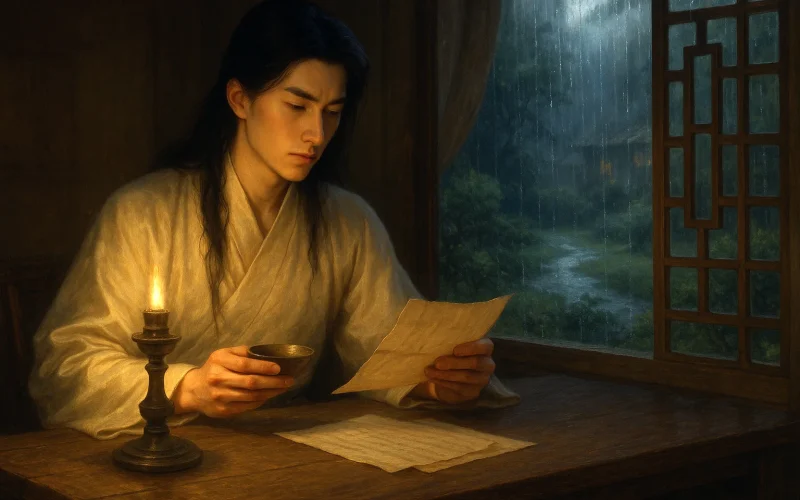



No water's wide enough when you have crossed the sea;
No cloud is beautiful but that which crowns the peak.
I pass by flowers which fail to attract poor me
Hail for your sake and half for Taoism I seek.
Original Poem
「离思五首 · 其四」
元稹
曾经沧海难为水,除却巫山不是云。
取次花丛懒回顾,半缘修道半缘君。
Interpretation
This poem is a timeless masterpiece of elegy by the Mid-Tang poet Yuan Zhen, mourning his deceased wife Wei Cong, composed in the fourth year of the Yuanhe period (809 AD). Yuan Zhen and Bai Juyi passed the imperial examination in the same year and advocated the New Yuefu Movement; together they are known as "Yuan-Bai." His poetic language is plain, his emotions deep and sincere, with the series of works mourning Wei Cong being particularly moving.
Wei Cong came from a noble family; she was the daughter of Wei Xiaqing, the Junior Guardian of the Heir Apparent. She married Yuan Zhen at twenty. At that time, Yuan Zhen had not yet achieved fame, and their life was austere. Wei Cong did not despise the poverty, content with a simple life. The couple supported each other through hardship, their affection profound and sincere. However, heaven did not grant them many years. In the fourth year of Yuanhe (809 AD), Wei Cong passed away from illness at the young age of twenty-seven. At this time, Yuan Zhen had already been demoted to Jiangling for offending the eunuchs. Disappointed in his official career, physically and mentally exhausted, he then suffered the pain of losing his wife—his sorrow can be imagined. This poem was composed by the poet after his wife's death. The couplet in the poem, "No water’s wide enough when you have crossed the sea; No cloud is beautiful but that which crowns the peak," uses the metaphor of the sea's water and the clouds of Mount Wu to express emphatically the irreplaceable position of his deceased wife in his heart—having experienced such profound and vast love, no other emotion in the world could move him again. The last two lines, "I pass by flowers which fail to attract poor me, Half for your sake and half for Taoism I seek," describe how even amidst a profusion of flowers, he is too lazy to look back, half because of cultivating the Tao to nurture his heart, and half because his heart belongs only to his deceased wife. The entire poem writes of the most profound longing with the most intense emotion, and writes of the most steadfast loyalty with the most sublime imagery, becoming one of the most moving chapters in ancient Chinese elegiac poetry.
First Couplet: "曾经沧海难为水,除却巫山不是云。"
Céng jīng cāng hǎi nán wéi shuǐ, Chú què Wū shān bù shì yún.
No water’s wide enough when you have crossed the sea; No cloud is beautiful but that which crowns the peak.
The poem opens with two grand images to express the pinnacle of emotion. "曾经沧海难为水" (No water’s wide enough when you have crossed the sea) adapts the phrase from Mencius: Jin Xin I: "Having seen the sea, it is difficult to consider other waters." It uses the vast, boundless sea as a metaphor for the depth and breadth of the love between him and Wei Cong; having experienced such profound and vast love, all other emotions in the world pale in comparison. The next line, "除却巫山不是云" (No cloud is beautiful but that which crowns the peak), adapts the典故 from Song Yu's Gaotang Fu about the Goddess of Mount Wu, who "at dawn is the morning cloud, at dusk the passing rain." It uses the wondrous beauty of the clouds of Mount Wu as a metaphor for Wei Cong's irreplaceability in his heart; having seen such beautiful clouds, clouds elsewhere are no longer clouds. The "难为水" (is wide enough) and "不是云" (is beautiful) use double negation to strengthen affirmation, writing exhaustively the uniqueness and irreplaceability of his deceased wife in his heart. The poet does not directly say "I love you"; he only presents it through the imagery of the sea and Mount Wu, yet the depth of love and the intensity of longing are fully contained within.
Second Couplet: "取次花丛懒回顾,半缘修道半缘君。"
Qǔ cì huā cóng lǎn huí gù, Bàn yuán xiū dào bàn yuán jūn.
I pass by flowers which fail to attract poor me, Half for your sake and half for Taoism I seek.
This couplet shifts from the grand metaphor of the previous two lines to the poet's own state. "取次花丛懒回顾" (I pass by flowers which fail to attract poor me) writes of the poet's attitude towards other women in the world—"花丛" (flowers) metaphorically refers to numerous women; the three characters "懒回顾" (fail to attract) describe his state of being single-minded and unmoved. The word "懒" (fail) here is not laziness, but lack of interest; it is not that he does not want to look, but that his heart can no longer accommodate anyone else. The next line, "半缘修道半缘君" (Half for your sake and half for Taoism I seek), uses the phrase "半缘" (half for) to indicate the reason for this "懒回顾" (fail to attract). Half is for cultivating the Tao, seeking purity of heart; half is for his deceased wife, for the irreplaceable person already in his heart. The three characters "半缘君" (half for your sake) are the poet's most affectionate confession: it is not that he no longer feels emotion because of cultivating the Tao, but rather that because his heart belongs only to you, he chose to cultivate the Tao. Within this couplet, using "懒回顾" to describe the state, and "半缘" to explain the reason, the poet writes of his deep affection for his deceased wife in a reserved yet moving way.
Holistic Appreciation
This is a divine work among Yuan Zhen's elegiac poems. The entire poem consists of four lines and twenty-eight characters. It begins with the grand metaphors of the sea and Mount Wu and concludes with the ordinary state of "I pass by flowers which fail to attract poor me," merging the irreplaceable position of his deceased wife in his heart with the poet's unwavering, lifelong deep affection, showcasing the most moving emotional realm in ancient Chinese elegiac poetry.
Structurally, the poem presents a progression from the abstract to the concrete, from principle to emotion. The first couplet uses the grand metaphors of the "sea" and "Mount Wu" to write, on a philosophical level, about the pinnacle and uniqueness of emotion. The second couplet uses the ordinary state of "I pass by flowers which fail to attract poor me" to write, on a realistic level, about the poet's inner steadfastness and persistence. Between the two lines, the poem moves from principle to emotion, from abstract to concrete, each layer deepening, forming a seamless whole.
Thematically, the core of this poem lies in the double negation of "难为" and "不是" . The "难为" in "曾经沧海难为水" is the state of no longer being moved after having experienced the pinnacle. The "不是" in "除却巫山不是云" is the state where there is no longer any scenery after having seen the most beautiful. This double negation pushes the uniqueness of his deceased wife in his heart to the extreme—it is not that other waters in the world are not good, but that having experienced the sea, one can no longer settle for less; it is not that clouds elsewhere are not beautiful, but that having seen Mount Wu, they can no longer catch one's eye. This technique of using negation to strengthen affirmation makes the poet's deep affection even more profoundly stirring.
Artistically, the poem's most moving aspect lies in the ingenious conception of "using allusions naturally, with sublime imagery." The poet alludes to Mencius's "Having seen the sea, it is difficult to consider other waters" and Song Yu's Gaotang Fu's clouds and rain of Mount Wu, elevating the status of his deceased wife to a kind of eternal existence transcending the mundane. The imagery of the "sea" and "Mount Wu" possesses both the vastness of nature and the splendor of myth, granting the poet's deep affection a sublime aesthetic character. The second couplet concludes with the ordinary state of "I pass by flowers which fail to attract poor me," and gently reveals the reason with "Half for your sake and half for Taoism I seek" (半缘修道半缘君) , grounding the grand metaphor of the first two lines in reality, giving the entire poem both sublime artistic conception and genuine emotion.
Artistic Merits
- Natural Allusion, Sublime Imagery: Using the metaphors of the "sea" and "Mount Wu" to elevate the deceased wife to an existence beyond the mundane—elegant without being obscure, vast without being insubstantial.
- Double Negation, Strengthening Affirmation: "难为水" (is wide enough) and "不是云" (is beautiful) use negative forms to strengthen affirmation, writing exhaustively the pinnacle and uniqueness of emotion.
- Concise Language, Intense Emotion: The entire poem lacks any ornate or flowery phrases, yet each word carries great weight, using the simplest language to write the most sincere emotion.
- Exquisite Structure, Powerful Turn: The first two lines use grand metaphors to write of the pinnacle of emotion; the last two lines use an ordinary state to write of inner steadfastness, moving from principle to emotion, from the abstract to the concrete, progressing layer by layer.
Insights
This poem, through the recollection of a love, speaks to an eternal theme—True love is, after having experienced the sea, no longer being moved; after having seen Mount Wu, there being no more scenery in the world.
First, it lets us see "the uniqueness of love." The "难为" in "曾经沧海难为水" is not that other waters in the world are not good, but that having experienced the best, one can no longer settle for less. It tells us: True love is not a comparison, but irreplaceability; it is not a choice, but the one and only.
On a deeper level, this poem makes us contemplate "the meaning of steadfastness." "I pass by flowers which fail to attract poor me"—it is not that there is no chance, but that one has no heart to choose again; it is not that there is no one to love, but that one's heart already belongs to someone. It makes us understand: True deep affection is not a momentary infatuation, but a lifetime of steadfastness; it is not lingering amidst the flowers, but still "failing to attract" even amidst the flowers.
And what is most touching is that honesty of "Half for your sake and half for Taoism I seek" in the poem. The poet says, half is for cultivating the Tao, half is for his deceased wife. Within this "half for" lies deep affection for his deceased wife, and also an accounting to himself—he did not cultivate the Tao to escape the mundane world, but because there was an irreplaceable person in his heart, he chose spiritual cultivation. This honesty makes the deep affection more genuine, and the steadfastness more moving.
This poem writes of an elegy in the Mid-Tang, yet allows everyone who has experienced love and understands what it means to treasure someone to find resonance within it. The sentiment of "having crossed the sea" is the shared feeling of everyone who has loved the best. The steadfastness of "fail to attract" is the common posture of everyone whose heart has found its home. The confession of "half for your sake" is the truest voice in the heart of everyone with deep affection. This is the vitality of poetry: it writes of Yuan Zhen's longing for Wei Cong, but one reads of people in all eras who have known the sea and carry someone in their heart.
Poem translator
Xu Yuanchong (许渊冲)
About the Poet
Yuan Zhen (元稹 779 - 831), a native of Luoyang, Henan Province, was a descendant of the Northern Wei imperial family and a renowned poet and statesman of the Mid-Tang Dynasty. As an important figure in Tang literary history, Yuan Zhen co-advocated the New Yuefu Movement with Bai Juyi. His poetic achievements are most distinguished in the yuefu (Music Bureau) style and erotic poetry. His romantic relationship with a woman named Yingying inspired the legendary tale The Story of Yingying. Yuan Zhen’s poetic style is characterized by its accessible clarity, occasionally interspersed with bold and striking expressions. During the transition from the Mid-Tang to the Late Tang, his accessible style exerted a profound influence, laying the foundation for the Yuan-Bai Poetic School.