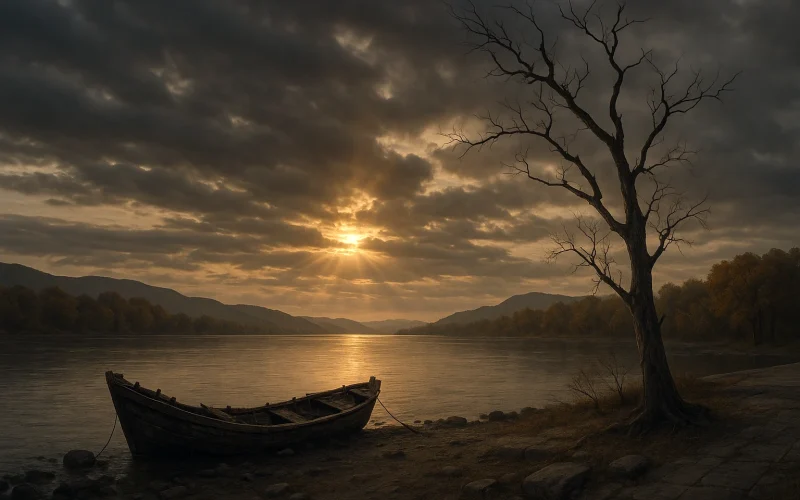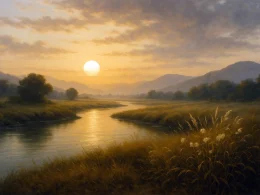
The nine-bend Yellow River rolls with sand from miles away;
Waves sift it, winds winnow it, from the end of the world, they say.

Now, straight up to the Silver River we could sail, I deem;
And reach the home of the Cowherd and the Weaving Maid, in dream.
Original Poem
「浪淘沙 · 其一」
刘禹锡
九曲黄河万里沙,浪淘风簸自天涯。
如今直上银河去,同到牵牛织女家。
Interpretation
This poem was composed during Liu Yuxi's exile in Langzhou (present-day Changde, Hunan Province) and stands as the first in a series. To grasp the poem's deeper significance, one must return to the pivotal moment that irrevocably altered the trajectory of his life—the first year of the Yongzhen era (805 AD). That year, the thirty-four-year-old Liu Yuxi, in the prime of his life, joined forces with figures like Liu Zongyuan and Wang Shuwen in a bold and ambitious reform movement, aiming to eradicate entrenched evils such as eunuch dominance and separatist military governorships. However, the reforms collapsed after barely over a hundred days. Eunuchs counterattacked, forcing Emperor Shunzong to abdicate in favor of his heir. The reformers were either executed or exiled. Liu Yuxi was initially demoted to the post of Prefect of Lianzhou, and on his journey there, was further demoted to the role of Marshal of Langzhou. Overnight, he plummeted from a brilliant, high-spirited rising star at court to a disgraced official relegated to a remote and obscure corner of the empire.
Langzhou, situated in northwestern Hunan, was widely regarded as a "barbarous frontier region" at the time. A remote, impoverished place with a damp, unwholesome climate, it bore no resemblance to the former splendor of Chang'an. More tormenting was the precipitous fall in his status—in the Tang dynasty, the position of Marshal was often a sinecure for disgraced officials, a title devoid of real authority or substantive duties. Liu Yuxi once described his own plight: "Living alone in this isolated place, suffering cold and hunger in silence—my situation is dire indeed."
Amidst such seemingly hopeless circumstances, Liu Yuxi revealed an extraordinary resilience of spirit. He did not succumb to self-pity; instead, he turned his gaze to the landscapes and folk life of Langzhou. He immersed himself in the study of local folk songs and ballads, composing a series of works, including his "Bamboo Branch Songs" and "Waves Scouring Sand" cycles. It is crucial to note that he had not personally visited the Yellow River at this time—the majestic riverine vista described is entirely a product of his imagination. This stance of "body confined to one place, yet spirit roaming free" is profoundly evocative: Physical confinement could not shackle the boundless wanderings of his mind. The surging, thousand-mile expanse of the Yellow River became, for the poet, a symbol of unyielding vitality. The vision of "going straight up to the Silver River" represented the spiritual path he forged for himself through the very heart of adversity.
First Couplet: "九曲黄河万里沙,浪淘风簸自天涯。"
Jiǔ qǔ Huáng Hé wàn lǐ shā, làng táo fēng bǒ zì tiānyá.
The Yellow River winds its ninefold course, bearing silt ten thousand miles;
Waves scour it, winds winnow it, journeying from the world's very end.
From the very first stroke of the brush, the poet outlines the overwhelming grandeur of the Yellow River. "Ninefold course" speaks of its sinuous twists and turns; "ten thousand miles" conveys its immeasurable length. The word "silt" captures the river's defining characteristic—that thick, sediment-laden turbidity that makes the Yellow River what it is. The four characters "waves scour… winds winnow" vividly depict the relentless process of refinement endured by the silt within the river's torrents and the gales above. "Journeying from the world's very end" expands the vista toward the infinite horizon, as if this mighty torrent originates at the very edge of the cosmos. It is vital to note that the silt is not merely a passive element—even as it is scoured and winnowed, it continues its relentless advance toward the distant sea. This posture of forging ahead despite tribulation serves as a powerful metaphor for the poet's own fate. His twenty-three years of exile mirrored this journey of being scoured by waves and winnowed by wind—arduous, yet never ceasing.
Second Couplet: "如今直上银河去,同到牵牛织女家。"
Rújīn zhí shàng Yínhé qù, tóng dào Qiānniú Zhīnǚ jiā.
Now I shall ascend its current straight to the Silver River,
And journey together to the home of the Herdboy and the Weaving Maid.
This couplet abruptly elevates the poem's vision into the realm of myth. The poet deftly weaves together two allusions. The first is the legend of Zhang Qian, who, seeking the river's source, sailed a raft up the Yellow River and miraculously reached the Silver River (the Milky Way). The second is the myth of the Herdboy and the Weaving Maid, the star-crossed lovers who meet but once a year across the celestial stream. Through the imaginative leap of "ascend… straight to the Silver River," the poet redirects the river's flow from the terrestrial to the celestial. The invitation to "journey together to the home" is both a conversation with the enduring silt and a yearning call toward an ideal realm. This leap from the suffering of reality toward the realm of ideal is the most profoundly moving spiritual gesture in Liu Yuxi's poetry. He never lingers in lamentation over hardship; his gaze is ever fixed on the possibility of transcendence.
Holistic Appreciation
This poem is like a spiritual landscape painting that moves seamlessly from the concrete to the abstract, from the majestic to the fantastical. The first two lines paint a picture of stark reality: the winding river, the endless silt, scoured by waves, winnowed by wind—a scene of overwhelming power. The final two lines conjure a vision: a direct ascent to the Silver River, arriving at the celestial home of the star-lovers, an imagination of breathtaking beauty. Using the surging flow of the Yellow River as his guiding thread, the poet accomplishes a soaring leap from the space of reality into the space of myth. This leap is not merely geographical—tracing the river upstream—but, more significantly, a spiritual transcendence and sublimation. The silt, tempered by wave and wind, finally reaches the Silver River; the poet, exiled for twenty-three years, finds, at last, a spiritual home in the realm of imagination. The poem's energy flows unimpeded; its imagery is vast and monumental, possessing both the grandeur of the natural world and the splendor of the mythic. It stands as a quintessential example of Liu Yuxi's romantic poetic style.
Artistic Merits
- Fusion of Hyperbole and Mythology: The poet masterfully links the real-world vista of the Yellow River with the visionary realm of the Silver River, spinning a magnificent tapestry of imagination from a realistic foundation. This lends the poem both overwhelming momentum and a fantastical hue.
- Masterful Use of Symbolism: The scouring and winnowing of the silt symbolizes the trials of human life; the ascent to the Silver River symbolizes the pursuit of ideals. Imagery and allegory are perfectly unified, rich with meaning for the contemplative reader.
- Condensed Language, Resonant Rhythm: The entire poem comprises only twenty-eight characters, each one potent. Phrases like "ninefold course," "ten thousand miles," "waves scour," "winds winnow," and "ascend straight" create a powerful sense of motion and force.
- A Structure Moving from Concrete to Abstract: The first couplet describes the real; the second evokes the visionary. The transition is so natural and seamless as to be almost imperceptible, a testament to the poet's superb artistic command.
Insights
This poem first encourages us to reflect on how to face life's tribulations. The silt, "scoured by waves, winnowed by wind," yet pressing forward despite a thousand hardships, serves as a perfect metaphor for an unyielding spirit confronting adversity. In our present age, fraught with uncertainty, each of us encounters our own "waves and wind"—career setbacks, life's pressures, the frustration of our ideals. Through this poem, Liu Yuxi tells us: Tribulation itself is not the end, but a process of tempering. The very experience of being scoured and winnowed is the necessary path that refines and strengthens us.
Secondly, the imaginative vision of "ascend… straight to the Silver River" also prompts us to reconsider the meaning of ideals in a human life. Confronted with the harsh reality of his confinement, the poet does not linger in recounting his suffering. Instead, he chooses to transcend it through the power of imagination, carving out for himself a spiritual sanctuary. This capacity to look up at the stars while firmly planted on the ground seems especially precious today. When we are submerged by the trivialities of daily life, swept along by relentless pressures, can we still, like Liu Yuxi, preserve the imagination and courage to "ascend straight to the Silver River"? Can we still, amidst wearying routines, preserve for ourselves a patch of sky to gaze upon?
On a deeper level, this poem also reveals a crucial truth: Genuine transcendence is not an escape from reality, but the ability to maintain a longing for the ideal while squarely facing reality. The silt in Liu Yuxi's verse does not cease its journey because it has endured scouring and winnowing. On the contrary, it is precisely this experience of being tempered a thousand times over that qualifies it for the celestial ascent. This reminds us that the ideal and the real are not opposed. The trials we endure in reality may well become the very steps that lead us to a higher plane.
Finally, the poem's spirit—having endured hardship yet retaining a romantic heart—is profoundly moving. Liu Yuxi, exiled for twenty-three years, did not become a bitter, disgruntled scholar blaming fate. Instead, he wrote lines brimming with childlike wonder and imagination: "如今直上银河去,同到牵牛织女家。" This preservation of an innocent heart despite life's vicissitudes, this refusal to let poetry and romance be extinguished by hardship, is perhaps the spiritual sustenance most needed in our overly pragmatic, overly utilitarian age.
About the poet
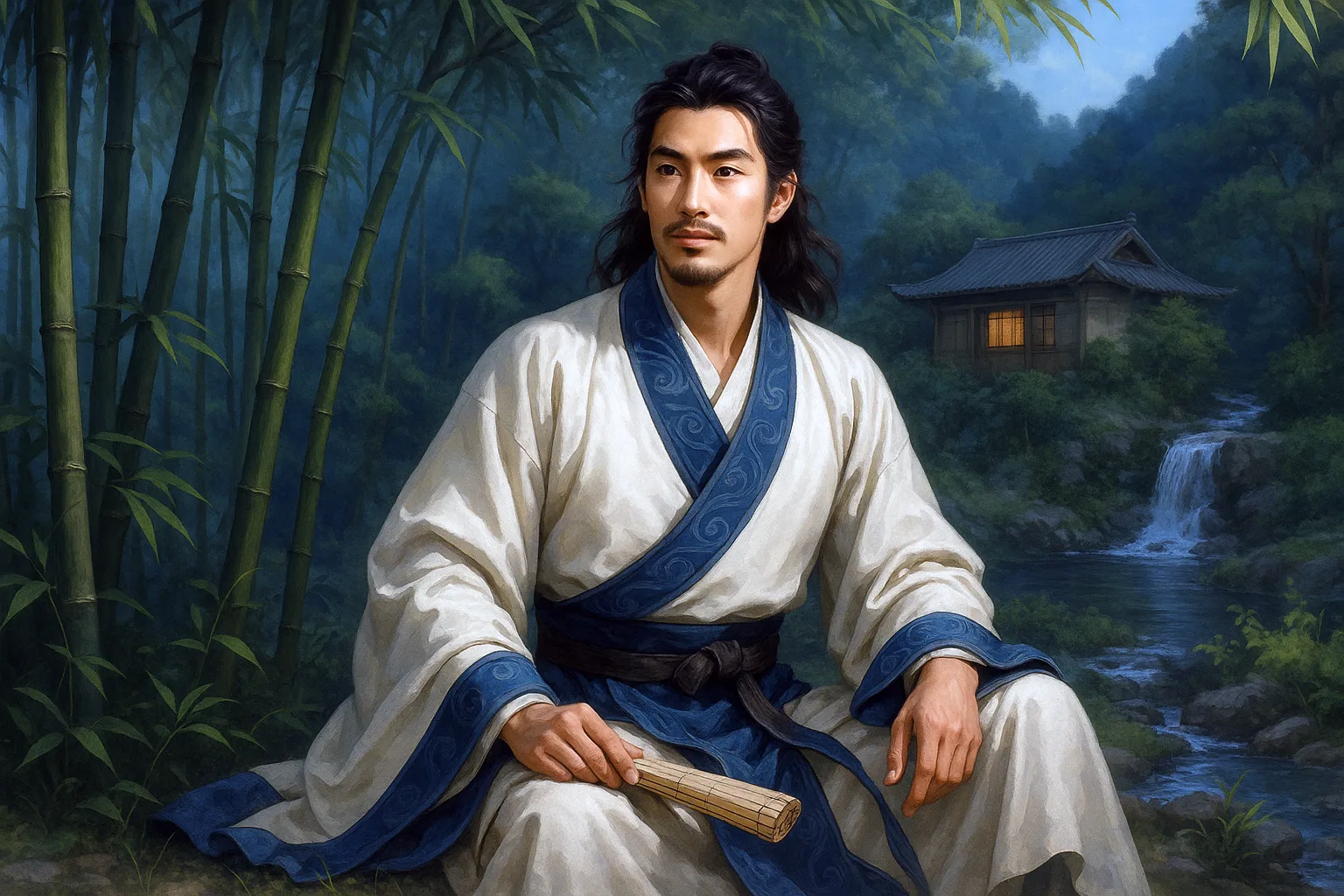
Liu Yuxi(刘禹锡), 772 - 842 AD, was a native of Hebei. He was a progressive statesman and thinker in the middle of the Tang Dynasty, and a poet with unique achievements in this period. In his compositions, there is no lack of poems reflecting current affairs and the plight of the people.