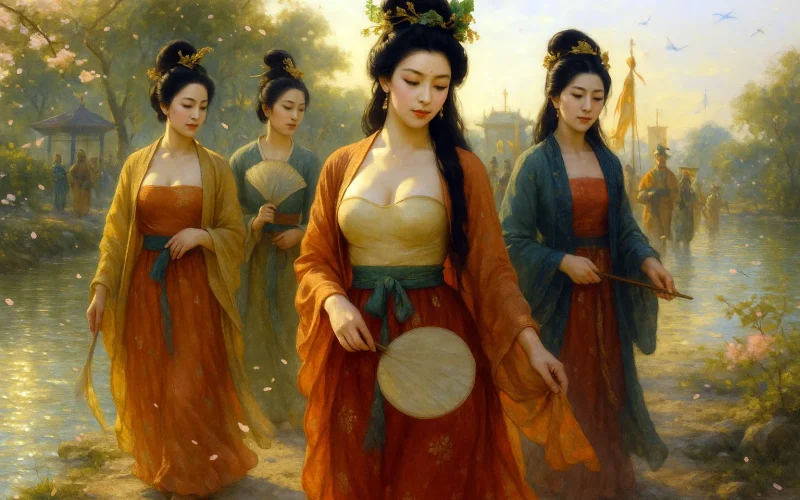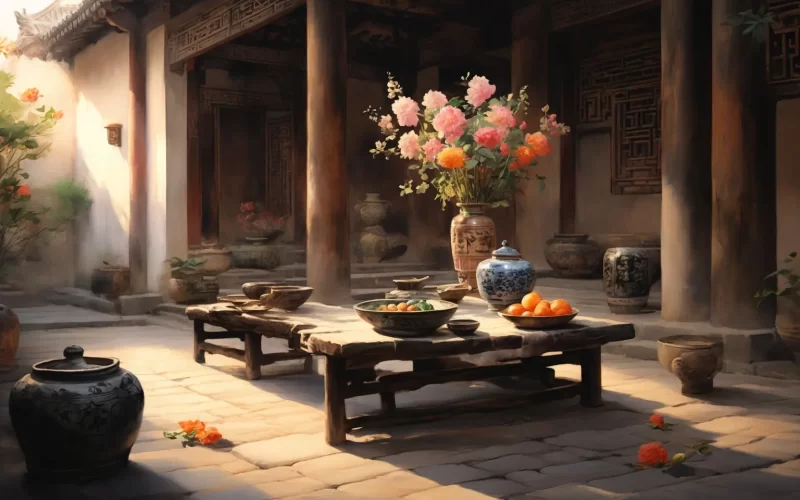
North of me, south of me, spring is in flood,
Day after day I have seen only gulls....
My path is full of petals -- I have swept it for no others.
My thatch gate has been closed -- but opens now for you.
It's a long way to the market, I can offer you little --
Yet here in my cottage there is old wine for our cups.
Shall we summon my elderly neighbour to join us,
Call him through the fence, and pour the jar dry?
Original Poem
「客至」
杜甫
舍南舍北皆春水,但见群鸥日日来。
花径不曾缘客扫,蓬门今始为君开。
盘飧市远无兼味,樽酒家贫只旧醅。
肯与邻翁相对饮,隔篱呼取尽余杯。
Interpretation
"This poem was composed in the spring of 761 CE, the second year of the Shangyuan era under Emperor Suzong of Tang. By then, Du Fu had lived for about a year in his thatched cottage by the Huanhua Stream in Chengdu. After the upheavals and wanderings caused by the An Lushan Rebellion, the poet found temporary respite in this riverside village. Though his life remained humble, his state of mind gradually grew more peaceful. On this day, his friend Prefect Cui ("Mingfu" was an honorific title for a county magistrate in the Tang dynasty) came specially to visit. Overjoyed by the arrival of a guest after a long period of solitude, Du Fu recorded the extraordinary delight of this ordinary day with this poem, brimming with simple warmth and the spark of everyday life.
First Couplet: 舍南舍北皆春水,但见群鸥日日来。
Shě nán shě běi jiē chūn shuǐ, dàn jiàn qún ōu rì rì lái.
To the south and north of my cottage, spring waters swirl; / I see only flocks of gulls coming day by day.
With sparse, light strokes, it outlines the secluded environment of the cottage. "Spring waters swirl" describes the dwelling surrounded by vibrant spring water, suggesting both seclusion and a taste for natural beauty. "I see only flocks of gulls coming day by day" alludes subtly to the典故 of "gulls forgetting all scheming" (ou lu wang ji). It implies both the rarity of visitors and the quietude of his gate, and even more, conveys the poet's transcendent state of being close to nature and possessing a serene, detached mind. Green waters and white gulls create a fresh, lovely picture, setting the poem's tone of tranquil joy.
Second Couplet: 花径不曾缘客扫,蓬门今始为君开。
Huā jìng bù céng yuán kè sǎo, péng mén jīn shǐ wèi jūn kāi.
The garden path strewn with blooms has not been swept for guests; / The wicker gate today for the first time is opened for you.
This couplet, expressing genuine feeling in homely language, has been celebrated through the ages. "Has not been swept" and "for the first time is opened" form a natural antithesis and emotional progression, subtly revealing two deeper meanings: first, the poet's usual truthful and unpretentious way of living, free from empty formalities; second, highlighting the guest's exceptional nature, for whom the poet is willing to make an exception, tidying up and welcoming him with sincere respect and delight. "Wicker gate" paired with "garden path strewn with blooms" shows, amidst self-deprecation about simplicity, the purity and refinement of the friendship between host and guest.
Third Couplet: 盘飧市远无兼味,樽酒家贫只旧醅。
Pán sūn shì yuǎn wú jiān wèi, zūn jiǔ jiā pín zhǐ jiù pēi.
The fare is simple, for the market is far; no choice of meats I can offer; / The wine is old, from my home-brew, for my family is poor.
The focus shifts from welcoming the guest to entertaining him. The poet does not shy away from frankly admitting his family's poverty and the plainness of the hospitality. "The market is far" and "my family is poor" are the facts; "no choice of meats" and "wine is old" are the results. Yet, this candid apology does not harm the friendship; on the contrary, its utter lack of pretense highlights the profound bond between host and guest, which transcends material concerns and is based on genuine heart-to-heart connection. Plain food and humble wine become a footnote to the friendship of noble minds.
Fourth Couplet: 肯与邻翁相对饮,隔篱呼取尽余杯。
Kěn yǔ lín wēng xiāng duì yǐn, gé lí hū qǔ jìn yú bēi.
If you're willing to drink with the old man next door, / I'll call him over the fence to finish the last of the wine.
The final couplet arises like a surprising peak, pushing the poetic sentiment to its climax. The poet breaks free from the confines of the host-guest pair and proposes to "call over" the neighbor. Instantly, the scene shifts from stillness to movement, and the mood transforms from secluded solitude to cheerful bustle. The four words "call him over the fence" are intensely vivid and auditory, vividly depicting the spontaneous, natural, and genuine interaction characteristic of rural neighborly life. This stroke not only reveals the poet's warmth and open-mindedness but also elevates this ordinary visit into a genre painting of village life, filled with the vitality of everyday human warmth.
Holistic Appreciation
This poem is a masterpiece among Du Fu's leisure poetry. Its wonder lies in "revealing the deepest feeling in the most ordinary places, showing the richest flavor in the simplest, plainest terms." The poem takes "the guest's arrival" as its thread, its structure perfectly natural: the first couplet describes the quiet environment before the arrival; the second, the joyful welcome upon the guest's coming; the third, the sincere hospitality after the arrival; and the final couplet expands the scene with an unexpected flourish, depicting the lingering pleasure of host and guest wishing to invite the neighbor. The emotion progresses layer by layer, from stillness to action, from mildness to intensity.
The poem brims with a long-absent sense of contentment and warmth rooted in daily life. Du Fu transforms his own impoverished circumstances, humble dwelling, and simple fare into poetic elements. Through honesty and self-deprecation, he highlights instead the sincerity and preciousness of the friendship between host and guest. The dramatic detail of daily life in the final line, "call him over the fence to finish the last of the wine," particularly reveals Du Fu's poetic mind, deeply rooted in the soil of life—true poetry lies not in distant realms but in genuine encounters and shared moments with friends and neighbors.
Artistic Merits
- Simple, Natural Language, Like Everyday Speech
The entire poem uses colloquial expressions like "has not been swept," "for the first time is opened," "wine is old, from my home-brew," and "call him over the fence." They are plain and intimate, yet rich in lasting flavor, embodying the perfected artistry of Du Fu's later style where "in old age, my poems become utterly spontaneous." - Precise Capture of Detail, Rich Sense of Daily Life
Details like "garden path…not been swept," "wicker gate…opened," and "call him over the fence" all stem from daily observation. They are vivid, lifelike, and full of pictorial quality and authentic lived experience, grounding the poem and filling it with vitality. - Sincere Flow of Emotion, Utterly Unaffected
The poet is straightforward about the plainness of his hospitality, while his cherishing of the friendship overflows between the lines. This honest attitude—neither embellishing nor concealing flaws—makes the poem's joy particularly genuine and moving. - A Stroke of Genius in the Closing Couplet, Expanding the Poetic Realm
The final couplet breaks the conventional pattern of banquet poetry by introducing the character of the "old man next door." It instantly expands the poem's social space and emotional capacity. The lingering aftertaste elevates a private gathering into a universal scene of neighborly warmth.
Insights
This work vividly illustrates the true meaning of "the friendship of noble minds is as pure as water." True friendship and hospitality never lie in material abundance or lavish display, but in the sincerity of the connection, the purity of intention, and the ease of companionship. The openness, warmth, and vitality Du Fu displays amidst poverty form a powerful counterpoint to utilitarian social interaction.
This poem reveals that the poetry and warmth of life are often nestled within the most ordinary human encounters and neighborly gestures. In our increasingly alienated modern world, the kind of natural, intimate, and trust-filled relationship embodied in “calling someone over the fence” feels especially precious. It reminds us that, no matter our circumstances, we ought to preserve a love for life, a sincerity toward others, and a cherishing of those moments when someone is willing to “sweep the garden path” and “open the wicker gate” for us. This beauty of simple human connection is like a warm, undying lamp that Du Fu lit for us over a thousand years ago — its glow still reaching us today.
Poem translator
Kiang Kanghu
About the poet

Du Fu (杜甫), 712 - 770 AD, was a great poet of the Tang Dynasty, known as the "Sage of Poetry". Born into a declining bureaucratic family, Du Fu had a rough life, and his turbulent and dislocated life made him keenly aware of the plight of the masses. Therefore, his poems were always closely related to the current affairs, reflecting the social life of that era in a more comprehensive way, with profound thoughts and a broad realm. In his poetic art, he was able to combine many styles, forming a unique style of "profound and thick", and becoming a great realist poet in the history of China.