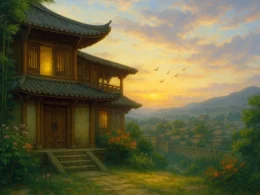

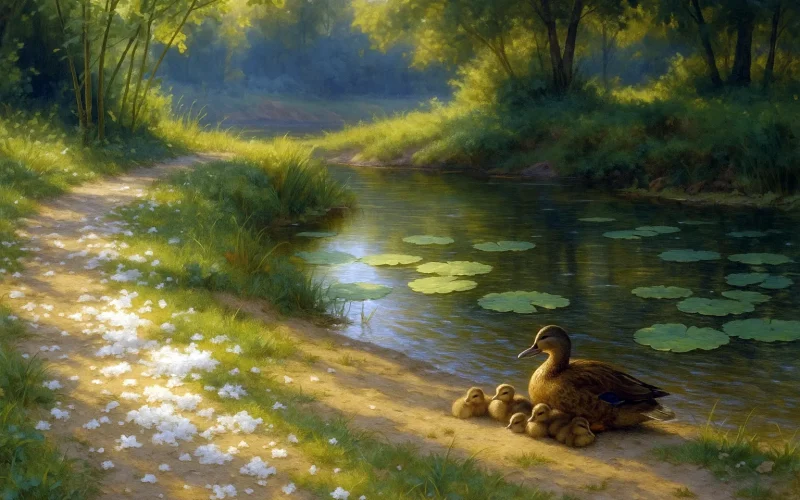
Catkins paved on the pathway a white way;
Lotus leaves strewn on the creek green coin on coin.
Young pheasants unseen lie 'mid bamboo shoots' array;
Young mallards sleep with mother ducks on sand fine.
Original Poem
「绝句漫兴九首 · 其七」
杜甫
糁径杨花铺白毡,点溪荷叶叠青钱。
笋根雉子无人见,沙上凫雏傍母眠。
Interpretation
This work is the seventh poem in Du Fu's series Nine Quatrains in an Improvisational Style, composed around early summer in 761 CE, the second year of the Shangyuan era under Emperor Suzong. The poet was then living in his thatched cottage by the Huanhua Stream in Chengdu. After the prolonged turmoil of war and displacement, life at the cottage granted Du Fu a precious interval of peace. The series title, "in an Improvisational Style," indicates casual, spontaneous composition. This particular piece captures several fleeting scenes of early summer witnessed by the poet during strolls around his cottage. It is not a grand narrative but an immersion of the soul into tiny creatures and subtle landscapes, revealing a rare moment of leisurely ease amidst turbulent times and a profound, attentive care for the quiet beauty of life.
First Couplet: “糁径杨花铺白毡,点溪荷叶叠青钱。”
Sǎn jìng yáng huā pū bái zhān, diǎn xī hé yè dié qīng qián.
Catkin-down, like scattered rice, carpets the path in white; / On the stream, dotting leaves of lotus, coins of jade shine bright.
With a shift in perspective between looking down and gazing out, the poet sketches a two-dimensional scroll of early summer. The character "sǎn" (to sprinkle, scatter) is wonderfully apt, describing both the catkin's granular, rice-like shape and its fluttering, falling motion, full of tactile and kinetic sensation. The metaphor "carpets… in white" lends a natural object the refinement and warmth of human craft, transforming an ordinary path into poetry. "On the stream, dotting" and "coins of jade" shift the focus from the ground to the water's surface. The word "dotting" is light and delicate, capturing the charm of the first, sparsely distributed lotus leaves. The metaphor "coins of jade" resembles them in both color and shape, exuding a rustic, playful charm. The two lines—one white, one green; one "carpeting," one "dotting"; one static, one dynamic—form a balanced yet lively parallel couplet.
Second Couplet: “笋根雉子无人见,沙上凫雏傍母眠。”
Sǔn gēn zhì zǐ wú rén jiàn, shā shàng fú chú bàng mǔ mián.
By bamboo shoots, a pheasant chick lies hid from human eyes; / On the warm sand, a duckling sleeps close to its mother, tranquil-wise.
The gaze shifts from plants to animals, from still life to scenes of activity imbued with greater warmth of life. "By bamboo shoots, a pheasant chick lies hid from human eyes" is the poem's most含蓄 and profound stroke: the chick is concealed among bamboo shoot roots—a hidden, safe, vital nook. The three words "hid from human eyes" are descriptive but, more importantly, create a profound意境 of observing all things in their self-sufficient state, undisturbed—reflecting the poet's respect for and discovery of the existence of minute life. "On the warm sand, a duckling sleeps close to its mother" presents a starkly different scene: the image is warm, bright, and overflowing with familial affection. The three words "sleeps close to its mother" capture the softest, most serene moment in the natural world—a scene of protection, dependence, and the tranquil continuity of life. One "hid," one "close"—these two states of existence in nature are rendered with penetrating depth.
Holistic Appreciation
This work resembles an exquisite album leaf, linking together four snapshot close-ups of early summer with an "improvisational" spirit. The entire poem contains not a single word of direct emotional expression, yet the poet's state of mind is completely infused in the choice of scenes, the arrangement of imagery, and the warmth of the diction.
Its brilliance lies in its "philosophy of observation." The poet seems like a naturalist observer holding his breath, his gaze both broad (path, stream) and exceedingly minute (granular, dotting, roots, close). He sees the overt beauty (white carpet, jade coins) but values even more the hidden life that requires patience and compassion to discover (the unseen pheasant chick). This observation is not a condescending appreciation but an equal, immersive co-existence. The "pheasant chick… hid from human eyes" might metaphor the poet himself—dwelling in his cottage far from the political center, like a creature hidden by bamboo shoots, growing alone yet possessing its own completeness of life.
On a deeper level, the four images together weave a self-contained, tranquil microcosm. The falling catkins, the newly sprouted lotus leaves, the concealed chick, the duckling nestled with its mother—all follow the rhythm of nature, existing in an undisturbed state of harmony. This is the actual scenery around the cottage, but it is also the spiritual sanctuary Du Fu deeply yearned for and temporarily attained after weathering life's storms—a quiet corner where life can rest and grow, and the heart can find solace.
Artistic Merits
- Balanced Parallelism Rich with Delight: Both couplets exhibit meticulous parallel structure yet feel utterly unforced. "Catkin-down… path" parallels "On the stream… leaves," creating a spatial echo between land and water. "Carpets… in white" parallels "coins of jade," showing clever metaphorical play and color contrast. "By bamboo shoots" parallels "On the warm sand," and "hid from human eyes" parallels "sleeps close to its mother," shifting from hidden solitude to warm companionship, enriching the emotional layers.
- Precise Use of Verbs and Measure Words: Verbs like "scattered," "carpets," "dotting," "coins," "hid," and "sleeps" precisely depict states and movements. Measure words or locatives like "path," "stream," "roots," and "sand" clearly construct the spatial coordinates of the imagery, making the poetic scene tangible.
- Profound Feeling within Plain Description: The entire poem employs plain description without embellishment. Yet, because the chosen images are themselves full of vitality and feeling (e.g., the charm of "jade coins," the warmth of "sleeps close to its mother"), the scenes, in their simplicity, are rich with the flavor of life and its inherent warmth.
- An Exemplar of the "Improvisational" Genre: The title "Improvisational Style" implies a casual, free-form composition. This poem appears to casually pick a few fragments, but they are in fact carefully edited, unified by an internal tranquility and harmony, achieving the perfect unity of "seeming artlessness" and "consummate artistry."
Insights
This masterpiece shows us a precious attitude toward life and an aesthetic capacity: Amid a world of turmoil and uncertainty, how to settle one's own soul by contemplating the microcosm of nature and life, thereby rediscovering the quietude and abundance of existence.
In the early summer at his cottage, Du Fu saw not just catkins and lotus leaves, but an order and beauty where all things find their proper place and grow in peace. He reminds us that true "leisure" and "contentment" may not come from distant achievements or grand vistas, but are often hidden within the most ordinary "catkin-strewn path" or "lotus-dotted stream" around us, residing in the subtle discovery of the "unseen pheasant chick" and the tender observation of the "duckling sleeping close to its mother."
In our fast-paced, information-saturated modern society, this poem invites us to learn from Du Fu's "improvisational" eye: to occasionally slow our steps, look closely, and let the mind immerse itself in a path carpeted white with catkins or a stream dotted with jade-like lotus leaves. It tells us that maintaining sensitivity and compassion for the minutiae of life is a potent remedy against the noise of the world and a nourishing source of inner peace. What this small poem safeguards is precisely that indispensable, simple poetry of co-existence with all living things, vital in any age.
Poem translator
Xu Yuanchong (许渊冲)
About the poet

Du Fu (杜甫), 712 - 770 AD, was a great poet of the Tang Dynasty, known as the "Sage of Poetry". Born into a declining bureaucratic family, Du Fu had a rough life, and his turbulent and dislocated life made him keenly aware of the plight of the masses. Therefore, his poems were always closely related to the current affairs, reflecting the social life of that era in a more comprehensive way, with profound thoughts and a broad realm. In his poetic art, he was able to combine many styles, forming a unique style of "profound and thick", and becoming a great realist poet in the history of China.