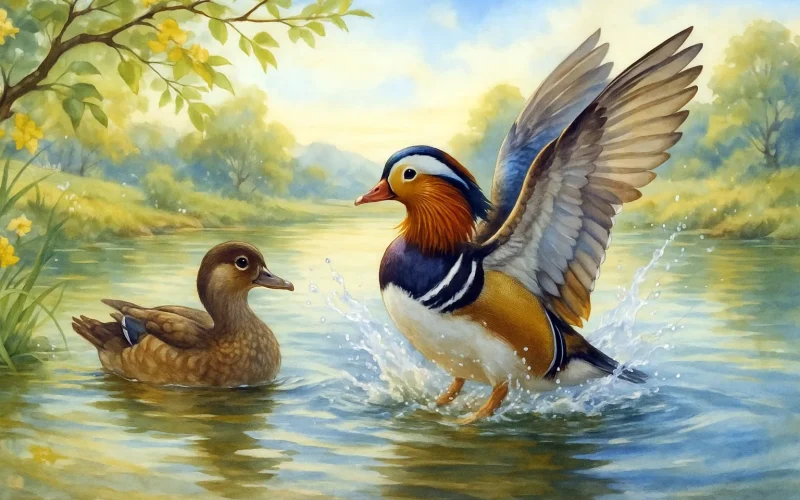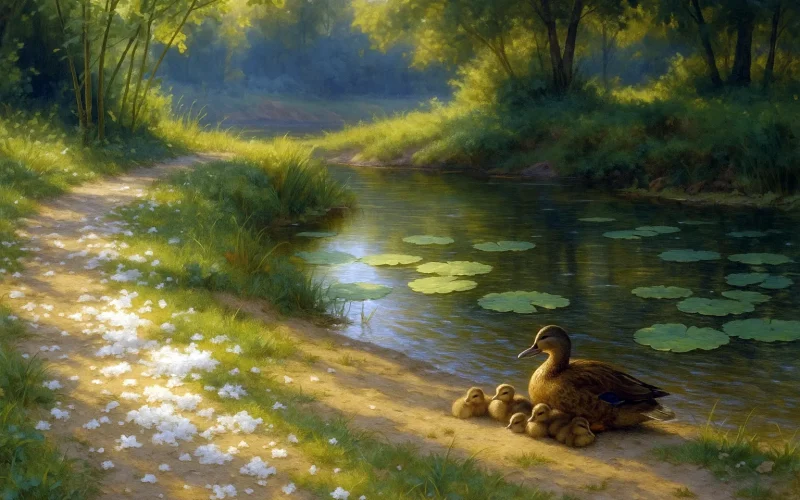



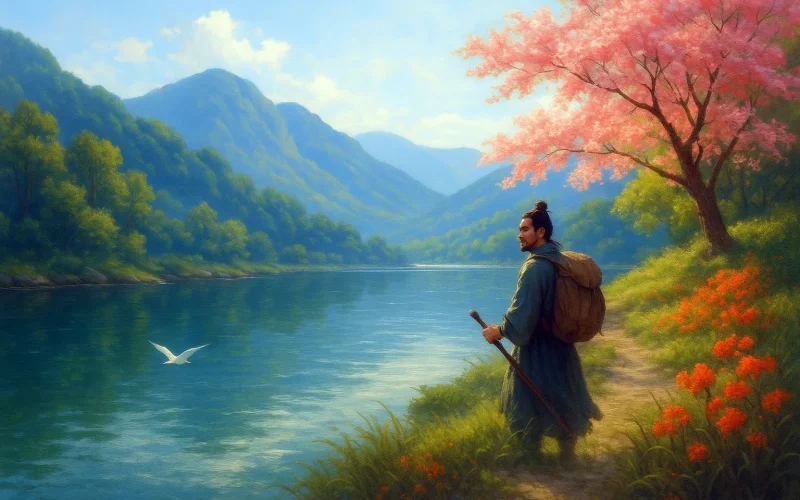
Against blue water birds appear more white;
On green hills red flowers seem to burn.
Again I see spring pass out of sight.
O when will come the day of my return?
Original Poem
「绝句二首 · 其二」
杜甫
江碧鸟逾白,山青花欲燃。
今春看又过,何日是归年。
Interpretation
This work belongs to the same series as the previous poem and was composed in the spring of 766 CE, the first year of the Dali era under Emperor Daizong, while Du Fu was residing in Kuizhou (present-day Fengjie, Chongqing). Unlike the brief period of peace in Chengdu, the poet was again adrift, with little hope of returning north. Though the landscape of Kuizhou was majestic and grand, it remained for him a "land of exile." When the most intense spring beauty collided abruptly with the most profound homesickness, it gave birth to this short poem—its colors as dazzling as an oil painting, its emotion as heavy as carved stone. It stands as a timeless model of using joyous scenery to express sorrow.
First Couplet: “江碧鸟逾白,山青花欲燃。”
Jiāng bì niǎo yú bái, shān qīng huā yù rán.
The river's blue makes the birds seem whiter in their flight; / Hills deep in green set crimson blooms ablaze with light.
With a painter's eye and sensibility, the poet selects the most impactful color juxtapositions. "Blue" and "white," "green" and the implied "crimson" (from "ablaze") form two sets of pure, intense complementary contrasts. The word "seem" is the poetic eye, revealing the wondrous chemical reaction colors undergo through mutual enhancement—without the blue water, the birds' whiteness would not shine; without the green hills, the flowers' crimson would not blaze. This is not merely objective description but a powerful projection of subjective feeling onto nature. Spring's beauty is perceived and intensified by the poet to a point of saturation, even discomfort, as if the world's vital force is erupting in this moment, so intense it becomes overwhelming. This extreme beauty sets the stage, in its most lavish form, for the extreme sorrow that follows.
Second Couplet: “今春看又过,何日是归年?”
Jīn chūn kàn yòu guò, hé rì shì guī nián?
This spring, I watch it pass once more before my eyes; / Tell me, on what day shall I greet my homeland's skies?
Here, the brushstroke makes a precipice-like turn, plunging from the dazzling external world into a desolate inner space-time. The three words "watch it pass once more" carry immense weight within their apparent simplicity. "Watch" implies helpless witnessing; "once more" conveys a sense of repetitive futility; "pass" signifies relentless passage. The word "once more" links countless springs wasted in exile, creating a vast sense of temporal emptiness. The ensuing question, "on what day shall I greet my homeland's skies?" is an almost despairingly plain cry that elevates personal displacement to an existential level. The date of return is not on any calendar, residing only in vague hope. The rootless, suspended state of the poet's life is laid bare.
Holistic Appreciation
The artistic magic of this quatrain lies in the violent clash it creates between "sensory feast" and "spiritual famine." The first couplet is a carnival of color, an eruption of life, nature's generous gift to the poet's senses. The second couplet is a wasteland of hope, the obliteration of a homeward path, fate's cold negation of the poet's existential meaning. The more radiant, full, and fervent the former, the more somber, empty, and cold the latter becomes.
This structure produces the classic effect in classical poetry of "using joyful scenery to express sorrow," achieving the ultimate result of "redoubling the grief." The poet's emotion (profound homesickness and the sorrow of late years) comes first. It acts like a tinted lens, filtering and intensifying the scene before him, rendering the spring beauty unreal, beautiful to the point of distress. This spring light, gorgeous to its extreme, becomes instead a mirror reflecting his own situation, revealing the exile's solitude and the panic of time consuming life.
Therefore, this work is not merely a poem of homesickness; it is a profound piece on "the sting of beauty" and "the anxiety of time." It reveals a universal human condition: in the face of the most beautiful things, we sometimes feel our own lack and loneliness more acutely.
Artistic Merits
- Isomorphism of Color Aesthetics and Emotional Tension: The colors "blue," "white," "green," and "crimson" are not arranged randomly. The cool‑toned base ("blue," "green") supports the vibrant warmth ("white," "crimson"). This color structure itself visually creates a feeling of coexisting excitement and unease, perfectly matching the poem's emotional shift from "dazzling" to "forlorn."
- Dramatic Syntactic Turn and Balance: The first two lines are purely accumulations of nominal imagery, omitting verbs, the picture static yet full of implied movement, incredibly dense. The latter two lines switch to purely colloquial lyricism, direct as a sigh. One dense, one sparse; one rich, one plain; one scene, one feeling—within an extremely short frame, they achieve perfect dynamic balance and structural tension.
- Dual Oppression of Temporal Imagery: "This spring" is the passing present; "once more" is the repetitive inertia of the past; "on what day" points to the inaccessible void of the future. These three tenses intertwine in the two lines, trapping the poet in a temporal prison with no exit, from which anxiety erupts.
- Open‑Ended Vastness of the Concluding Question: Ending with the question "on what day shall I greet my homeland's skies?" provides no answer and offers no further emotional elaboration. This open‑ended conclusion casts a personal plea into boundless time and space, transforming sorrow from a private sentiment into an enveloping, universal atmosphere of vastness, with endless resonance.
Insights
This masterpiece engages with a timeless, quintessentially modern theme: In a state of displacement and existential estrangement, how does one confront "the beauty of a place that is not home"? Du Fu's response is complex and profound. On one hand, he wholly embraces and etches this beauty into memory with all his senses ("The river's blue accentuates the birds' white…"); on the other, this very beauty stands in sharp, painful contrast to his condition, thereby heightening his loneliness and longing ("…on what day shall I see my homeland?").
It reveals to us that the most acute sorrow often walks hand-in-hand with the most intense beauty. While modern individuals may no longer have a geographical "Kuizhou," a sense of spiritual exile can be felt everywhere. When we find ourselves surrounded by prosperity yet feel deeply alienated, or faced with splendid vistas yet are overcome by a sense of profound loss, Du Fu's poem offers a deep well of understanding and shared feeling. It teaches us that this "sadness dwelling within joyful scenes" is not a mark of fragility, but a sign of profound clarity about one's own circumstances and the very nature of existence.
Simultaneously, the poet's piercing awareness of "This spring too, I watch it pass…" is itself an act of intensely valuing life's fleeting time. It reminds us that while questioning "…when will be the year of my return?" (the distant goal), we must not disregard the significance of the "watching it pass" itself—the weight and truth of the immediate, lived process. This brief poem, therefore, is both a poignant questioning of fate and a quiet, steadfast affirmation of the gravity inherent in every present moment.
About the poet

Du Fu (杜甫), 712 - 770 AD, was a great poet of the Tang Dynasty, known as the "Sage of Poetry". Born into a declining bureaucratic family, Du Fu had a rough life, and his turbulent and dislocated life made him keenly aware of the plight of the masses. Therefore, his poems were always closely related to the current affairs, reflecting the social life of that era in a more comprehensive way, with profound thoughts and a broad realm. In his poetic art, he was able to combine many styles, forming a unique style of "profound and thick", and becoming a great realist poet in the history of China.