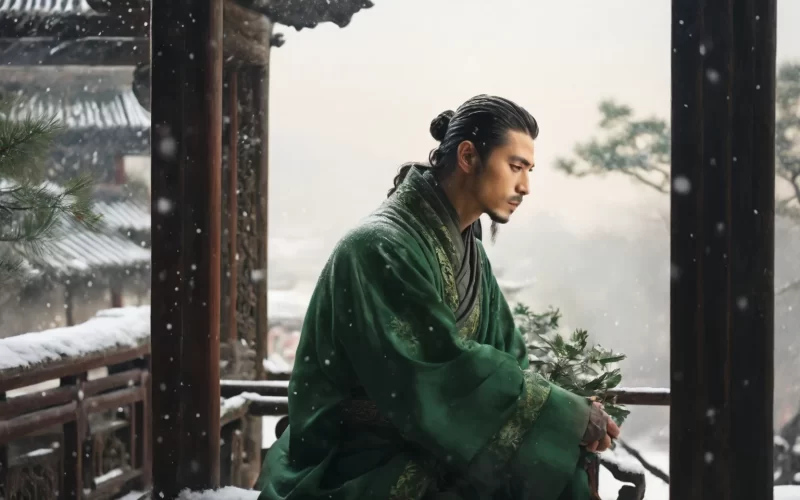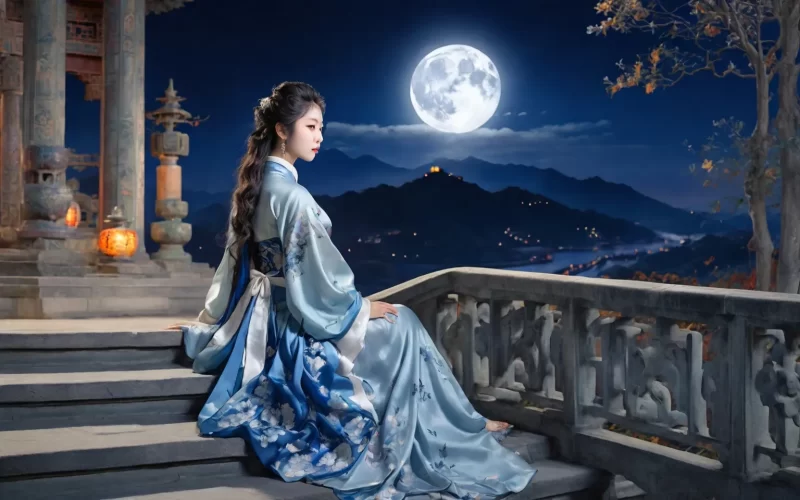



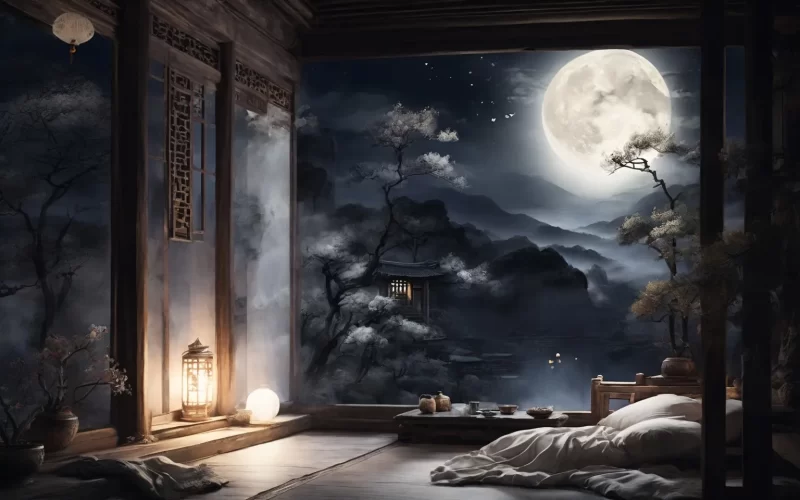
So bright a gleam on the foot of my bed -
Could there have been a frost already?
Lifting myself to look, I found that it was moonlight.
Sinking back again, I thought suddenly of home.
Original Poem
「静夜思」
李白
床前明月光,疑是地上霜。
举头望明月,低头思故乡。
Interpretation
This poem was likely composed in the autumn of 744 CE, after Li Bai was “granted gold and sent away” from Chang'an, embarking on a life of wandering. On an autumn night in a strange land, the poet, alone beneath the bright moon, was stirred by the most fundamental and intense homesickness, giving rise to this quatrain hailed as the “greatest homesickness poem of all time.” Uniting utmost simplicity with utmost depth, it transcends all cultural barriers to become an immortal crystallization of a shared human emotion.
First Couplet: “床前明月光,疑是地上霜。”
Chuáng qián míngyuè guāng, yí shì dìshàng shuāng.
Before my bed, the bright moon’s light is cast; A suspicion rises—frost upon the ground, amassed.
These lines depict the cognitive shift from illusion to clarity. “The bright moon’s light” is the most common autumn night sight, while the word “suspicion” is the poem’s pivotal spark, precisely capturing the dazed, lonely, even slightly chilly mental state of a traveler waking deep in the night. Mistaking moonlight for frost is a clever illusion achieving a triple transformation: visual confusion (both light and frost are white), tactile association (the coldness evoked by frost), and emotional projection (the bleak, chilly connotations of “frost” mirroring the traveler’s desolate mood). Regarding “bed”, scholarly interpretations vary—it could be a sleeping couch, a well railing (a “silver bed”). This ambiguity, however, expands the poetic realm; whether indoors by a couch or in a courtyard by a well, the core scene of lonely moon-gazing remains intact.
Second Couplet: “举头望明月,低头思故乡。”
Jǔ tóu wàng míngyuè, dī tóu sī gùxiāng.
I lift my head, gaze at the brilliant moon so bright; Then bow my head, adrift in thoughts of home, the night.
This couplet uses two opposing physical gestures to outline a complete arc of emotional surge. “Lift my head” is an instinctive search for the source of this clear radiance; “gaze at the brilliant moon” establishes a connection through contemplation with this eternal, shared image. The moon, the most classic vehicle for homesickness in Chinese poetry, naturally triggers a flood of feeling. “Bow my head” is the withdrawal of external action and the deepening of inner activity—the moment when surging emotion condenses into deep, quiet thought. The sequence of “lift” and “bow,” “gaze” and “adrift in thoughts,” forms a perfect emotional circle and rhythmic pulse, making intangible homesickness vividly present, rich in imagery and motion.
Holistic Appreciation
The poem’s charm lies precisely in its paradoxical unity of “utmost simplicity and utmost depth.” In only twenty characters, with no obscure words or crafted lines, it seems spoken spontaneously, yet constructs an immensely profound emotional universe. It strips away all specific personal circumstances (like career setbacks) and all particular spatio-temporal details (like where, what courtyard), distilling only the purest emotional model: “a traveler abroad sees the moon and thinks of home.” Precisely because of this, it resonates with all who have left home, across all eras and regions.
The poem’s conception shifts subtly between stillness and motion: the first two lines describe illusion within stillness, the latter two连贯的动作 and thought. Emotion flows between the chill of illusion and the warmth of homesickness, finally reaching the deepest, most personal core of longing in the silence of “bowing my head.” It does not dramatize sorrow or vent grief; it merely presents the process and state of “thinking” with calm clarity. Yet, through this restraint and truthfulness, it possesses the power to move hearts profoundly.
Artistic Merits
- Extreme Conciseness and Accessibility of Language: The poem flows as naturally as speech, achieving the highest realm of returning to simplicity, truly embodying the aesthetic ideal of “lotus rising from clear water, naturally unadorned.”
- Precise Capture of Psychology and Action: Through the three verbs “suspicion,” “lift,” and “bow,” it meticulously depicts the psychological journey from illusion to recognition, from outward gaze to inward reflection, creating a strong sense of dynamism and immersion.
- Classic Use of the Moon Imagery: It seamlessly integrates the culturally rich public image of the “bright moon” with the personal, momentary feeling of “thinking of home,” granting personal emotion an eternal cultural echo.
- Perfect Symmetry and Balance of Structure: The four lines form two parallel pairs, with a natural progression and fluid rhyme. When recited, they create a musical beauty of circular repetition, making the poem easy to memorize and disseminate.
Insights
This masterpiece demonstrates that the greatest art often speaks directly to the most universal human heart. It crosses barriers of knowledge, language, and culture precisely because it touches upon the softest, most shared part of the human psyche—the longing for belonging, the attachment to one’s origins. In today’s world of high mobility, where migration is commonplace, the poem’s resonance is perhaps broader and deeper than ever.
It teaches us: sincere emotion needs no complex rhetoric to adorn it; profound thought can reach the heart through the simplest form. No matter how technology shrinks the world or shortens physical distance, that “homesickness” rooted in cultural memory and emotional identity remains an indispensable dimension of the modern spiritual world. Li Bai’s poem, like the eternal moon in the night sky, quietly reminds us that even as we journey far, we must not forget where the heart finds its peace.
Poem translator
Kiang Kanghu
About the poet
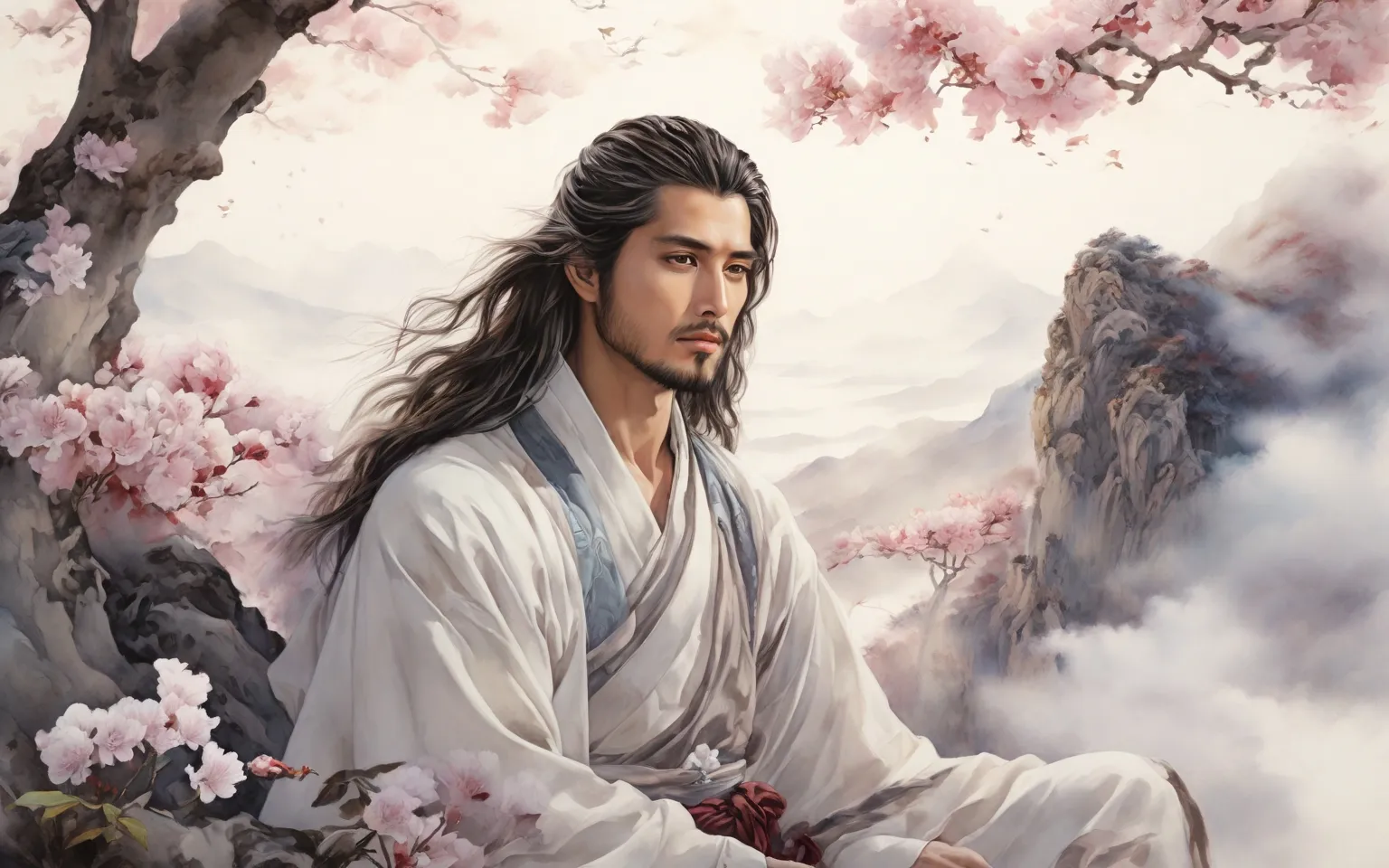
Li Bai (李白), 701 - 762 A.D., whose ancestral home was in Gansu, was preceded by Li Guang, a general of the Han Dynasty. Tang poetry is one of the brightest constellations in the history of Chinese literature, and one of the brightest stars is Li Bai.